Courtmacsherry Coastal Deposits31940 BCE
Around 31,940 BCE, Ireland lay within the climatically unstable Late Pleistocene, before the Last Glacial Maximum and peak British–Irish Ice Sheet expansion. Lower sea levels altered coastlines, while later glaciation reshaped landscapes and destroyed much earlier evidence. Southern coastal deposits, including those at Courtmacsherry, confirm pre-maximum landscapes survived beneath later tills. Cave assemblages, notably at Castlepook, preserve reindeer, deer and other cold-stage fauna, indicating open grazing environments. A possibly butchered reindeer bone may suggest a brief human visit around 33,000 years ago, but remains unconfirmed. Secure evidence of human occupation appears much later, with substantial settlement beginning in the Mesolithic.

Dateline
“31,940 BCE” is a modern label, not a year that can be recovered from Ireland’s Ice Age record. No Irish calendar, written source, settlement sequence or historical event can be fixed to it. In archaeological terms, it serves only as a point within a much wider span: approximately 34,000 years ago, during the Late Pleistocene and Marine Isotope Stage 3, before the fullest expansion of the last British–Irish Ice Sheet. Dates for this deep past are normally expressed as radiocarbon years or calibrated ranges, each with uncertainties. The responsible history of Ireland at this point is therefore not a story of a named people or a dated occurrence, but of changing climate, animals, landscapes and a tantalising—still unconfirmed—possibility of brief human visits.
A Point Within a Long Cold Age
The date falls before the global Last Glacial Maximum, conventionally dated to about 26.5–19 thousand calibrated years before present, and before the local maximum of the British–Irish Ice Sheet, generally placed around 27,000 years ago. That distinction matters. Ice-sheet growth was not a single instant, nor did all parts of Ireland and the surrounding seas experience the same conditions at once. The island was moving into the severe later stages of the last Ice Age, but the evidence does not justify imagining it as a uniform, permanently frozen white expanse in 31,940 BCE.
Marine Isotope Stage 3 was climatically unstable. Cold phases alternated with relatively milder intervals, and the scale, thickness and direction of ice changed over millennia. Later ice advances greatly reworked the land, scouring away soils and deposits and burying older evidence beneath till, gravel and outwash. Consequently, the surviving record is uneven: caves in the limestone districts of the south and west have preserved bones and sediments far better than most open-air landscapes. Absence of an archaeological site is not, by itself, proof that nobody ever entered Ireland; yet it does mean that claims of occupation must remain restrained.
Southern Ireland and the Ice
At the requested notional date, Ireland was not the island familiar today. Global sea level was lower than at present because much water was locked in continental ice sheets. Broad shelves now beneath the Atlantic, Irish Sea and Celtic Sea formed a larger exposed or shallow-water world, although the exact coastlines and crossings changed as sea level, ice and the Earth’s crust responded to glaciation. Ireland’s physical connection with Britain and continental Europe at particular moments remains a matter for detailed reconstruction, not a licence to assume an easy land bridge from every shore.
The south of the island is especially important. Research on coastal sediments at Courtmacsherry and elsewhere shows that some southern Irish deposits formed during Marine Isotope Stages 4–3, before the later ice advance laid down tills over them. This demonstrates that landscapes and shorelines existed there before the Last Glacial Maximum, even though later ice covered much of southern Ireland. It also overturns older, simpler maps that treated major moraine belts as the fixed outer limit of the final Irish ice sheet.
We should nevertheless avoid projecting the well-dated maximum backwards without qualification. The strongest evidence for ice reaching the Atlantic shelf edge west and north-west of Ireland belongs to the later maximum and its retreat, especially after about 27,000 calibrated years before present. Moraines, subglacial tills, streamlined landforms and offshore sediment cores record powerful, mobile ice. They reveal the processes that made much of modern Ireland’s physical framework—drumlins, glacial troughs, eskers, spreads of gravel and thick deposits of till—but they do not provide a photograph of one particular year in the thirty-second millennium BCE.
A Faunal Ireland
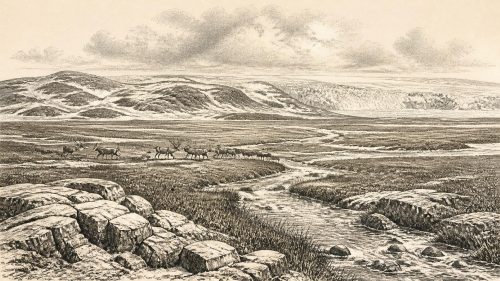
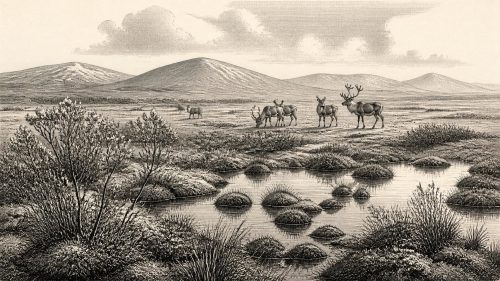
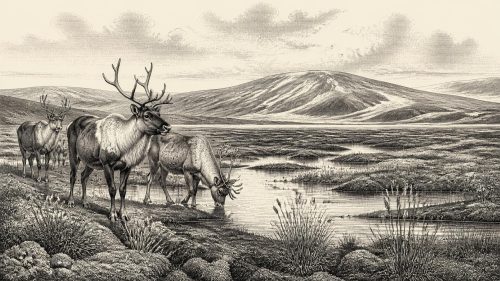
The clearest direct evidence for Irish conditions around this broader period comes from animal remains. Cave deposits in southern Ireland contain an Ice Age fauna that differs sharply from the later, post-glacial island fauna. Castlepook Cave, near Doneraile in north County Cork, is particularly significant because it has yielded extensive Pleistocene bone assemblages. Its record includes reindeer and other cold-stage animals, while the cave evidence as a whole demonstrates that at least parts of Ireland could support sizeable mammals during intervals before the final ice maximum.
Radiocarbon reassessment has made this evidence more valuable but also more complicated. Improvements in bone pretreatment can alter very old radiocarbon results, and calibrated ages near the practical limits of radiocarbon calibration require special care. Studies of Irish deer remains identify pre-Last Glacial Maximum dates in the broad range relevant here, including southern cave specimens dated to approximately 32,930–31,280 calibrated years before present and 30,297–29,594 calibrated years before present. These dates establish the presence of large deer in southern Ireland before the maximum; they do not prove that every species was contemporaneous, widespread or continuously resident.
Reindeer are a useful environmental indicator, though not a complete climate thermometer. Their presence accords with open, cold landscapes where grass, sedges, herbs and low shrubs could support grazing herds. Such terrain was unlike the dense oak-and-hazel woods of much later prehistoric Ireland. Caves may have served as natural traps, den sites, occasional shelters or places where water and sediment accumulated carcass remains. A bone found in a cave is therefore evidence for an animal’s presence, not automatically for a human hunt, a habitation floor or a seasonal camp.
The Castlepook Question
Castlepook also lies at the centre of a potentially important claim. A reindeer bone from the older collection has been reported as bearing a mark consistent with butchery by a sharp stone tool and as dating to roughly 33,000 years ago. If confirmed through full publication, contextual study and comparison with natural damage, it would be the earliest known indication of human activity in Ireland, and it would lie close in time to the modern label used for this article. It would suggest a very brief Upper Palaeolithic visit, perhaps by people moving through the wider north-west European world, rather than a settled Irish population.
But this must remain interpretation, not established narrative. The reported Castlepook evidence has prompted renewed excavation precisely because the earlier digs recovered rich fauna but did not establish a secure human occupation. The 2022 investigation aimed to determine whether intact Pleistocene deposits survived and whether new evidence—such as lithics, charcoal, further modified bone or cave art—could be recovered. Until a securely dated assemblage is published, it is not responsible to describe people living at Castlepook in 31,940 BCE, still less to assign them houses, language, kin groups or territory.
The contrast with later evidence is instructive. The butchered brown-bear kneecap from Alice and Gwendoline Cave in County Clare has independent calibrated radiocarbon determinations of about 12,810–12,590 calibrated years before present and offers evidence for a much later Upper Palaeolithic human presence. The first substantial and securely attested settlement record, however, belongs to the Mesolithic, from roughly 8000–7000 BCE onward. The National Museum of Ireland therefore continues to state that clear proof of human presence during the Palaeolithic has not yet emerged.
Society, Economy and Culture: What Cannot Be Claimed
There is no evidence for political affairs, diplomacy, warfare, chiefs, tribes or territorial boundaries in Ireland at this date. There are no settlements, burials, tools securely associated with occupation, monuments, artworks or inscriptions that can reveal social organisation. Likewise, no evidence supports statements about Irish religion, ritual, learning, trade networks, farming, seafaring or exchange in 31,940 BCE. These are not gaps to be filled with picturesque speculation. The terms “Ireland”, “Irish society” and even “community” must be used cautiously here: they designate a geographical frame, not a demonstrable population.
If the Castlepook cut mark eventually proves anthropogenic, the most that could be said is that one or more Upper Palaeolithic visitors processed an animal. Butchery would imply practical knowledge of cutting implements, carcass use and survival in a demanding northern environment. It would not demonstrate permanent occupation. A temporary hunting or exploratory party could leave only a few modified bones, while later glaciation and erosion might remove almost everything else. Conversely, natural striations, carnivore activity, excavation damage and disturbed cave deposits can all imitate or obscure human traces. The distinction is made by microscopic analysis, taphonomy, dating and context—not by the attractiveness of a story.
Landscapes Still in the Making
What can be said with confidence is that Ireland’s future terrain was being shaped on a colossal scale. The expanding British–Irish Ice Sheet redirected ice flow, transported rock, eroded valleys and bedrock, and deposited sediment across land and continental shelf. Later stages produced the drumlin fields of the north and midlands, glacially deepened basins and moraine systems visible on land and beneath the sea. Modern high-resolution seabed surveys continue to reveal iceberg scours, meltwater channels, moraines and other traces of these processes, showing how much of the relevant evidence now lies offshore.
For Ireland in the vicinity of 31,940 BCE, then, the principal development was environmental rather than political: the approach of the great ice expansion that would transform the island and severely limit the preservation of earlier landscapes. Southern caves preserve a rare glimpse of pre-maximum animal life and perhaps of a human encounter with it. The evidence is powerful precisely because it is so slight. It tells us not of an established Ice Age nation, but of a marginal, changing land whose earliest human traces, if real, were fleeting footprints before the deep freeze.
Primary Sources
- A Reconsideration of the Radiocarbon Dating of the Marine Isotope Stage 3 Fauna from Southern Ireland
- Phylogeographic, Ancient DNA, Fossil and Morphometric Analyses Reveal Ancient and Modern Introductions of a Large Mammal: The Complex Case of Red Deer (Cervus elaphus) in Ireland
- First Evidence of a Late Upper Palaeolithic Human Presence in Ireland
- 2022:564 – Castlepook Cave, Castlepook South, Cork
- Archaeology Research Excavation Grant 2022
- Prehistoric Details
- Stone Age
- Who Lived in Ireland Before Neolithic Times?
- Climate Change and Hunter Gatherers in Ireland: Problems, Potentials and Pressing Research Questions
- Quaternary
- Ireland Through Geological Time
- Marine Institute Releases New Seabed Geomorphology Map
- Dimensions and Chronology of the Last Ice Sheet in Western Ireland
- Trimlines, Blockfields and the Vertical Extent of the Last Ice Sheet in Southern Ireland
- Late Pleistocene Chronostratigraphy and Ice Sheet Limits, Southern Ireland
- Maximum Extent and Dynamic Behaviour of the Last British-Irish Ice Sheet West of Ireland
- Early Deglaciation of the British-Irish Ice Sheet on the Atlantic Shelf Northwest of Ireland Driven by Glacioisostatic Depression and High Relative Sea Level
- Timing and Pace of Ice-Sheet Withdrawal Across the Marine–Terrestrial Transition West of Ireland During the Last Glaciation
- Maximum Extent and Readvance Dynamics of the Irish Sea Ice Stream and Irish Sea Glacier Since the Last Glacial Maximum
- Stratigraphic and Palaeo-Geomorphological Evidence for the Glacial-Deglacial History of the Last British-Irish Ice Sheet in the North-Western Irish Sea
- Growth and Retreat of the Last British–Irish Ice Sheet, 31,000 to 15,000 Years Ago: The BRITICE-CHRONO Reconstruction
- The Last Scottish Ice Sheet