North Cork’s Single Incision31880 BCE
Around 31,880 BCE, Ireland was a cold, changing landscape on the north-western fringe of Upper Palaeolithic Europe, approaching but preceding the Last Glacial Maximum. Calendar precision is impossible; evidence consists chiefly of cave remains, sediments and glacial landforms. Castlepook Cave, north County Cork, contains Ireland’s richest pre-maximum vertebrate assemblage, including reindeer, mammoth, giant deer, bears and hyenas, indicating habitats able to sustain Ice Age fauna over millennia. Ice was advancing unevenly, though the extent of ice-free ground remains uncertain. A possibly cut-marked reindeer femur suggests a human visit, but lacks secure context. No evidence proves Palaeolithic settlement, society or continuity.
Dateline
“31,880 BCE” is a modern label, not a date that anyone living in prehistoric Ireland could have recognised. At this depth of time, calendar-year precision is not available. The figure corresponds only nominally to about 33,830 calendar years before AD 1950, and the evidence for Ireland is dated in broad radiocarbon and calibrated ranges rather than to a particular year. The responsible question is therefore not what happened on the island in one named year, but what archaeology, palaeontology and glacial science can say about Ireland in the later part of Marine Isotope Stage 3, before the Last Glacial Maximum.
This was not yet the familiar island of later Irish history. Nor was it a settled country with rulers, territories, farms or monuments. Ireland lay at the north-western edge of Upper Palaeolithic Europe, in a world shaped by sharp climatic fluctuations, low sea levels and expanding ice. The most important evidence comes from caves, old museum collections, animal bones, sediments and the landforms left by ice. It offers a vivid but incomplete picture: a cold landscape used by large mammals and predators, with a contested possibility of very brief human activity.
A Date Beyond Annual History
Archaeologists employ several clocks for this period. Radiocarbon results are conventionally reported in years before present, where “present” means AD 1950; because atmospheric carbon has varied through time, those results must be calibrated against independently dated records. Even calibrated dates are ranges of probability, not single moments. Deposits may also have been disturbed by water, frost, scavengers, excavation and later collecting. A bone can date the death of an animal, but it does not necessarily date the formation of a whole cave layer or the arrival of every other object beside it.
That caution matters especially at Castlepook Cave near Doneraile in north County Cork. Its chambers were explored in the late nineteenth and early twentieth centuries, before modern excavation methods could record every find in its original position. The cave nevertheless preserves Ireland’s richest known assemblage of vertebrate remains from the long interval approaching the Last Glacial Maximum. More than 2,000 bones recovered there represent a span of activity extending, on published radiocarbon evidence, from roughly 45,700 to 19,950 years before present. It is a repository assembled over many millennia, not a frozen snapshot of one season.
Castlepook’s Animal World
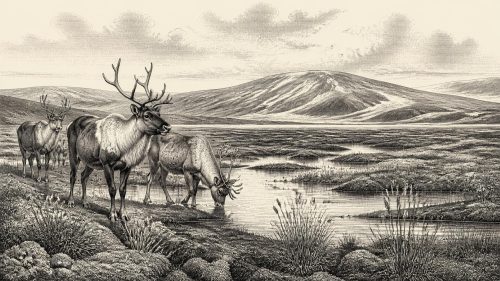
The faunal record makes one conclusion secure: parts of Ireland supported substantial Ice Age animal communities before the glacial maximum. Castlepook has yielded woolly mammoth, giant deer, reindeer, brown bear and spotted hyena, while later cold-stage material includes Arctic fox, wolf, Norwegian lemming and collared lemming. Such animals did not all necessarily live together at precisely the same moment, and a cave assemblage is never a straightforward census of the surrounding countryside. Yet their presence demonstrates that, over this broad phase, habitats existed in southern Ireland capable of sustaining large herbivores, carnivores and small cold-adapted mammals.
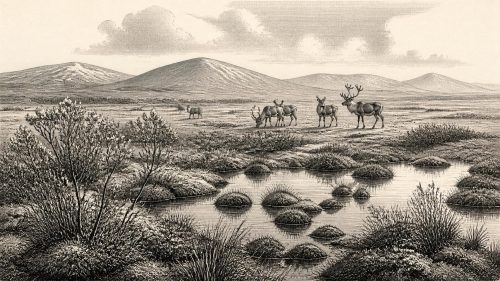
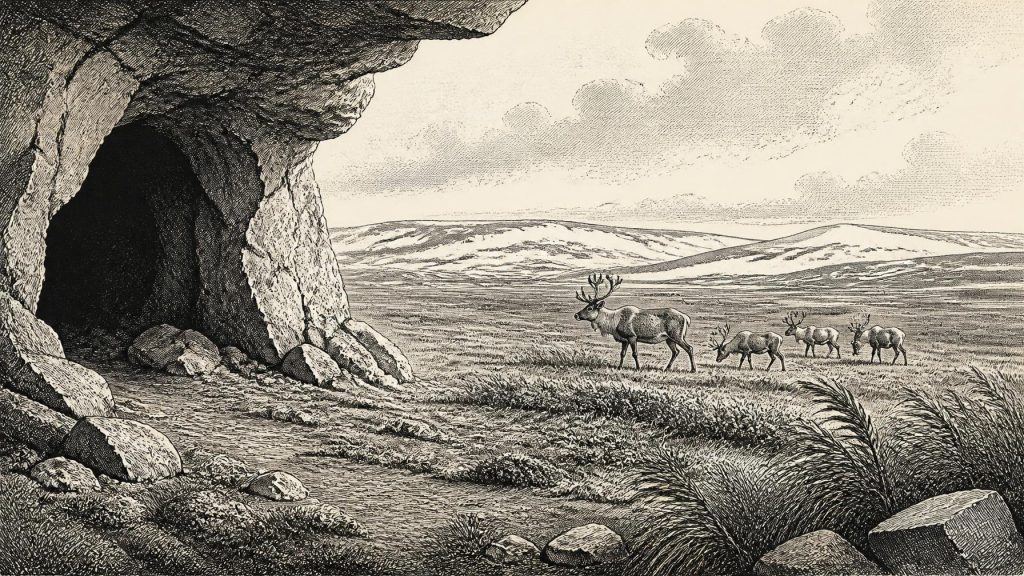
Reindeer are especially appropriate to the notional horizon of 31,880 BCE. They point towards open, treeless or sparsely wooded country in which seasonal grazing could be productive. Mammoth and giant deer add to the impression of a varied Pleistocene landscape rather than a uniform, lifeless ice desert. Brown bears and spotted hyenas reveal a food web in which caves could be dens, temporary shelters, scavenging sites and traps for bone accumulations. Hyenas are particularly significant because their teeth, droppings, transport of carcass parts and disturbance of deposits can all help explain how bones entered a cave. Their presence is also a warning against assuming that every marked bone records people.
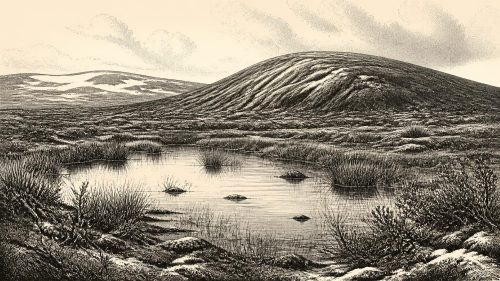
The vegetation cannot be reconstructed for every Irish district at this exact point. Nonetheless, the broader north-west European setting was one of cold, wind-exposed environments, with grasses, sedges, herbs, mosses and low shrubs providing patches of forage. Local topography, shelter, drainage and distance from ice would have created contrasts between exposed uplands, valley floors, limestone country and coastal plains. Much land now beneath the Atlantic and Irish Sea was dry or shallower than today because global sea level was lower, but this did not automatically provide a simple walkable route into Ireland. The changing geometry of sea, ice and land was complex, and later palaeogeographic research has challenged older, uncomplicated ideas of a lasting Irish land bridge.
Ice Was Advancing, Not Yet at Its Peak
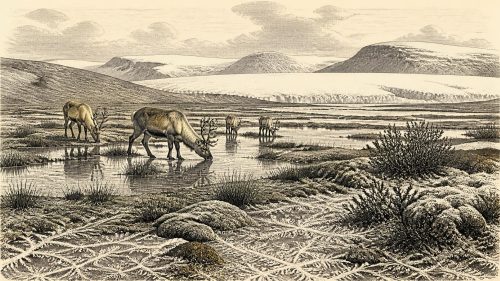
In the long view, 31,880 BCE belonged to the approach towards the Last Glacial Maximum, not to its fullest expression. The maximum is generally placed at about 26,500–19,000 calibrated years before present, although different sectors of the British–Irish Ice Sheet advanced and reached their greatest extent at different times. Recent reconstructions describe a dynamic ice sheet whose margins and flow patterns altered markedly between about 31,000 and 15,000 years ago. At the article’s horizon, therefore, it would be misleading to imagine a single, stable ice front or to state that every part of Ireland was buried beneath ice.
The safest interpretation is regional and conditional. Ice was becoming an increasingly powerful force in Ireland’s environment; it would later scour bedrock, redirect drainage, deposit till and create many of the drumlins, moraines and meltwater features that shape the modern landscape. But the pre-maximum cave fauna shows that at least some southern areas had earlier supported animals in ice-age habitats. Exactly how much ground was ice-free at any one moment around 33,830 calendar years before present remains uncertain. The record is far better at showing long phases of environmental change than drawing a precise map for one imagined year.
The Reindeer Femur Question
Castlepook also raises the most provocative question about this period: were people present? A reindeer femur from the old cave collection has been reported as bearing marks consistent with butchery by a sharp stone tool and as dating to about 33,000 BCE in public accounts. If the marks are confirmed as anthropogenic and the date accurately represents the specimen, the find would indicate a human visit to Ireland during the Upper Palaeolithic, more than 20,000 years before the long-established evidence for post-glacial settlement.
It is an important possibility, but not a licence for invention. The National Museum of Ireland continues to state that clear evidence for Palaeolithic human presence in Ireland has not yet emerged. No securely associated stone-tool assemblage, hearth, dwelling, burial, artwork or repeatedly occupied surface has been published from Castlepook for this early horizon. The relevant bone came from historically excavated material with limited contextual information, while caves are environments in which carnivore damage, trampling, sediment movement, excavation damage and later handling must be excluded before a cut mark can be accepted. Improved accelerator mass spectrometry and bone pretreatment have also led scholars to revisit older Irish cave chronologies.
The evidence can therefore support only a modest proposition. Small, mobile hunter-gatherer groups may have reached, passed through or briefly exploited parts of Ireland during a favourable interval before the glacial maximum. A cut-marked reindeer bone, if ultimately accepted, would imply carcass processing: perhaps the dismembering of a hunted animal, perhaps the recovery of meat from an animal killed by another cause. It would not demonstrate a permanent population, a village, a named culture, a language or uninterrupted descent into later Irish communities. The people themselves, their number, their route and the length of any visit remain unknown.
Society Without Institutions
For that reason, conventional headings such as politics, diplomacy and religion must be handled honestly. There is no evidence for chiefs, kingdoms, warfare between communities, treaties, formal trade or cult places in Ireland at this date. Nor can archaeology identify household organisation, marriage rules, language or beliefs from a single possible butchery trace. The wider European Upper Palaeolithic demonstrates that Homo sapiens possessed sophisticated technologies, social networks, symbolic practices and ways of managing fire, hides and stone tools. But those wider comparisons are context, not proof that the same practices occurred in Ireland.
Likewise, no Irish economy can be described beyond the ecological opportunities suggested by the bones. Reindeer, mammoth and other large animals would have supplied meat, fat, hides, sinew and bone to any hunters able to obtain them. Yet there is no direct evidence here for routine hunting territories, exchange routes, storage, fishing or seasonal camps. The cave’s principal historical value is not that it supplies a fully formed Palaeolithic society, but that it keeps open the question of whether Ireland was intermittently visited at all during this earlier phase.
An Archive of Absence and Possibility
The lasting significance of Ireland around 31,880 BCE lies in that combination of environmental richness and human uncertainty. North Cork’s caves preserve proof that a formidable animal world existed before the greatest expansion of the last ice sheet. They also preserve one disputed incision on reindeer bone that may eventually alter the starting point of Irish human history. Future work in undisturbed cave deposits, alongside microscopic analysis, direct dating, palaeogenetics and better reconstructions of ancient coasts and ice margins, may clarify the case.
For now, the honest account is more compelling than a fabricated annual chronicle. Ireland was a cold, changing north-western landscape, inhabited at different times by reindeer, mammoth, bears, hyenas and other Ice Age animals. It was entering a period in which ice would transform much of its surface. Whether a small group of Upper Palaeolithic people briefly stood in that landscape remains a live archaeological question, not an established chapter of continuous settlement.
Primary Sources
- A reconsideration of the radiocarbon dating of the Marine Isotope Stage 3 fauna from southern Ireland
- Castlepook Cave: Cork County Geological Site Report
- Growth and retreat of the last British–Irish Ice Sheet, 31,000 to 15,000 years ago: the BRITICE-CHRONO reconstruction
- Pattern and timing of retreat of the last British-Irish Ice Sheet
- Timing and pace of ice-sheet withdrawal across the marine–terrestrial transition west of Ireland during the last glaciation
- Maximum extent and dynamic behaviour of the last British–Irish Ice Sheet west of Ireland
- The timing and magnitude of the British–Irish Ice Sheet between Marine Isotope Stages 5d and 2
- Trimlines, blockfields and the vertical extent of the last ice sheet in southern Ireland
- Genetic and archaeological evidence for the historical and contemporary population structure of Irish red deer
- The Irish Quaternary Fauna Project
- Prehistoric Details: Mell Flint Flake
- Archaeology Research Excavation Grant 2022: Final Report
- Castlepook Cave Excavation Report, 2022
- The Archaeological Heritage of County Cork
- Heritage Artefacts of County Cork
- The Island of Ireland: Drowning the Myth of an Irish Land-bridge?
- The problem of a late Quaternary landbridge between Britain and Ireland
- Ireland: Submerged Prehistoric Sites and Landscapes
- Deglaciation, Earth crustal behaviour and sea-level changes in the determination of insularity: A perspective from Ireland
- New age constraints for the maximum extent of the last British-Irish Ice Sheet (NW sector)