Derryvree’s Tundra Silt31831 BCE
31,831 BCE is a modern label, not a recoverable Irish historical year, and evidence belongs broadly to climatically unstable Marine Isotope Stage 3. At Derryvree, Fermanagh, freshwater silts dated to 30,500 radiocarbon years BP, between glacial tills, preserve signs of cold, open, waterlogged tundra rather than woodland. Cave assemblages show that reindeer, giant deer, horse, mammoth, predators and other mammals occupied Ireland during parts of MIS 3. A marked Castlepook reindeer femur may indicate butchery by humans around 33,000 years ago, but remains unconfirmed. Ice advances, changing coastlines and poor preservation limit secure conclusions about settlement, society, movement and subsistence.

Dateline
31,831 BCE is not a year that can be recovered from the Irish archaeological record in any literal sense. It is a modern calendar label, equivalent as bookkeeping to roughly 33,780 calendar years before AD 1950, the conventional reference point for “BP”. Neither people nor animals in Ice-Age Ireland left evidence that can be assigned to one season, let alone one numbered year. The responsible subject is therefore Ireland during the later part of Marine Isotope Stage 3 (MIS 3), a long and climatically unstable interval of the last glacial cycle. The closest evidence consists of dated deposits, bones and cave sediments whose ranges span centuries or millennia. They illuminate a world of cold open ground, freshwater hollows and mobile animals, not an annual chronicle.
A Date Within a Long Cold Stage
MIS 3 broadly covers the interval before the most extensive phase of the last British–Irish Ice Sheet. It was not a single, unchanging “Ice Age”. Greenland ice-core records and Irish cave mineral deposits both indicate abrupt alternations between colder stadials and relatively milder interstadials. At Crag Cave in County Kerry, uranium-thorium dates show that stalagmites formed episodically during the last glacial period. Because liquid water was needed for their growth, these phases provide strong evidence that south-west Ireland sometimes experienced conditions above freezing, although they do not by themselves reveal the precise appearance of the landscape outside the cave at 31,831 BCE.
The numerical year should not be mistaken for a calibrated archaeological date. Radiocarbon determinations measure remaining carbon-14, then require calibration against an internationally maintained curve. At depths of more than 30,000 years, the relationship between radiocarbon and calendar age is especially not a simple one-for-one conversion, and uncertainty ranges matter greatly. The modern IntCal20 curve extends to 55,000 calendar years BP, but it does not turn a broad environmental episode into a datable historical year.
Derryvree’s Freshwater Record
The most informative Irish setting for this broad period lies at Derryvree, near Maguiresbridge in County Fermanagh. Road works in 1969 exposed a remarkable sequence through a drumlin: organic freshwater silts and fine sands lay between two thick tills, the deposits left by separate glacial advances. The organic layer produced a radiocarbon age of 30,500 years BP, with a reported uncertainty of +1,170/−1,030 years. That is a radiocarbon result rather than a direct calendar equivalent, but it places the deposit within the middle part of the last glacial cycle and makes it highly relevant to the environmental world surrounding the nominal date.
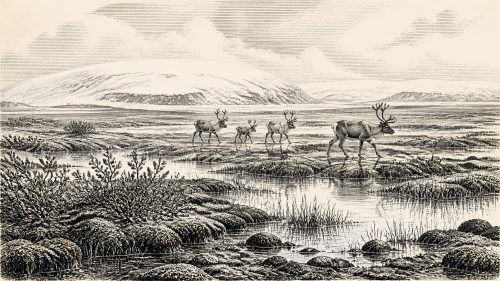
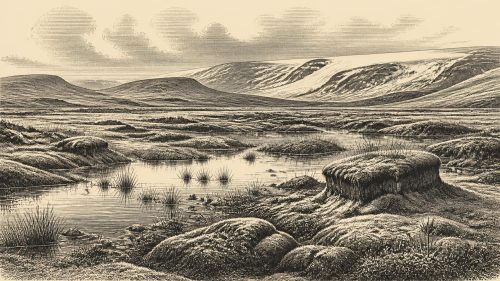
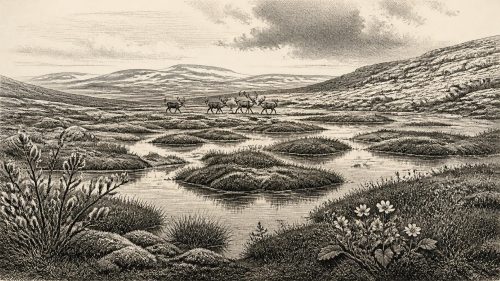
Its contents are more revealing than its bare age. Pollen, plant macrofossils and animal evidence indicated a full-glacial, periglacial environment: open tundra vegetation, sparse dry-land cover and wet ground resembling muskeg. Mosses and herbaceous plants mattered in such a landscape. They stabilised patches of soil, occupied wet depressions and supplied forage to the food web. A few grains from trees such as pine and hazel were not secure proof of local woodland; they may have travelled far or derived from older material. Derryvree therefore does not support pictures of a forested Ireland. It supports an exposed, cold and locally waterlogged country in which freshwater basins could preserve organic evidence before later ice buried it.
That sequence also teaches an important lesson about change. The lower and upper tills show that this was not a stable tundra lasting unchanged for generations beyond count. Ice advanced, sediment accumulated in an ice-free or less heavily glaciated interval, and ice later overrode the locality again. Much of the island’s older surface archaeology would have been scoured away, reworked or sealed beneath glacial deposits. The scarcity of evidence is consequently part of the history, rather than proof that the landscape was empty of life.
Animals on Open Ground
Irish caves provide a second, more fragmentary archive. The Irish Quaternary Fauna Project concluded that a wide range of mammals reached Ireland between at least about 45,000 and 20,000 years ago. Later re-dating has demonstrated that several older cave radiocarbon results require revision, especially at Castlepook Cave near Doneraile in north Cork. Modern sample preparation produced dates substantially older than some 1990s results, and the revised work places important elements of the southern Irish fauna in MIS 3.
Among the animals represented in the wider southern cave record are reindeer, giant deer, horse, brown bear, wolf, hare, woolly mammoth and spotted hyaena. This is not a checklist for a single day at one Irish valley. Bones recovered in antiquarian cave digs can be mixed across time, carried in by scavengers, displaced by water or excavation, and dated specimens are only a fraction of an assemblage. Nevertheless, the fauna is decisive evidence that Ireland could sustain large grazing and browsing mammals, their predators and scavengers during portions of MIS 3. Reindeer in particular suit the picture from Derryvree: mobile herds exploiting open, herb-rich country rather than closed woodland.
Castlepook is especially valuable and especially difficult. Early twentieth-century excavators recovered abundant Ice-Age bones there, but their methods removed much of the original context. Recent work has sought surviving sediments in both upper and lower passages; it has confirmed the need for cautious micromorphological and chronological study rather than assuming that every old bone belongs together. Castlepook is best understood as a complex natural bone archive, potentially including carnivore activity, not as a securely excavated camp.
The Reindeer Femur Question
One object makes this period unusually important for Irish prehistory: a reindeer femur from Castlepook. It has been reported as approximately 33,000 years old and bears a deep mark interpreted by zooarchaeologist Ruth Carden as a cut made by a sharp stone tool during butchery. If that interpretation is confirmed, it would be the earliest known evidence for human activity in Ireland, dramatically earlier than the securely evidenced terminal-Pleistocene human presence at Alice and Gwendoline Cave in County Clare, dated to about 12,810–12,590 calibrated BP.
“If” is essential. The Castlepook femur is compelling but isolated. No associated stone tool, hearth, dwelling floor, human bone or undisturbed hunting surface has yet been published from the same context. A mark on bone must be distinguished from damage caused by trampling, carnivore teeth, sediment movement, excavation tools or later handling. Nor does a butchered limb demonstrate that a kill occurred in the cave: a hyaena or other scavenger could have transported discarded material there. The reported mark justifies renewed investigation; it cannot responsibly sustain an invented story of a named hunting party, a settlement or a migration in 31,831 BCE.
People Without a Political History
Should the reindeer mark prove anthropogenic, the minimum conclusion would be modest but momentous: one or more Upper Palaeolithic people reached Ireland during MIS 3 and processed animal tissue with a sharp implement. They may have been highly mobile hunters, but whether they came seasonally, briefly explored, or lived here for any length of time remains unknown. There is no evidence from this date for population size, kinship, language, ethnicity, leadership, territorial boundaries or enduring communities.
Accordingly, political affairs, diplomacy and organised conflict cannot be written for this Irish date. There were no recorded polities, no inscribed agreements and no monuments that can be assigned to this interval. Warfare cannot be inferred merely because people may have hunted large animals or travelled through harsh country. Similarly, religion, art, formal learning and ritual are archaeologically invisible here. Such practices may have existed among any people who visited Ireland, as they did among Upper Palaeolithic societies elsewhere in Europe, but Irish evidence does not identify them. To supply shamans, chiefs or ceremonies would be fiction presented as history.
Subsistence, Movement and a Changing Coast
What can be discussed is the material logic of survival. In a cold, largely treeless environment, animal movement, sheltered ground, freshwater and workable stone would have mattered. Reindeer, horse and perhaps other large mammals offered meat, fat, hide, sinew and bone; yet no Irish assemblage of tools or camp debris presently demonstrates how people obtained or divided these resources around this time. “Economy” therefore means potential subsistence opportunities, not trade routes or a proven system of exchange. There is no evidence for agriculture, herding, pottery, metalworking or permanent village life.
Regional geography was also in flux. A British–Irish Ice Sheet reconstruction begins at 31,000 years BP, later than the nominal date but close enough to show the direction of rapid climatic change: ice was building in parts of the region, while its exact earlier Irish extent remains poorly constrained. The same reconstruction models sea level at 31 ka as roughly 50–100 metres below present around the archipelago. Exposed shelves would have altered coastlines and routes, but this is not evidence for a simple, continuous land bridge into Ireland at 31,831 BCE. Any crossing by people, animals or ice depended on shifting local topography, sea conditions and glaciation.
The central development, then, was environmental precariousness. Ireland possessed habitable pockets and a substantial Ice-Age fauna during parts of MIS 3, while repeated cold shifts and advancing ice threatened to erase those opportunities. Derryvree’s silt preserves a tundra wetland; Castlepook’s bones preserve animals and a tantalising possible human action. Together they offer not a year’s events, but the proper scale of this deep past: a changing island landscape in which evidence survives in small, difficult fragments.
Primary Sources
- A Reconsideration of the Radiocarbon Dating of the Marine Isotope Stage 3 Fauna from Southern Ireland
- The Irish Quaternary Fauna Project
- Middle Midlandian Freshwater Series at Derryvree, Maguiresbridge, County Fermanagh, Northern Ireland
- Growth and Retreat of the Last British–Irish Ice Sheet, 31,000 to 15,000 Years Ago: The BRITICE-CHRONO Reconstruction
- BRITICE-CHRONO Maps and GIS Data of the Last British-Irish Ice Sheet 31 to 15 ka
- The Timing and Magnitude of the British–Irish Ice Sheet Between Marine Isotope Stages 5d and 2
- Maximum Extent and Readvance Dynamics of the Irish Sea Ice Stream and Irish Sea Glacier Since the Last Glacial Maximum
- Trimlines, Blockfields and the Vertical Extent of the Last Ice Sheet in Southern Ireland
- The Deglaciation of the Western Sector of the Irish Ice Sheet From the Inner Continental Shelf to its Terrestrial Margin
- Episodic Speleothem Deposition Tracks the Terrestrial Impact of Millennial-Scale Last Glacial Climate Variability in SW Ireland
- Spatio-Temporal Dynamics of Speleothem Growth and Glaciation in the British Isles
- First Evidence of a Late Upper Palaeolithic Human Presence in Ireland
- New Insights on the Fauna of Ireland's Younger Dryas and Early Holocene from Alice & Gwendoline Cave
- The IntCal20 Northern Hemisphere Radiocarbon Age Calibration Curve (0–55 cal kBP)
- 2022:564 – Castlepook Cave, Castlepook South, Cork
- Heritage Artefacts of County Cork
- Castlepook Cave: County Geological Site Report
- Irish Cave Exploration
- Ireland's Red Deer: Their Distribution, History and Genetics
- Palaeoecology: Irish Quaternary Association Field Guide