Castlepook’s Lone Incision31830 BCE
31,830 BCE is a modern label for a climatically unstable phase of MIS 3, not a recoverable Irish calendar year. Ireland was cold, largely treeless and open, with changing ice, lowered seas and uncertain access from Britain. Castlepook Cave in County Cork preserves fauna including reindeer, mammoth, giant deer, hyaena, wolves and lemmings, evidencing a wider north-west European cold-stage ecosystem. Cave deposits are complex and bones may reflect predators, water or natural deaths. A deeply incised reindeer femur, reportedly about 33,000 years old, may record stone-tool butchery, but cannot prove settlement. Expanding ice later erased evidence and profoundly transformed Ireland.

Dateline
31,830 BCE is a modern numerical label, not a year that can be recovered from the Irish archaeological record. No person in Ireland marked such a date, and no excavation can identify a political decision, journey or season with calendar-year precision at this depth of time. In calendar terms it falls roughly 33,780 calibrated years before AD 1950 (cal BP), within the later part of Marine Isotope Stage 3 (MIS 3), the long and climatically unstable interval conventionally placed between about 57,000 and 29,000 years ago. The responsible history of Ireland at this point is therefore a history of evidence: bones, cave sediments, pollen, beetle remains, landforms and changing ice.
It was not yet the Last Glacial Maximum, the period when the British–Irish Ice Sheet reached its greatest extent, generally dated to roughly 27,000–21,000 years ago, though regional reconstructions use slightly differing ranges. Around 31,830 BCE, the ice sheet was developing rather than standing at its later maximum. Conditions across and around Ireland changed repeatedly, and the survival of deposits is uneven. Much of the evidence has been scoured, buried or displaced by later ice advances, leaving caves and rare sediment sequences as exceptionally important, but difficult, archives.
A Date Without an Annal
Radiocarbon dating does not produce a simple ancient calendar. A conventional radiocarbon age measures remaining carbon-14 relative to AD 1950; it must then be calibrated against a curve built from independently dated natural archives. Beyond about 14,000 years ago, those calibration curves rest on combinations of floating tree-ring sequences, lake and marine sediments, corals and cave deposits rather than an unbroken annually counted chronology. At around 34,000 calendar years ago, calibrated ranges are consequently far more meaningful than a single reconstructed year.
This distinction matters particularly for Castlepook Cave, near Doneraile in north County Cork, also known as Mammoth Cave. Its Pleistocene collection was gathered largely through antiquarian excavations, not modern recovery from a fully intact occupation floor. Subsequent re-dating has shown that some earlier radiocarbon determinations for Irish cave fauna were substantially too young. The cave is invaluable, but each bone has to be assessed for its own date, identification, surface modification and depositional history. A bone dates an animal’s death; it does not automatically date the arrival of a human, predator or flood that later moved it.
An Open, Cold Landscape
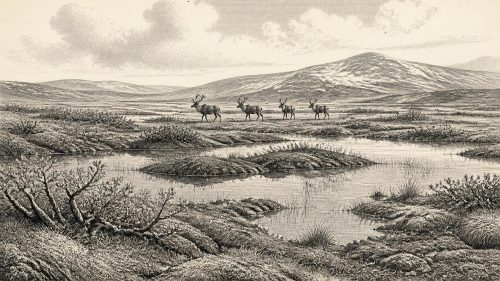
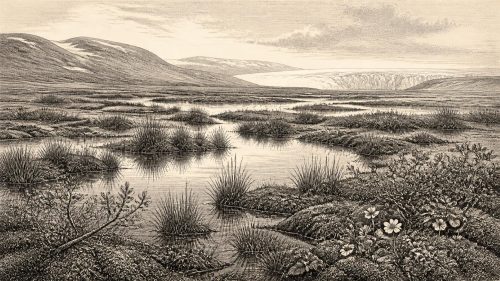
The most defensible environmental picture is of a cold, largely open landscape, not of the familiar green and wooded Ireland of later millennia. Irish Quaternary sequences associated with this broad phase, including organic silts beneath later glacial deposits at Derryvree in County Fermanagh, have been interpreted as records of treeless, wet tundra or muskeg-like ground. Other northern deposits have yielded plant and insect evidence consistent with cold, seasonal conditions. These sites do not furnish a weather report for 31,830 BCE, nor can they be assumed to have been exactly contemporary with a Cork cave deposit. Together, however, they establish the kind of environments that existed in Ireland during the wider interval.
Low shrubs, sedges, grasses, herbs and patches of damp ground would have offered forage in favourable seasons. The terrain was shaped by frost, meltwater, exposed rock and unconsolidated sediments, while tree cover was at best very limited. The sea also stood very differently from today. Lower global sea levels exposed parts of the continental shelf around north-west Europe, making the modern coastline a poor guide to the geography of the time. Yet exposed shelf does not prove an easy, continuous land bridge from Britain to Ireland. Ice, sea channels, shifting shorelines and local relief all affected access. The arrival of land animals demonstrates ecological connections at some stage, not the precise route they followed in any particular year.
The Castlepook Fauna
Castlepook provides the richest Irish indication of the animal world before the height of the last glaciation. Its assemblage includes reindeer, woolly mammoth, giant deer, brown bear, wolf, Arctic fox, mountain hare, collared lemming and Norwegian lemming. Spotted hyaena is especially striking: Castlepook is the principal Irish site for this formidable scavenger and predator. Such a list must not be converted into a single illustrated tableau in which every species meets at once. Cave deposits may combine material accumulated over long periods, and different animals occupied different habitats and seasons. Nonetheless, the fauna shows that Ireland formed part of a wider north-west European cold-stage ecosystem.
Reindeer are especially relevant to the broad period because they were mobile grazers suited to open country and because their remains occur at Castlepook. Mammoths and giant deer point to substantial herbivore resources, while wolves and hyaenas reveal a landscape in which carcasses were contested and caves could become dens, traps or natural bone accumulators. Carnivores may have dragged prey into a cave; water may have carried bones in; animals may have died naturally in fissures. These processes are not archaeological inconveniences but part of the history being reconstructed. They explain why a cave rich in bones is not, by itself, proof of a human camp.
The Reindeer Bone Question
The most consequential, and most limited, possible human evidence is a reindeer femur from Castlepook. It has been publicly reported as dating to about 33,000 years ago and as bearing a deep incision interpreted by the palaeozoologist Ruth Carden as a cut made with a sharp stone tool during butchery. If that interpretation is upheld, it would indicate that people handled a reindeer in Ireland during the Ice Age, dramatically earlier than the long-established evidence for sustained Mesolithic settlement after the final retreat of the ice.
It would not demonstrate a settled community. No securely associated hearth, stone-tool assemblage, dwelling, burial, food-preparation area or stratified occupation surface of the same age has yet been identified at Castlepook. Nor can one marked bone tell us whether visitors crossed from Britain, arrived by a now-submerged route, stayed briefly, hunted regularly or left descendants. Even the exact dating language requires care: popular statements that the bone is “33,000 years old” do not substitute for a published calibrated range tied to the specimen, its laboratory measurement and the latest calibration curve. The find is best treated as a potentially transformative trace of butchery, rather than a licence to populate Ireland with an imagined tribe.
People Beyond the Evidence
Across north-west Europe, Homo sapiens communities of the Upper Palaeolithic used stone tools, exploited large animals, made clothing and shelters, maintained social ties over considerable distances and, in some regions, produced ornaments and cave art. Those wider comparisons make a short human visit to Ireland conceivable. They cannot establish any of those practices in Ireland at this date. There is no Irish evidence from around 31,830 BCE for named groups, languages, kinship systems, ritual places, artistic traditions, territorial boundaries or enduring settlements.
Accordingly, political affairs, diplomacy and organised conflict are not hidden chapters awaiting a more colourful retelling: they are absent from the present evidence. A reindeer carcass may have been scavenged, hunted or processed; it cannot reveal leadership or alliances. Nor is there evidence for exchange in the ordinary archaeological sense of traded objects or identifiable imported materials. The most that can responsibly be said is that any humans present would have depended on knowledge, movement and social connections extending beyond a single cave, because survival in a cold and variable landscape required them. That is an inference from Upper Palaeolithic lifeways elsewhere, not a demonstrated feature of Irish society.
Approaching the Great Freeze
The longer trajectory gives the period its importance. After this broad phase, ice expanded across Ireland and the surrounding shelves, eroding older surfaces and helping to explain why evidence for very early people is so scarce. At the Last Glacial Maximum, Ireland was extensively ice-covered. The later recolonisation of the island by animals and people occurred in altered landscapes and along changing coasts; it should not be assumed that any possible visitors of MIS 3 formed a continuous ancestral population.
For Ireland around 31,830 BCE, therefore, the central development was environmental rather than political: a cold, open Pleistocene world supported mobile herds and large predators while climatic deterioration and growing ice transformed the possibilities of movement and survival. Castlepook’s animal bones securely attest that world. Its lone marked reindeer femur may preserve a human action within it. Keeping those two levels of certainty separate is not a failure of historical imagination. It is the means by which this extraordinarily early Irish past can be described honestly.
Primary Sources
- A reconsideration of the radiocarbon dating of the Marine Isotope Stage 3 fauna from southern Ireland
- The Irish Quaternary Fauna Project
- Growth and retreat of the last British–Irish Ice Sheet, 31,000 to 15,000 years ago: the BRITICE-CHRONO reconstruction
- Extent and timing of the Last Glacial Maximum (LGM) in Britain and Ireland: a review
- Pattern and timing of retreat of the last British-Irish Ice Sheet
- Late Pleistocene chronostratigraphy and ice sheet limits, southern Ireland
- Radiocarbon constraints on the age of the maximum advance of the British-Irish Ice Sheet in the Celtic Sea
- Early deglaciation of the British-Irish Ice Sheet on the Atlantic shelf northwest of Ireland driven by glacioisostatic depression and high relative sea level
- The subdivision of the Quaternary Period in Ireland
- Castlepook Cave, Castlepook South, Cork: Excavation Report 2022:564
- Heritage Artefacts of County Cork
- Pleistocene vertebrates in the British Isles
- Occurrence of mammalia relicts at site Castlepook Cave
- First evidence of a Late Upper Palaeolithic human presence in Ireland
- New insights on the fauna of Ireland's Younger Dryas and Early Holocene from Alice & Gwendoline Cave
- The Archaeology of Caves in Ireland
- The IntCal20 Northern Hemisphere Radiocarbon Age Calibration Curve (0–55 cal kBP)
- The problem of a late quaternary landbridge between Britain and Ireland
- Ireland: Submerged Prehistoric Sites and Landscapes
- The Mesolithic in Ireland: when was it?