
The Doneraile Reindeer Line31288 BCE
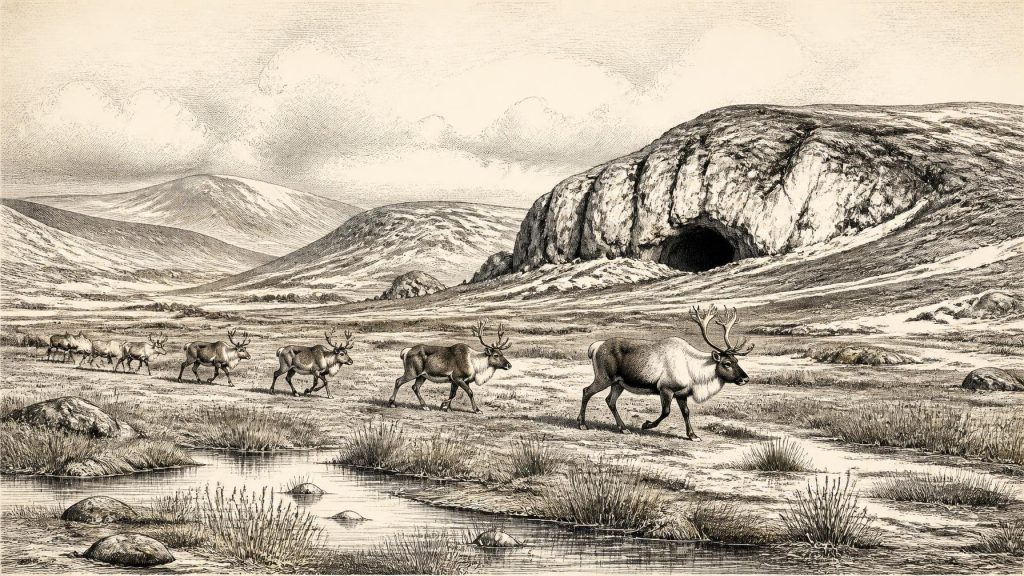
At roughly 33,200 years before present, Ireland lay within the climatically volatile later Marine Isotope Stage 3. Derryvree deposits indicate tundra wetlands and periglacial conditions, while Crag Cave stalagmites record recurrent milder intervals. Castlepook Cave near Doneraile preserves a mixed Ice Age fauna including reindeer, mammoth, giant deer, hyaena and bears. A reindeer femur reportedly dated to about 33,000 years ago bears a possible stone-tool butchery mark, perhaps Ireland’s earliest direct human trace. However, no associated tools, hearths or settlements confirm occupation. Changing ice, sea levels and habitats shaped animal and potential human movement. Later glaciation may have erased evidence.
Dateline
Modern calendar-year precision is not available for Ireland in 31,288 BCE. This label is a convenient point in deep time, roughly 33,200 years before present in the archaeological convention that counts back from AD 1950, rather than a date at which an Irish event can be assigned to a particular season or generation. The responsible setting is the later part of Marine Isotope Stage 3 (MIS 3), an exceptionally changeable phase of the last Ice Age. Evidence consists of radiocarbon ranges, cave bones, pollen and plant remains, sediments, and cave mineral deposits. Each carries uncertainties of centuries or millennia. What can be recovered is not a historical chronicle, but a careful picture of landscapes, animals and a possible human encounter.
A Cold, Unsettled Island
Ireland lay on Europe’s Atlantic north-western margin, exposed to rapid shifts in temperature, rainfall, sea ice and glacier growth. It was not yet in the full Last Glacial Maximum, the great expansion of the British–Irish Ice Sheet which followed and reached its maximum volume around 23,000 years before present. Reconstructions show that ice-sheet growth and maximum extent varied considerably from one sector to another. Therefore, it would be unsafe to imagine every part of Ireland as either wholly ice-covered or wholly open in 31,288 BCE. The island’s geography was being repeatedly remade by advancing ice, frost action, meltwater and changing sea level.
The strongest Irish indication of conditions broadly comparable with this nominal date comes from Derryvree near Maguiresbridge, County Fermanagh. Road works there exposed organic silts and fine sands trapped between two till sheets within a drumlin. A radiocarbon determination on this freshwater deposit was 30,500 radiocarbon years before present, with a wide uncertainty; subsequent calibration places the evidence broadly between about 36,900 and 31,700 calibrated years before present. That is a range, not an anniversary, but it overlaps the wider period in question. Its plants, insects and other remains indicated open tundra and a periglacial regime: ground shaped by intense seasonal freezing and thawing rather than a forested landscape.
Such a world was not necessarily lifeless or uniformly bleak. Low vegetation could occupy sheltered ground, wet hollows and the margins of shallow waters. Mosses, sedges, grasses and cold-adapted flowering plants formed a patchwork whose composition altered as temperatures shifted. Waterlogged deposits preserve these minute witnesses far better than exposed slopes preserve campsites. They show that, during at least some milder intervals, fresh water and vegetation persisted in northern Ireland even while the broader climatic direction was towards harsher conditions and renewed glaciation.
Crag Cave and Rapid Climate Change
Crag Cave in County Kerry supplies a different kind of record. Stalagmites grow only when water can circulate through the cave system and temperatures permit liquid water. Uranium-thorium dates show that calcite deposition in the cave occurred episodically through much of the last glacial period, including MIS 3. This is evidence for repeated ameliorations, not proof of a warm Irish climate. The cave’s record fits the wider North Atlantic pattern in which abrupt Greenland warm phases, followed by colder stadials, could change conditions over only decades or centuries.
For people or animals attempting to live at Europe’s edge, such instability mattered as much as average temperature. A landscape productive enough for grazing animals in one interval could become wind-scoured, frozen or ice-bound in another. Rivers could alter course under meltwater, and cave entrances and valleys could become inaccessible. Long-term settlement, if it existed at all, would have faced repeated interruption. That volatility helps explain why a modern historian cannot sensibly write of a settled Irish polity, fixed territory or continuous community at this date.
The Castlepook Evidence
The most important site for the period is Castlepook Cave near Doneraile in north Cork, also known historically as Mammoth Cave. Its chambers produced more than 2,000 animal bones during excavations from the late nineteenth century onwards, and later work has shown that individual remains span a long part of the Ice Age. Geological Survey Ireland describes it as Ireland’s richest site for vertebrate fauna in the period leading towards the Last Glacial Maximum. Its assemblage includes woolly mammoth, reindeer, giant deer, brown bear and spotted hyaena; later deposits also contain lemmings, Arctic fox and wolf.
That list should not be read as a single herd grazing together on one day. Cave deposits accumulate over long periods, and Castlepook was a carnivore den, a bone trap and a place disturbed by water as well as an archaeological archive. Spotted hyaenas could carry and gnaw carcass parts into their lairs. Roof collapse, flowing water, antiquarian excavation and later mixing all complicate the original positions of bones. Improved radiocarbon pretreatment has already demonstrated that some earlier dates from southern Irish caves were too young. Every individual bone therefore needs its own identification, dating and taphonomic assessment.
Within this difficult record, a fragment of reindeer femur from Castlepook has particular importance. It has been publicly reported as dating to about 33,000 years ago and bears a deep linear modification interpreted by zooarchaeologist Ruth Carden as a cut or chop made by a sharp stone tool during butchery. If that reading is confirmed through full specialist publication and comparison, it would be the earliest direct indication that people handled an animal in Ireland: not merely that humans could have reached the island, but that they processed a reindeer here.
The distinction is crucial. The dated bone is evidence for a reindeer; the incision is the basis for the human interpretation. No securely associated stone tool, hearth, dwelling floor, human skeleton, clothing, art or settlement of this age has yet been recovered in Ireland. The femur cannot tell us whether one hunting party visited briefly, whether several people camped nearby, or whether a carcass was processed elsewhere before part of it entered the cave. It certainly cannot establish permanent occupation. Yet it makes the question of Upper Palaeolithic activity in Ireland much more serious than it once was.
Animals, Movement and Food
Reindeer were well suited to cold, open country and are the animal most directly relevant to the Castlepook line. Mammoth and giant deer also point to landscapes capable, at intervals, of sustaining large herbivores, while wolves and hyaenas indicate a complex predatory system. Their presence demonstrates animal movement into and through Ireland during the Ice Age, although the timing and routes differed by species. Sea levels were far lower than today, and the configuration of the Irish Sea basin, ice margins and exposed land was changing. There is no basis for imagining a simple, permanent land bridge or a single migration route. Animals and any humans instead moved through a shifting coastal and glacial borderland.
If people made the Castlepook mark, their immediate economy was likely founded on mobile hunting and scavenging, knowledge of carcass processing, and the practical use of sharp stone edges. That is an inference from the proposed cut mark and the wider Upper Palaeolithic record of north-west Europe, not an excavated Irish tool-kit. Reindeer could provide meat, fat, hide, sinew, antler and bone, but no Irish evidence from this time demonstrates how those materials were shared or used. It is more accurate to speak of a possible short-lived hunting episode than of an established “reindeer-hunting culture”.
Society Beyond the Evidence
There is no evidence for political institutions, leaders, diplomacy, warfare, territorial boundaries or organised conflict in Ireland at this date. Nor can archaeologists identify an Irish language, named people, ethnic group or religion. These are not omissions waiting to be filled with imaginative detail; they are questions that the surviving record cannot answer. A single modified bone does, however, imply skills that were learned socially: an understanding of animal anatomy, a workable cutting implement and knowledge of how to obtain food in a risky environment. If visitors came, they probably belonged to social networks extending beyond Ireland, because no small group survives an Ice Age frontier solely through isolated improvisation. This remains a reasoned possibility, not direct proof.
Likewise, there is no securely Irish evidence for ritual, cave art, burial or formal learning around 31,288 BCE. European Upper Palaeolithic communities elsewhere produced striking art and sophisticated hunting technologies, but those achievements cannot simply be transferred across the sea to Ireland. Castlepook was a natural cave used heavily by animals; it should not be treated as an Irish sanctuary or a human home without stratified archaeological evidence.
An Archive, Not an Origin Story
Later Irish prehistory is much more visible. A brown-bear kneecap with stone-tool cut marks from Alice and Gwendoline Cave, County Clare, is directly dated to about 12,810–12,590 calibrated years before present. Sustained evidence for settlement is clearer still in the Mesolithic, millennia afterwards. The contrast matters. The temptation is to turn the Doneraile femur into the beginning of an uninterrupted national story. The Ice Age record does not support that. Advancing ice later covered much of or perhaps all of the island, and any early visitors may have left no surviving descendants or continuing settlement.
The real importance of 31,288 BCE lies in its challenge to old assumptions. Ireland was not simply an empty, frozen blank before the first well-known post-glacial settlers. It was an environmentally dynamic frontier inhabited by a changing fauna, with caves preserving fragments of an otherwise devastated record. Derryvree offers a dated window onto tundra wetlands; Crag Cave records repeated climatic reversals; Castlepook holds the remains of animals that lived near the threshold of major ice advance. The reindeer line, cautiously interpreted, may also preserve a fleeting human trace. Future excavation, direct dating and microscopic study may strengthen, alter or reject that conclusion. For now, uncertainty is not a weakness in the story: it is the most honest feature of Ireland’s deep past.
Primary Sources
- A reconsideration of the radiocarbon dating of the Marine Isotope Stage 3 fauna from southern Ireland
- Phylogeographic, ancient DNA, fossil and morphometric analyses reveal ancient and modern introductions of a large mammal: the complex case of red deer (Cervus elaphus) in Ireland
- The Irish Quaternary Fauna Project
- Castlepook Cave, County Geological Site Report
- Archaeology Research Excavation Grant 2022: Castlepook Cave Final Report
- 2022:564 – Castlepook Cave, Castlepook South, Cork
- A Middle Midlandian Freshwater Series at Derryvree, Maguiresbridge, County Fermanagh, Northern Ireland
- Episodic speleothem deposition tracks the terrestrial impact of millennial-scale last glacial climate variability in SW Ireland
- Growth and retreat of the last British–Irish Ice Sheet, 31,000 to 15,000 years ago: the BRITICE-CHRONO reconstruction
- Pattern and timing of retreat of the last British-Irish Ice Sheet
- Maximum extent and dynamic behaviour of the last British-Irish Ice Sheet west of Ireland
- Character of advance and retreat of the southwest sector of the British-Irish Ice Sheet during the last glaciation
- The evolution of the terrestrial-terminating Irish Sea glacier during the last glaciation
- A stratigraphic framework for abrupt climatic changes during the Last Glacial period based on three synchronized Greenland ice-core records: refining and extending the INTIMATE event stratigraphy
- The problem of a late Quaternary landbridge between Britain and Ireland
- First evidence of a Late Upper Palaeolithic human presence in Ireland
- New insights on the fauna of Ireland's Younger Dryas and Early Holocene from Alice & Gwendoline Cave
- The Mesolithic in Ireland: when was it?
- Prehistoric Details
- Anthropogenic changes to the Holocene nitrogen cycle in Ireland
- Using novel methods to track British and Irish Ice Sheet dynamics since the Late Pleistocene, along the west Porcupine Bank, NE Atlantic
- Irish Cave Exploration