Doneraile’s Incised Reindeer Femur31832 BCE
Around 31,832 BCE, Ireland lay within the climatically unstable MIS 3, before the Last Glacial Maximum, with changing ice, exposed shelves and open periglacial habitats. Derryvree sediments in Fermanagh indicate treeless tundra wetlands, while Castlepook Cave near Doneraile preserves mammoth, giant deer, reindeer, bear, wolf and hyaena remains accumulated over time. These finds demonstrate intermittent suitable habitats and animal movements, not a complete landscape or settled population. An incised reindeer femur, dated roughly 33,000 years ago, may record stone-tool butchery and fleeting human activity. However, poor stratigraphic context and absent associated artefacts mean permanent occupation and cultural traditions remain unproven.

Dateline
Modern calendar-year precision is not available for Ireland in 31,832 BCE. Nobody on the island used this year-number, and no document, settlement layer or dated event can be tied to it. The label is a modern point on a much wider timescale: approximately 33,780 calibrated years before AD 1950, or c. 33.8 thousand calibrated years BP. At this depth in time, calibrated ranges, deposits and laboratory measurements are more meaningful than an apparent single year. Ireland belonged to the Late Pleistocene world of Marine Isotope Stage 3 (MIS 3), a long, climatically unstable portion of the last glacial cycle.
The evidence is fragmentary but significant. Cave bones in the south and waterlogged sediments in the north show that parts of Ireland supported cold-climate animal and plant communities before the Last Glacial Maximum. They do not yield a political narrative or prove a settled human population. Yet they illuminate a landscape far older than farming, monuments, Irish kingdoms or even the post-glacial hunter-gatherer communities more securely known from later millennia.
A Date Within Ranges
The conversion of 31,832 BCE into a scientific age should not imply false exactitude. Archaeologists conventionally express radiocarbon results in years before present, where “present” means AD 1950. Radiocarbon ages also require calibration because the amount of carbon-14 in the atmosphere has varied over time. For this remote period, the calibration curve is built from several independently dated natural archives rather than from a continuous local Irish record. A laboratory date may therefore translate into a broad calibrated interval, not a single calendar year.
Nor do the relevant Irish deposits form a neat annual sequence. An animal bone can date the death of an animal, but not necessarily the moment at which it entered a cave. A cave may have been a carnivore den, a trap, a refuge, a place through which water and sediment passed, or all of these in different phases. Many of the bones from Castlepook Cave near Doneraile, County Cork, were recovered in antiquarian and early twentieth-century excavations, before modern expectations of stratigraphic recording. Their scientific value is real, but so are the limits on reconstructing precisely associated events.
Before the Ice Sheet’s Peak
About 33.8 thousand calibrated years ago, Ireland had not yet reached the Last Glacial Maximum, the later interval when ice sheets attained their greatest broad extent. Reconstructions of the British–Irish Ice Sheet show that its advance and retreat varied markedly between regions; the fullest Late Pleistocene ice expansion belongs largely to the period after this notional year, especially c. 26,500–19,000 years ago in global terminology. The island around 31,832 BCE should therefore not be pictured simply as a uniform white cap of ice.
That does not make it a mild or stable country. MIS 3 was an interval of pronounced climatic shifts, and the distribution of ice, snow, permafrost, vegetation and animals could alter over centuries and millennia. Lower global sea levels exposed large areas of the continental shelf. Ireland’s coastlines and its connections with neighbouring lands were consequently unlike those of today, although the exact routes available at any one time remain uncertain. It is reasonable to see the island as part of a wider north-west European ecological zone; it is not responsible to draw a fixed land bridge or a precise shoreline for this one nominal year.
Glacial processes were already shaping the terrain that later generations would inherit. Moving ice, meltwater and frost broke rock, shifted sediments and remodelled valleys and lowlands. Much of the familiar modern surface of Ireland is a legacy of later glacial erosion and deposition. This destructive power also helps explain the archaeological silence: open-air camps, fragile hearths and small stone artefacts would have had poor prospects of surviving subsequent ice advance, erosion and acidic soils.
Derryvree’s Open Country
One of the best Irish environmental records for the broader period lies at Derryvree near Maguiresbridge in County Fermanagh. Roadworks in 1969 exposed freshwater silts and fine sands sealed between two substantial sheets of till within a drumlin. The organic sediments produced a radiocarbon determination of 30,500 radiocarbon years BP, with a sizeable error range. They cannot be assigned precisely to 31,832 BCE, but they offer important evidence for the Middle Midlandian, broadly corresponding to MIS 3.
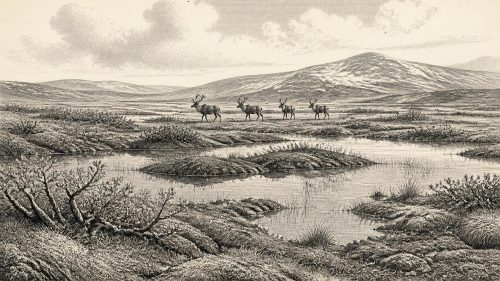
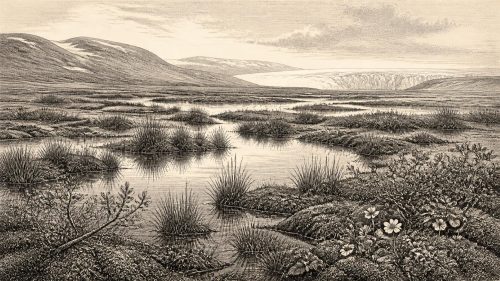
The plants and small animals preserved at Derryvree indicate open tundra vegetation and a periglacial regime rather than woodland. In practical terms, this was a treeless, exposed environment with wet ground and freshwater habitats, subject to severe cold and seasonal constraints. Mosses, sedges and other low vegetation could sustain herbivores in favourable patches, while shallow water, silt and peat-like organic deposits recorded local conditions with an accidental durability unavailable to most Ice Age landscapes.
Derryvree is evidence for a particular environment in a particular region, not a complete map of Ireland. The record warns against imagining the whole island as identical. Altitude, drainage, shelter, proximity to ice and local water systems would all have mattered. Nevertheless, its central lesson is secure: areas of Ireland were not continuously buried beneath ice throughout MIS 3, and cold open habitats existed during an interval that broadly includes this date.
The Castlepook Faunal Archive
In north County Cork, Castlepook Cave—also called Mammoth Cave or Doneraile Cave—provides the richest known Irish archive of vertebrate life before the Last Glacial Maximum. Its assemblage includes remains of woolly mammoth, giant deer, reindeer, brown bear, wolf and spotted hyaena, among other animals. These species did not necessarily live together at one moment. The cave accumulated material across a long span, and improved radiocarbon methods have shown that some earlier determinations underestimated the true ages of bones by thousands of years.
The revised chronology nevertheless establishes an important point. Large mammals reached Ireland during MIS 3, in some cases well before the maximum expansion of the later ice sheet. Their presence implies routes into the island’s wider region and sufficient food and habitat at least intermittently. Reindeer are particularly apt indicators of open, cold-country conditions, while hyaena and wolf remains also remind us that carcasses were contested resources. A cave assemblage records animal movement, scavenging and deposition as much as it records the surrounding living community.
There was no prehistoric “Irish elk” in the cultural sense sometimes suggested by the popular name. Giant deer, Megaloceros giganteus, were a widespread Eurasian species, and their Irish bones are a valuable part of the Pleistocene record. Mammoth similarly evokes an Ice Age world now absent from the island, but its remains must not be used to fill every valley with mammoth herds. The evidence demonstrates occurrence over long periods, not a census of wildlife in 31,832 BCE.
The Mark on a Reindeer Bone
A reindeer femur from Castlepook has acquired special importance because it has been dated to roughly 33,000 years ago and bears a deep incision interpreted by Ruth Carden as a cut mark made with a sharp stone tool during butchery. County Cork heritage material presents it as possible evidence that Palaeolithic hunters handled reindeer in the Doneraile area far earlier than the long-established post-glacial record of human activity in Ireland. If the interpretation is confirmed through further research, it would be an exceptionally early trace of people on the island.
The necessary caution is as historically important as the discovery. The bone did not come from a recently excavated, intact occupation floor with associated tools, hearths and food debris. The radiocarbon result dates the animal’s death, not automatically the making of the incision, the place where it was killed or the length of any human visit. No securely associated Upper Palaeolithic stone-tool assemblage, dwelling, burial or human bone has yet established a resident community in Ireland at this date. The best formulation is that short-lived human activity is possible, perhaps involving the processing of reindeer, while permanent settlement remains unproved.
If people did reach Ireland, they should not be given later ethnic names or imagined as ancestors of a continuous population. They would have been mobile hunter-gatherers operating in a demanding Ice Age landscape. Their immediate economy, insofar as the marked bone hints at one, would have centred on the acquisition and processing of animal resources rather than cultivation. There is no evidence here for crops, livestock, pottery, metalworking, built villages, regular overseas trade or managed fields.
What Cannot Be Recovered
Political affairs, diplomacy and organised conflict cannot responsibly be described for Ireland in this year. There are no named groups, rulers, laws, territories, alliances or battle sites. Predators competed for animals and shelter; any people present would have faced weather, hunger and risk. Such ecological pressures are not evidence of warfare or government. Equally, no Irish monument, ritual deposit, cave art, ornament, inscription or ceremonial structure is securely dated to this period.
Upper Palaeolithic communities elsewhere in Europe possessed skilled technologies and rich traditions of art and symbolism. That wider context makes it possible that visitors to Ireland had knowledge, customs and social ties beyond the island. It cannot prove that a particular artistic, religious or linguistic tradition existed at Castlepook. Absence of local evidence does not show an absence of imagination or belief; it defines the boundary between responsible inference and invention.
The history of Ireland around 31,832 BCE is thus not a story of a named event. It is the history of an unstable cold-age environment, of tundra wetlands at Derryvree, of large mammals entering southern Ireland, and of a single incised reindeer bone whose interpretation may yet alter the chronology of human arrival. Its strongest lesson is methodological: the deeper the past, the more carefully evidence, probability and possibility must be kept distinct.
Primary Sources
- Castlepook Cave, County Geological Site Report
- A Reconsideration of the Radiocarbon Dating of the Marine Isotope Stage 3 Fauna from Southern Ireland
- The Irish Quaternary Fauna Project
- Middle Midlandian Freshwater Series at Derryvree, Maguiresbridge, County Fermanagh, Northern Ireland
- Heritage Artefacts of County Cork
- 2022:564 – Castlepook Cave, Castlepook South, Cork
- Quaternary
- Geological Heritage
- Growth and Retreat of the Last British–Irish Ice Sheet, 31,000 to 15,000 Years Ago: the BRITICE-CHRONO Reconstruction
- Maximum Extent and Dynamic Behaviour of the Last British–Irish Ice Sheet West of Ireland
- The Deglaciation of the Western Sector of the Irish Ice Sheet from the Inner Continental Shelf to its Terrestrial Margin
- Timing and Pace of Ice-Sheet Withdrawal Across the Marine–Terrestrial Transition West of Ireland During the Last Glaciation
- Maximum Extent and Readvance Dynamics of the Irish Sea Ice Stream and Irish Sea Glacier Since the Last Glacial Maximum
- Trimlines, Blockfields and the Vertical Extent of the Last Ice Sheet in Southern Ireland
- BRITICE Glacial Map, Version 2: a Map and GIS Database of Glacial Landforms of the Last British–Irish Ice Sheet
- The Last Glacial Maximum
- The IntCal20 Northern Hemisphere Radiocarbon Age Calibration Curve (0–55 cal kBP)
- Phylogeographic, Ancient DNA, Fossil and Morphometric Analyses Reveal Ancient and Modern Introductions of a Large Mammal: the Complex Case of Red Deer (Cervus elaphus) in Ireland
- New Insights on the Fauna of Ireland’s Younger Dryas and Early Holocene from Alice & Gwendoline Cave
- First Evidence of a Late Upper Palaeolithic Human Presence in Ireland