
Birm-166’s Permafrost Ledger31762 BCE
31,762 BCE is not a knowable Irish year but a broad Late Pleistocene horizon. Derryvree, County Fermanagh, dated through Birm-166, preserves freshwater silts, plants and small animals from roughly 36,900–31,700 years ago, indicating cold, open tundra and periglacial conditions before the ice sheet’s maximum expansion. Castlepook Cave, County Cork, contains mixed remains of mammoth, reindeer, giant deer, bears, hyenas and other fauna, proving episodic animal access. A cut-marked reindeer femur may indicate human butchery, but neither permanent settlement nor associated tools are established. No polities, farming, trade or recoverable culture are evidenced; later ice obscured much of this fragile record.
Dateline
There can be no history of a single, knowable Irish year in 31,762 BCE. Modern calendar numbering is being projected backwards across more than thirty-three millennia, while the evidence is dated by radiocarbon measurements, stratigraphy and comparison with wider climatic records. The most responsible description is therefore of a broad interval, not an anniversary. On the conventional scale in which ‘present’ is AD 1950, 31,762 BCE is about 33,711 years ago. It falls within the calibrated range of a remarkable deposit at Derryvree, near Maguiresbridge in County Fermanagh: approximately 36,900–31,700 calibrated years before present. That range is wide, and its younger edge is close to the notional year used here. It nonetheless provides Ireland’s clearest environmental window onto this phase of the Late Pleistocene.
A Date Within a Range
Derryvree was exposed during roadworks in 1969, when a section through a drumlin revealed organic silts and fine sands between two separate layers of glacial till. The material was assigned the laboratory number Birm-166 and produced a radiocarbon age of 30,500 years before present, with a substantial error range. Subsequent calibration converts that measurement into a span rather than an exact date. This is not a defect peculiar to the site: far back in time, radiocarbon calibration curves and the accumulated uncertainty of samples make year-by-year precision impossible.
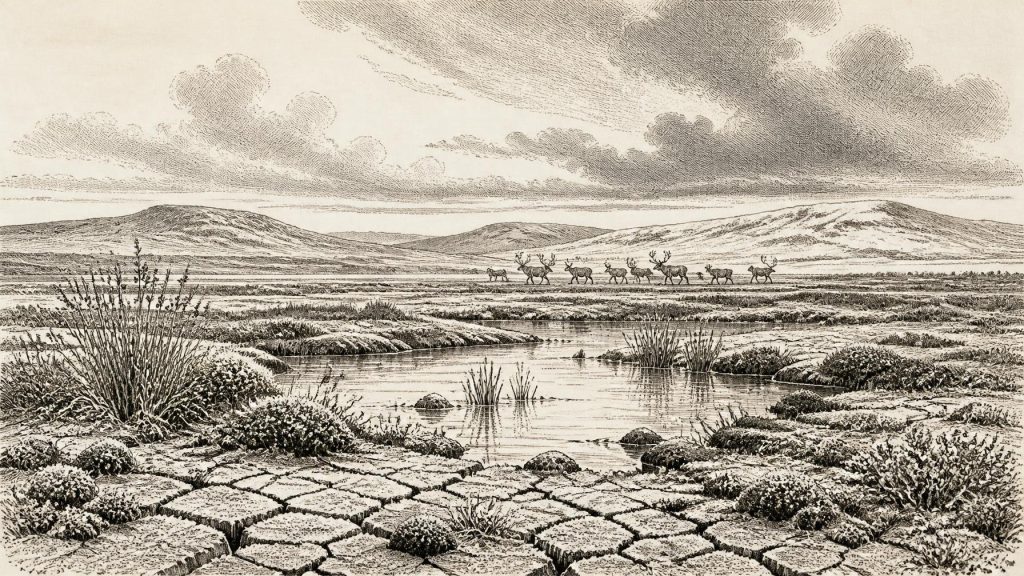
What the Derryvree sequence securely shows is that, before later ice overran and sealed the deposits, there was an interval in which freshwater sediments, plants and small animals accumulated in north-central Ireland. Its organic remains do not record a settlement, a battle or a named community. They record a local environment. The flora and fauna point to open tundra vegetation and a periglacial climate: a cold landscape shaped by frost, with sparse woody cover rather than the dense woodland familiar from later prehistoric Ireland. Derryvree is valuable precisely because so much evidence of this age was later removed, mixed or buried by glacier ice.
Land Before the Ice Peak
This was Marine Isotope Stage 3, a long and climatically unstable part of the last glacial cycle. It was not yet the Last Glacial Maximum, the later period when the British–Irish Ice Sheet expanded much more extensively over Ireland and its surrounding shelf. The distinction matters. To picture the whole island under permanent, uniform ice in 31,762 BCE would be misleading. The Derryvree deposits and other dated evidence indicate that parts of Ireland had remained ice-free during the preceding interval, even as conditions were cold and the larger ice-sheet system was developing.
Neither does “ice-free” mean mild. The evidence from Derryvree suggests a treeless or very sparsely wooded landscape of herb-rich, sedge-rich ground, wet hollows and shallow freshwater. In such a setting, freezing and thawing would have broken rock, disturbed soils and altered drainage. Summers could support plant growth and animal grazing, but winters were severe. The country’s later patchwork of enclosed fields, hedges, villages, peatlands and woods did not exist. Rivers, lakes and slopes followed courses unfamiliar to modern observers, while low global sea level altered the coastlines and reduced marine barriers around Ireland.
Regional difference must also be retained. A short-lived freshwater environment under a Fermanagh drumlin cannot simply stand for every shore, upland and valley. Ice margins, local relief, wind exposure, water supply and changing temperatures created varied conditions. In the west, marine evidence from Donegal Bay indicates open water during parts of the wider pre-maximum interval; elsewhere, ice may have advanced or retreated at different times. The archaeological lesson is caution: Ireland was a changing glacial-edge landscape, not a single climatic zone.
Castlepook’s Animal Archive
The strongest evidence for large animals in Ice-Age Ireland comes from Castlepook Cave, also called Mammoth Cave, near Doneraile in north County Cork. Excavations begun in the early twentieth century produced more than 2,000 bones from the cave’s galleries and chambers. Modern radiocarbon reassessment has shown that the assemblage spans a long period rather than one neatly sealed moment. That limitation is fundamental. The cave was used and disturbed by water, carnivores, excavators and later natural processes; it cannot supply a photographic snapshot of Ireland in 31,762 BCE.
Even so, its fauna demonstrates that Ireland was periodically accessible to a striking range of mammals during the middle and later Ice Age. The assemblage includes woolly mammoth, reindeer, giant deer, brown bear and spotted hyena, alongside wolf, fox, Arctic fox, mountain hare and lemmings in cold-stage contexts. These animals did not necessarily occupy the same patch of country on the same day, nor need every specimen belong to the exact Derryvree interval. But together they overturn an older image of an entirely lifeless Ireland before the last ice maximum. At favourable moments, northern grassland and tundra habitats supported substantial animal communities.
The spotted hyena deserves particular emphasis, not because it permits sensational stories, but because its presence explains part of the archive. A cave may be a shelter, den, trap, drainage route and bone repository. Hyenas and other carnivores could drag carcass parts into chambers, gnaw them, leave droppings, and mix remains from different episodes. Castlepook therefore tells us both that large mammals reached Ireland and why careful taphonomic study is needed before assigning every bone to hunting, scavenging or human occupation.
The Reindeer Bone Question
One Castlepook specimen has transformed discussion of the earliest possible human activity in Ireland: a reindeer hind-leg femur bearing a deep incision interpreted by zooarchaeologist Ruth Carden as a cut made by a sharp stone tool during butchery. The bone has been reported as approximately 33,000 years old, broadly around 31,000 BCE in calendar terms. County Cork heritage material consequently presents it as evidence that Palaeolithic hunters may have handled a reindeer in the Doneraile area.
This is potentially momentous, but it must not be converted into a settled history for 31,762 BCE. The radiocarbon result dates the animal’s death, not automatically the moment when the mark was made, the place where the carcass was cut, or the date at which the bone entered the cave. The femur came from an old collection rather than a newly excavated, intact occupation surface. No securely associated hearth, dwelling, stone-tool assemblage, human burial or repeated domestic debris of comparable age has been recovered in Ireland. The best present formulation is that the bone is a serious and potentially very early indication of human butchery, while proof of a permanent population remains absent.
If people did reach Ireland in this broad period, they were probably highly mobile hunter-gatherers exploiting an intermittently accessible landscape. That is an inference from the cut-mark interpretation, the available game and the wider Upper Palaeolithic world, not a directly observed Irish camp. Reindeer could provide meat, fat, hide, sinew and bone; a single butchered limb, however, does not reveal the size of a party, whether a hunt succeeded locally, or whether people stayed for a day, a season or longer. Nor does it demonstrate that the visitors were ancestors of later inhabitants of Ireland.
No Polities, No Proven Trade
There were no known Irish kingdoms, chiefdoms, laws, named peoples or diplomatic relationships in this period. There is likewise no direct Irish evidence for organised warfare or political frontiers. Predators competed for carcasses and shelter; any people present would have confronted cold, hunger, injury and dangerous animals. Yet ecological competition is not evidence for human conflict. A hyena-den assemblage and a possibly cut-marked reindeer bone cannot responsibly be turned into tales of rival tribes, raids or alliances.
Economy is visible only in its most elementary possible form: the gathering, hunting, scavenging or processing of wild resources. There was no evidence of farming, livestock, crops, metalworking, pottery, permanent fields or long-distance commercial exchange in Ireland at this date. Lower sea levels may have made movement between Ireland, Britain and the wider north-west European plain easier at times than it later became, and the arrival of mammals shows that crossings were possible. But no Irish object securely dated to this horizon maps a trade route, identifies a source of flint, or proves the direction of human travel.
Culture Beyond Recovery
Upper Palaeolithic communities elsewhere in Europe made sophisticated stone and organic tools, personal ornaments, images and musical instruments. Their existence is an important reminder that Ice-Age people were culturally capable, observant and inventive. It would nevertheless be unsound to import a specific continental art style, language, ritual or social system into Ireland without Irish evidence. No cave art, figurine, ornament, inscription, ceremonial structure or human remains has been securely dated in Ireland to this period.
The same restraint applies to religion and learning. People, if present, surely possessed shared knowledge of animals, weather, routes and materials, and may have had stories, beliefs and ritual practices. Archaeology cannot recover their content from Derryvree’s silts or Castlepook’s mixed cave bones. Absence of evidence is not evidence that imagination or custom was absent; it defines the limit of what this particular Irish record can demonstrate.
A Fragile Window
The most important development around this notional year was environmental, not political: Ireland still contained habitats capable of supporting tundra life during a volatile pre-maximum phase of the last Ice Age. Derryvree preserves the quiet evidence of that world beneath a drumlin. Castlepook preserves its larger animals and the provocative possibility that people briefly entered it. Later expansion of the Irish ice sheet would erase or bury many comparable landscapes, helping to explain why the record is so thin.
Thus 31,762 BCE should be approached not as a date of recorded events but as a carefully bounded archaeological horizon. The evidence supports cold open country, freshwater pockets, travelling herds and carnivores in parts of Ireland; it also supports the possibility, not yet the full demonstration, of human butchery in the wider era. Everything more particular—a village, a leader, a ritual, a war, a voyage or a continuous settlement—would be invention. The Birm-166 deposit remains more revealing than such invention: a small survival of silt, plants and insects from an Ireland poised before the great ice advance.
Primary Sources
- A Middle Midlandian Freshwater Series at Derryvree, Maguiresbridge, County Fermanagh, Northern Ireland
- A reconsideration of the radiocarbon dating of the Marine Isotope Stage 3 fauna from southern Ireland
- Trimlines, blockfields and the vertical extent of the last ice sheet in southern Ireland
- Exploring controls of the early and stepped deglaciation on the western margin of the British Irish Ice Sheet
- Deglaciation chronology of the Donegal Ice Centre, north-west Ireland
- Growth and retreat of the last British–Irish Ice Sheet, 31,000 to 15,000 years ago: the BRITICE-CHRONO reconstruction
- The Irish Quaternary Fauna Project
- The exploration of Castlepook Cave, Co. Cork. With 3 plates.
- Proceedings of the Royal Irish Academy: The Exploration of Castlepook Cave, County Cork
- Castlepook Cave
- Spotted Hyena Skull
- Heritage Artefacts of County Cork
- Archaeological Heritage of County Cork
- The Mesolithic in Ireland: when was it?
- Introduction to the Late Quaternary and Holocene of Northern Ireland
- Ireland Under The Ice
- Occurrence of mammalia relicts at site Castlepook Cave
- Pleistocene vertebrates in the British Isles
- New insights on the fauna of Ireland's Younger Dryas and Early Holocene from Alice & Gwendoline Cave
- A North-Western Habitat: the Paleoethology and Colonisation of a European Peninsula
- Figure 6.— The subdivision of the Quaternary Period in Ireland
- Reindeer bone found in Cork cave shows human activity in Ireland 33,000 years ago