Castlepook’s Cave-Bear Horizon31761 BCE
31,761 BCE is not a recoverable Irish historical year but a notional point within unstable Marine Isotope Stage 3. Radiocarbon calibration and disturbed deposits permit only broad chronological ranges. Derryvree, Fermanagh, preserves freshwater plants, insects and wetland sediments between tills, demonstrating locally treeless, tundra-like habitats during glacial fluctuations. Castlepook Cave, Cork, yielded MIS 3 remains of reindeer, mammoth, giant deer, bears, wolves, foxes, hyaenas, lemmings and other animals, indicating cold open-country ecosystems. A cut-marked reindeer bone suggests, but cannot prove, Pleistocene human activity. Later ice expansion, erosion and sea-level rise destroyed or buried evidence, leaving environmental traces, not social history.
Dateline
The label 31,761 BCE identifies no recoverable Irish ‘year’ in the historical sense. No people in Ireland used this calendar, and neither archaeology nor Quaternary science can assign a political act, birth, battle or journey to that precise point. In simple modern arithmetic it lies about 33,700 years before the radiocarbon convention’s reference year of AD 1950. That makes it broadly relevant to the later part of Marine Isotope Stage 3 (MIS 3), a climatically unstable interval of the last Ice Age. The responsible account is therefore of a time-range, not an anniversary: evidence from Irish deposits dated in broad calibrated ranges can illuminate the landscapes and animals that existed around this notional date, but not a particular day or human community.
A Date Within Deep Time
Even the conversion between radiocarbon and calendar time needs care. Radiocarbon years are not calendar years: atmospheric carbon levels changed through time, so laboratory measurements must be calibrated against international curves. For ages as old as this one, the calibration curve itself is built from several independently dated archives, including speleothems, lake sediments, corals and floating tree-ring sequences. The result is indispensable but not year-level precision. Dates should be read as probability ranges, while the relationship between an old bone, the sediment enclosing it and any marks upon it may involve further uncertainty.
Irish archaeologists and geologists commonly describe this part of the record as Middle Midlandian or Devensian in older regional terminology, and as MIS 3 in the wider international framework. It came before the Last Glacial Maximum, when the British–Irish Ice Sheet expanded over Ireland and the surrounding shelves. That does not mean a uniformly ice-free Ireland at 31,761 BCE. Evidence from the western seaboard indicates substantial, fluctuating ice-sheet activity over parts of the preceding 40,000 to 19,000 calibrated years. Ice margins, sea level, drainage and local habitat could change on scales far longer than a human lifetime but short in geological terms. Ireland was a varied and unstable northern environment, not a single unchanging sheet of snow.
Derryvree’s Buried Wetland
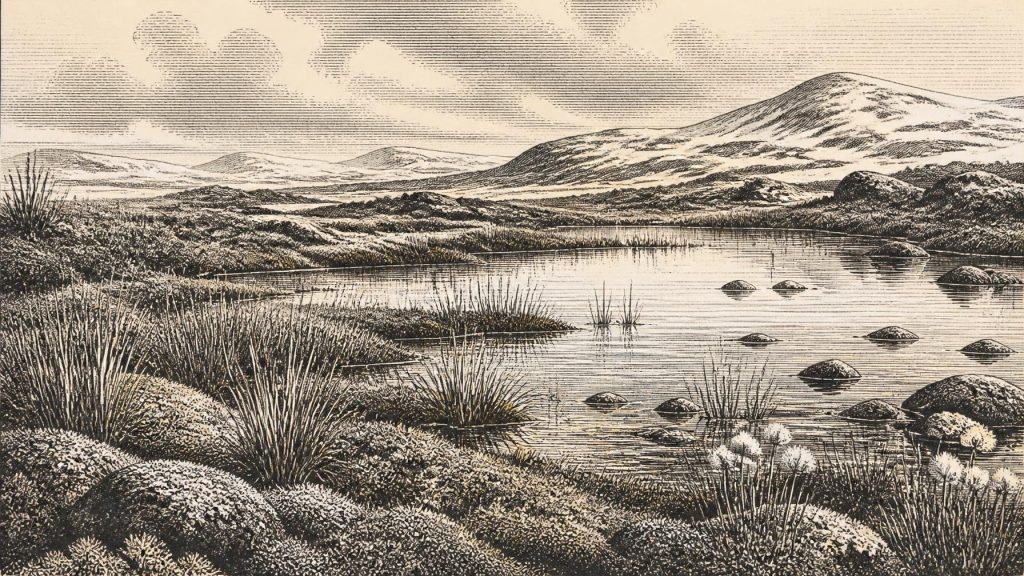
The best direct environmental evidence for the broad period comes from Derryvree near Maguiresbridge in County Fermanagh. There, organic freshwater deposits survived between two tills: sediments laid down by ice before and after the intervening episode. The sequence contains freshwater mosses and sedges, aquatic plants, pollen and an insect fauna of cold northern character. It records a treeless, wet landscape with pools or slow water, mossy ground and sedge-rich margins. It is a striking corrective to any picture of Ireland as either entirely buried beneath ice or completely barren.
Derryvree is also a lesson in the limits of the evidence. Its published radiocarbon measurement of about 30,500 radiocarbon years BP has a large uncertainty and is a date for organic material within a sedimentary sequence, not for an event in 31,761 BCE. The plants and insects demonstrate conditions at that locality during a cold interval; they do not identify a nation, a village or a named people. Nevertheless, they show that freshwater ecosystems endured in at least some protected settings. Water, wet ground and vegetation would have structured the movement of animals, while frost, seasonal snow, wind exposure and poor soils constrained the possibilities of more permanent occupation.
The wider Fermanagh record reinforces this regional picture. Organic deposits at Hollymount and Greenagho also occur between glacial sediments and point to episodes when non-glacial, cold-climate environments existed between advances of ice. Their dates and correlations are not exact enough to turn them into a neat annual sequence. Taken together, however, they establish an important fact: the Irish landscape during the last glacial cycle repeatedly changed between phases of ice occupation and phases in which tundra-like freshwater and terrestrial habitats were possible.
Animals at Castlepook
For the animal world nearest to this broad chronological horizon, Castlepook Cave near Doneraile in north County Cork is indispensable. Excavations undertaken in the early twentieth century recovered a remarkable but difficult collection of animal remains from the limestone cave system. Subsequent radiocarbon work by the Irish Quaternary Fauna Project, and later reassessment, showed that the material did not represent one simple deposit or one moment in time. The cave accumulated bones over multiple phases, while antiquarian excavation and disturbance complicated the original stratigraphy.
Yet the fauna is powerful evidence in its own right. Castlepook has produced remains attributed to reindeer, woolly mammoth, giant deer, brown bear, wolf, red and Arctic foxes, spotted hyaena, stoat, mountain hare and lemmings. Re-dating has placed important southern Irish faunal material within MIS 3, with some relevant specimens falling broadly between about 45,000 and 33,000 calibrated years ago. That range overlaps the modernly numbered date considered here, though it does not demonstrate that every species shared the same valley, season or generation.
The combination suggests open, cold habitats capable at intervals of supporting grazers and browsers as well as predators and scavengers. Reindeer and lemmings are especially consistent with northern, open-country conditions; mammoth points to productive enough grazing in parts of the wider landscape; hyaena, wolf and bear reveal a more complex food web than a simple image of frozen emptiness allows. Caves, however, are not straightforward snapshots of living communities. Carnivores may carry prey in, animals may die in traps or sheltered passages, and water or later excavation can mix material. The assemblage demonstrates animal presence in southern Ireland across a broad period, not a population census for one year.
A Possible Human Trace
The question of people is both important and unresolved. A reindeer femur from Castlepook has been reported as carrying a deep mark interpreted as the cut of a sharp stone tool. If that interpretation and its chronology are upheld, it would be evidence that a person handled or butchered reindeer in Ireland during the Pleistocene, immensely earlier than the formerly accepted archaeological record. It is a hypothesis of major significance, and it has rightly encouraged renewed excavation and analysis at Castlepook.
It is not, however, evidence for an Irish settlement in 31,761 BCE. The bone originated in an old collection rather than from a modern, intact occupation surface. The date measures the animal bone, not automatically the time when the mark was made. No securely associated hearth, stone-tool assemblage, dwelling floor, human remains, cemetery or repeated food-processing area of comparable age has yet established a resident population. Fresh investigations seek precisely the stratified material that could test these possibilities. Until that work supplies firmer associations, the careful conclusion is that Pleistocene human presence in Ireland is possible and perhaps increasingly plausible, but remains unproven as a sustained occupation.
Society Beyond Recovery
Accordingly, there is no evidence from Ireland for political affairs, diplomacy, warfare, law, leadership or territorial boundaries at this date. There were no documented kingdoms, farms, ports, markets, churches, monuments or written institutions. Nor can Irish evidence recover a language, religion, stories, artistic tradition, kinship system or formal learning. Such absences should not be confused with claims that any visiting people had no beliefs, skills or social ties; they mark the limits of preservation and discovery.
If people did enter the island during this phase, comparison with Upper Palaeolithic groups elsewhere in north-west Europe suggests highly mobile lifeways dependent on knowledge of weather, animal movements, fuel, stone, safe routes and temporary shelter. That is an informed comparison, not a description of a known Irish band. Reindeer, for example, could potentially have provided food, hides, sinew, bone and antler, but Castlepook does not permit those uses to be reconstructed beyond the contested inference of butchery. Agriculture, herding, pottery, metalworking and permanent built settlement belong to much later Irish prehistory.
Trade and sea travel must be treated with similar restraint. Lower global sea levels altered the surrounding continental shelves, but changing ice, marine channels and local relative sea level mean that no simple, permanent land bridge into Ireland can be assumed. Animals evidently reached the island during favourable phases, yet the routes, timing and frequency of their dispersal remain debated. No Irish artefact of this age identifies an exchange network or a point of origin for people.
Approaching a Harder World
The great development visible from this distance is environmental change. In the millennia after the interval relevant to 31,761 BCE, the British–Irish Ice Sheet reached extensive Last Glacial Maximum limits. Research on the Atlantic shelf west of Ireland places grounded ice at the outer shelf around 26,800 calibrated years BP, with retreat beginning by about 25,900 cal BP. Those later results do not tell us that ice covered every place at the earlier nominal date. They do show why the Derryvree wetland and Castlepook fauna matter: both belong to a precarious world before, or amid, the major expansion and reorganisation of ice.
Glaciers subsequently eroded landscapes, redeposited sediment and removed or buried many possible archaeological traces. Rising seas after the Ice Age also drowned former coastal plains and routes. The scarcity of evidence is therefore historically meaningful but not conclusive proof of human absence. Around 31,761 BCE, Ireland can responsibly be envisaged as a changing cold-stage landscape, locally capable of sustaining freshwater vegetation and Ice Age mammals, but subject to advancing ice and profound ecological disruption. Its history at this depth is written not in annals or monuments, but in mosses beneath till, insect remains in silt and the fragmentary bones of Castlepook Cave.
Primary Sources
- A reconsideration of the radiocarbon dating of the Marine Isotope Stage 3 fauna from southern Ireland
- The Irish Quaternary Fauna Project
- A Middle Midlandian Freshwater Series at Derryvree, Maguiresbridge, County Fermanagh, Northern Ireland
- Early Midlandian–Middle Midlandian, Pleistocene, Northern Ireland
- Occurrence of mammalia relicts at site Castlepook Cave
- The Exploration of Castlepook Cave, County Cork, Being the Third Report from the Committee Appointed to Explore Irish Caves
- Dublin Radiocarbon Dates II
- Figure 6.— The subdivision of the Quaternary Period in Ireland
- Radiocarbon constraints on the history of the western Irish ice sheet prior to the Last Glacial Maximum
- Maximum extent and dynamic behaviour of the last British–Irish Ice Sheet west of Ireland
- Timing and pace of ice-sheet withdrawal across the marine–terrestrial transition west of Ireland during the last glaciation
- Dimensions and chronology of the last ice sheet in Western Ireland
- Trimlines, blockfields and the vertical extent of the last ice sheet in southern Ireland
- BRITICE Glacial Map, version 2: a map and GIS database of glacial landforms of the last British–Irish Ice Sheet
- Response of the Irish ice sheet to abrupt climate change during the last deglaciation
- The Last Glacial Maximum
- The IntCal20 Northern Hemisphere Radiocarbon Age Calibration Curve (0–55 cal kBP)
- Marine20—The Marine Radiocarbon Age Calibration Curve (0–55,000 cal BP)
- Archaeology Research Excavation Grant 2022: Final Report
- Heritage Artefacts of County Cork
- Ireland's Palaeolithic Archaeology – Fleeting Footprints in a Frozen Land
- The colonization of Ireland: A human ecology perspective
- New insights on the fauna of Ireland's Younger Dryas and Early Holocene from Alice & Gwendoline Cave
- Investigating seasonal mobility in Irish giant deer Megaloceros giganteus through strontium isotope analysis