Awbeg Valley Hyena Den31760 BCE
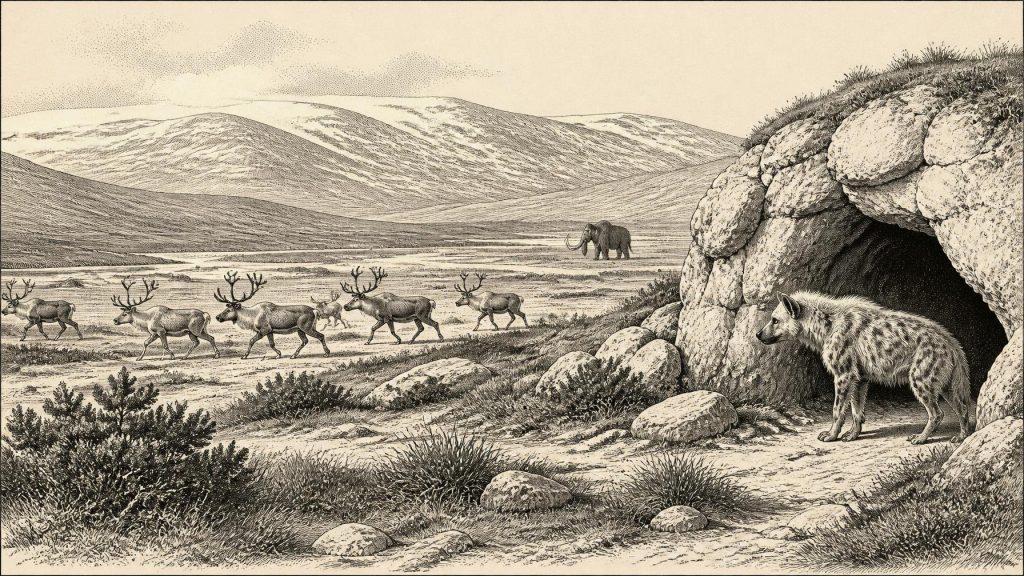
Around 31,760 BCE, Ireland was within the unstable later Marine Isotope Stage 3, approaching the Last Glacial Maximum, not a precisely datable year. Castlepook Cave above County Cork’s Awbeg Valley preserves disturbed but evidence of a cold, open mammal fauna, including reindeer, mammoth, giant deer, wolves, bears and Ireland’s only known spotted hyaenas, probably denning there. Environmental deposits elsewhere confirm fluctuating habitable conditions before expanding ice. A cut-marked reindeer bone may indicate an early human visit, but no hearths, tools or settlements prove occupation. The evidence reveals a changing ecological frontier, while precluding claims about prehistoric society, politics or population.
Dateline
31,760 BCE cannot be treated as a date on which a recorded Irish event occurred. No written record, named individual, settlement plan or securely datable human occupation belongs to this calendar year. Indeed, modern calendar-year precision is not available for Ireland at so remote a point in the Late Pleistocene. In simple year-count terms it lies about 33,700 years before 1950, the conventional “present” of radiocarbon dating, but a radiocarbon result must be calibrated and expressed as a probability range rather than converted into an apparently exact BCE anniversary. The responsible frame is therefore later Marine Isotope Stage 3 (MIS 3), an unstable interval of the last Ice Age, and the archaeological and environmental traces that can illuminate Ireland broadly around it.
For this period, the most important Irish evidence lies not in a village, grave or monument but in caves and buried sediments. These are fragmentary archives, and their limits matter as much as their revelations. They show that animals entered and lived on parts of the island during phases before the Last Glacial Maximum; they do not demonstrate a permanent human population, a polity, or an Irish society comparable with later prehistory. Around the horizon represented by 31,760 BCE, Ireland was a cold, changing north-western landscape whose connection to neighbouring lands, available habitat and ice cover altered over long timescales.
A Date Within a Moving Ice Age
MIS 3, conventionally dated to roughly 57,000–29,000 years ago, was not one uniform deep freeze. Greenland ice-core records and North Atlantic research reveal abrupt shifts between relatively milder interstadials and severe stadials. The British–Irish Ice Sheet also waxed and waned unevenly. Reconstructions indicate substantial ice-sheet growth after about 31,000 years before present, culminating later, with the principal British–Irish maximum around 27,000–23,000 years ago. That broad sequence makes 31,760 BCE a threshold in geological terms: well before the fullest Last Glacial Maximum, but within the long approach to it.
It would nevertheless be misleading to colour the entire island either white with ice or green with habitable pasture for this one numbered year. Ice margins were dynamic; evidence from different Irish regions is discontinuous; and the timing of local glaciation remains an active area of research. Some uplands may have supported local ice while lower ground, particularly in parts of the south, could at intervals sustain cold-adapted vegetation and animals. Subsequent glaciation eroded, buried and redeposited much older ground surface, leaving caves and rare sub-till deposits disproportionately important. Absence of a camp or hearth is therefore not proof that no person ever arrived; it is, however, a powerful reason not to assert an occupation without direct evidence.
Castlepook’s Uneven Archive
The central site is Castlepook Cave, also called Mammoth Cave, near Doneraile in north County Cork, above the Awbeg Valley. Its limestone passages were explored extensively between 1904 and 1918. Early excavators recovered an immense collection of animal bone from sands beneath calcite floors, but their methods and records do not meet modern archaeological standards. Much of the original material is no longer extant, and floodwater, animal activity and excavation disturbance mixed deposits of different ages. Castlepook is consequently a remarkable source for Pleistocene life, but not a neatly layered diary of a single moment.
Modern radiocarbon work transformed the interpretation of this collection. The Irish Quaternary Fauna Project established that a wide range of mammals reached Ireland between at least about 45,000 and 20,000 radiocarbon years ago. Later re-dating, using improved pretreatment of bone collagen, showed that several older determinations required revision and placed elements of the southern Irish fauna firmly in MIS 3. One important conclusion was that giant deer and spotted hyaena may have disappeared locally before the Last Glacial Maximum, perhaps around 40,000 calibrated years before present. That is an inference from dated bones and regional chronology, not a claim that every Castlepook animal lived together or that any one species can be placed exactly in 31,760 BCE.
What the cave does securely establish is the existence, over a substantial pre-maximum interval, of an Irish mammal community far richer and stranger than the historic fauna of the island. Identified material includes reindeer, woolly mammoth, giant deer, brown bear, wolf, Arctic fox, mountain hare, collared and Norwegian lemmings, and spotted hyaena. Castlepook is Ireland’s only known spotted-hyaena locality. The hyaena remains, including a skull preserved by the National Museum of Ireland, are especially suggestive because the cave appears to have served, at least at times, as a carnivore den where prey remains accumulated.
Open Ground and Predators
The animal list points towards a predominantly open, cold landscape rather than the wooded Ireland familiar today. Reindeer, lemmings, Arctic fox and mountain hare are consistent with treeless or sparsely shrubby tundra-steppe conditions, with grasses, sedges, herbs, mosses and low shrubs providing seasonal grazing and cover. Mammoth and giant deer imply substantial plant productivity in suitable places, not an empty polar desert. Brown bear, wolf and hyaena occupied different ecological roles as predators, scavengers or omnivores. Yet the precise balance of grassland, wet ground, snow cover and scrub cannot be reconstructed from a cave inventory alone, particularly when its bones accumulated over millennia.
Derryvree, near Maguiresbridge in County Fermanagh, offers a complementary but earlier and differently dated sort of evidence: organic sediments sealed beneath glacial deposits. Its freshwater and wetland deposits preserve plant remains and other environmental indicators from a Middle Midlandian interstadial setting. They demonstrate why the phrase “Ice Age” should not be equated automatically with permanent continental ice across all Ireland. In suitable intervals, pools, sedge-rich margins and mossy ground existed in the north as well as more open terrain. Derryvree cannot be made a year-by-year weather report for north Cork, but it reinforces the picture of fluctuating, locally habitable environments before later ice advance.
The caves also caution against sentimental images of a tranquil animal paradise. Hyaenas could carry carcass parts into underground shelters; wolves and bears left their own traces; flooding shifted sediment; and bones survived or disappeared according to chance. A mammoth bone may register scavenging rather than hunting, a reindeer limb might have been carried by a carnivore rather than deposited beside a living herd, and a species represented by one specimen need not have been common. The important historical fact is not that every listed animal shared one meadow, but that Ireland intermittently supported routes and habitats through which these large mammals could reach it.
The Human Question
Human presence is the most compelling and most uncertain issue. A reindeer femur from Castlepook has been reported as bearing a deep incision interpreted by Ruth Carden as a sharp-tool cut made during butchery. Its reported age, around 33,000 years ago, has raised the possibility of a human visit to Ireland far earlier than the well-established post-glacial record. If the mark is genuinely anthropogenic and the dating and context hold, it would be exceptionally important: evidence not of an Ice-Age nation, but of people processing an animal during a fleeting incursion into a difficult landscape. Recent research excavation has sought undisturbed deposits capable of testing such questions with modern methods.
For 31,760 BCE, however, that proposition must remain precisely worded. There is no securely excavated hearth, stone-tool assemblage, dwelling, burial, genetic sample or repeated settlement sequence from Ireland at this age. Nor can a single modified bone identify the visitors’ language, kinship, culture or route of travel. Contemporary Upper Palaeolithic groups elsewhere in north-west Europe were highly mobile hunter-gatherers who possessed sophisticated stone technologies and social networks, but applying that knowledge to Ireland is interpretation by comparison, not direct Irish evidence. The most defensible conclusion is that occasional human exploration is possible and under investigation, while permanent settlement is unproven.
No Politics, No Trade Network
There can be no responsible account here of kingship, diplomacy, warfare, religious institutions or formal trade. Such categories require evidence that Ireland around this time does not provide. Even the island’s physical accessibility should not be reduced to a simple land-bridge story. Lower sea levels exposed areas of the surrounding shelf, but the changing configuration of sea, ice and land was complex, and scholarship has long disputed when, where and whether practicable land connections linked Ireland and Britain. Animal colonisation demonstrates movement into Ireland at certain times, but it does not identify a universally open route, still less a human trading corridor.
Everyday life, if people did reach the island, would have been organised around mobility, weather and animal behaviour. A short hunting or scavenging visit might have involved stone cutting implements, knowledge of hides and meat preservation, fire-making and close co-operation; none of these can yet be recovered directly from Castlepook. There is no evidence for farming, pottery, metalworking, monuments or settled coastal communities. Nor is there evidence for ritual at the cave. Its evocative modern gallery names, such as Hyaena Hall and Elephant Hall, should not be mistaken for prehistoric meanings.
An Ireland Before Historical Ireland
The significance of this date is therefore environmental and methodological. Around the broad 33,700-years-before-present horizon represented by 31,760 BCE, Ireland belonged to a shifting Ice-Age world in which animal populations could enter, flourish locally and vanish as climate, ice and geography changed. Castlepook preserves the strongest Irish testimony to that world, even as its disturbed deposits prevent overly exact reconstruction. The future of the question rests on careful excavation, direct dating, microscopic analysis of bone modifications and willingness to revise dramatic claims.
That restraint is not a deficiency in Ireland’s story. It is the story. Long before recorded communities, the Awbeg Valley cave system held the remains of reindeer, hyaena and mammoth in a landscape poised between habitable cold ground and expanding ice. The evidence permits us to see an ecological frontier and perhaps the shadow of rare human visitors. It does not permit us to populate 31,760 BCE with invented tribes, conflicts or ceremonies. In this far prehistoric Ireland, uncertainty is not an empty space to fill: it is the most important historical fact.
Primary Sources
- A reconsideration of the radiocarbon dating of the Marine Isotope Stage 3 fauna from southern Ireland
- The Irish Quaternary Fauna Project
- Castlepook Cave, County Geological Site Report
- Spotted Hyena Skull
- Heritage Artefacts of County Cork
- The Archaeological Heritage of County Cork
- 2022:564 – Castlepook Cave, Castlepook South, Cork
- Archaeology Research Excavation Grant 2022: Final Report
- The Exploration of Castlepook Cave, County Cork
- Occurrence of mammalia relicts at site Castlepook Cave
- Growth and retreat of the last British-Irish Ice Sheet, 31,000 to 15,000 years ago: the BRITICE-CHRONO reconstruction
- Pattern and timing of retreat of the last British-Irish Ice Sheet
- Timing and pace of ice-sheet withdrawal across the marine-terrestrial transition west of Ireland during the last glaciation
- Maximum extent and dynamic behaviour of the last British-Irish Ice Sheet west of Ireland
- The timing and magnitude of the British-Irish Ice Sheet between Marine Isotope Stages 5d and 2
- The problem of a late Quaternary landbridge between Britain and Ireland
- The Island of Ireland: Drowning the Myth of an Irish Land-Bridge?
- Palaeoecology
- Irish Pleistocene Biostratigraphy
- New insights on the fauna of Ireland's Younger Dryas and Early Holocene from Alice & Gwendoline Cave
- First evidence of a Late Upper Palaeolithic human presence in Ireland