Doneraile’s Reindeer Question31711 BCE
Around 31,711 BCE, Ireland’s history can only be reconstructed through broad archaeological and environmental evidence. During unstable MIS 3 conditions, Derryvree in County Fermanagh preserved an ice-free, periglacial wetland with tundra vegetation. Castlepook Cave near Doneraile yielded remains of reindeer, mammoth, giant deer, hyaena and other Ice-Age animals, accumulated over extended periods. Revised dating places much fauna in MIS 3. A marked reindeer femur may record human carcass processing about 33,000 years ago, suggesting possible brief Upper Palaeolithic visits. However, no secure settlement, tools, hearths or social evidence survives. Ireland remained a changing cold landscape, not a recoverable historical society.
Dateline
“31,711 BCE” is a modern numerical label, not a year that can be recovered from Irish evidence. No calendar, writing system, named ruler or chronicle existed on the island, and archaeology cannot isolate an event, a person or even a single generation to that precise point. Converted mechanically to the archaeological convention of calibrated years before present, with “present” fixed at 1950, it lies about 33,660 cal BP. That places it in the Late Pleistocene, during Marine Isotope Stage 3 (MIS 3), a long and climatically unstable part of the last Ice Age. The appropriate history is therefore one of dated ranges, deposits and probabilities, rather than an invented annual narrative.
A Date at the Edge of Resolution
At this depth of time, even a radiocarbon result is not a calendar date until it has been calibrated against evidence for changing atmospheric carbon. Calibration produces ranges, sometimes broad ones, rather than the certainty suggested by a numbered BCE year. A date around 33,660 cal BP also falls very close to the beginning of Greenland Interstadial 6 in widely used North Atlantic chronologies: a comparatively milder pulse within an overall cold age. That does not mean that weather in Ireland changed everywhere on the same day, or that a Greenland ice-core signal can be read as an Irish weather report. It does, however, underline the volatility of the wider climatic setting.
Ireland was not yet at the Last Glacial Maximum, the later period when the British–Irish Ice Sheet attained its greatest extent. Recent syntheses show that ice-sheet growth and maximum extent were regionally asynchronous: expansion was under way during the later part of MIS 3, while major maximum conditions belong principally to the period after roughly 27,000 cal BP. Around the nominal date considered here, the island should not be pictured either as wholly entombed beneath ice or as a familiar green and wooded country. Conditions varied sharply by region, season and century; glacier margins, periglacial ground, exposed mineral soils, wetlands and open vegetation all mattered.
Derryvree’s Buried Wetland
The best Irish environmental evidence relevant to this broad interval comes from Derryvree, near Maguiresbridge in County Fermanagh. Roadworks in 1969 exposed freshwater silts and fine sands enclosed between two layers of glacial till within a drumlin. The sequence itself is important: an earlier ice advance laid down till, a non-glacial freshwater environment developed, and a later advance buried it. Organic material from the freshwater deposits produced a radiocarbon determination of 30,500 BP, with substantial uncertainty. Modern calibration places it broadly within later MIS 3, rather than at an annual resolution.
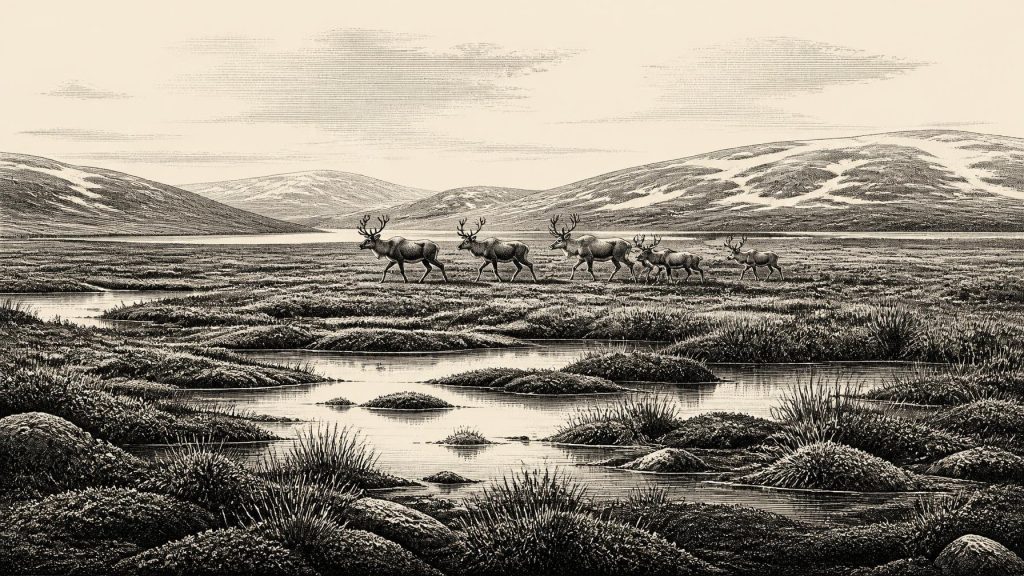
Pollen, plant macrofossils, mosses and small animal evidence from Derryvree indicate open tundra vegetation and a periglacial climate. The researchers described a muskeg-like setting: waterlogged ground with sedges, mosses and shallow pools, subject to frost and a short growing season. Herbs, grasses and sedges are better supported than woodland. A few tree-pollen grains cannot safely be treated as proof of nearby forest, since pollen may be reworked or carried from afar. Derryvree therefore offers a secure lesson about environmental possibility: parts of Ireland could contain cold, ice-free freshwater landscapes during MIS 3. It is not a complete map of the island, nor evidence for people at Maguiresbridge.
The Cave at Castlepook
In north County Cork, near Doneraile, Castlepook Cave—also called Mammoth Cave in older accounts—provides the most consequential faunal archive for this article. Antiquarian excavations, particularly those associated with Richard J. Ussher in the early twentieth century, recovered a large assemblage of animal bones. Subsequent study has identified remains including reindeer, woolly mammoth, giant deer, brown bear, wolf, fox, mountain hare, lemmings and spotted hyaena. This is not a list of creatures known to have stood together outside the cave on one day. The bones accumulated over a long period and could have been brought in by carnivores, water movement, denning animals and excavation disturbance.
Nevertheless, the Castlepook record establishes that Ireland was periodically part of a much richer Ice-Age animal world than its later fauna suggests. Reindeer are particularly informative: they are compatible with cold, open country and mobile seasonal grazing. Mammoth and giant deer point to a varied large-herbivore community, while hyaena and wolves reveal a food web that included powerful predators and scavengers. The combination makes Ireland’s Late Pleistocene landscape seem less like an empty frozen margin and more like a changing, thinly productive northern environment. But it remains essential not to turn a time-averaged cave collection into a single painted scene.
Dating has also changed the interpretation. The Irish Quaternary Fauna Project first demonstrated the importance of cave bones, but later re-dating showed that some older measurements had produced ages that were too young. Improved pretreatment and ultrafiltration of collagen pushed several Castlepook specimens thousands of radiocarbon years further back. The revised work places important parts of the cave fauna in MIS 3 and suggests that some species, especially giant deer and spotted hyaena, may have disappeared locally before the later glacial maximum. Such revisions are a reminder that Irish Pleistocene history remains evidence-led and provisional, especially where old collections lack modern excavation records.
A Reindeer Femur and Human Possibility
The greatest historical question raised by Castlepook is a reindeer femur bearing a deep mark interpreted by zooarchaeologist Ruth Carden as damage made on fresh bone by a sharp stone tool during carcass processing. Public heritage documentation associates the specimen with an age of about 33,000 years ago, conventionally expressed as around 31,000 BCE. If the mark is correctly identified as a human cut or chop mark and is contemporary with the animal’s death, it would be evidence that Upper Palaeolithic people reached Ireland far earlier than the long-established late-glacial and Mesolithic record.
That is an important possibility, but its limits must be stated plainly. The bone is not accompanied by a securely excavated camp floor, hearth, stone-tool assemblage, shelter, human burial or repeated occupation sequence. It came from a cave archive whose deposits were investigated before modern stratigraphic standards and whose animal remains may have been moved after death. A marked bone can demonstrate an action on an animal carcass more readily than it can demonstrate permanent settlement, the size of a group, a named culture or an ancestral population. The most responsible conclusion for around 31,711 BCE is that a brief human incursion into Ireland is possible; sustained occupation is unproven.
Life Without a Recoverable Society
If people did reach the island in this period, they were not “Irish” in any later ethnic, linguistic or political sense. Nothing permits the identification of a tribe, chiefdom, territory, language or kin group. There is no evidence for government, diplomacy, warfare, formal law or institutional leadership. Nor can archaeology identify a meeting, alliance or conflict from this date. Such absences do not mean that visitors lacked social ties, decision-making, stories or obligations; every human group had them. They mean only that none can yet be described from Irish material.
Similarly, there is no secure Irish evidence of religion, burial rite, cave art, monument building or formal learning at this date. Upper Palaeolithic communities elsewhere in Europe made sophisticated lithic tools, ornaments and art, and some pursued highly mobile hunting economies. Those comparisons help explain what might have been technically possible for any visitors to Ireland, but they cannot be used to populate Castlepook with ceremonies, styles or beliefs that have not been found there. Context is not proof.
Subsistence, Movement and Exchange
The reindeer femur allows one modest economic inference. If its mark was made by people, they understood how to process a carcass using a sharp lithic edge. Meat, fat, marrow, hide, sinew and bone can all be valuable products, though the mark alone cannot establish which were taken. It does not demonstrate whether hunters killed the animal, encountered it already dead, processed it near the cave or lost the bone to scavengers later. Reindeer herds could have been a mobile resource; any human use of them may have been opportunistic and seasonal rather than the foundation of a settled local economy.
No evidence supports agriculture, animal husbandry, permanent villages, pottery, metalworking, markets or regular trade networks in Ireland at this time. Nor should lower Ice-Age sea levels be simplified into an assured overland route. Coastlines and sea passages were very different from today, but their detailed configuration, the extent of ice and the practical routes available to animals or people changed through time. Ireland’s later separation from Britain is better understood than the exact accessibility of every MIS 3 episode. Mobility is plausible; a mapped migration corridor is not yet demonstrated.
An Unfinished Prehistory
The principal development around this nominal year is therefore environmental and archaeological rather than political. Ireland lay within a shifting northern world of cold grass- and sedge-rich ground, wetlands, ice advances and retreats, and episodic access for large mammals. Derryvree preserves a rare freshwater record of that world; Castlepook preserves its animal remains. The debated reindeer femur adds the possibility that humans, too, entered this landscape.
Further work may clarify the picture. Re-excavation at Castlepook in 2022 identified surviving sediments in parts of the cave, while continuing advances in radiocarbon pretreatment, zooarchaeology, sediment analysis, ancient DNA and the survey of submerged landscapes can test older assumptions. For now, the evidence does not support a year-specific story of an Irish settlement in 31,711 BCE. It does support something more valuable: an honest view of a changing Ice-Age Ireland, where reindeer, hyaenas and mammoths could move through open country, and where the faintest possible trace of human hands remains under examination.
Primary Sources
- A reconsideration of the radiocarbon dating of the Marine Isotope Stage 3 fauna from southern Ireland
- The Irish Quaternary Fauna Project
- First evidence of a Late Upper Palaeolithic human presence in Ireland
- New insights on the fauna of Ireland’s Younger Dryas and Early Holocene from Alice & Gwendoline Cave
- Growth and retreat of the last British–Irish Ice Sheet, 31,000 to 15,000 years ago: the BRITICE-CHRONO reconstruction
- Pattern and timing of retreat of the last British-Irish Ice Sheet
- Extent and timing of the Last Glacial Maximum (LGM) in Britain and Ireland: a review
- Response of the Irish Ice Sheet to abrupt climate change during the last deglaciation
- The IntCal20 Northern Hemisphere radiocarbon age calibration curve (0–55 cal kBP)
- IntCal Publications
- Consistently dated Atlantic sediment cores over the last 40 thousand years
- Palaeoecology: Irish Quaternary Association Guide No. 16
- Landscapes and environments of the last glacial-interglacial transition: a time of amazingly rapid change in Ireland
- Irish Pleistocene biostratigraphy
- Heritage Artefacts of County Cork 2021
- Archaeological Heritage of County Cork
- 2022:564 – Castlepook Cave, Castlepook South, Cork
- The Mesolithic in Ireland: When Was It?
- The Exploration of the Caves of County Clare: Geology
- Growth and Retreat of the Last British–Irish Ice Sheet, 31,000 to 15,000 Years Ago: the BRITICE-CHRONO Reconstruction
- Ice-core data used for the construction of the Greenland Ice-Core Chronology 2005 and 2021 (GICC05 and GICC21)
- The IntCal20 Northern Hemisphere Radiocarbon Age Calibration Curve (0–55 cal kBP)