Sedges Beneath Fermanagh31669 BCE
Around 31,669 BCE, Ireland lay within the unstable later Marine Isotope Stage 3 of the Last Glacial Period, rather than a datable year. Freshwater sediments at Derryvree, County Fermanagh, indicate locally ice-free, treeless wetlands of sedges, mosses, herbs and shallow water, supporting cold-adapted life. Castlepook Cave, County Cork, records reindeer, mammoth, giant deer, predators and smaller mammals, though its deposits span multiple periods. Expanding ice increasingly reshaped and buried landscapes. Lower sea levels allowed animal access at times, but routes remain uncertain. No secure human settlement is known; a possibly cut reindeer bone offers only tentative evidence of Palaeolithic visitation.
Dateline
“31,669 BCE” is a modern way of placing a point deep in the past, not a date that people in prehistoric Ireland could have recognised or recorded. No annual chronicle, settlement sequence or securely dated human event allows historians to describe this particular year. At this depth of time, even radiocarbon measurements produce broad calibrated ranges rather than calendar-year precision. The responsible subject is therefore Ireland during the later part of Marine Isotope Stage 3, within the Last Glacial Period: an unstable, cold age when the island’s landscapes, animal populations and ice cover were changing on scales of centuries and millennia.
The closest Irish environmental evidence is a freshwater deposit exposed at Derryvree, near Maguiresbridge in County Fermanagh. Organic silts and fine sands lay between two beds of glacial till within a drumlin. Their position is crucial: they preserve an interval in which water, plants and animals occupied the site after one phase of ice deposition and before a later advance buried the evidence. A radiocarbon determination from the deposit gave 30,500 radiocarbon years before present, with a large uncertainty. Published calibration places the material broadly around 36,900–31,700 calendar years before present, approximately 34,950–29,750 BCE. Thus 31,669 BCE falls within the far end of that wide range, but cannot be isolated within it.
A Cold-Stage Landscape
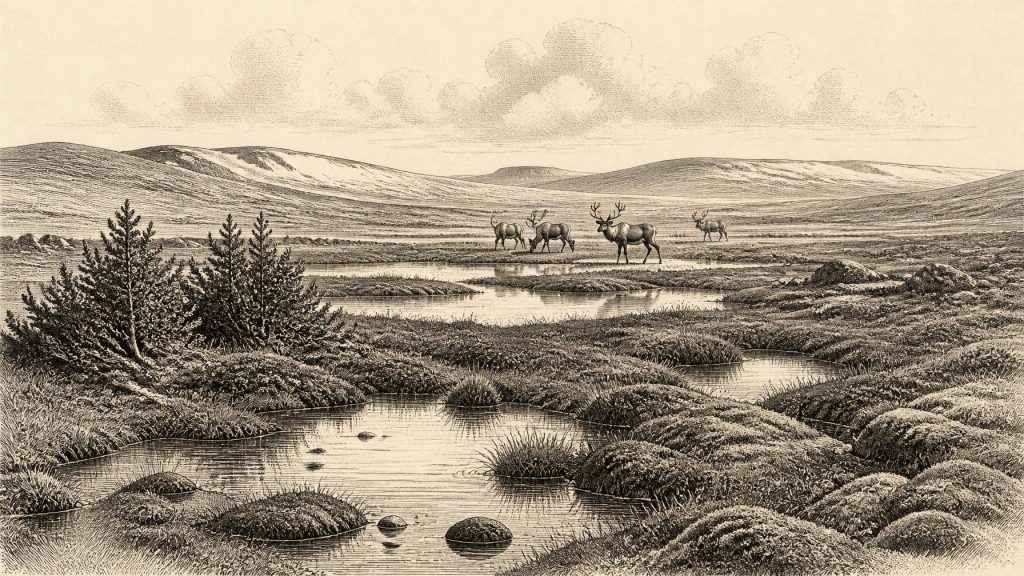
Derryvree is not a complete portrait of all Ireland. It is a small local archive, and its pollen was poorly preserved. Yet the combined plant, moss and insect evidence is unusually valuable because later glaciation removed or disturbed so much of the island’s earlier surface record. It indicates an open, treeless and wet landscape commonly described as tundra or muskeg: sedge-rich ground, mossy marsh, shallow freshwater and patches of exposed mineral soil, rather than an unbroken wilderness of ice or snow.
Grasses, sedges, herbs, juniper and cold-adapted mosses point to sparse but real vegetation. Some aquatic plant evidence indicates freshwater nearby. The word “tundra” should not conjure a single modern analogue. The Fermanagh lowlands may have contained pools and saturated hollows amid drier, wind-scoured ground; vegetation would have altered with drainage, snow cover, season and temperature. It was a hard environment, but not a lifeless one. The plants preserved at Derryvree were the base of a food web that could sustain insects, birds and grazing mammals.
The wider Irish evidence suggests a markedly seasonal climate. Permafrost or seasonally frozen soils, frost action and limited tree growth belong to this broad picture. Winters were severe; summers, though brief, could permit a flush of herbaceous growth. Interpretation must nevertheless remain cautious. A fossil plant assemblage cannot supply an exact temperature for a named year, and conditions in sheltered Fermanagh need not have matched exposed Atlantic coasts, mountains or the southern limestone country.
Animals Before the Ice Maximum
Castlepook Cave, near Doneraile in north Cork, provides the principal faunal archive relevant to this period. Excavations in the early twentieth century recovered more than 2,000 bones and teeth from a complex cave system whose galleries were given evocative names including Hyenahall and Elephant Hall. Modern re-dating has shown that surviving bones represent a long and complicated history, not one single occupation episode. Individual results span much of the middle and later Ice Age, and the cave deposits have also been affected by antiquarian excavation, mixing and later contamination.
Even so, the assemblage establishes that Ireland was visited by an impressive cold-stage fauna before the Last Glacial Maximum. It includes reindeer, mammoth, giant deer, wolf, fox, Arctic fox, brown bear, spotted hyaena, mountain hare and lemmings. Not every animal necessarily lived at Castlepook at the same moment, nor do their remains prove a single open plain extending over the island. But together they show that suitable habitats and routes existed for large herbivores and their predators during portions of Marine Isotope Stage 3.
For a date around 31,669 BCE, reindeer are especially evocative but should not be over-romanticised. Their presence supports the inference of open country with available forage; mammoth and giant deer likewise imply substantial grazing resources somewhere within the connected landscapes available to them. Hyaena bones and gnawing evidence remind us that caves could be carnivore dens, feeding places and bone traps rather than domestic shelters. A cave faunal collection is therefore evidence both of living animal communities and of the ways death, scavenging, water movement and excavation concentrated remains.
Ice, Water and Changing Connections
Ireland was not yet necessarily the fully ice-covered island of the Last Glacial Maximum. Research on the British–Irish Ice Sheet shows that its growth and peak were regionally asynchronous. The largest expansion followed later, with maximum ice volume around 23,000 years ago and extensive advance across Ireland and the surrounding continental shelf during the period broadly between 30,000 and 22,000 years ago. Evidence from Derryvree, Greenagho and other sites indicates that parts of Ireland had been ice-free or only locally glaciated during earlier phases of this long build-up.
That does not mean that a traveller in 31,669 BCE could simply have crossed a stable land bridge from Britain or continental Europe. Sea level was lower than today, exposing additional land on the continental shelf, but coastlines, ice margins, estuaries and channels were changing. Whether dry, continuous walking routes existed at any particular time is a difficult palaeogeographical question, not a fact that can be assumed from lower sea level alone. Ireland’s animal evidence proves repeated access at some stages; it does not map the route, season or duration of every arrival.
The approaching ice-sheet expansion is the central development behind the sparse evidence. Glaciers reshaped valleys, carried sediment, built and remodelled drumlins, and eventually erased many landscapes on which animals or people might once have left traces. Derryvree survived precisely because its freshwater sediments became sealed under later till. This uneven preservation helps explain why prehistoric Ireland before the final stages of the Ice Age appears so fragmentary: absence of excavated sites is not automatically proof that no activity ever occurred.
The Human Question
There is no securely identified camp, hearth, tool assemblage, burial or dwelling that can be assigned to Ireland in 31,669 BCE. Consequently there is no basis for describing an Irish population, language, kin group, political authority, diplomacy, warfare, ritual or trade network at this date. Terms such as Ireland, Fermanagh and Cork are used only as modern geographical conveniences. There were no states, counties or communities documented by written sources, and no evidence for farming, permanent villages, monuments, metalworking or exchange systems of the kinds known from much later Irish prehistory.
A reindeer femur from Castlepook has, however, made the question of human presence more urgent. A deep mark on the bone has been interpreted as a fresh-bone cut or chop made by a sharp stone implement during carcass processing, and the bone has been reported as about 33,000 years old. If both the dating and modification interpretation are sustained, the find could indicate a brief Upper Palaeolithic human incursion into Ireland during the broad era considered here.
That conclusion should remain provisional. A marked bone is not equivalent to an excavated settlement, and a single find cannot reveal the size, origins, duration or practices of any visiting party. The contextual history of Castlepook is difficult, while reassessment of Irish cave material has shown why old collections demand modern dating and taphonomic study. The better-established evidence for human activity in Ireland comes far later: a butchered brown-bear bone from Alice and Gwendoline Cave in County Clare dates to roughly 12,810–12,590 calibrated years before present. It demonstrates Upper Palaeolithic activity near the end of the Ice Age, but cannot be projected back twenty millennia.
Everyday Life Without a Community Record
If people did reach Ireland in the broader period around 31,669 BCE, comparative Upper Palaeolithic archaeology suggests that they would have depended on mobile hunting, gathering and careful use of animal materials. Such a statement is an inference from neighbouring European evidence, not a description of a known Irish camp. Reindeer and other large animals could have provided meat, fat, hides, sinew and bone; caves could have offered temporary shelter but were also dangerous places contested by carnivores. Movement, weather and access to fuel would have governed survival.
There is no direct Irish evidence from this horizon for ceremonial life, images, musical instruments, formal exchange or teaching traditions. Nor is silence proof that people lacked them: it reflects the extreme limits of the archaeological record. What can be said is that knowledge of seasonal animals, wet ground, safe water and changing ice would have been essential to any human visitor. For the animals actually attested, those same environmental constraints structured migration, predation and reproduction.
A Record of Possibility
The historical importance of this date lies less in an event than in a threshold. The Derryvree sediments show that a biologically active, treeless freshwater landscape existed in Fermanagh within a wide calibrated period encompassing 31,669 BCE. Castlepook records a rich Ice-Age fauna in Cork and preserves a debated clue to very early human contact. Together they replace the older image of a uniformly blank, permanently ice-bound Ireland with a more careful one: regional habitats opened and closed, animals entered and disappeared, and the expanding ice sheet increasingly transformed the island.
This was not yet a society from which political history can be written. It was a changing Pleistocene environment whose surviving silts, mosses, bones and cave sediments set strict limits on storytelling. The evidence supports open cold-country wetlands, large mammals and an approaching phase of major glaciation. It supports only the possibility—not a securely documented fact—of human visitors. That distinction is the most important lesson of Ireland around 31,669 BCE.
Primary Sources
- A Middle Midlandian Freshwater Series at Derryvree, Maguiresbridge, County Fermanagh, Northern Ireland
- A Reconsideration of the Radiocarbon Dating of the Marine Isotope Stage 3 Fauna from Southern Ireland
- Trimlines, Blockfields and the Vertical Extent of the Last Ice Sheet in Southern Ireland
- Growth and Retreat of the Last British–Irish Ice Sheet, 31,000 to 15,000 Years Ago: the BRITICE-CHRONO Reconstruction
- Pattern and Timing of Retreat of the Last British-Irish Ice Sheet
- Maximum Extent and Dynamic Behaviour of the Last British–Irish Ice Sheet West of Ireland
- Radiocarbon Constraints on the Age of the Maximum Advance of the British-Irish Ice Sheet in the Celtic Sea
- Dimensions and Chronology of the Last Ice Sheet in Western Ireland
- New Data for the Last Glacial Maximum in Great Britain and Ireland
- Maximum Extent and Readvance Dynamics of the Irish Sea Ice Stream and Irish Sea Glacier Since the Last Glacial Maximum
- The Colonization of Ireland: A Human Ecology Perspective
- The Irish Quaternary Fauna Project
- Occurrence of Mammalia Relicts at Site Castlepook Cave
- Castlepook Cave, County Geological Site Report
- Spotted Hyena Skull, Mammoth Cave, Castlepook, County Cork
- Archaeological Excavation at Castlepook Cave, County Cork, 2022
- Palaeoecology: Irish Quaternary Association Field Guide
- Figure 6: The Subdivision of the Quaternary Period in Ireland
- The Irish Ice Sheet and Relative Sea-Level Modelling
- First Evidence of a Late Upper Palaeolithic Human Presence in Ireland
- New Insights on the Fauna of Ireland's Younger Dryas and Early Holocene from Alice and Gwendoline Cave
- The IntCal20 Northern Hemisphere Radiocarbon Age Calibration Curve (0–55 cal kBP)
- Archaeological Heritage of County Cork
- Ireland: Submerged Prehistoric Sites and Landscapes