
Beneath Maguiresbridge Drumlin31633 BCE
Around 31,633 BCE, Ireland lay in an unstable Late Pleistocene interval before the Last Glacial Maximum. Evidence cannot reconstruct a single year or island-wide landscape, but sediments at Derryvree in Fermanagh record freshwater wetlands between ice advances, supporting tundra-like vegetation and insects. Other sites confirm episodic ice-free conditions. Castlepook Cave in Cork preserves a long-accumulated fauna including mammoth, giant deer, reindeer, predators and smaller cold-adapted animals. A cut-marked reindeer bone may indicate Upper Palaeolithic butchery, but human presence remains unproven without associated tools or settlement evidence. The record depicts environmental change, wildlife and possible transient human access, not named societies.
Dateline
The label 31,633 BCE is a modern way of indexing deep time, not a year that anyone in Ireland could have named or recorded. It corresponds only approximately to 33,600 calibrated years before AD 1950, within the later part of the Late Pleistocene and Marine Isotope Stage 3. At this distance, archaeology cannot offer calendar-year precision: radiocarbon results must be calibrated, their ranges can be broad, and deposits often represent periods rather than single moments. The responsible task is therefore to describe the evidence relevant to Ireland around this horizon, rather than invent an event for a particular year.
A Changing Ice-Age Island
Ireland lay within the climatic world of the last Ice Age, but it was not yet simply an island buried beneath the ice sheet familiar from later reconstructions of the Last Glacial Maximum. The British–Irish Ice Sheet grew and altered over long timescales, with its most extensive late-glacial phase occurring substantially later, broadly after c. 27,000 calibrated years BP. A modern reconstruction places a major phase of ice-sheet growth between about 31,000 and 26,000 years BP, followed by maximum volume around 23,000 years BP. The numerical date represented by 31,633 BCE therefore belongs to an earlier and unstable interval, when conditions, ice margins and habitats could change greatly across centuries and millennia.
The best evidence does not permit a single map of Ireland for this particular year. Later glaciers eroded, redeposited and buried much of the earlier landscape. Yet surviving sediments show that parts of the island had ice-free ground during sections of this period. In County Fermanagh and County Antrim, organic layers, freshwater silts and sands occur between separate sheets of till, the stony sediment laid down by moving ice. Their sequence records an important environmental rhythm: an earlier advance of ice, an interval in which water, plants and animals occupied the land, and a later glacial advance that sealed much of the evidence.
Freshwater Under Later Ice
At Derryvree, near Maguiresbridge in County Fermanagh, roadworks exposed such an archive inside a drumlin. Freshwater silts and fine sands, rich in organic material, lay between two distinct tills. The order of these deposits is more secure than any attempt to squeeze their history into a precise calendar date. It demonstrates that, before later ice covered the locality, there was a non-glacial freshwater setting in north-central Ireland. The site’s conventional radiocarbon determination of about 30,500 BP carries a large uncertainty; when calibration is considered, it has been discussed as broadly relevant to c. 36,900–31,700 calibrated years BP. That is a wide interval, but it includes the approximate horizon denoted by 31,633 BCE.
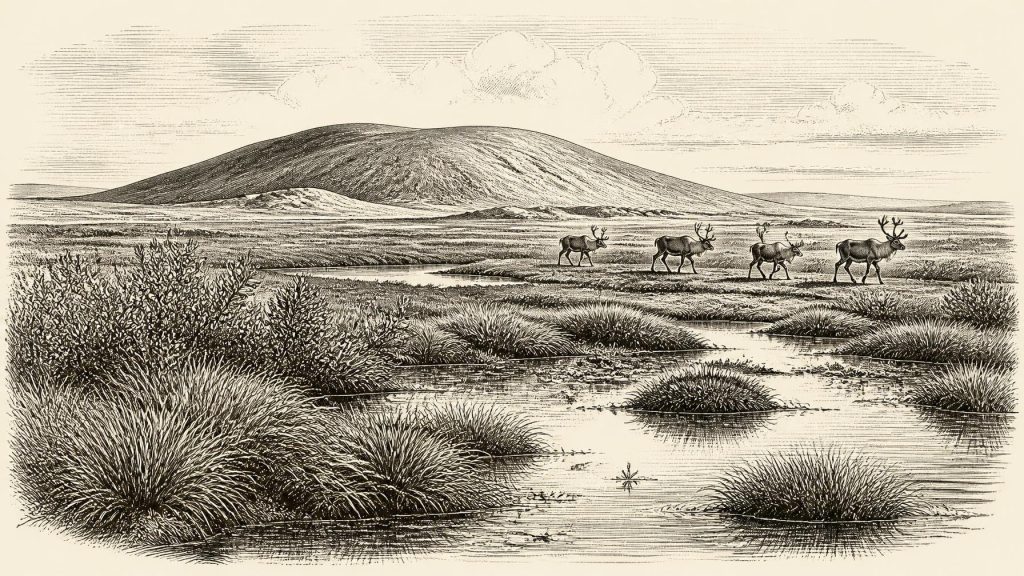
The Derryvree evidence is unusually vivid. Plant remains, mosses, pollen and insects indicate a cold, largely treeless landscape, not the densely green and wooded Ireland of much later prehistory. Sedges, bogbean, dwarf willow and mountain avens point to wet hollows, shallow freshwater and open tundra-like ground. Seasonal thaw would have created pools and saturated margins, while severe winter frost shaped soils and restricted the growing season. Occasional tree pollen should not be treated as proof of local woodland: pollen can travel over considerable distances, and the wider assemblage supports open country. This was not an empty, uniform expanse of snow, but a patchwork of water, marsh, herb-rich ground and exposed mineral soil.
Nearby records reinforce the wider point while also showing why caution matters. Organic deposits at Hollymount and Greenagho in Fermanagh suggest cold, non-glacial phases during the Middle Midlandian, the Irish regional term often used for this part of the Devensian glaciation. But dates can be minimum ages, samples may be difficult to correlate, and one locality cannot automatically speak for every valley or coast. At Aghnadarragh beside Lough Neagh in County Antrim, a remarkable succession preserves tills, peats, water-laid sediments and a gravel horizon containing woolly mammoth remains. Together, these sites establish regional environmental change; they do not provide a weather report for all Ireland in 31,633 BCE.
Castlepook’s Animal Archive
For animal life, the key Irish site is Castlepook Cave near Doneraile in north Cork. Its limestone galleries have yielded more than 2,000 bones and remain Ireland’s richest known vertebrate archive for the long period leading towards the Last Glacial Maximum. Radiocarbon dating of individual bones has shown that the collection spans a considerable duration, rather than a single occupation or a single ecosystem. The material includes woolly mammoth, giant deer, reindeer, brown bear, wolf, fox, hare, lemmings and the only securely recorded Irish Ice-Age spotted hyaenas. These animals should not be imagined as standing together at one moment outside the cave entrance. The assemblage accumulated over many thousands of years and was affected by scavengers, natural deaths and the movement of bones within a complicated cave system.
Nonetheless, Castlepook makes the broader ecological setting intelligible. Reindeer, hares and lemmings are consistent with open, cold habitats. Mammoth and giant deer evoke a productive but harsh mosaic in which grazing and browsing animals could exploit seasonal vegetation. Hyaenas and wolves indicate predators and scavengers capable of transporting carcass parts into sheltered spaces. The cave itself was not necessarily a human dwelling, a hyaena den or an animal trap at every stage of its history; its significance lies in the accumulated record of changing faunas. Reassessment of old radiocarbon samples has been essential, since early cave excavations disturbed deposits and older dates sometimes required improved pretreatment and redating.
The Earliest Human Question
Castlepook also raises the most tantalising question for Irish history at this date: were people present? A reindeer femur from the cave, recovered in the twentieth-century excavations and reported in 2021, has been dated to about 33,000 years ago. Zoologist Ruth Carden interpreted a deep incision on it as a mark made by a sharp stone tool during butchery. If that interpretation is sustained, it would indicate that Upper Palaeolithic people processed a reindeer in Ireland far earlier than the previously accepted evidence for human activity on the island.
The qualification is crucial. The radiocarbon result dates the animal bone, not automatically the cutting episode; a mark on a surface must be distinguished from damage caused by carnivores, sediment, excavation or later handling. No securely associated stone tools, hearth, shelter floor, butchered assemblage or human remains have yet been found at Castlepook to establish a settlement. Recent licensed excavations have sought undisturbed Pleistocene deposits precisely because the old collection, though invaluable, cannot answer every question about context. The femur is best regarded as important but contested evidence of possible human presence, not as proof of a resident Irish population in 31,633 BCE.
What Society Cannot Yet Be Seen
There is no basis for describing political affairs, rulers, tribes, diplomacy, territories or organised warfare in Ireland at this date. No written language existed locally, and the archaeological evidence does not identify a named community. Equally, there is no direct Irish evidence for religious ceremony, burial practice, art, schooling, exchange networks or a domestic economy. The word “Ireland” is useful geographically, but it should not imply a country, people or cultural tradition continuous with later Gaelic society.
If people did visit the island during this phase, the most cautious inference is that they would have been highly mobile hunter-gatherers, probably moving through a broader north-west European world in which animal migrations, weather, raw materials and safe routes governed decisions. Such groups elsewhere used stone tools, shared knowledge through oral teaching and maintained social ties across considerable distances. But these are comparisons with the Upper Palaeolithic of Europe, not observations of an excavated Irish camp. They cannot demonstrate whether people came once, repeatedly, seasonally or not at all.
Mobility, Not Trade
Nor should the movement of animals and possible visitors be called “trade”. The evidence supports natural colonisation and dispersal during windows when climate and geography permitted, rather than documented exchange between communities. Lower sea levels altered coastlines and may have reduced or changed water barriers, but the precise availability of routes between Ireland, Britain and continental Europe varied through time. Any human crossing would have required knowledge, planning and favourable conditions; it cannot be reconstructed from the Castlepook bone alone.
The principal story illuminated by 31,633 BCE is therefore environmental opportunity and vulnerability. Freshwater wetlands survived in some ice-free districts. Cold-adapted plants and mammals used open landscapes. Cave deposits in Cork preserved fragments of a wider faunal world, while Fermanagh sediments retained a rare record of water and vegetation later buried by ice. Human activity is possible, and one specimen may eventually alter the accepted beginning of Irish prehistory, but it remains an interpretation being tested rather than a settled fact.
For this year, then, Ireland cannot responsibly be given a king, a battle or a founding event. Its history lies in silt under a drumlin, in seeds and insect remains from a frost-affected wetland, and in animal bones gathered in a north Cork cave. Those traces reveal a landscape on the threshold of major glacial change: inhabited certainly by wildlife, intermittently habitable for people, and still far beyond the reach of calendar history.
Primary Sources
- A Middle Midlandian Freshwater Series at Derryvree, Maguiresbridge, County Fermanagh, Northern Ireland
- Early Midlandian–Middle Midlandian, Pleistocene, Northern Ireland
- Freshwater Organic Deposits and Stratified Sediments Between Early and Late Midlandian (Devensian) Till Sheets, at Aghnadarragh, County Antrim, Northern Ireland
- Aghnadarragh
- The Irish Quaternary Fauna Project
- A Reconsideration of the Radiocarbon Dating of the Marine Isotope Stage 3 Fauna from Southern Ireland
- Castlepook Cave: Cork County Geological Site Report
- The Exploration of Castlepook Cave, County Cork
- 2022:564 – Castlepook Cave, Castlepook South, Cork
- Archaeology Research Excavation Grant 2022: Final Reports
- Figure 6: The Subdivision of the Quaternary Period in Ireland
- Quaternary Site Descriptions
- The IntCal20 Northern Hemisphere Radiocarbon Age Calibration Curve (0–55 cal kBP)
- Growth and Retreat of the Last British–Irish Ice Sheet, 31,000 to 15,000 Years Ago: The BRITICE-CHRONO Reconstruction
- Timing, Pace and Controls on Ice Sheet Retreat: An Introduction to the BRITICE-CHRONO Transect Reconstructions of the British–Irish Ice Sheet
- Dimensions and Chronology of the Last Ice Sheet in Western Ireland
- Last Glacial Maximum Cirque Glaciation in Ireland and Implications for Reconstructions of the Irish Ice Sheet
- Maximum Extent and Dynamic Behaviour of the Last British–Irish Ice Sheet West of Ireland
- Dynamic Cycles, Ice Streams and Their Impact on the Extent, Chronology and Deglaciation of the British–Irish Ice Sheet
- Anthropogenic Changes to the Holocene Nitrogen Cycle in Ireland
- Heritage Artefacts of County Cork
- Menyanthes trifoliata L.
- Salix herbacea L.
- Dryas octopetala L.