Derryvree’s Vanishing Pools30437 BCE
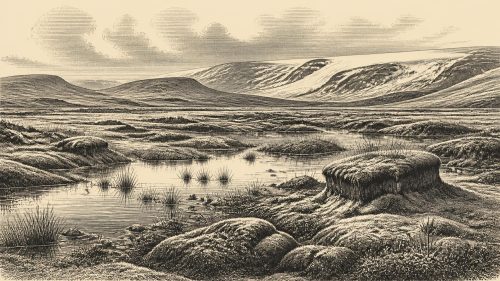
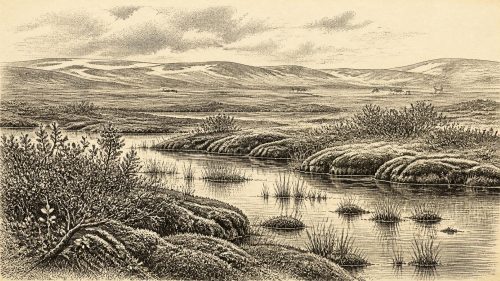
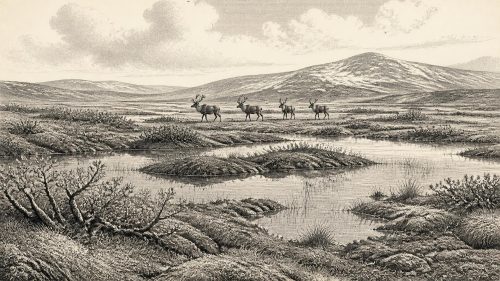
30,437 BCE is a modern label rather than a recoverable Irish year, and evidence must be read through broad calibrated ranges. During climatically unstable Marine Isotope Stage 3, Ireland contained shifting mosaics of cold, open, wet ground and local ice before the later glacial maximum. At Derryvree, Fermanagh, freshwater organic deposits between tills preserve mosses, sedges, insects and pollen, indicating a treeless, tundra-like wetland temporarily surviving between glacial advances. Castlepook Cave records diverse cold-stage fauna across millennia. A cut-marked reindeer bone may suggest early human activity, but remains unconfirmed. Environmental change, ice-driven landscape remodelling and fragmentary preservation dominate this period.
Dateline
30,437 BCE is a modern calendar label, not a year that can be recovered from Ireland’s prehistoric record. No inhabitants left writing, a calendar, named leaders or an event sequence that can be aligned with twelve particular months. In the convention that counts backwards from AD 1950, it lies roughly 32,386 calendar years before present. That arithmetic should not be confused with a radiocarbon age: radiocarbon measurements require calibration and, at this depth of time, normally produce ranges spanning centuries or millennia. The responsible history of this point is therefore an account of Late Pleistocene evidence whose date ranges overlap it, rather than a claim that something identifiable happened in Ireland during this particular year.
A Place Within Marine Isotope Stage 3
The broad setting was Marine Isotope Stage 3, a climatically volatile part of the last Ice Age. Ireland was neither permanently buried beneath the great ice sheet of later millennia nor a familiar green island of woodland, farms and coasts. Conditions changed repeatedly as temperature, precipitation, sea level and glacier extent altered. Around this notional date, the most useful evidence points to a patchwork of cold open ground, wetland and local ice in different regions, with the balance changing over long periods. The fullest expansion of the last British–Irish Ice Sheet came later; modern reconstructions place its maximum total volume at about 23,000 years before present, while also showing that its margins advanced at different times in different sectors.
It would be misleading, however, to turn a continent-scale reconstruction into a detailed map of Ireland in 30,437 BCE. The BRITICE-CHRONO reconstruction begins at 31,000 years before present because earlier constraints are sparse. Its 31,000-year slice depicts substantial ice nourishment in northern and upland Ireland, but it does not provide an exact snapshot for a date more than a millennium earlier. What can be said securely is that this was an era of growing glacial instability, before the later ice sheet remodelled much of the island and destroyed, buried or displaced many older traces.
Freshwater Beneath the Drumlin
The closest exceptionally informative Irish archive is at Derryvree, near Maguiresbridge in County Fermanagh. Roadworks exposed a remarkable sequence through a drumlin: a lower till, organic freshwater silts and sands, then an upper till. Till is unsorted material deposited by glacier ice. The order of these deposits is firm evidence for a major environmental sequence. Ice first occupied the locality; a non-glacial interval then permitted fresh water, plants, insects and fine sediment to accumulate; later glacial activity sealed the wetland beneath further till.
The organic layers produced the radiocarbon determination BIRM-166, conventionally reported as 30,500 with an uncertainty of +1,170/−1,030 radiocarbon years BP. This is not a date of 30,500 BCE, nor does it identify a single moment in the life of the wetland. Under modern calibration, published discussions place the deposit within a broad range of approximately 36,900–31,700 calibrated years BP, or about 34,950–29,750 BCE. The label 30,437 BCE falls inside that wide span. Yet it cannot be attached to a particular plant, pool or season in the Derryvree sequence. The deposit is an environmental window on a long interval, not an annual diary.
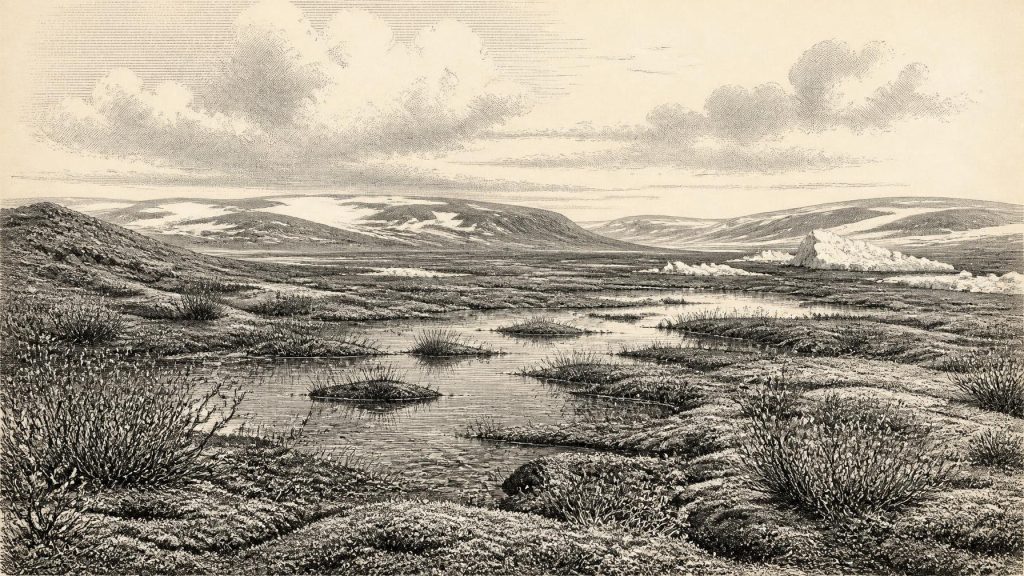
The fossils provide the most vivid evidence. Freshwater mosses and sedges, together with a cold-northern insect fauna, demonstrate wet ground and pools in or near the former basin. Other reported plant remains and pollen point to an open, treeless setting, rather than dense forest. The landscape is often described as tundra or muskeg-like: waterlogged ground with mossy surfaces, sedge margins, open water and mineral-rich silts, subject to hard winter cold and a short growing season. Such terms are useful ecological comparisons, not proof that every square kilometre of Ireland looked alike.
Derryvree also corrects the simple image of an Ice Age as an unbroken white wilderness. Fresh water could persist locally between glacial episodes, and plants, insects and small animals occupied those habitats. But the wetland’s survival beneath a later till also reveals its fragility. What appears in the modern road cutting is a landscape that was overtaken, compressed and hidden by returning ice. Its preservation is unusual; its incompleteness is equally important.
Animals, Caves and Caution
County Cork provides the other principal Irish perspective. Castlepook Cave, near Doneraile, is the country’s richest known cave archive for vertebrate life before the Last Glacial Maximum. More than 2,000 bones have been recovered from its galleries. The assemblage includes woolly mammoth, giant deer, reindeer, brown bear and spotted hyaena; later Ice Age deposits have also yielded wolf, Arctic fox, Norwegian lemming and collared lemming. The range shows that Ireland was reached, at differing times, by a striking cold-stage fauna.
That list must not be treated as a single living community at Derryvree in 30,437 BCE. Castlepook’s individually dated bones span a very long interval, roughly 45,700 to 19,950 years BP. Water movement, carnivore activity and early twentieth-century excavation disturbed and mixed parts of the cave deposits. A hyaena den, for example, can accumulate prey remains over time; bones brought in by animals are not a census of one valley or one season. The cave therefore establishes long-term faunal possibility and changing habitats, rather than a neat scene of mammoths, reindeer and people standing together.
One Castlepook object nevertheless bears directly on the question of people. A reindeer femur, held in the National Museum of Ireland’s collections, has a deep surface incision interpreted by palaeozoologist Ruth Carden as a cut made with a sharp stone tool during carcass processing. County Cork heritage material has presented the bone as about 33,000 years old. If microscopic study, dating and contextual investigation ultimately sustain that interpretation, it would be potentially the earliest evidence for human activity in Ireland, dramatically earlier than the previously accepted terminal-Pleistocene evidence.
The qualification is fundamental. The bone is not from a newly excavated, sealed campsite with associated stone tools, hearths, shelter remains, burials or a concentration of food waste. A date on the femur measures when the reindeer died within a range, not necessarily the moment when an incision was made. Nor can one marked bone determine whether people hunted the animal, encountered a carcass, camped nearby, travelled in a small party or ever returned. Recent Royal Irish Academy-supported fieldwork at Castlepook has confirmed that potentially valuable Pleistocene deposits survive in parts of the cave, but further work is needed before the claim can carry the weight of a settled human presence.
People Without a Recoverable Society
For this reason, political affairs, diplomacy and organised conflict cannot responsibly be reconstructed for Ireland at this date. There is no evidence for a polity, territory, chiefdom, army or named community. Nor is there evidence for houses, villages, cultivated plots, storage pits or a durable economic network. If people did reach the island, the available evidence is compatible only with brief, highly mobile activity by Upper Palaeolithic foragers; even that remains an interpretation resting chiefly on the contested significance of the Castlepook femur.
There is likewise no securely attributable Irish evidence for religion, burial, formal learning, figurative art, ceremonial monuments or exchange in valued goods. Absence of evidence is not evidence that Ice Age people lacked beliefs, language, skills or social ties. It means that Ireland’s surviving record cannot identify them. Analogies with contemporary Upper Palaeolithic societies elsewhere in Europe can suggest what mobile hunters may have known or practised, but they cannot be substituted for Irish finds. The distinction matters: a plausible continental comparison is not an Irish fact.
Subsistence can be discussed only at the scale of ecology. Reindeer and other large herbivores would have represented concentrated food, hide, bone and sinew resources for any humans who encountered them; predators such as hyaenas, wolves and bears were competitors or scavengers in the same wider landscapes. That is an inference from animal biology and the cave fauna, not evidence for a documented Irish hunting economy. No trade routes can be demonstrated. Lower sea levels altered the surrounding shelf and may have changed access, but no simple, permanent land-bridge narrative is warranted: coastlines, channels, ice margins and crossing conditions shifted repeatedly.
Regional Change as the Main Story
The largest historical development relevant to 30,437 BCE was environmental change. Derryvree records a freshwater interval between glacial advances in Fermanagh; Castlepook records animals entering a cave system in north Cork over many millennia. Together they show that parts of Ireland could support cold-adapted life before the Last Glacial Maximum, while also showing how quickly those opportunities could be curtailed. Expanding ice later scoured terrain, redirected drainage, reshaped hills and lowlands, and obscured the shallow deposits where camps or tracks might otherwise have survived.
Thus this date should not be made to bear the false precision of an anniversary. The evidence demonstrates an Ireland of open, cold and locally wet environments, repeatedly affected by ice; a diverse fauna that arrived at different times; and a tantalising but unconfirmed indication of human carcass processing. It does not reveal a nation before history, but a changing northern landscape from which history’s usual subjects—people, places and events—have almost entirely vanished.
Primary Sources
- A Middle Midlandian Fresh-Water Series at Derryvree, Maguiresbridge, County Fermanagh, Northern Ireland
- Early Midlandian–Middle Midlandian, Pleistocene, Northern Ireland
- Figure 6.—The Subdivision of the Quaternary Period in Ireland
- Soils of County Waterford
- Castlepook Cave, County Geological Site
- Heritage Artefacts of County Cork
- Archaeological Heritage of County Cork
- 2022:564 — Castlepook Cave, Castlepook South, Cork
- Archaeology Research Excavation Grant 2022: Final Report
- A Reconsideration of the Radiocarbon Dating of the Marine Isotope Stage 3 Fauna from Southern Ireland
- The Irish Quaternary Fauna Project
- Growth and Retreat of the Last British–Irish Ice Sheet, 31,000 to 15,000 Years Ago: The BRITICE-CHRONO Reconstruction
- Pleistocene Glaciations in Ireland
- Last Glacial Maximum Cirque Glaciation in Ireland and Implications for Reconstructions of the Irish Ice Sheet
- Maximum Extent and Dynamic Behaviour of the Last British–Irish Ice Sheet West of Ireland
- The Last Eurasian Ice Sheets — A Chronological Database and Time-Slice Reconstruction, DATED-1
- The IntCal20 Northern Hemisphere Radiocarbon Age Calibration Curve (0–55 cal kBP)
- The IntCal20 Approach to Radiocarbon Calibration Curve Construction: A New Methodology Using Bayesian Splines and Errors-in-Variables
- Composition and Consequences of the IntCal20 Radiocarbon Calibration Curve
- Freshwater Organic Deposits and Stratified Sediments Between Early and Late Midlandian (Devensian) Till Sheets, at Aghnadarragh, County Antrim, Northern Ireland
- Trimlines, Blockfields and the Vertical Extent of the Last Ice Sheet in Southern Ireland
- The Geological Heritage of County Leitrim
- Menyanthes trifoliata L. in Fermanagh: Fossil Record
- Ireland’s Palaeolithic Archaeology – Fleeting Footprints in a Frozen Land