Faunal Dispersal31656 BCE
31,656 BCE is a modern calendar projection, approximately 33,600 calibrated years before present, not a precisely datable Irish event. Ireland was entering colder Late Pleistocene conditions as the British–Irish Ice Sheet expanded unevenly. Derryvree deposits in Fermanagh preserve evidence of treeless, periglacial wetlands and open vegetation between glaciations. Castlepook caves in Cork contain mixed, imperfectly dated remains of mammoth, giant deer, reindeer, predators and other cold-adapted fauna, revealing changing connections with wider Europe rather than a single contemporaneous ecosystem. Routes of animal arrival remain uncertain. No archaeological evidence demonstrates human residence, society, rituals or institutions; environmental change defined this period.
Dateline
The label 31,656 BCE gives an appealingly exact appearance to a time that cannot be dated with modern calendar-year precision. No Irish document, settlement layer or event belongs to this particular year. It is a backwards projection of a modern calendar, useful only as a point on a very long timeline. In scientific terms it corresponds approximately to 33,600 calibrated years before present (cal BP, where “present” is 1950), within the Late Pleistocene and Marine Isotope Stage 3. Even that conversion should not be mistaken for an anniversary: radiocarbon determinations have error ranges, calibration produces ranges rather than single dates, and the surviving Irish evidence represents intervals rather than moments.
What can responsibly be said is that Ireland stood near a decisive environmental threshold. The island lay in the later part of a fluctuating Ice Age, before the fullest development of the Last Glacial Maximum. The British–Irish Ice Sheet was not a fixed white blanket appearing everywhere at once. It grew and retreated unevenly across different regions and sectors; the most extensive later glaciation belongs broadly to the period after about 31,000 years ago, with maximum positions reached at different times between roughly 30,000 and 22,000 years ago. Around the nominal date, therefore, Ireland was entering a worsening climatic phase, but the precise distribution of ice, open ground, sea and vegetation cannot be reconstructed year by year.
A Landscape in Transition
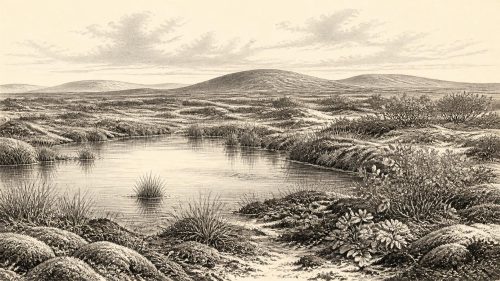
The familiar image of Ireland as a green, wooded island is wholly inappropriate. During cold phases of the Late Pleistocene, woodland could not have formed a continuous cover. Periglacial conditions – severe seasonal freezing, frost-shattered ground, sparse vegetation and unstable drainage – shaped much of the land that was not buried beneath ice. Streams carried fine sediment; exposed soils could be disturbed by frost and wind; and shallow pools or wet hollows offered sharply local habitats. The coastlines too were unlike those of the present. Global sea level was substantially lower because enormous quantities of water were held in ice sheets, exposing parts of the continental shelf. Yet lowered sea level does not itself demonstrate a simple, enduring walkable bridge between Ireland and Britain at every stage. The changing Irish Sea basin, ice margins and channels make routes of movement a subject for reconstruction rather than certainty.
The best Irish environmental archives near this broad timespan are neither houses nor artefacts but deposits sealed beneath later glacial sediments. At Derryvree near Maguiresbridge in County Fermanagh, road works revealed fine freshwater silts and sands between two distinct till sheets within a drumlin. The sequence proves that freshwater and vegetation occupied the locality between episodes of glaciation. Its conventional radiocarbon date, approximately 30,500 radiocarbon years BP with a large uncertainty, calibrates to a broad later-Pleistocene range rather than a single calendar point. Derryvree is therefore relevant to the world of 31,656 BCE, not proof of conditions in that exact year.
Plant macrofossils, pollen, mosses and insects from Derryvree indicate open, cold ground with freshwater margins: a tundra or muskeg-like landscape rather than mature forest. Sedges, mosses, bogbean and other wet-ground plants could grow around pools and saturated hollows, while the wider terrain supported herb-dominated vegetation. Small amounts of tree pollen do not overturn that interpretation, since pollen can travel considerable distances. The value of this evidence lies in its specificity about a local wetland and its wider indication of a treeless, periglacial setting; it does not license a detailed map of all Ireland’s plants or rainfall in 31,656 BCE.
Castlepook and the Animal Record
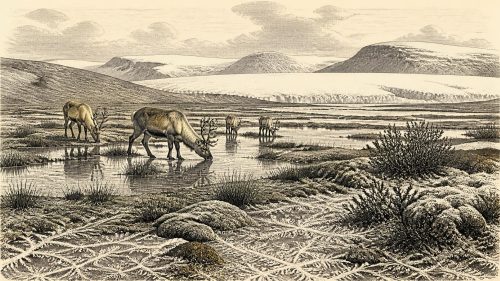
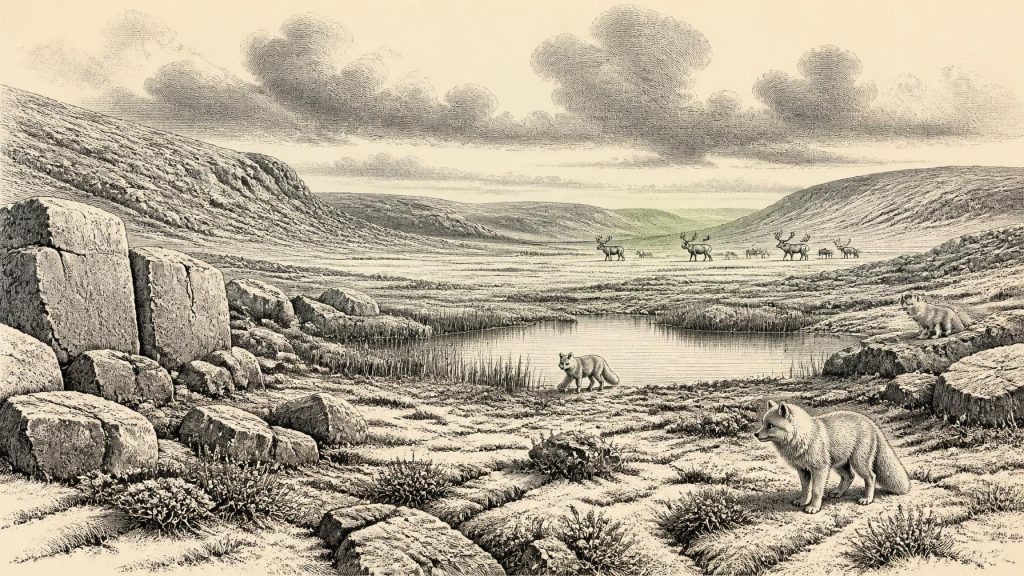
County Cork provides a complementary but equally cautious record. The limestone caves at Castlepook, near Doneraile in the Awbeg valley, have yielded Ireland’s most important assemblage of Middle to Late Pleistocene animal remains. Among the animals identified from the cave deposits are woolly mammoth, giant deer, reindeer, brown bear, wolf, Arctic fox, mountain hare, lemmings and spotted hyaena. These finds establish a major point about Ireland’s place in Ice-Age Europe: at favourable times, cold-adapted mammals reached this north-western edge of the continent and formed part of wider ecological networks.
The cave collection must not, however, be turned into a single imaginary procession of animals in one valley on one day. Many bones were excavated in the early twentieth century, before modern standards of stratigraphic recovery and recording. Cave sediments can be disturbed, material can be redeposited, and fossils from different episodes may be mixed. Improved radiocarbon pretreatment and re-dating have shown that some older determinations from Castlepook and nearby caves were too young. Current scholarship places important elements of the Castlepook fauna within Marine Isotope Stage 3, while also suggesting that giant deer and spotted hyaena may have disappeared locally before the later Last Glacial Maximum, perhaps around 40,000 cal BP. That is why the evidence is best read as a changing faunal history, not a checklist for 31,656 BCE.
Nevertheless, the record gives a vivid sense of the ecological pressures at work. Reindeer and lemmings point towards cold, open habitats. Mammoth and giant deer imply that, during their respective occupations, enough grazing and browsing resources existed to support very large herbivores. Wolves and hyaenas belonged to a predatory and scavenging guild dependent on such prey. Their presence makes clear that Ireland was not biologically empty throughout the Pleistocene. Yet populations at the Atlantic margin were likely vulnerable to rapid climatic shifts, shrinking suitable habitat and the advancing ice sheet. Local extinction, recolonisation and genetic turnover are more defensible themes than permanent, stable occupation by any species.
Connection Without a Known Route
How did these animals arrive? The honest answer is that no single route has been demonstrated for every species and every phase. Low sea levels, changing exposed shelf landscapes and ice-associated corridors altered the geography of access. Recent sedimentary ancient-DNA research from Castlepook has recovered traces of several ancient taxa and suggests genetic links between Irish cave hyaenas and mammoths and wider Eurasian populations. This is promising evidence for faunal connectivity before the Last Glacial Maximum, but it is presently a preprint rather than a final peer-reviewed conclusion. It strengthens the case for Ireland’s participation in a broader north-west European animal world; it does not settle whether a particular herd crossed dry ground, ice, narrow water or a sequence of changing routes.
There is no basis for describing trade, exchange or diplomacy in the human sense. Mammals moved through ecological opportunity, not political frontiers. Nor can one infer a settled human community from the presence of large game. The food resources that attracted predators might also have been attractive to people in other parts of Upper Palaeolithic Europe, but suitability is not evidence of occupation. Ireland’s subsequent glaciation has undoubtedly destroyed, buried or reworked older landscapes, so absence of evidence cannot prove that no person ever visited during the wider period. It does mean that archaeology cannot demonstrate a resident population here in this year.
No Demonstrated Human Society
This limitation matters especially when discussing everyday life. Ireland has no securely dated hearth, house, burial, tool-making floor, lithic assemblage or human remains attributable to around 33,600 cal BP. A reindeer femur from Castlepook has been publicised as bearing possible human modification and as potentially very early evidence of human activity. The observation is important and deserves continued investigation, but a single bone from a historically excavated cave cannot support a full social narrative. It does not identify the maker, establish a camp, reveal a language or prove continuous settlement. The National Museum of Ireland accordingly still presents the Palaeolithic human record as lacking clear evidence of human presence.
Political affairs, warfare, diplomacy, named leaders and institutions are therefore absent not because people of this era elsewhere lacked social relationships, but because no Irish evidence allows them to be recovered. The same restraint applies to religion and learning. There are no Irish ritual sites, portable artworks, inscriptions or teaching traditions that can be assigned to this date. It would be misleading to fill the gap with later Gaelic mythology, Celtic imagery or assumptions borrowed wholesale from continental cave art. Those belong to different bodies of evidence and, in some cases, vastly later periods.
If people did make brief visits to Ireland somewhere within this broad Ice-Age interval, their lives would have required expert knowledge of cold weather, animal behaviour, shelter, fire and movement across a hazardous landscape. That is a general inference from Upper Palaeolithic societies elsewhere in Europe, not a demonstrated Irish fact. For Ireland itself, the responsible story is more elemental: freshwater beds beneath Fermanagh drumlins record a cold open environment; Cork caves preserve evidence of shifting animal communities; and ice-sheet research shows that climatic deterioration was gathering force. Around the modern label 31,656 BCE, the principal historical development was environmental change, setting limits on every possible future human and animal occupation of the island.
Source References
Hover over a number to see the source. Select it to open the source.

- [1] A Reconsideration of the Radiocarbon Dating of the Marine Isotope Stage 3 Fauna from Southern Ireland
- [2] Growth and Retreat of the Last British–Irish Ice Sheet, 31,000 to 15,000 Years Ago: The BRITICE-CHRONO Reconstruction
- [3] BRITICE-CHRONO Maps and GIS Data of the Last British-Irish Ice Sheet 31 to 15 ka
- [4] The IntCal20 Northern Hemisphere Radiocarbon Age Calibration Curve (0–55 cal kBP)
- [5] The Irish Quaternary Fauna Project
- [6] A Middle Midlandian Freshwater Series at Derryvree, Maguiresbridge, County Fermanagh, Northern Ireland
- [7] Middle Midlandian Interstadial Deposits at Greenagho, Near Belcoo, County Fermanagh, Northern Ireland
- [8] Early Midlandian–Middle Midlandian, Pleistocene, Northern Ireland
- [9] BSBI: Menyanthes trifoliata
- [10] Last Glacial Maximum Cirque Glaciation in Ireland and Implications for Reconstructions of the Irish Ice Sheet
- [11] Dimensions and Chronology of the Last Ice Sheet in Western Ireland
- [12] Vertical Dimensions and Age of the Wicklow Mountains Ice Dome, Eastern Ireland, and Implications for the Extent of the Last Irish Ice Sheet
- [13] Trimlines, Blockfields and the Vertical Extent of the Last Ice Sheet in Southern Ireland
- [14] Late Pleistocene Chronostratigraphy and Ice Sheet Limits, Southern Ireland
- [15] The Deglaciation of the Western Sector of the Irish Ice Sheet from the Inner Continental Shelf to its Terrestrial Margin
- [16] Maximum Extent and Readvance Dynamics of the Irish Sea Ice Stream and Irish Sea Glacier Since the Last Glacial Maximum
- [17] The Timing and Magnitude of the British–Irish Ice Sheet Between Marine Isotope Stages 5d and 2
- [18] Sedimentary Ancient DNA Reveals Late Pleistocene Faunal Connectivity Between Ireland and Eurasia
- [19] Could Brown Bears Have Survived in Ireland During the Last Glacial Maximum?
- [20] Phylogeographic, Ancient DNA, Fossil and Morphometric Analyses Reveal Ancient and Modern Introductions of a Large Mammal: The Complex Case of Red Deer (Cervus elaphus) in Ireland
- [21] Ireland: Submerged Prehistoric Sites and Landscapes
- [22] Prehistoric Details: Mell Flint Flake
- [23] Spotted Hyena Skull
- [24] Ireland Through Geological Time
- [25] Outreach and Education Resources
- [26] First Evidence of a Late Upper Palaeolithic Human Presence in Ireland
- [27] New Insights on the Fauna of Ireland’s Younger Dryas and Early Holocene from Alice & Gwendoline Cave
- [28] Castle Pook Cave, Castlepook South, Cork
Primary Sources
- A Reconsideration of the Radiocarbon Dating of the Marine Isotope Stage 3 Fauna from Southern Ireland
- Growth and Retreat of the Last British–Irish Ice Sheet, 31,000 to 15,000 Years Ago: The BRITICE-CHRONO Reconstruction
- BRITICE-CHRONO Maps and GIS Data of the Last British-Irish Ice Sheet 31 to 15 ka
- The IntCal20 Northern Hemisphere Radiocarbon Age Calibration Curve (0–55 cal kBP)
- The Irish Quaternary Fauna Project
- A Middle Midlandian Freshwater Series at Derryvree, Maguiresbridge, County Fermanagh, Northern Ireland
- Middle Midlandian Interstadial Deposits at Greenagho, Near Belcoo, County Fermanagh, Northern Ireland
- Early Midlandian–Middle Midlandian, Pleistocene, Northern Ireland
- BSBI: Menyanthes trifoliata
- Last Glacial Maximum Cirque Glaciation in Ireland and Implications for Reconstructions of the Irish Ice Sheet
- Dimensions and Chronology of the Last Ice Sheet in Western Ireland
- Vertical Dimensions and Age of the Wicklow Mountains Ice Dome, Eastern Ireland, and Implications for the Extent of the Last Irish Ice Sheet
- Trimlines, Blockfields and the Vertical Extent of the Last Ice Sheet in Southern Ireland
- Late Pleistocene Chronostratigraphy and Ice Sheet Limits, Southern Ireland
- The Deglaciation of the Western Sector of the Irish Ice Sheet from the Inner Continental Shelf to its Terrestrial Margin
- Maximum Extent and Readvance Dynamics of the Irish Sea Ice Stream and Irish Sea Glacier Since the Last Glacial Maximum
- The Timing and Magnitude of the British–Irish Ice Sheet Between Marine Isotope Stages 5d and 2
- Sedimentary Ancient DNA Reveals Late Pleistocene Faunal Connectivity Between Ireland and Eurasia
- Could Brown Bears Have Survived in Ireland During the Last Glacial Maximum?
- Phylogeographic, Ancient DNA, Fossil and Morphometric Analyses Reveal Ancient and Modern Introductions of a Large Mammal: The Complex Case of Red Deer (Cervus elaphus) in Ireland
- Ireland: Submerged Prehistoric Sites and Landscapes
- Prehistoric Details: Mell Flint Flake
- Spotted Hyena Skull
- Ireland Through Geological Time
- Outreach and Education Resources
- First Evidence of a Late Upper Palaeolithic Human Presence in Ireland
- New Insights on the Fauna of Ireland’s Younger Dryas and Early Holocene from Alice & Gwendoline Cave
- Castle Pook Cave, Castlepook South, Cork