
Maguirebridge’s Trifoliate Pools31657 BCE
About 31,657 BCE, Ireland lay within the climatically unstable later Marine Isotope Stage 3, not a recoverable historical year. Derryvree, County Fermanagh, preserves freshwater sediments between glacial tills, dated broadly to 34,950–29,750 BCE, indicating cold, open, wet tundra with pools, mosses, sedges and herbs. Castlepook Cave, County Cork, contains MIS 3 fauna including reindeer, mammoth, giant deer, hyaena and predators, though disturbed contexts limit interpretation. A possibly cut-marked reindeer bone may indicate an early human visit, but remains unconfirmed. No secure evidence supports permanent settlement, society or politics. These fragmentary archives document regional environmental change, animal use and advancing ice.
Dateline
31,657 BCE is not a year that can be recovered from Ireland’s archaeological record. It is a modern calendar label imposed on a period far beyond writing, named communities or annual chronology. Expressed in the usual radiocarbon convention, it lies roughly 33,600 calendar years before AD 1950, but that conversion is only approximate. At this depth in time, radiocarbon results require calibration and normally yield broad probability ranges, not dates precise enough to identify a season, a journey or a single generation. The responsible setting is therefore later Marine Isotope Stage 3, an unstable part of the last Ice Age, rather than an invented event in one Irish year.
An Interval Within the Ice Age
Ireland at this broad horizon was neither the familiar green island of later prehistory nor simply a featureless sheet of ice. It lay in a North Atlantic world marked by sharp climatic shifts, changing glaciers, exposed ground and great differences between local environments. The Last Glacial Maximum—the phase when the British–Irish Ice Sheet was at or near its greatest later extent—still lay ahead. Yet glacial growth and ice-margin fluctuations had already profoundly altered the country, while later ice would scour, bury and rearrange much of the evidence now sought by archaeologists.
That destructive history explains the extraordinary sparseness of the record. There are no securely dated houses, hearths, stone-tool scatters, graves, food stores or occupation surfaces from Ireland that can be assigned to around 31,657 BCE. Nor can a map of one locality be extended uncritically to the whole island. Ice, water, vegetation and animal movements varied from district to district; the present coastline was also irrelevant to a period of lower sea level and changing ice-loaded landscapes. What survives comes chiefly from exceptional sediment deposits and cave bone collections. These are windows, not a complete national archive.
Freshwater Beneath a Drumlin
The most valuable Irish environmental evidence near this notional date comes from Derryvree townland, near Maguiresbridge in County Fermanagh. Roadworks in 1969 cut through a drumlin and exposed freshwater silts and fine sands trapped between two separate layers of till, the unsorted sediment left by glacier ice. The sequence has an unusually clear relative order: an earlier glacier laid down the lower till; a non-glacial interval allowed waterborne sediment and organic material to accumulate; then a later advance buried the deposits beneath fresh till.
Organic material from the Derryvree series produced a conventional radiocarbon age of about 30,500 ± 1,170 radiocarbon years BP. Using modern calibration, discussion of that determination places the deposits broadly at about 36,900–31,700 calibrated years BP, approximately 34,950–29,750 BCE. The date label considered here falls within that wide interval, but it cannot be located within a particular bed or treated as the moment at which the pool existed. The evidence demonstrates an ice-free freshwater and periglacial environment in this part of Fermanagh during later MIS 3; it does not show that all Ireland was ice-free at the same time.
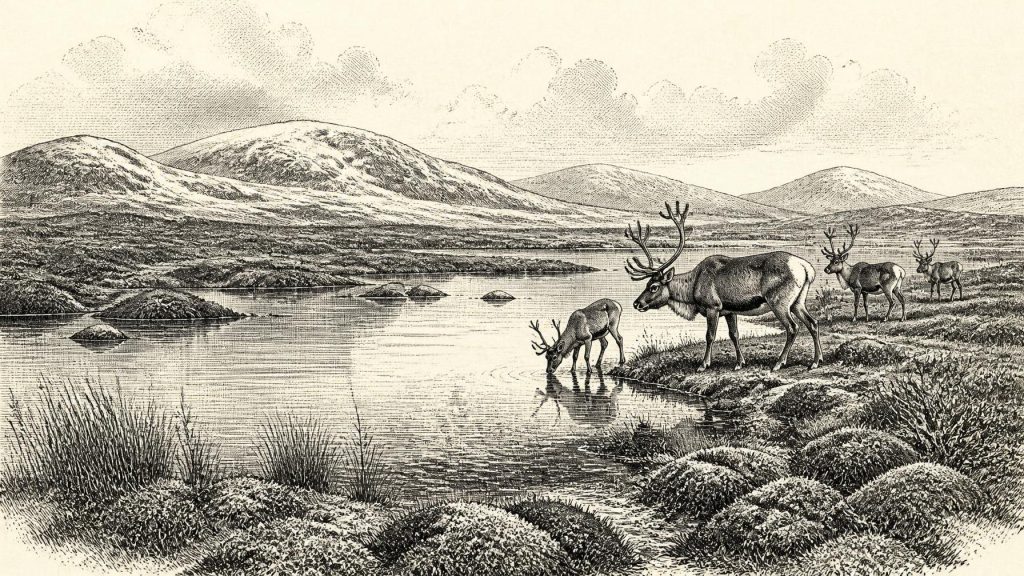
The Derryvree biological remains make the landscape more tangible. Pollen, plant macrofossils, mosses and insects indicate open tundra or muskeg: wet, largely treeless ground, with pools and plant-rich margins. Grasses, sedges, herbs and low shrubs were important, alongside mosses. Finds including bogbean (Menyanthes trifoliata), alternate water-milfoil and mountain avens point to freshwater or damp habitats embedded in a cold open country. These remains do not permit a picturesque reconstruction of every hillside, but they decisively rule out mature temperate woodland. Winters were harsh, growing seasons short, and frost likely shaped soils, drainage and the availability of plant cover.
A Patchwork, Not a White Void
Open ground should not be confused with lifeless ground. Summer light could support grasses, flowering herbs, moss beds and wetland plants; pools and watercourses created sheltered, productive niches. The most realistic image is a patchwork of stony or frost-disturbed terrain, sedgy water margins, low vegetation and locally variable shelter, not an unbroken snowfield. Equally, it was not a stable landscape. North Atlantic climate during MIS 3 could change abruptly on millennial and shorter scales, affecting the reach of ice, river flow, snow cover and the distribution of animals.
Evidence from western Irish marine sequences reinforces the need for caution. It suggests that the Irish Ice Sheet was active and capable of substantial expansion before the later maximum, while other studies show that its margins did not behave as one fixed island-wide line. Fermanagh’s buried freshwater deposits and southern or western coastal records therefore belong in a regional history of advance, retreat and reorganisation. Derryvree preserves an interval when its locality supported open wetland; it should not be used to claim either a wholly ice-free Ireland or a uniform climate from Cork to Donegal.
Animals and Cave Deposits
Castlepook Cave, near Doneraile in north County Cork, supplies the principal faunal counterpoint to Fermanagh’s plants and sediments. Antiquarian excavations there, often calling the site Mammoth Cave, produced a remarkable collection of Late Pleistocene bones. Modern reappraisal and radiocarbon work have shown that several species were present in southern Ireland during MIS 3, although the old excavations disturbed deposits and often left poor contextual records. The cave material must therefore be read as evidence for animals in the wider landscape, not as a neatly dated assemblage from one occupation episode.
The documented fauna includes reindeer, woolly mammoth, giant deer, brown bear, wolf, foxes, mountain hare, lemmings and spotted hyaena. This is a striking community of large herbivores, smaller cold-adapted mammals and formidable carnivores, but it was not necessarily a single group living together at one moment. Direct re-dating has in fact made some Castlepook specimens substantially older than earlier measurements suggested. Research indicates that giant deer and spotted hyaena may have disappeared locally before the Last Glacial Maximum, around 40,000 calibrated years BP. Individual dates and species ranges matter more than any simple ‘Ice Age animal list’.
Reindeer are particularly evocative because their presence fits an open, cold landscape in which mobile grazers could exploit seasonal vegetation. But caves were also places where carnivores dragged and consumed carcasses. A bone recovered there may record predation, scavenging, denning, water movement or nineteenth- and early twentieth-century excavation practices, rather than a human hunt. The hyaena skull held by the National Museum of Ireland is a useful reminder that these animals were once part of the Irish fossil record, despite their modern African association.
The Unsettled Human Question
A reindeer femur from Castlepook has been reported as bearing a deep mark consistent with fresh-bone cutting or chopping by a stone implement, and the specimen has been publicised as around 33,000 years old. If specialist assessment ultimately confirms that the mark is anthropogenic and contemporary with the animal’s death, it would be important evidence that Upper Palaeolithic people reached Ireland far earlier than the formerly accepted record. It would not, however, demonstrate a permanent settlement, a village or continuous occupation. One modified bone could reflect a short visit by a very small party processing a carcass.
That qualification is essential. Natural abrasion, carnivore damage, excavation damage and later handling can sometimes resemble human modification. Castlepook’s historic collection also lacks the undisturbed stratigraphic context that would link a bone securely to a living floor, hearth or tool assemblage. Current excavation and reassessment are valuable precisely because they test such claims rather than merely repeating them. The National Museum of Ireland still describes unequivocal Palaeolithic human presence on the island as unproven. The stronger published evidence for a human visit belongs much later: a cut-marked brown-bear patella from Alice and Gwendoline Cave, County Clare, directly dated to about 12,810–12,590 cal BP.
No Politics to Recover
For this reason, political affairs, diplomacy and organised conflict cannot responsibly be narrated for Ireland around 31,657 BCE. There are no rulers, peoples, territories, languages or institutions identifiable in the evidence. Nor are there grounds for claims about formal religion, ritual, learning, trade networks, farming or domestic livestock. Those subjects become historically meaningful only much later, when settlements, artefacts, burials and eventually written records permit social relationships to be traced.
If people did visit the island during this phase, comparison with Upper Palaeolithic societies elsewhere in north-west Europe suggests that mobility, knowledge of terrain, access to animal food, shelter and fuel would have mattered greatly. That is an informed archaeological analogy, not direct Irish evidence. No Irish object from this horizon establishes what tools were carried, what language was spoken, whether groups crossed by land or water, or how often they returned. The most defensible conclusion is smaller but still important: the island’s cold-stage environments could support animals, and they may have been accessible to people on rare occasions.
What the Record Can Say
Thus the significance of this nominal year lies not in an anniversary but in the survival of fragile archives. Derryvree’s silts preserve a cold freshwater tundra landscape sealed between glacial episodes. Castlepook’s bones show that large mammals and carnivores used parts of Ireland during the broader MIS 3 period, while also warning how carefully old collections must be interpreted. Together they reveal an Irish landscape undergoing profound environmental change: locally habitable for specialised plants and animals, increasingly vulnerable to renewed ice, and almost silent about human lives. That silence is evidence in itself, setting the limits within which Ireland’s earliest history must be written.
Primary Sources
- A Middle Midlandian Freshwater Series at Derryvree, Maguiresbridge, County Fermanagh, Northern Ireland
- The Irish Quaternary Fauna Project
- A reconsideration of the radiocarbon dating of the Marine Isotope Stage 3 fauna from southern Ireland
- First evidence of a Late Upper Palaeolithic human presence in Ireland
- New insights on the fauna of Ireland's Younger Dryas and Early Holocene from Alice & Gwendoline Cave
- Radiocarbon constraints on the history of the western Irish ice sheet prior to the Last Glacial Maximum
- Growth and retreat of the last British–Irish Ice Sheet, 31,000 to 15,000 years ago: the BRITICE-CHRONO reconstruction
- Timing and pace of ice-sheet withdrawal across the marine–terrestrial transition west of Ireland during the last glaciation
- The deglaciation of the western sector of the Irish Ice Sheet from the inner continental shelf to its terrestrial margin
- Advance and retreat of the marine-terminating Irish Sea Ice Stream into the Celtic Sea during the Last Glacial: Timing and maximum extent
- Sedimentary and foraminiferal records of Late Quaternary environmental change west of Ireland and implications for the last British–Irish Ice Sheet
- New data for the Last Glacial Maximum in Great Britain and Ireland
- Late Pleistocene chronostratigraphy and ice sheet limits, southern Ireland
- Cenozoic: Tertiary and Quaternary (until 11,700 years before 2000)
- The IntCal20 Northern Hemisphere Radiocarbon Age Calibration Curve (0–55 cal kBP)
- A stratigraphic framework for abrupt climatic changes during the Last Glacial period based on three synchronized Greenland ice-core records: refining and extending the INTIMATE event stratigraphy
- Prehistoric Details: Mell Flint Flake
- Spotted Hyena Skull
- Heritage Artefacts of County Cork
- Archaeology Research Excavation Grant 2022: Final Report
- Castlepook Cave, Cork, 2022
- Conserving Quaternary geoheritage in Northern Ireland
- Geology of Ireland
- Quaternary Geomorphology