

Doneraile’s Reindeer Horizon31655 BCE
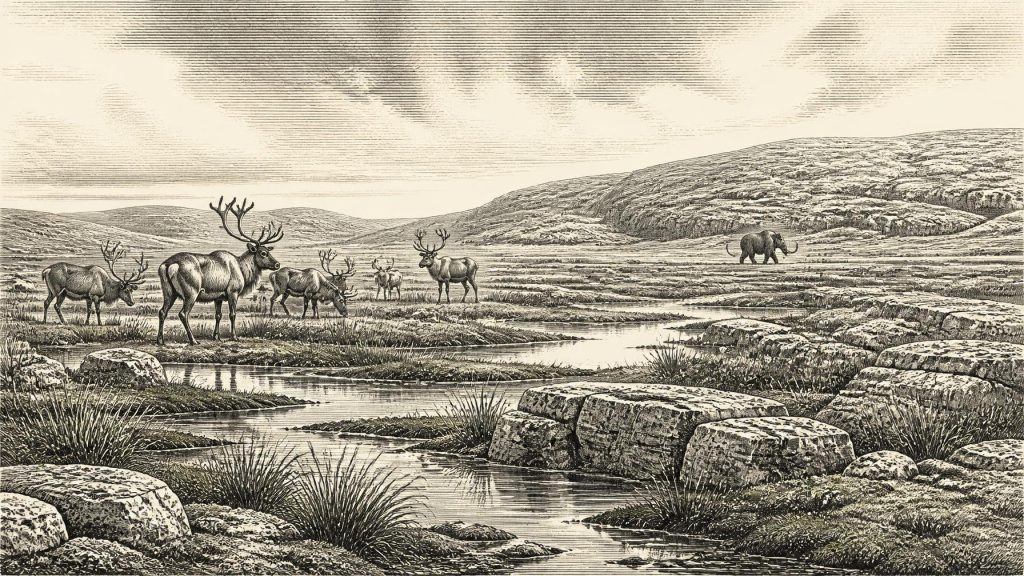
Around 31,655 BCE, Ireland was in Marine Isotope Stage 3, before the Last Glacial Maximum, with fluctuating ice, low sea levels and cold, varied habitats. Castlepook Cave near Doneraile preserves bones from repeated Late Pleistocene episodes, including mammoth, reindeer, hyaena, bear, wolf and Arctic fox, but mixed deposits prevent reconstruction of a single fauna or occupation. Derryvree wetlands indicate treeless tundra-like conditions. A dated Castlepook reindeer femur bearing a possible stone-tool mark may indicate brief human contact, yet cannot prove settlement. No securely associated camps, tools, hearths or cultural evidence exist. The record chiefly documents ecology, climate and uncertainty alone.
Dateline
The label “31,655 BCE” is a modern chronological convenience, not a year that people in prehistoric Ireland could have named or counted. At this depth of time, archaeology cannot isolate a political event, a journey or a human life within a single calendar year. The number corresponds approximately to 33,600 years before AD 1950, but radiocarbon results must be calibrated and are normally meaningful only as broad ranges of centuries or millennia. Ireland at this notional point lay in the Late Pleistocene, within Marine Isotope Stage 3: an unstable phase of the last Ice Age, long before the climatic extreme known as the Last Glacial Maximum.
The responsible history of Ireland at this date is therefore not a story of rulers, borders or recorded communities. It is a story reconstructed from cave bones, buried wetland sediments, pollen, insects, glacial deposits and the careful re-dating of old museum collections. These sources show that parts of Ireland could sustain cold-adapted animals during portions of this era. They do not establish a permanent human population, a village or an Irish society in any ethnic, linguistic or political sense.
A Landscape Before Maximum Ice
About 31,655 BCE, the great British–Irish Ice Sheet had not yet reached its better-documented later maximum. Research on its earlier growth increasingly indicates advance, retreat and regional variation during Marine Isotope Stage 3. That makes sweeping statements that all Ireland was continuously buried beneath ice misleading. Some ground was glaciated; elsewhere, or at other times, exposed terrain, coastal margins and river valleys may have remained available to plants and animals. The precise outline of ice at any one moment remains uncertain, especially because later ice repeatedly eroded or concealed earlier landscapes.
The major expansion associated with the Last Glacial Maximum came later, broadly after 30,000 years ago and most extensively around 26,000–20,000 years ago. Thus 31,655 BCE belongs to a world moving towards more severe conditions, rather than to the point of maximum ice coverage. The island’s physical geography also differed from today’s. Sea level was lower than now, though changing ice load, land movement and marine conditions make it unsafe to draw a simple, certain land bridge across the Irish Sea for this particular date. Animal movements demonstrate connectivity of some kind between Ireland, Britain and continental Europe over long periods; they do not by themselves reveal the exact route, season or frequency of passage.
Castlepook’s Mixed Cave Archive
The most important Irish site for this period is Castlepook Cave near Doneraile in north County Cork, above the Awbeg Valley. Its limestone passages, including galleries historically called Hyenahall and Elephant Hall, yielded a remarkable collection during excavations from the late nineteenth century into the early twentieth. Geological Survey Ireland describes Castlepook as Ireland’s richest site for vertebrate evidence in the long interval leading to the Last Glacial Maximum. Individual bones have produced dates spanning roughly 45,700 to 19,950 years before present, demonstrating that the cave archive represents repeated episodes across many millennia rather than one frozen instant.
This is a crucial caution. A cave is not automatically a home. It can be a carnivore den, a natural trap, a shelter, a drainage route and a repository into which water moves bones from outside. At Castlepook, flowing water disturbed and mixed material; early excavators also removed much sediment before modern recording methods existed. Consequently, bones from mammoth, reindeer, giant deer, brown bear, wolf, Arctic fox, lemmings and spotted hyaena are powerful evidence that these animals reached Ireland in different parts of the Late Pleistocene, but not all necessarily evidence that they occupied the cave together.
The spotted hyaena is especially revealing. Its presence shows that Ireland’s fauna included a large scavenging predator now absent from Europe. Hyaenas can accumulate bones in dens, gnawing, carrying and rearranging carcass parts. This makes Castlepook both richer and harder to interpret: a concentration of bones may reflect predation and scavenging as much as a living landscape outside the entrance. Woolly mammoth and reindeer point to an open, cold environment capable of supporting large herbivores, while bears, foxes and wolves indicate a more complex food web. Yet species lists cannot furnish an exact census of the Awbeg Valley in 31,655 BCE.
Open Ground and Wet Places
Evidence from north-western Ireland complements the Cork caves. At Derryvree near Maguiresbridge, County Fermanagh, roadworks exposed organic silts and fine sands sealed between tills left by separate ice advances. A radiocarbon determination from the intervening deposits has been calibrated broadly to about 36,900–31,700 calendar years before present, approximately 34,950–29,750 BCE. The range embraces 31,655 BCE, but it must not be converted into an event date. It records an environmental interval, not a day, generation or named occupation.
Pollen, mosses, plant remains and insects from the Derryvree sequence indicate cold, open and treeless conditions, often described as tundra or muskeg. This was not the familiar green, wooded Ireland of later prehistory. Low vegetation, sedges, mosses and wet ground around shallow water probably formed a patchwork with exposed mineral soils and periglacial surfaces. Such places could provide seasonal forage and freshwater, but would also have been vulnerable to frost, wind and abrupt climatic change. The survival of these deposits beneath later ice is fortunate: most surfaces on which people or animals moved were destroyed, reworked or remain hidden.
It follows that the Ireland of this period should not be imagined either as an unbroken white ice cap or as a fertile grassland. It was a variable northern landscape whose habitable patches expanded or contracted with climate and ice margins. The available record is strongest for environments and animals, weaker for the timing of their movements, and weakest of all for human presence.
The Reindeer Bone Question
A reindeer femur from Castlepook has made this period newly important to Irish archaeology. Public reporting and County Cork heritage material identify a deep mark on the bone as consistent with cutting or chopping by a sharp stone implement, and report a date of about 33,000 years ago. If specialist study ultimately confirms that interpretation, it would be extraordinarily early evidence that Upper Palaeolithic people handled a reindeer in Ireland, perhaps during butchery. It would move possible human activity on the island far earlier than the long-established late-glacial evidence from County Clare.
That finding is promising, but it is not a licence for certainty. The bone comes from an old cave collection rather than a modern excavation of an intact occupation surface. A radiocarbon date measures the animal’s death, not necessarily the exact time, place or agent of the modification. Identifying a mark on bone requires taphonomic assessment: carnivore damage, sediment abrasion, breakage and later handling must be distinguished from cuts made on fresh bone. Nor has a securely associated hearth, stone-tool assemblage, dwelling, burial, food-preparation area or repeated occupation layer of comparable age been published from Castlepook.
The most defensible conclusion is therefore deliberately limited. Around this broad phase of Marine Isotope Stage 3, Ireland may have received brief visits from hunter-gatherers able to exploit large game. The Castlepook reindeer bone is possible evidence for one such encounter, not proof of continuous settlement. It cannot tell us whether people crossed from Britain, travelled over an exposed northern route, used watercraft, stayed for hours or seasons, or returned in later years. Nor can it identify a language, ancestry, social group or cultural tradition.
Life, Society and Absence
If people did reach the island, their immediate concerns would have been shelter, fire, clothing, stone tools, food and safe movement through a cold terrain shared with large predators. Comparisons with Upper Palaeolithic groups elsewhere in north-west Europe make those practical needs plausible, particularly where reindeer formed part of mobile hunting economies. But comparison is context, not direct Irish evidence. No Irish artefact assemblage of this age securely demonstrates spear technology, hide-working, camp layout, clothing, art or seasonal organisation.
There is no evidence from Ireland around 31,655 BCE for agriculture, livestock, permanent houses, pottery, metalworking, monuments or long-distance trade in the later prehistoric sense. Equally, there is no basis for naming chiefs, tribes, wars, alliances, diplomacy, law or ritual institutions. Religion and learning leave no identifiable Irish trace for this date: no graves, carvings, paintings, structured deposits or ceremonial places can safely be assigned to it. The absence is not evidence that people lacked thought, culture or belief; it is evidence that the Irish archaeological record has not preserved material by which those subjects can responsibly be described.
Political history, in the conventional sense, begins much later. Here the decisive forces were climate, ice, sea and ecology. A reindeer herd shifting across open ground, a hyaena using a limestone den, or a small party of hunters processing a carcass would have mattered more to survival than any imagined frontier. The cave collections and buried Fermanagh wetlands offer rare windows into that world, but they are windows with cracked glass.
What Can Be Said Securely
For 31,655 BCE, the secure historical picture is one of Late Pleistocene Ireland before the final great ice expansion: environmentally harsh, regionally varied and intermittently capable of supporting a cold-stage fauna. Castlepook Cave confirms the importance of north Cork as an archive of mammoth-steppe and tundra-associated animals across a long span. Derryvree confirms that cold, treeless wetlands existed during a broad interval that includes this notional year. The possibility of human activity at Castlepook deserves serious investigation because it rests on a potentially modified, directly dated animal bone.
But precision must stop there. Modern calendar-year accuracy is unavailable; the evidence supports calibrated ranges, not an annual chronicle. Ireland may have been visited, but it cannot yet be shown to have been permanently inhabited. The most important development was not a recorded human event but the formation of an Ice Age landscape whose few surviving deposits still determine what can be known about the island’s deepest past.
Primary Sources
- A reconsideration of the radiocarbon dating of the Marine Isotope Stage 3 fauna from southern Ireland
- The Irish Quaternary Fauna Project
- Castlepook Cave, County Cork: County Geological Site Report
- Archaeology Research Excavation Grant 2022: Castlepook Cave Project Final Report
- 2022:564 – Castlepook Cave, Castlepook South, Cork
- First evidence of a Late Upper Palaeolithic human presence in Ireland
- New insights on the fauna of Ireland’s Younger Dryas and Early Holocene from Alice & Gwendoline Cave
- Phylogeographic, ancient DNA, fossil and morphometric analyses reveal ancient and modern introductions of a large mammal: the complex case of red deer (Cervus elaphus) in Ireland
- Prehistoric Details
- Heritage Artefacts of County Cork
- The timing and magnitude of the British–Irish Ice Sheet between Marine Isotope Stages 5d and 2
- Growth and retreat of the last British–Irish Ice Sheet, 31,000 to 15,000 years ago: the BRITICE-CHRONO reconstruction
- Maximum extent and dynamic behaviour of the last British–Irish Ice Sheet west of Ireland
- Stratigraphic and palaeo-geomorphological evidence for the glacial-deglacial history of the last British-Irish Ice Sheet in the north-western Irish Sea
- Growth, dynamics and deglaciation of the last British-Irish Ice Sheet: the deep-sea ice-rafted detritus record
- Figure 6: The subdivision of the Quaternary Period in Ireland
- The problem of a late Quaternary landbridge between Britain and Ireland
- The IntCal20 Northern Hemisphere Radiocarbon Age Calibration Curve (0–55 cal kBP)
- AMS radiocarbon dating of ancient bone using ultrafiltration
- The exploration of Castlepook Cave, County Cork
- Pleistocene vertebrates in the British Isles