Derryvree’s Inter-Till Flora31683 BCE
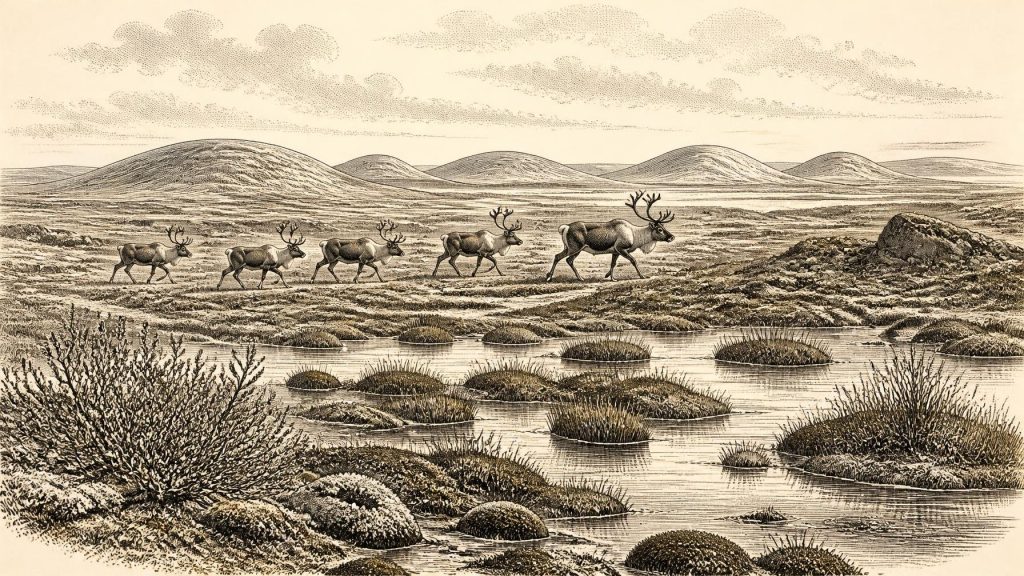
Around 31,683 BCE, Ireland cannot be described through a precise calendar year, but through unstable MIS 3 conditions. Derryvree, County Fermanagh, preserves freshwater sediments between glacial tills, indicating open tundra, wet hollows, mosses, sedges and sparse vegetation during an ice-free interval. Castlepook Cave, County Cork, contains a long-accumulated fauna including reindeer, mammoth, giant deer, bear and hyaena, reflecting cold open landscapes. A marked reindeer femur may indicate brief human activity, though its interpretation remains contested and proves neither settlement nor occupation. Changing ice margins, lowered seas and uncertain routes shaped Ireland as it approached renewed extensive glaciation during this period.
Dateline
Modern calendar-year precision is not available for Ireland in 31,683 BCE. The label is a retrospective convenience, roughly 33.6 thousand years before the conventional radiocarbon reference year of AD 1950, rather than a date that people could have recognised or recorded. No Irish deposit can be assigned responsibly to that particular twelve-month interval. The appropriate setting is the later part of the Pleistocene, broadly Marine Isotope Stage 3 (MIS 3), a climatically unstable stretch of the last Ice Age. For this time, Ireland’s history is recovered from sediments, fossil plants, animal bones, cave deposits and ice-sheet reconstructions—not from chronicles, settlements with known inhabitants or datable political events.
A Date Range, Not a Dateline
The closest environmental evidence comes from deposits whose ages overlap this notional year. At Derryvree near Maguiresbridge in County Fermanagh, roadworks in 1969 cut through a drumlin and revealed freshwater silts and fine sands trapped between two sheets of glacial till. The organic deposit produced a conventional radiocarbon determination of 30,500 years before present, with a substantial error range. When expressed in calibrated terms, the evidence is commonly placed broadly between about 36,900 and 31,700 calibrated years before present. That is a span of millennia, but it securely makes Derryvree one of the most important Irish windows onto the cold landscape relevant to 31,683 BCE.
Such caution matters. Radiocarbon ages are not calendar ages: atmospheric carbon-14 has varied through time, and calibration is especially difficult at this depth in the record. Deposits may also form intermittently, be reworked by water, or be sealed beneath later ice. A radiocarbon result dates the sampled organic matter, not every plant, animal or incident represented in a layer. The evidence can therefore illuminate conditions in parts of Ireland during a broad interval; it cannot supply a weather report, population total or event for one named year.
Cold Water Under Ice
Derryvree shows that at least part of Fermanagh contained a freshwater environment between glacial episodes. Its pollen, plant macrofossils and insect remains point to open tundra and periglacial conditions: ground affected by freezing and thawing, wet hollows, exposed mineral soil, shallow water and sparse vegetation rather than dense woodland. Mosses and herbaceous plants dominate the record. Finds include dwarf willow, sedges and bogbean, a plant of wet ground and shallow water. The resulting landscape was not necessarily an unbroken white wilderness. It was a seasonal mosaic in which wet basins and streams could sit among open, windswept ground.
The flora also establishes limits on interpretation. Occasional pollen grains from trees such as pine or hazel do not demonstrate a local forest. They may have travelled long distances or entered deposits in other ways. The defensible conclusion is that woodland, if present nearby at all, was not the dominant landscape recorded at Derryvree. Cold-adapted plants and mosses indicate a difficult environment in which growing seasons were short, shelter limited and ecological productivity highly seasonal.
Derryvree was not a representative sample of the entire island. Ireland’s topography, proximity to the Atlantic, elevation and changing ice margins would have produced regional variation. The sediments nevertheless disprove any simple picture in which the island was either wholly smothered by permanent ice or uniformly habitable grassland. They preserve an ice-free freshwater refuge at one point within an evolving glacial landscape, later entombed by ice and reshaped into a drumlin.
Castlepook’s Animal World
The complementary archive lies far to the south at Castlepook Cave near Doneraile in north County Cork. This limestone cave system has yielded more than 2,000 bones and is Ireland’s richest known archive of vertebrate life leading up to the Last Glacial Maximum. Its material accumulated over a long interval, not in one occupation layer. Improved radiocarbon pretreatment has shown that several older dates obtained from the cave and neighbouring southern Irish caves were too young, sometimes by thousands of radiocarbon years. The revised evidence places important animal remains within MIS 3 and stresses why old collections need continual re-examination.
Animals represented at Castlepook include reindeer, giant deer, woolly mammoth, brown bear and spotted hyaena; later cold-stage material includes lemmings, Arctic fox and wolf. No single list should be treated as a census for 31,683 BCE, because individual bones have different ages and may have entered the cave through different processes. Even so, the assemblage supports a broad reconstruction of open, cold country capable of sustaining large grazing mammals and their predators or scavengers. Reindeer and lemmings suit tundra-like habitats; mammoths and giant deer imply extensive feeding grounds, though their precise local ranges remain uncertain.
Spotted hyaenas are especially important for understanding the cave. Their presence indicates that Castlepook was not simply a human shelter awaiting discovery. Carnivores could drag carcass parts into chambers, gnaw and scatter bones, while water, roof collapse and later disturbance could move material again. A cave bone is therefore evidence first of an animal and a depositional history. It becomes evidence of people only where modification and dating can withstand close taphonomic scrutiny.
The Reindeer Femur
One Castlepook reindeer femur gives this period unusual archaeological significance. The bone has been reported as dating to about 33,000 years ago and bears a deep mark interpreted by zooarchaeologist Ruth Carden as a cut or chop made by a sharp stone edge while the bone was fresh. If that interpretation and the association of mark and carcass are sustained, it would provide evidence of human activity in Ireland during the wider period represented by this article—far earlier than the island’s formerly accepted terminal-Pleistocene evidence.
Its implications must be kept proportionate. A marked reindeer bone may record the processing of one carcass by one or more people. It does not demonstrate a village, permanent settlement, named cultural group, family lineage, language or continuous occupation. No securely associated hearth, dwelling, stone-tool assemblage, burial or midden of comparable age has been found at Castlepook. Nor is it certain that the animal was killed or butchered inside the cave; County Cork heritage interpretation reasonably notes that scavengers may have carried discarded remains into their lair.
The most cautious reading is thus one of possible, perhaps brief, human presence. Upper Palaeolithic hunter-gatherers elsewhere in north-west Europe were skilled makers and users of stone, bone and antler equipment, and could move widely through demanding environments. That wider context makes a visit to Ireland conceivable. It does not license the transfer of continental cave art, ornaments, houses, ritual practices or particular tool traditions to Ireland without Irish finds. At present, the femur is a provocative clue rather than a complete archaeological horizon.
Society Without Names
There is no evidence from Ireland around this date for political institutions, chiefs, territories, diplomacy, warfare or organised religious sites. There are no human remains, written symbols or structures from which to reconstruct kinship, authority or belief. It would be misleading to fill the silence with imagined Ice-Age clans. If people did reach the island, their small-scale social world was likely organised around close cooperation in travel, food acquisition, shelter and the use of animal materials, but that is an inference drawn from hunter-gatherer lifeways elsewhere, not a direct observation of Irish society.
The same distinction applies to everyday life. Reindeer could have supplied meat, marrow, hide, sinew and bone to any people who processed them, yet Castlepook supplies no securely associated tool kit or camp debris to show how this work was done in Ireland. Mammal movement, carcass scavenging and cave use were probably as significant to the site’s formation as human action. The strongest historical fact is not that Ireland possessed a settled Palaeolithic community, but that its landscapes and fauna offered opportunities that a mobile visitor might have exploited during favourable intervals.
Routes, Coasts and Isolation
Economy and trade are similarly beyond direct recovery. There is no local evidence for exchange networks, boats or regular crossings at this date. Yet Ireland was part of a wider north-west European environmental zone. Lower sea levels altered coastlines and exposed land now submerged around the island, while glaciers and sea ice repeatedly changed possible routes. The presence of a diverse mammal fauna shows that animals reached Ireland during parts of the Pleistocene, but it does not reveal one simple, permanent land bridge or a single route used by people.
For any human party, movement into Ireland would have been an undertaking shaped by weather, coastlines, animal corridors and ice conditions. A route may have involved exposed coastal plains, narrow sea passages, seasonal ice or some combination of these; the physical geography is still debated in detail. This uncertainty is central rather than inconvenient. The arrival of animals and, potentially, people depended on a changing regional landscape that later inundation and glacial erosion have largely removed.
Approaching the Great Freeze
At roughly 33.6 thousand years before AD 1950, Ireland was moving towards the fuller expansion of the last British–Irish Ice Sheet, but it had not yet become the uniformly ice-dominated landscape of the Last Glacial Maximum. Ice-sheet reconstructions indicate a dynamic, regionally asynchronous advance. Western Ireland records substantial ice-sheet influence before the maximum, while wider reconstructions place significant growth and changing margins around and after 31,000 years ago. The exact position of ice at any locality on the article’s nominal date cannot be fixed with confidence.
That uncertainty gives Derryvree its force. The freshwater silts beneath a later drumlin preserve a world that subsequent glaciation almost erased: mossy wet ground, sedges, shallow water and open tundra, existing within a landscape vulnerable to renewed ice advance. Castlepook preserves another fragment, a cave repository of large animals and carnivores from a long, changing cold stage. Together they offer the responsible history of Ireland around 31,683 BCE: not a year of rulers or battles, but an unstable ecological frontier, briefly capable of supporting a remarkable fauna and perhaps visited by people whose presence survives, if at all, in a single contested cut on reindeer bone.
Primary Sources
- A Middle Midlandian Freshwater Series at Derryvree, Maguiresbridge, County Fermanagh, Northern Ireland
- A Reconsideration of the Radiocarbon Dating of the Marine Isotope Stage 3 Fauna from Southern Ireland
- The Irish Quaternary Fauna Project
- Castlepook Cave
- Spotted Hyena Skull
- 2022:564 – Castlepook Cave, Castlepook South, Cork
- Palaeoecology
- Figure 6.— The Subdivision of the Quaternary Period in Ireland
- Radiocarbon Constraints on the History of the Western Irish Ice Sheet Prior to the Last Glacial Maximum
- Growth and Retreat of the Last British–Irish Ice Sheet, 31,000 to 15,000 Years Ago: the BRITICE-CHRONO Reconstruction
- Episodic Speleothem Deposition Tracks the Terrestrial Impact of Millennial-Scale Last Glacial Climate Variability in SW Ireland
- Spatio-Temporal Dynamics of Speleothem Growth and Glaciation in the British Isles
- The IntCal20 Northern Hemisphere Radiocarbon Age Calibration Curve (0–55 cal kBP)
- Origin of British and Irish Mammals: Disparate Post-Glacial Colonisation and Species Introductions
- Quaternary Deposits and Glacial Stratigraphy in Ireland
- Irish Pleistocene Biostratigraphy
- Landscapes and Environments of the Last Glacial-Interglacial Transition: a Time of Amazingly Rapid Change in Ireland
- First Evidence of a Late Upper Palaeolithic Human Presence in Ireland
- New Insights on the Fauna of Ireland's Younger Dryas and Early Holocene from Alice & Gwendoline Cave
- Heritage Artefacts of County Cork