
Sedges and Reindeer31625 BCE
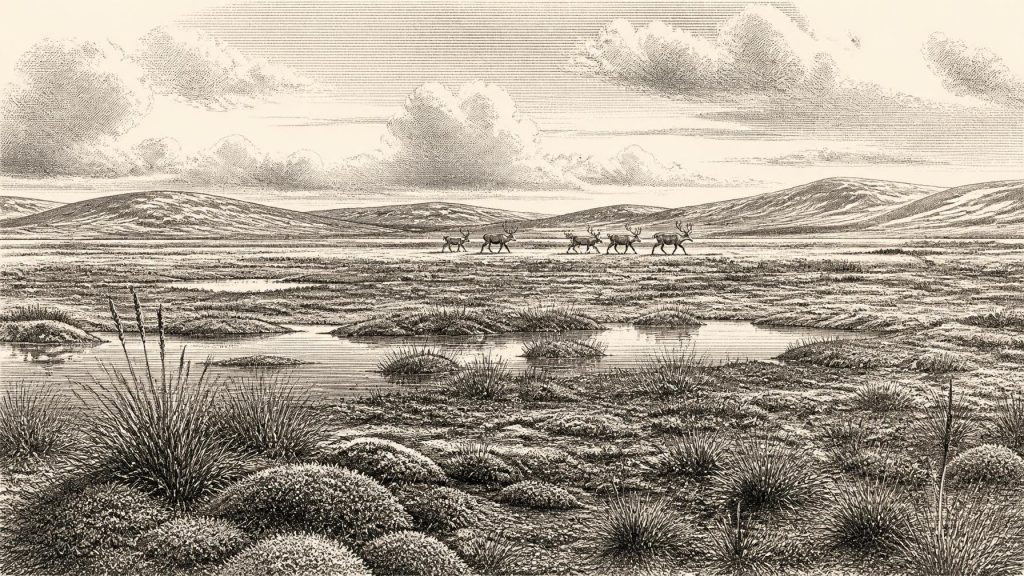
31,625 BCE is a modern label for an uncertain interval within Marine Isotope Stage 3, not a recoverable Irish year. Derryvree, County Fermanagh, preserves freshwater sediments between glacial tills, dated broadly to 36,900–31,700 cal BP, indicating cold, open periglacial wetlands with sedges and mosses. Castlepook Cave, County Cork, contains fauna including reindeer, mammoth, hyaena and Arctic fox, demonstrating intermittent links with wider European ecosystems. A marked reindeer femur may indicate human butchery around 33,000 years ago, but cannot prove settlement. Evidence supports changing climates, temporary animal access and possible brief human visits, while society, culture and permanent occupation remain unknown.
Dateline
31,625 BCE is not a date that can be recovered as a particular Irish year. Nobody on the island used a calendar, wrote an account, named a ruler or recorded a season in terms recognisable today. The number is a modern chronological label: approximately 33,574 years before AD 1950, the conventional “present” used in archaeological dating. At such depth, even radiocarbon results must be calibrated and expressed as probability ranges. The responsible subject is therefore Ireland during a broad Late Pleistocene interval, rather than an invented event on a precise day or year.
In geological terms, this falls within Marine Isotope Stage 3 (MIS 3), a long, unstable stretch of the last Ice Age. It was before the maximum expansion of the last British–Irish Ice Sheet, which occurred much later, broadly around 27,000–25,000 years ago in the wider Irish sector. Ireland was neither permanently one uniform ice sheet nor a stable, hospitable island. Ice margins, rivers, plant cover and animal ranges changed repeatedly over millennia. The evidence closest to this notional date comes principally from a buried freshwater deposit at Derryvree, near Maguiresbridge in County Fermanagh, and from faunal remains in Castlepook Cave near Doneraile, County Cork.
A Window Between the Tills
Derryvree is unusually important because roadworks in 1969 cut through a drumlin and exposed organic silts and fine sands lying between two thick layers of till. Till is the unsorted sediment deposited directly by moving ice. The lower till represents an earlier glacial advance; the upper till a later one. Between them lay the remains of an interval in which ice had withdrawn from, or at least no longer covered, this part of Fermanagh and freshwater conditions developed.
The Derryvree organic series produced a conventional radiocarbon determination of 30,500 BP, with a substantial laboratory uncertainty of +1,170/−1,030 years. Modern calibration does not convert that figure into one neat calendar year. Published treatments place its broad calibrated span at roughly 36,900–31,700 cal BP. The modern label 31,625 BCE lies within that broad window, but this must not be mistaken for proof that every plant, insect or waterbody represented in the deposit existed in precisely that year. Derryvree provides a time-depth archive, not a dated snapshot.
Its plant and insect evidence is nonetheless revealing. Freshwater mosses and sedges, together with other cold-adapted indicators, point to open tundra or muskeg-like ground under a periglacial regime. “Periglacial” does not mean covered by glacier: it refers to a severe cold environment shaped by frost, seasonal thaw, sparse vegetation and unstable ground near an ice-dominated world. There may have been shallow pools, sedge marshes, small channels and wetter hollows. Shelter, slope, drainage and season would have created local variation, but there is no evidence for the dense oak, hazel and elm woodland of later prehistoric Ireland.
The landscape around Maguiresbridge was thus not simply a blank field of snow. In the growing season, low vegetation could exploit wet soils and long daylight; in winter, freezing temperatures, wind exposure and limited forage would have imposed formidable constraints. The later ice advance that laid down the upper till sealed this fragile record. That burial is precisely why Derryvree survives and why comparable environmental sequences are so rare. Ice also eroded or redistributed much of the evidence that might otherwise have shown how widely such habitats extended across Ireland.
Cold Change, Not Climatic Stillness
MIS 3 was marked across the North Atlantic by abrupt climatic oscillations, often identified in Greenland ice cores as Dansgaard–Oeschger events. These provide a broad regional framework, not a weather diary for Fermanagh. They show that northern climates could shift markedly on timescales far shorter than an ice age as a whole. In Ireland, such change could alter the balance between ice, meltwater, exposed ground and wetland vegetation, as well as the routes by which animals entered or left the landmass.
It is not possible to draw an exact coastline for 31,625 BCE. Sea level was lower than today because water was retained in continental ice sheets, but the Irish Sea basin had a complex topography and shifting marine conditions. Ireland’s relationship with Britain was not equivalent to the much later, simple image of a dry “land bridge” open to all travellers. Animals and perhaps people may have crossed during favourable phases by routes that are now submerged, interrupted, or poorly understood. The evidence supports connectivity at times; it does not prove a permanent, broad land corridor at this particular point.
This uncertainty matters for regional change. Derryvree demonstrates an ice-free environmental interval in the north-western interior, whereas the cave record from north Cork shows that animals had reached southern Ireland during the middle part of the last glacial cycle. Neither archive can be expanded uncritically into a single all-island reconstruction. Ireland’s topography, proximity to Atlantic weather systems and the behaviour of ice masses ensured that conditions differed between upland and lowland, coast and interior, and from one millennium to another.
Castlepook’s Animal Archive
Castlepook Cave, also called Mammoth Cave, lies near Doneraile in north County Cork. Antiquarian excavations and later research recovered a remarkable Pleistocene assemblage from its limestone passages. Reassessment and improved radiocarbon methods have shown that the cave preserves animals from several different phases, rather than one single occupation episode. Direct dates reviewed for its MIS 3 fauna place some remains around 34,000–35,000 years ago, close in broad terms to the date represented here, while the assemblage as a whole extends over a much longer span.
The fauna includes reindeer, brown bear, wolf, Arctic fox, mountain hare, lemmings, woolly mammoth, giant deer and spotted hyaena. Not every species need have lived together at the same moment, and a cave collection cannot by itself supply a census of Ireland. Yet the range is powerful evidence that cold-stage animal communities reached the island during suitable intervals. Reindeer in particular fit the open, cold landscapes suggested by Derryvree. Mammoth, hyaena and other large mammals indicate connections with wider north-west European faunal worlds, however intermittent those connections may have been.
A cave is not necessarily where these animals lived or died. It can act as a predator den, scavenger refuge, natural trap, drainage channel and sediment store. Hyaenas may have carried bones into passages; water and excavation may have moved them again. This is why animal bones must be read with attention to their individual contexts and dates. Castlepook tells us that Ice Age fauna was present in Ireland, but it cannot reliably tell us the size of herds, the exact rhythm of migrations, or whether its caves overlooked a permanently occupied plain.
The Reindeer Femur Question
The most consequential human clue is a reindeer femur from Castlepook. County Cork heritage material and researchers associated with renewed study of the site have identified a deep mark on the bone as consistent with cutting or chopping by a sharp stone implement while the bone was fresh. The animal has been publicly reported as dating to about 33,000 years ago. If the interpretation of the mark is sustained, it would be potentially very early evidence that one or more Upper Palaeolithic people handled and processed a reindeer in Ireland, within the broad environmental world discussed here.
Its importance requires equal caution. The femur came from an old cave collection, not from a modern excavation of an intact occupation floor. A radiocarbon measurement dates the animal’s death within a statistical range; it does not independently date the mark, establish where the animal was killed, or reveal how long any people stayed. Nor has a securely associated stone-tool assemblage, hearth, shelter floor, burial, human bone, ornament or artwork of comparable antiquity been published from Ireland.
The best evidence-based conclusion is modest but significant. A human butchery episode is possible, perhaps involving mobile hunters exploiting a reindeer carcass, but permanent settlement is not demonstrated. The animal could have been hunted, scavenged after a natural death, or taken from a predator kill; the surviving femur cannot decide among these possibilities. Nor can it establish a named culture, a migration route, family ties or descent from later inhabitants. It is a potentially transformative trace, not the foundation for a complete story of “Ireland’s first people”.
Society Beyond Recovery
There is no evidence from around this horizon for political institutions, chiefs, territories, diplomacy, formal warfare or organised states in Ireland. The same restraint applies to religion, language, art, teaching and ritual. Absence of such evidence does not mean that any visitors lacked social relationships, beliefs, knowledge or stories. It means that archaeology cannot responsibly describe them. A single altered bone and a handful of environmental archives cannot recover ceremonies, kinship rules or spoken traditions.
Economy is knowable only at its narrowest. If the Castlepook incision is human-made, it suggests animal processing: reindeer could have supplied meat, marrow, hides, sinew and bone. That is not evidence for farming, herding, exchange networks, markets or regular trade. There were no crops, domestic livestock, villages or monuments known from Ireland at this date. “Settlement” must likewise remain an open question. The evidence permits a brief visit or visits; it does not demonstrate a resident population, still less continuity through the later glacial maximum.
What can be said with confidence is that Ireland formed part of a changing Ice Age world, periodically accessible to cold-adapted fauna and perhaps, on at least one occasion, to people. Derryvree’s sedges and mosses record an exposed freshwater landscape between glacial advances. Castlepook’s reindeer and other bones record animal lives and deaths within a wider European ecological network. Together they replace a fictitious annual chronicle with something more valuable: a carefully bounded view of a land in transition, where survival depended on climate, movement and opportunity, and where the human record remains no more than a question cut into bone.
Primary Sources
- A Middle Midlandian Freshwater Series at Derryvree, Maguiresbridge, County Fermanagh, Northern Ireland
- Early Midlandian–Middle Midlandian, Pleistocene, Northern Ireland
- Irish Pleistocene Biostratigraphy
- A Reconsideration of the Radiocarbon Dating of the Marine Isotope Stage 3 Fauna from Southern Ireland
- The Irish Quaternary Fauna Project
- Heritage Artefacts of County Cork
- Archaeology Research Excavation Grant 2022: Final Report
- Ireland's Palaeolithic Archaeology – Fleeting Footprints in a Frozen Land
- First Evidence of a Late Upper Palaeolithic Human Presence in Ireland
- New Insights on the Fauna of Ireland’s Younger Dryas and Early Holocene from Alice & Gwendoline Cave
- Growth and Retreat of the Last British–Irish Ice Sheet, 31,000 to 15,000 Years Ago: the BRITICE-CHRONO Reconstruction
- Maximum Extent and Dynamic Behaviour of the Last British–Irish Ice Sheet West of Ireland
- Radiocarbon Constraints on the Age of the Maximum Advance of the British-Irish Ice Sheet in the Celtic Sea
- Timing and Pace of Ice-Sheet Withdrawal Across the Marine–Terrestrial Transition West of Ireland During the Last Glaciation
- New Age Constraints for the Maximum Extent of the Last British-Irish Ice Sheet (NW Sector)
- Trimlines, Blockfields and the Vertical Extent of the Last Ice Sheet in Southern Ireland
- The IntCal20 Northern Hemisphere Radiocarbon Age Calibration Curve (0–55 cal kBP)
- IntCal Publications
- Dansgaard–Oeschger Events in Climate Models: Review and Baseline Marine Isotope Stage 3 Protocol
- Mechanisms of Abrupt Climate Change of the Last Glacial Period
- Marine Isotope Stage 3 Sea Level Fluctuations: Data Synthesis and New Outlook
- Quaternary – Geological Survey Ireland
- Ireland Through Geological Time