
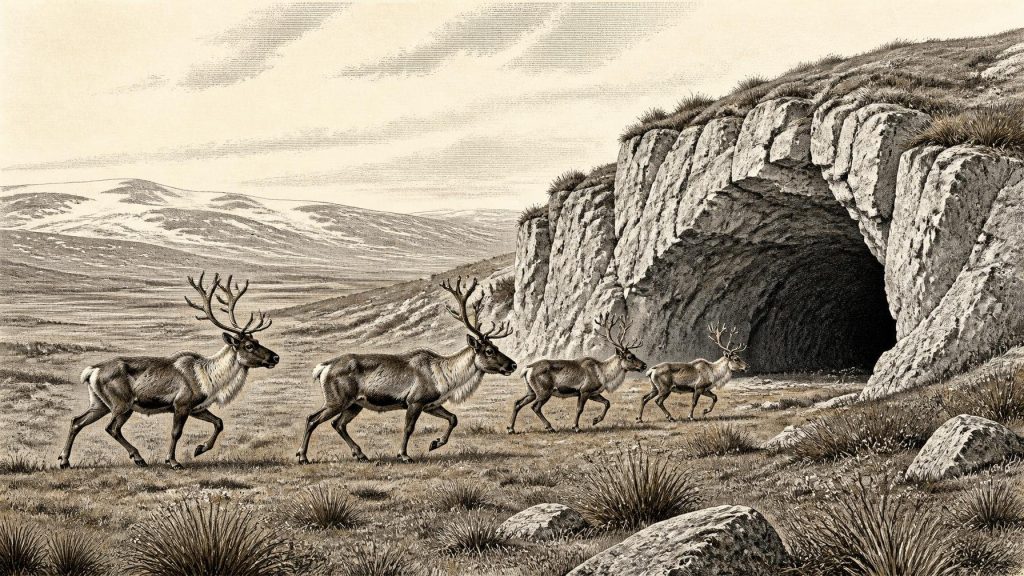
Reindeer at Castlepook31595 BCE
About 31,595 BCE is an imprecise modern label for late Marine Isotope Stage 3, roughly 33,500 calibrated years before present. Ireland experienced unstable cold conditions before the British–Irish Ice Sheet’s maximum expansion. Freshwater deposits at Derryvree indicate locally ice-free wetlands, while Crag Cave speleothems record milder phases. Castlepook Cave in County Cork preserved reindeer, mammoth, giant deer, predators and tundra fauna, though cave contexts and earlier dates require caution. A marked reindeer femur may indicate human butchery, but cannot establish settlement or occupation. Lower sea levels may have aided dispersal, yet routes remain uncertain. Evidence depicts environmental change, not history.
Dateline
31,595 BCE cannot be treated as a date in the modern historical sense. No community in Ireland recorded a year, season or named event at this depth of time, and archaeology cannot identify an occurrence on that particular point in a retrospective calendar. The label is best understood as an approximate modern conversion, placing the subject somewhere around 33.5 thousand calibrated years before present (cal BP; “present” conventionally means 1950). At this age, radiocarbon calibration is necessarily expressed as ranges, and those ranges may be revised as methods improve. What can responsibly be described is Ireland during the later part of Marine Isotope Stage 3: a cold, unstable phase of the last glacial cycle, before the full Last Glacial Maximum.
The evidence is sparse but unusually important. It consists chiefly of animal bones from caves, freshwater sediments sealed beneath later glacial deposits, cave calcite, offshore landforms and laboratory dating. These records do not yield a narrative of rulers, wars or settlements. They do, however, show that Ireland was not an empty abstraction before the great ice advance. Parts of the island, or its wider land-and-sea setting, could at intervals support tundra and open-country animals; conditions then changed on scales of centuries or millennia rather than according to a stable, predictable climate.
A Date With Wide Margins
Modern calendar notation can create a false impression of precision. A conventional radiocarbon determination is not itself a calendar year: atmospheric carbon-14 has varied through time, so measurements must be calibrated against independently dated archives. For the period beyond the securely tree-ring dated part of the sequence, the IntCal20 curve integrates evidence from floating tree rings, lake and marine sediments, speleothems and corals. Thus a useful archaeological statement is not that something happened in “31,595 BCE”, but that a deposit or animal belongs within a calibrated interval encompassing roughly this time.
The closest substantial Irish terrestrial comparison is at Derryvree, near Maguiresbridge in County Fermanagh. Roadworks exposed freshwater silts and fine sands lying between two separate tills: sediment deposited during an ice-free or less severely glaciated interval and later overridden by ice. Organic material from those deposits produced calibrated ages broadly between 36.9 and 31.7 thousand years ago. This is not a diary of a single year, nor proof that every region of Ireland shared exactly the same conditions. It is, nevertheless, direct evidence that freshwater and wetland environments existed in at least one northern Irish locality during part of the relevant late-MIS-3 timespan.
Before the Maximum Ice
This was a world moving towards major glaciation, not yet the familiar maximum of the last Ice Age. The British–Irish Ice Sheet grew rapidly after about 31,000 years ago and later covered most of Ireland and extensive adjacent shelves. Reconstructions based on hundreds of new dates, seafloor cores and landform records have transformed the older idea of a modest Irish ice cover. They demonstrate a large, dynamic ice-sheet system with marine margins and fast-flowing ice streams. Yet its build-up was neither uniform nor simultaneous across the island. At the time represented by this article, exact local ice limits remain less certain than they are for the later maximum and retreat.
That uncertainty matters. It would be misleading to picture all of Ireland as either a single continuous white desert or a wholly open plain in 31,595 BCE. The surviving record indicates shifting combinations of glacier ice, periglacial ground, exposed sediment, wetlands, rivers, caves and open vegetation. In south-west Ireland, dates from broken and reworked speleothems in Crag Cave show that calcite formation occurred episodically through the last glacial period. Because shallow cave speleothems require liquid water and conditions broadly above freezing on an annual basis, their growth phases are evidence for milder intervals, not for permanent warmth.
Irish evidence fits a wider North Atlantic pattern of abrupt Greenland stadials and interstadials. Ice-core chronologies identify repeated cold and relatively warmer phases, using oxygen-isotope and dust signals. Crag Cave’s episodes of calcite deposition broadly coincide, within dating uncertainties, with Greenland interstadials. This does not mean that Ireland copied Greenland’s weather day by day. It does mean that the island, facing the Atlantic, responded to large North Atlantic climatic shifts. The practical consequence for plants, animals and any occasional people was instability: habitats could expand, contract or be cut off as cold intensified and ice margins changed.
Castlepook’s Animal Archive
The most evocative Irish evidence lies far to the south, at Castlepook Cave near Doneraile in north County Cork. Cave collections there preserve a Late Pleistocene fauna including reindeer, woolly mammoth, giant deer, brown bear, wolf, Arctic fox, mountain hare, lemmings and spotted hyaena. Such a list points towards open, cold-country habitats rather than woodland. Reindeer and lemmings are especially strong indicators of a northern, tundra-like setting; hyaena and mammoth underline that this was part of a broader north-west European faunal world, not the later island ecology familiar from the Holocene.
But cave deposits require caution. Bones can be carried in by carnivores, water, scavengers or people; older excavations did not always record layers to modern standards; and cave material may have been disturbed. Re-dating has shown that several previous radiocarbon ages from Castlepook and other southern Irish caves were too young, in some cases by many thousands of radiocarbon years. Carden, Higham and Woodman’s reassessment places important elements of the Castlepook fauna securely within MIS 3 and suggests that giant deer and spotted hyaena may have disappeared locally before about 40,000 cal BP. The lesson is not that every bone shares one date, but that each specimen and its context must be tested separately.
A reindeer femur from Castlepook has particular significance because a mark upon it has been interpreted as damage made by a sharp stone tool during carcass processing. Its approximate age has been publicly associated with the period around this article’s notional date. If both the interpretation of the mark and its association with the animal’s death are upheld, it would be evidence for a brief Upper Palaeolithic human act in Ireland: the handling or butchery of a reindeer. It is not, however, a securely excavated camp with a hearth, house floor, tool assemblage, burial or repeated occupation surface. The responsible conclusion is that Castlepook presents a remarkable possibility, rather than a settled account of a resident population.
No Kingdoms, No Known Settlements
There is no evidence for political institutions, named peoples, diplomacy, organised warfare, agriculture, permanent villages, trade routes or religious monuments in Ireland at this time. There are no texts and no identifiable Irish art. Nor can archaeology currently demonstrate a continuous human population. The much later, securely dated evidence for human presence from Alice and Gwendoline Cave in County Clare is a butchered brown-bear bone dated to about 12,810–12,590 cal BP; even that evidence has prompted careful debate. The gap between such late-glacial traces and the Castlepook possibility should not be filled with imagined clans or Ice-Age kingdoms.
If people did reach Ireland around 33.5 thousand years ago, the evidence supports only a small-scale and perhaps short-lived visit. In Upper Palaeolithic Europe, mobile foragers commonly organised life around changing animal distributions, seasonal resources and knowledge of terrain. That comparison can help explain why a reindeer might matter: its carcass could provide food, hide, sinew, marrow and bone. Yet none of those uses is demonstrable from Castlepook beyond the disputed implication of the incision. We cannot responsibly infer the visitors’ language, kinship, beliefs, route of arrival, gender, group size or length of stay.
Economy, in the later historical sense, is equally invisible. There is no evidence for cultivation, livestock, metalworking, exchange institutions or long-distance trade into Ireland. The relevant “economy” was ecological: the movement of animals and the availability of water, shelter and workable stone. Caves may have offered protected spaces, but the cave record primarily documents where bones survived, not necessarily where animals died or humans lived. A hyaena den, carnivore scavenging place or natural trap can mimic aspects of a human food deposit unless marks, breakage and stratigraphy are examined closely.
Connections Across a Changing Sea
Ireland’s relation to Britain and continental Europe was also unlike that of the present. Lower global sea levels exposed extensive shelves, while ice, crustal depression and local relative sea level made the geography complex. Modelling indicates that Ireland and Britain were connected or closely linked in parts of the glacial period, although the nature, timing and usability of any route varied. Later work places Ireland’s final separation from Britain around 16,000 cal BP. For the much earlier period considered here, lower seas and changing ice would have made animal dispersal and possible human access more plausible than they became after post-glacial inundation—but “plausible” is not proof of a walkable, continuously safe land bridge at a specified place or season.
Regional change therefore provides the real story of this notional year. Fermanagh’s buried freshwater sediments preserve an interval in which plants and standing water existed between glacial advances. Cork’s cave fauna records cold-adapted and large grazing animals, predators and scavengers in a landscape later transformed or stripped by ice. Offshore ridges, moraines and sediment cores reveal the approaching growth of an ice sheet that would eventually extend to the Atlantic shelf edge west of Ireland. Much of the physical evidence has survived precisely because it was buried, reworked or sealed; much else was probably destroyed by the glacier that followed.
For Ireland around 31,595 BCE, then, the most historically meaningful subject is not a purported event but a threshold. It was an age of open cold-country environments and abrupt climatic oscillation, with animals crossing or occupying a changing north-west European frontier. Castlepook’s reindeer femur holds out the possibility that people briefly entered that world. The evidence does not yet allow more than that—and its restraint is precisely what makes this deep past intelligible rather than mythical.
Primary Sources
- A Reconsideration of the Radiocarbon Dating of the Marine Isotope Stage 3 Fauna from Southern Ireland
- The Irish Quaternary Fauna Project
- First Evidence of a Late Upper Palaeolithic Human Presence in Ireland
- The Archaeology of Caves in Ireland
- A Middle Midlandian Freshwater Series at Derryvree, Maguiresbridge, County Fermanagh, Northern Ireland
- Episodic Speleothem Deposition Tracks the Terrestrial Impact of Millennial-Scale Last Glacial Climate Variability in SW Ireland
- The IntCal20 Northern Hemisphere Radiocarbon Age Calibration Curve (0–55 cal kBP)
- A Stratigraphic Framework for Abrupt Climatic Changes During the Last Glacial Period Based on Three Synchronized Greenland Ice-Core Records: Refining and Extending the INTIMATE Event Stratigraphy
- Growth and Retreat of the Last British–Irish Ice Sheet, 31,000 to 15,000 Years Ago: The BRITICE-CHRONO Reconstruction
- The Timing and Magnitude of the British–Irish Ice Sheet Between Marine Isotope Stages 5d and 2: Implications for Glacio-Isostatic Adjustment, High Relative Sea Levels and ‘Giant Erratic’ Emplacement
- Reconstructing the Last Irish Ice Sheet 1: Changing Flow Geometries and Ice Flow Dynamics Deciphered from the Glacial Landform Record
- Reconstructing the Last Irish Ice Sheet 2: A Geomorphologically-Driven Model of Ice Sheet Growth, Retreat and Dynamics
- Subglacial Bedforms of the Irish Ice Sheet
- Last Glacial Maximum Cirque Glaciation in Ireland and Implications for Reconstructions of the Irish Ice Sheet
- Maximum Extent and Dynamic Behaviour of the Last British–Irish Ice Sheet West of Ireland
- Extent and Retreat History of the Barra Fan Ice Stream Offshore Western Scotland and Northern Ireland During the Last Glaciation
- Exploring Controls of the Early and Stepped Deglaciation on the Western Margin of the British Irish Ice Sheet
- Timing and Pace of Ice-Sheet Withdrawal Across the Marine–Terrestrial Transition West of Ireland During the Last Glaciation
- The Deglaciation of the Western Sector of the Irish Ice Sheet from the Inner Continental Shelf to Its Terrestrial Margin
- Ireland: Submerged Prehistoric Sites and Landscapes
- The Problem of a Late Quaternary Landbridge Between Britain and Ireland
- Relative Sea-Level Change Around the Irish Coast
- New Insights on the Fauna of Ireland’s Younger Dryas and Early Holocene from Alice & Gwendoline Cave