
Fermanagh’s Sealed Tundra31578 BCE
Around 31,578 BCE, Ireland lay within the climatically unstable Late Pleistocene, not a datable historical year. At Derryvree, County Fermanagh, freshwater silts between glacial tills, broadly dated to 36,900–31,700 calibrated years BP, preserve tundra-like wetlands, sparse vegetation and insect life during an ice-free interval. Other deposits confirm repeated advances and retreats of ice. Castlepook Cave records mammoth, giant deer, reindeer and carnivores, but its bones reflect complex accumulation processes. A cut-marked reindeer femur may indicate human butchery, yet cannot prove settlement or population. Evidence supports a harsh, ecologically active, repeatedly transformed island, while human presence remains unconfirmed. Routes remain uncertain.
Dateline
The label 31,578 BCE is a modern way of indexing a time far beyond written history, named peoples or usable annual chronology. It corresponds roughly to 33,500 calendar years before AD 1950, within the Late Pleistocene and Marine Isotope Stage 3 (MIS 3), a climatically unstable part of the last Ice Age. No archaeological or environmental record can identify what occurred in one particular Irish calendar year at this depth of time. The responsible subject is therefore Ireland around this notional date: a changing, cold landscape known through sediments, pollen, plant remains, insects, animal bones, cave deposits and glacial landforms.
The evidence is sparse, local and uneven. It does not support a narrative of tribes, rulers or settled communities. Yet it does show that parts of Ireland could sustain freshwater habitats, tundra vegetation and sizeable mammals during intervals before the Last Glacial Maximum. It also raises, without finally settling, an important question: whether people may have reached the island much earlier than the long-accepted post-glacial settlement record.
A Date Range, Not a Year
Radiocarbon dating measures residual carbon-14 in once-living material, rather than directly reading a calendar. Results are reported in radiocarbon years before present, where “present” conventionally means AD 1950, and must be calibrated against independently dated records. At roughly 30,000–40,000 years ago, the calibration curve produces broad probability ranges, not precise historical dates. A date on an animal bone records the animal’s death; it does not by itself date every action, deposit or landscape associated with that bone.
The most relevant securely dated Irish environmental sequence is at Derryvree, near Maguiresbridge in County Fermanagh. Road works exposed freshwater silts and fine sands enclosed between two tills: unsorted sediments deposited by glacier ice. Organic material from the intervening beds yielded a conventional radiocarbon determination of about 30,500 ± 1,100 radiocarbon years BP. Modern calibration places this broadly between about 36,900 and 31,700 calibrated years BP, or approximately 34,950–29,750 BCE. The numbered year falls within that wide interval, but cannot be assigned to a particular layer, season or event within it.
This distinction matters. Derryvree is compelling evidence for an ice-free interval at one Fermanagh locality, and for the sequence of glaciation, freshwater deposition and later renewed ice advance. It is not a weather report for the whole island, nor proof that every Irish region was simultaneously open ground. Ice-sheet margins, meltwater, vegetation and permafrost conditions varied greatly with altitude, latitude, coast and local topography.
Water Beneath the Drumlin
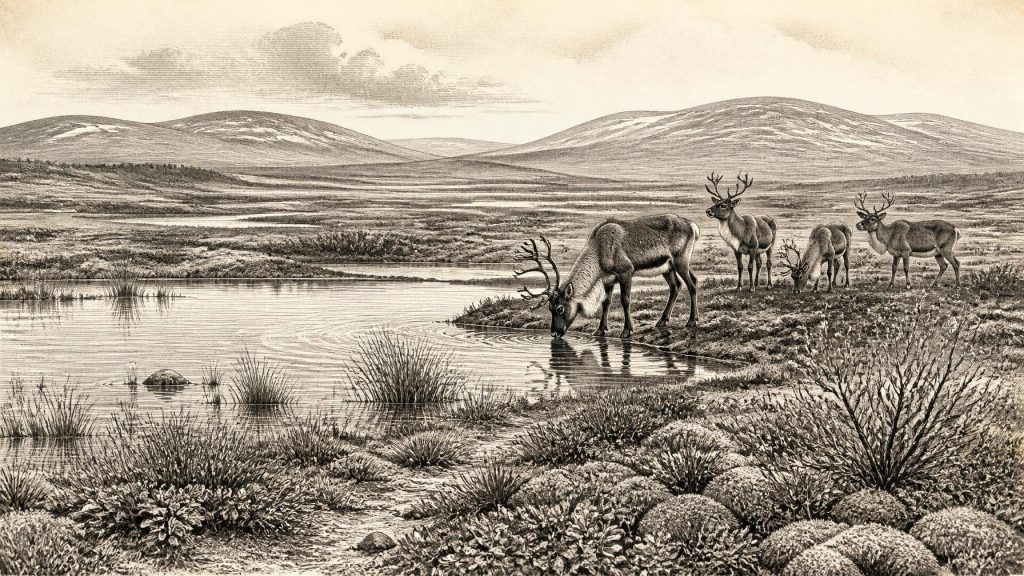
The Derryvree deposits preserve a rare ecological window because the later glacier sealed the older landscape beneath till. Pollen, plant macrofossils, mosses and insect remains point towards open, almost treeless ground, with wet mossy or sedgy areas and shallow freshwater. The word “muskeg” has often been used for this type of waterlogged, peaty, tundra-like terrain. Low plants were more important than trees: grasses, sedges, herbs and mosses could grow where the short growing season, frost disturbance and exposure prevented woodland from taking hold.
This was not a featureless snow desert. A patchwork of pools, saturated margins, exposed mineral soils and sparse vegetation could sustain insects and provide seasonal grazing. But neither should it be romanticised as a benign meadow. The evidence indicates cold conditions, pronounced seasonality and a landscape vulnerable to freezing, thawing and flooding. Winter would have imposed severe constraints on food, shelter and movement for any animal attempting to live there.
The broader Irish record contains other late-Pleistocene organic deposits, including sequences at Greenagho, Hollymount and Aghnadarragh. Together, they demonstrate that the island’s Ice Age history was not a simple, uninterrupted blanket of ice. There were episodes in which ice retreated or remained restricted, allowing freshwater sediments and living communities to form; these were followed by renewed cold and glaciation. Correlating every Irish deposit precisely with North Atlantic climate oscillations remains difficult, however, and proposed correlations should be treated as interpretation rather than direct observation.
Castlepook’s Animal Archive
In southern Ireland, Castlepook Cave near Doneraile in north County Cork is the principal faunal archive for the broad period surrounding this date. Excavated largely in the early twentieth century, it yielded remains attributed to an Ice Age assemblage including woolly mammoth, giant deer, reindeer, brown bear, spotted hyaena, wolf, foxes, hares and lemmings. Later programmes of radiocarbon dating and re-examination have shown that some older dates from Irish cave collections were misleadingly young, partly because pretreatment methods have improved. Castlepook nevertheless remains a complex archive assembled through animal activity, water movement, excavation and subsequent museum collecting.
The animals are evidence that Ireland was intermittently part of a wider north-west European ecological world. Reindeer imply open cold-country habitats; lemmings and mountain hare reinforce that impression. Hyaenas, meanwhile, are especially important for understanding caves. A cave containing bones need not be a human living site: carnivores may drag in prey, chew bones, leave droppings and use sheltered chambers repeatedly. Bones may also be redeposited after death. Castlepook therefore reveals an ecosystem and a set of possible animal routes, but rarely a simple scene of animals all living together on the same day.
For the economy of non-human life, large herbivores turned sparse vegetation into meat, marrow, hide, bone and prey for carnivores. That is a reasonable ecological inference. It is not evidence that Ireland possessed a human hunting economy, regular meat exchange or permanent camps. No settlement floor, hearth, tool-making area, structure or buried human remains of this age has been securely demonstrated on the island.
The Reindeer Femur Question
One Castlepook object has made this period unusually significant for Irish prehistory: a reindeer femur fragment reported as approximately 33,000 radiocarbon years old and bearing a deep linear modification. Zooarchaeologist Ruth Carden has interpreted the mark as damage caused while fresh tissue was being removed with a sharp stone tool. If that diagnosis is confirmed, it would be evidence that a person or very small group processed a reindeer in Ireland during MIS 3, vastly earlier than the previously secure evidence for human activity.
That possibility deserves attention, but it must be described accurately. The bone derives from an old cave collection, not a modern excavation of an intact occupation surface. It was not recovered beside a securely associated stone-tool assemblage, hearth, dwelling, butchered refuse deposit or human burial. The radiocarbon determination dates the reindeer’s death, while identification of the incision as a tool mark is a separate specialist assessment. A single modified bone cannot establish population size, duration of residence, language, kinship or a permanent settlement.
The National Museum of Ireland continues to state that no clear evidence has yet emerged demonstrating human presence in Ireland during the Palaeolithic. That cautious institutional position reflects the difference between a potentially transformative clue and an unequivocal archaeological case. The Castlepook femur should therefore be understood as serious, intriguing evidence for possible human butchery, not as licence to populate Ireland at this date with named hunter-gatherer societies.
Ice, Coasts and Movement
At this point in MIS 3, global sea level was lower than today, exposing additional coastal plain around Ireland and Britain. But lower seas did not necessarily create an easy continuous land route to Ireland. The Irish Sea basin, tidal channels, ice margins and changing shorelines made the geography of movement complex. Any human arrival suggested by Castlepook may have involved routes now submerged, but the exact route remains unknown. The same caution applies to animals: fossil occurrence proves that a species reached Ireland at some time, not the particular pathway or frequency of crossings.
The major growth and maximum extent of the last British–Irish Ice Sheet came later. Large-scale reconstructions concentrate on expansion after about 31,000 years BP and its eventual retreat after the Last Glacial Maximum. Around 33,500 years BP, Ireland was thus not yet at the later peak of ice cover, although local glaciers and earlier ice masses had already shaped parts of the landscape and would return. Derryvree’s sequence makes the rhythm tangible: glacial deposition, an interval of cold freshwater life, then burial beneath renewed ice.
No Polities, No Proven Rituals
Political affairs, diplomacy and warfare cannot responsibly be reconstructed for Ireland around 31,578 BCE. There are no documents, monuments, territories, weapons assemblages or settlements from which to infer leaders, alliances or conflict. Nor is there direct Irish evidence for religion, ritual practice, visual art, music, teaching or formal systems of learning at this date. The possible presence of people would establish only a human action on an animal carcass, not beliefs or institutions.
Culture in the narrow archaeological sense is equally elusive. Stone tools could have been used if the Castlepook mark is anthropogenic, but no associated implement survives. It would be unsafe to assign an Irish group to a specific Upper Palaeolithic archaeological culture known elsewhere in Europe. The closest defensible conclusion is modest: Ireland lay within an ecologically connected Ice Age region, and its caves and buried wetlands preserve fragmentary evidence of life during a period when climate was repeatedly remaking the possibilities for animals and perhaps for people.
What Can Be Said
Around this modernly numbered year, the best evidence places at least some Irish localities in a severe but biologically active Late Pleistocene world. At Derryvree, cold freshwater and tundra-like vegetation accumulated between episodes of glaciation. At Castlepook, an exceptional cave archive records large mammals and carnivores adapted to open-country conditions during the wider MIS 3 interval. A marked reindeer femur may point to a fleeting human encounter with that world, but does not yet demonstrate an Irish population.
That restraint is not a failure of history. It is the history available at this depth of time: an island of ice margins, wetlands, caves and migrating fauna, reconstructed from physical traces rather than stories. Future controlled excavation, direct dating, microscopic study of bone surfaces and analysis of ancient biomolecules may clarify the picture. For now, the central fact is change itself. Ireland was not fixed at the edge of the Ice Age; it was repeatedly opened, cooled, inhabited by animals, and transformed again by advancing ice.
Primary Sources
- A Reconsideration of the Radiocarbon Dating of the Marine Isotope Stage 3 Fauna from Southern Ireland
- The Irish Quaternary Fauna Project
- Red Deer in Ireland: From the Last Glacial Maximum to the Present
- Castlepook Cave, County Geological Site Report
- Growth and Retreat of the Last British–Irish Ice Sheet, 31,000 to 15,000 Years Ago: The BRITICE-CHRONO Reconstruction
- The Timing and Magnitude of the British–Irish Ice Sheet Between Marine Isotope Stages 5d and 2
- Trimlines, Blockfields and the Vertical Extent of the Last Ice Sheet in Southern Ireland
- Dimensions and Chronology of the Last Ice Sheet in Western Ireland
- British–Irish Ice Sheet and Polar Front History of the Goban Spur, Offshore Southwest Ireland Over the Last 250,000 Years
- Exploring the Conceptual Challenges of Reconstructing the Last British–Irish Ice Sheet
- Episodic Speleothem Deposition Tracks the Terrestrial Impact of Millennial-Scale Climate Change During the Last Glacial Period
- The IntCal20 Northern Hemisphere Radiocarbon Age Calibration Curve (0–55 cal kBP)
- Radiocarbon Calibration
- OxCal
- Prehistoric Details
- Figure 6: The Subdivision of the Quaternary Period in Ireland
- Irish Pleistocene Biostratigraphy
- The Geology of Ireland: Cenozoic, Tertiary and Quaternary
- Heritage Artefacts of County Cork
- Proceedings: Postglacial Colonisation Conference