
Reindeer Beside the Awbeg31585 BCE
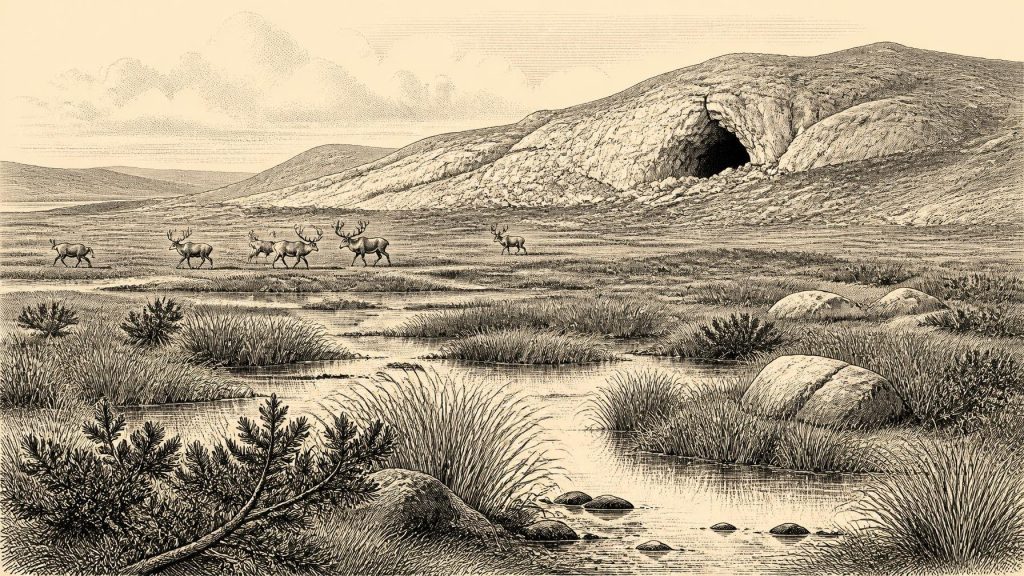
Around 31,585 BCE, Ireland was a cold, open Ice Age landscape during Marine Isotope Stage 3. Radiocarbon evidence cannot identify this calendar year precisely, but Derryvree’s sub-till sediments indicate treeless tundra wetlands, grasses, sedges and freshwater habitats during a broadly relevant interval. Castlepook Cave preserves a diverse fauna, including reindeer, mammoth, giant deer, bear, wolf, Arctic fox, lemmings and hyaena, though dates and deposits require caution. A reported cut-marked reindeer bone suggests possible early human activity, but no secure evidence establishes settlement or a defined culture. Growing ice would later transform these landscapes. The period is understood through environmental evidence.
Dateline
31,585 BCE is a useful modern label, not a date that prehistoric Ireland’s evidence can identify with calendar-year precision. It corresponds approximately to 33,500 calendar years before the conventional radiocarbon baseline of 1950, during Marine Isotope Stage 3, a fluctuating cold phase before the Last Glacial Maximum. For Ireland, this was an Ice Age landscape in transition: not yet the island wholly dominated by the later great ice sheet, but already a northern, exposed and environmentally severe place.
The responsible history of Ireland at this point is therefore not a narrative of named communities, chiefs or battles. It is an account assembled from animal bones in limestone caves, pollen, seeds, mosses and insects preserved beneath later glacial deposits, and the changing evidence of ice and sea. These sources reveal much about landscapes and wildlife. They offer only limited and debated indications of people.
Dating a Deep Past
Radiocarbon dates are not calendar dates. A measurement reported as years “BP” means years before 1950, and must be calibrated against changing levels of atmospheric carbon-14 to produce a calendar-age range. At more than 30,000 years ago, the ranges are broad and the relation between a radiocarbon determination and calendar time is especially uneven. Nor can a date on a bone establish the precise day, season or even necessarily the exact year in which an animal died.
Consequently, no excavated Irish deposit can responsibly be said to record events in 31,585 BCE itself. The closest framework is a calibrated range. At Derryvree, near Maguiresbridge in County Fermanagh, organic silts and fine sands lay between two tills, deposits left by separate advances of glacier ice. Their conventional radiocarbon age of about 30,500 BP has been expressed as approximately 36,900–31,700 calibrated years BP in later synthesis. The requested year falls within that broad interval. It can illuminate the kind of Ireland that existed during the Derryvree interstadial episode, but it cannot turn that episode into a year-by-year chronicle.
The precision problem is heightened by the history of discovery. Many Irish Pleistocene animal assemblages were excavated in caves in the late nineteenth and early twentieth centuries, before modern recording methods. Bones from different layers could be disturbed or mixed, while old radiocarbon measurements have since been reassessed. Interpretation must keep separate what is direct—an identified, dated bone or a buried plant remain—from wider reconstruction.
An Open, Cold Landscape
Derryvree provides one of the clearest environmental windows. Its plant and insect evidence points to open, treeless ground and wet, organic-rich hollows: a cold muskeg or tundra-wetland mosaic rather than woodland. Grasses and sedges were prominent. Juniper and herbs occurred, and the plant assemblage included dwarf shrub and arctic-alpine elements. Mosses, aquatic plants and insects associated with pools indicate that this was not a uniformly frozen desert. Water collected in shallow basins during at least part of the year, with plant matter accumulating in them.
The evidence nevertheless implies hard winters, short growing seasons and considerable seasonal contrast. Wind-exposed ground, frost action, bare mineral soil, sedge marshes and low vegetation would have produced a patchwork of habitats. Such a landscape should not be imagined as a single unbroken “mammoth steppe”. That phrase can be useful for the broad open ecosystems of Ice Age Eurasia, but the Irish evidence describes local wetland, periglacial and cave settings, not a complete map of every valley.
Greenagho, also in County Fermanagh, preserves older interstadial lake deposits below till. Its organic material has produced calibrated dates broadly around 37,200–35,700 years BP. It does not date the requested point directly, yet it confirms an important regional fact: northern Ireland was ice-free on more than one occasion before later ice expansion. The Fermanagh records show that glaciers did not simply advance once over an empty, timeless wasteland. They overrode landscapes which had supported freshwater habitats and cold-adapted life.
Castlepook and the Ice-Age Fauna
In north County Cork, Castlepook Cave near Doneraile is Ireland’s richest known Pleistocene vertebrate site. Its many chambers preserved remains of woolly mammoth, reindeer, giant deer, brown bear, wolf, Arctic fox, mountain hare, lemmings and spotted hyaena. The cave is not a neat, single occupation layer. It was used, entered or received remains over long spans of time, and carnivores as well as natural processes helped accumulate and rearrange bone.
Even so, the fauna gives a powerful impression of Ireland in the later part of Marine Isotope Stage 3. Reindeer were present; so were large herbivores and formidable scavenging predators. Spotted hyaena remains are particularly significant, since hyaenas could transport carcass parts and alter bones in their dens. Mammoth remains attest to access by animals normally associated with broad, open, cold environments. Giant deer, whose enormous antlers later gave them the misleading popular name “Irish elk”, were also part of this changing fauna.
Direct dates on Castlepook specimens once seemed to place several animals between roughly 35,000 and 34,000 radiocarbon years BP. A 2020 reassessment, using improved pretreatment and dating, concluded that several Marine Isotope Stage 3 animal occurrences were substantially older than the earlier determinations indicated. The lesson is not that the fauna disappears from the historical picture, but that individual dates and assumed associations demand caution. Castlepook securely demonstrates a diverse Late Pleistocene animal world; it cannot provide a census of animals alive in 31,585 BCE.
People: A Significant but Unsettled Signal
The question of human presence is more delicate still. A reindeer femur from Castlepook has been reported as bearing marks consistent with butchery by a stone tool, and it was publicised in 2021 as evidence for human activity in Ireland around 33,000 years ago. If that interpretation and chronology are confirmed in full scholarly publication, it would indicate that people reached Ireland far earlier than the better-known post-glacial hunter-gatherer settlement.
For this date, however, it is best treated as a compelling lead rather than a settled foundation for a detailed social history. The relevant bone came from an old collection and cave deposits can be complex. No securely stratified camp floor, hearth, stone-tool assemblage, dwelling, human burial or continuous settlement sequence is presently available for Ireland at about 33,500 calendar years ago. A single modified bone, even if genuine, could record a brief visit by hunters or scavengers rather than a resident population.
It is reasonable to say that Ireland lay within a wider north-west European zone through which animals moved and, potentially, small human groups could move when terrain, weather and access allowed. Lower sea levels changed the surrounding geography, although the exact land and ice connections between Ireland, Britain and continental Europe remain model-dependent and disputed. It is not responsible to assert a particular migration route, a permanent land bridge, or a named Upper Palaeolithic culture in Ireland on the evidence now available.
No Polities, but Real Ecologies
There is no evidence for political institutions, diplomacy, warfare, trade networks, farming, villages, monuments, religious practice or formal learning in Ireland at this horizon. None should be invented to make the period resemble later prehistory. If people did visit, their economy would most plausibly have involved highly mobile foraging, using perishable equipment and stone tools, but that is an inference from comparable European hunter-gatherers, not a demonstrated Irish lifeway.
Conflict is visible only in ecological terms: predators, scavengers and herbivores competed within a difficult seasonal environment. Hyaena tooth marks and cave-bone accumulations show that caves could be carnivore places before they became archaeological archives. The most important regional change was climatic and glacial. The British–Irish Ice Sheet was beginning its major growth after roughly 35,000–32,000 years ago, though its maximum extent came much later, broadly between 27,000 and 21,000 years ago. Over ensuing millennia, ice would transform and bury many of the accessible landscapes represented at Derryvree and Castlepook.
What This Year Can Mean
Ireland around 31,585 BCE was therefore neither historically blank nor historically legible in the ordinary sense. It was a cold, open country of wetlands, low vegetation and large mammals, with caves that later safeguarded fragmentary evidence of its fauna. Fermanagh’s sub-till sediments show freshwater tundra conditions during a broad relevant interval; Castlepook demonstrates the striking diversity of southern Irish Ice Age animals. A reported cut-marked reindeer bone raises the possibility of an early human encounter with this world, but does not yet establish a permanent community or a year-specific event.
That restraint is not a deficiency. It is the achievement of the evidence: the ability to recover a living landscape from silts, pollen, bones and ice, while recognising where the record falls silent.
Primary Sources
- A Middle Midlandian Freshwater Series at Derryvree, Maguiresbridge, County Fermanagh, Northern Ireland
- Middle Midlandian Interstadial Deposits at Greenagho, Near Belcoo, County Fermanagh, Northern Ireland
- The Irish Quaternary Fauna Project
- A Reconsideration of the Radiocarbon Dating of the Marine Isotope Stage 3 Fauna from Southern Ireland
- Castlepook Cave: County Geological Site Report
- Castlepook Cave Excavation, County Cork, 2022
- Occurrence of Mammalia Relicts at Site Castlepook Cave
- Irish Pleistocene Biostratigraphy
- First Evidence of a Late Upper Palaeolithic Human Presence in Ireland
- Revisiting Alice and Gwendoline Cave, Co. Clare: New Light on the 1902 Excavations
- New Insights on the Fauna of Ireland's Younger Dryas and Early Holocene from Alice & Gwendoline Cave
- Trimlines, Blockfields and the Vertical Extent of the Last Ice Sheet in Southern Ireland
- Late Pleistocene Chronostratigraphy and Ice Sheet Limits, Southern Ireland
- Dimensions and Chronology of the Last Ice Sheet in Western Ireland
- Last Glacial Maximum Cirque Glaciation in Ireland and Implications for Reconstructions of the Irish Ice Sheet
- Early Deglaciation of the British-Irish Ice Sheet on the Atlantic Shelf Northwest of Ireland
- Growth and Retreat of the Last British–Irish Ice Sheet, 31,000 to 15,000 Years Ago: the BRITICE-CHRONO Reconstruction
- Extent and Timing of the Last Glacial Maximum in Britain and Ireland: A Review
- Exploring Controls of the Early and Stepped Deglaciation on the Western Margin of the British-Irish Ice Sheet
- The Problem of a Late Quaternary Landbridge Between Britain and Ireland
- Deglaciation, Earth Crustal Behaviour and Sea-Level Changes in the Determination of Insularity: A Perspective from Ireland
- The IntCal20 Northern Hemisphere Radiocarbon Age Calibration Curve (0–55 cal kBP)
- IntCal Publications
- The IntCal20 Northern Hemisphere Radiocarbon Age Calibration Curve (0–55 cal kBP)