Derryvree and the Reindeer31250 BCE
31,250 BCE is a modern label within variable Marine Isotope Stage 3, not a precisely dated Irish event. Ireland experienced fluctuating cold conditions, with ice, periglacial terrain and occasional ice-free habitats. At Derryvree, Fermanagh, an interglacial wetland deposit, dated broadly to 36,900–31,700 calibrated BP, preserves tundra-like plants and insects between glacial advances. Castlepook Cave, Cork, contains fauna accumulated over millennia, including reindeer, mammoth, predators and other cold-country species, indicating ecological connections with north-west Europe. A cut-marked reindeer femur may record Upper Palaeolithic butchery, but proves neither permanent settlement nor wider society. Together sites reveal changing environments and possible human visits.
Dateline
“31,250 BCE” is a modern chronological label, not a year that can be recovered from Ireland’s archaeological record. No written calendar existed, and the evidence available is dated in radiocarbon years, calibrated ranges and relative sequences of sediment. The most responsible frame is the later part of Marine Isotope Stage 3 (MIS 3), a highly variable phase of the last Ice Age. The nominal date falls about 33,200 calendar years before AD 1950, but that arithmetic must not be confused with a dated event. What can be described is an Irish environment changing over millennia, together with a small and exceptionally important body of animal and possible human evidence.
An Ice-Age Interval
Ireland at this point was not the familiar green, wooded island of later millennia. It belonged to the Midlandian cold stage, before the Last Glacial Maximum reached its fullest extent. Conditions shifted sharply during MIS 3: colder phases encouraged ice growth, while relatively milder interstadials allowed ice margins to retreat or thin locally. These changes were neither uniform across the island nor conveniently measurable to a particular season in 31,250 BCE. Coastlines, rivers, exposed ground and routes between Ireland and Britain also differed greatly from those of today because so much water was locked in continental ice sheets and sea level was lower.
The crucial qualification is that cold did not mean that every part of Ireland was continuously buried beneath glacier ice. Geological evidence records a patchwork of ice, periglacial ground, lakes, wet hollows and open vegetation at different times. Conversely, an ice-free locality does not demonstrate a wholly ice-free island. The broad picture is of a north-western European landmass at the edge of climatic possibility: exposed to Atlantic weather, seasonal snow, frozen or waterlogged soils, powerful winds and repeated environmental disruption. Any people or animals moving through it faced a landscape whose resources and hazards could change profoundly between generations.
Derryvree’s Buried Wetland
The best Irish environmental evidence close to this nominal date comes from Derryvree near Maguiresbridge in County Fermanagh. Roadworks exposed a sequence through a drumlin: lower glacial till, then freshwater sands, silts and organic mud, followed by later glacial deposits. Till is unsorted material laid down by ice. The order of these layers is strong evidence that a glacier had occupied the area, that an intervening ice-free episode permitted water and plants to accumulate, and that a subsequent advance sealed the wetland beneath fresh ice-borne sediment.
Organic material from this inter-till deposit, laboratory sample BIRM-166, produced a conventional radiocarbon age of 30,500 radiocarbon years BP, with an uncertainty of roughly a millennium. Radiocarbon years are not calendar years: atmospheric carbon-14 levels varied, so laboratory results must be calibrated using internationally maintained curves. Published recalibrations place the determination broadly at about 36,900–31,700 calibrated years BP, or approximately 34,950–29,750 BCE. The requested year lies inside that wide span. It cannot be assigned to a particular layer, plant, animal or episode of pond formation.
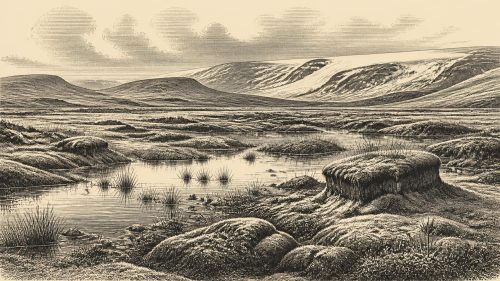
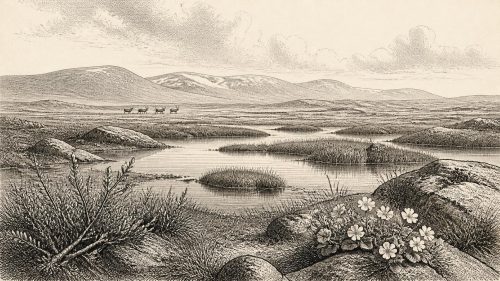
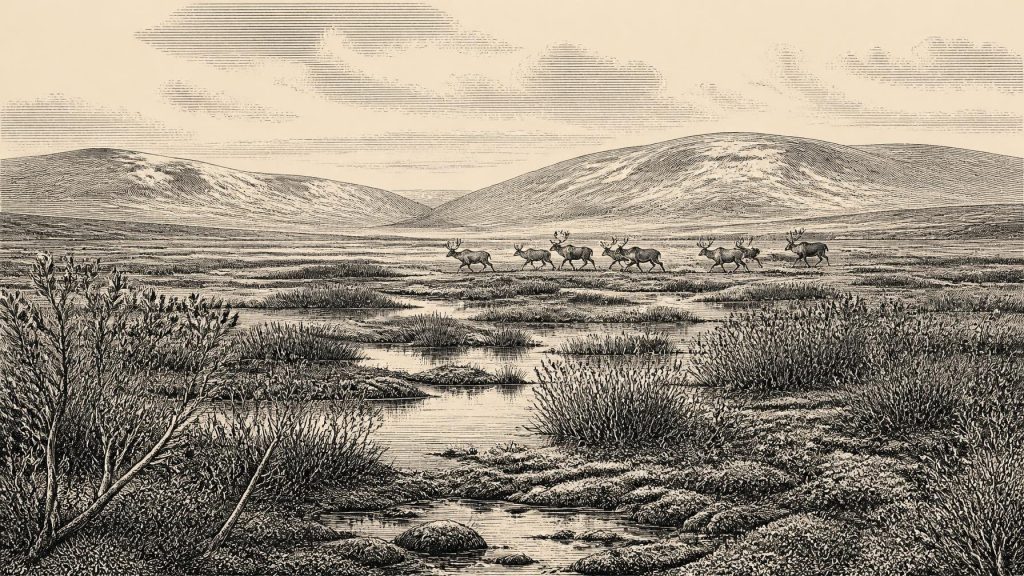
The Derryvree fossils nevertheless give unusually vivid evidence of the kind of locality that existed during part of this interval. Plant macrofossils and insect remains indicate cold, open tundra-like vegetation and freshwater conditions. Mosses, sedges, bogbean, dwarf willow, mountain-avens, clubmoss and other hardy plants point to damp ground around pools or sluggish water rather than forest. The assemblage does not license a claim that the entire island was a single uniform tundra. It does show that, at Derryvree, a functioning wetland community developed between glacial episodes. In such a setting, summer growth, standing water and vegetation could have supported insects, birds and grazing animals, while winter imposed much harsher constraints.
Reindeer Country in North Cork
In north County Cork, Castlepook Cave near Doneraile offers a different sort of archive. Excavated principally in the early twentieth century by Richard J. Ussher and colleagues, it yielded a very large collection of Ice-Age animal bones. Later radiocarbon work, including improved methods for preparing bone samples, showed that the cave fauna covers a much longer period than older dates had suggested. Individual finds represent repeated accumulation over tens of thousands of years, rather than one community or one occupation.
The fauna demonstrates that animals capable of living in cold, open country reached Ireland during MIS 3. Castlepook has produced remains identified as reindeer, woolly mammoth, giant deer, brown bear, wolf, Arctic fox, mountain hare, lemmings and spotted hyaena. These animals did not necessarily all occupy the district together, and their presence in a cave need not mean that they lived in the cave. Carnivores could have used its galleries as dens and brought in carcass remains; water, sediment movement and later digging could mix material from different dates. Even so, the range of species is important evidence that Ireland was connected to wider north-west European ecological movements before the severe conditions of the Last Glacial Maximum restricted or eliminated many local populations.
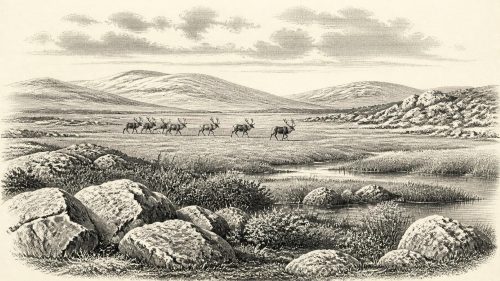
Reindeer are especially relevant. Herd animals move across broad territories in response to pasture, snow cover and season, and a treeless, herb-rich landscape could provide their forage. That does not prove a predictable annual migration route through the Awbeg valley, nor does it tell us how many animals were present in any one year. But it makes the Doneraile area a plausible part of a mobile grazing landscape. Predators and scavengers, including hyaenas and wolves, would have followed opportunities created by such animals. The cave’s bone record is therefore evidence of ecological relationships, not a census of an Ice-Age menagerie.
A Possible Human Trace
One reindeer femur from Castlepook has transformed discussion of early Ireland. County Cork heritage material dates it broadly to c. 31,000 BCE and describes a deep surface incision identified by zooarchaeologist Ruth Carden as a mark made by a sharp stone tool during butchery. If that reading is correct, it is evidence that a person or small group processed a reindeer in Ireland during the Upper Palaeolithic, far earlier than the long-recognised post-glacial settlement record.
Its significance is considerable, but its limits must remain equally clear. The femur was recovered from an antiquarian cave collection, not from a newly excavated, intact living floor with associated tools, hearths and food waste. A date on the bone establishes the age of the animal’s remains; it does not independently date the incision, identify its maker, locate the kill, or reveal how long people stayed. No securely associated Palaeolithic stone-tool assemblage, dwelling, burial, human skeleton, hearth or repeated occupation surface of comparable age has yet been found in Ireland. The most cautious interpretation is therefore brief human activity, possibly carcass processing by travelling hunters, rather than proof of permanent settlement or a continuously occupied island.
Life Beyond the Evidence
That restraint matters when considering society. There is no evidence from Ireland around this date for named communities, leaders, territories, law, diplomacy or organised warfare. It would be misleading to turn a possible butchery mark into a tribe, a political boundary or a campaign. Nor can Irish evidence reveal language, kinship systems, gender roles, childhood, teaching, artistic practice or religious belief. Upper Palaeolithic communities elsewhere in Europe made sophisticated tools, ornaments and images, but those achievements cannot be transferred automatically to Ireland in the absence of Irish finds.
The same is true of economy and exchange. There were no farms, cereal fields, livestock herds, villages, metal objects or known trade networks. If hunters were present, their subsistence may have involved a flexible use of animal resources, especially meat, marrow, hide, sinew and bone, but Castlepook directly supports only the much narrower proposition that a reindeer bone may have been cut with a stone implement. A cave used by carnivores should not be imagined as a human home merely because a modified bone was found among its deposits.
The most important development illuminated by 31,250 BCE is thus not a political event but a question of survival and movement. Derryvree preserves an ice-free wetland interval in Fermanagh; Castlepook preserves a rich southern fauna and a potentially momentous sign of human butchery. Together they replace the old, simple image of an Ireland either empty or wholly ice-covered. They instead reveal a changing Ice-Age landscape in which animal populations entered and disappeared, local wetlands briefly flourished between glacial advances, and human visitors may have reached the island. The evidence is fragmentary, but it is precisely this fragmentary quality that defines Ireland’s deep prehistory at this date.
Primary Sources
- A Middle Midlandian Freshwater Series at Derryvree, Maguiresbridge, County Fermanagh, Northern Ireland
- A Reconsideration of the Radiocarbon Dating of the Marine Isotope Stage 3 Fauna from Southern Ireland
- The Irish Quaternary Fauna Project
- Episodic Speleothem Deposition Tracks the Terrestrial Impact of Millennial-Scale Last Glacial Climate Variability in SW Ireland
- Timing and Pace of Ice-Sheet Withdrawal Across the Marine–Terrestrial Transition West of Ireland During the Last Glaciation
- The Timing and Magnitude of the British–Irish Ice Sheet Between Marine Isotope Stages 5d and 2
- Ice Sheet Extension to the Celtic Sea Shelf Edge at the Last Glacial Maximum
- New Insights on the Fauna of Ireland's Younger Dryas and Early Holocene from Alice and Gwendoline Cave, County Clare
- Archaeological Heritage of County Cork
- Heritage Artefacts of County Cork
- 32564: Castlepook Cave, Castlepook South, Cork
- On the Cave of Castlepook, Near Doneraile, Co. Cork
- Preliminary Assessment of the Archive of Faunal Remains from Excavated Irish Cave Sites
- The IntCal20 Northern Hemisphere Radiocarbon Age Calibration Curve (0–55 cal kBP)
- The IntCal20 Approach to Radiocarbon Calibration Curve Construction: A New Methodology Using Bayesian Splines and Errors-in-Variables
- Composition and Consequences of the IntCal20 Radiocarbon Calibration Curve
- IntCal
- The Antiquity of Man in Ireland
- The Origin and Affinities of the Larnian Culture
- Dimensions and Chronology of the Last Ice Sheet in Western Ireland