Elephant Hall’s Mixed Ages31586 BCE
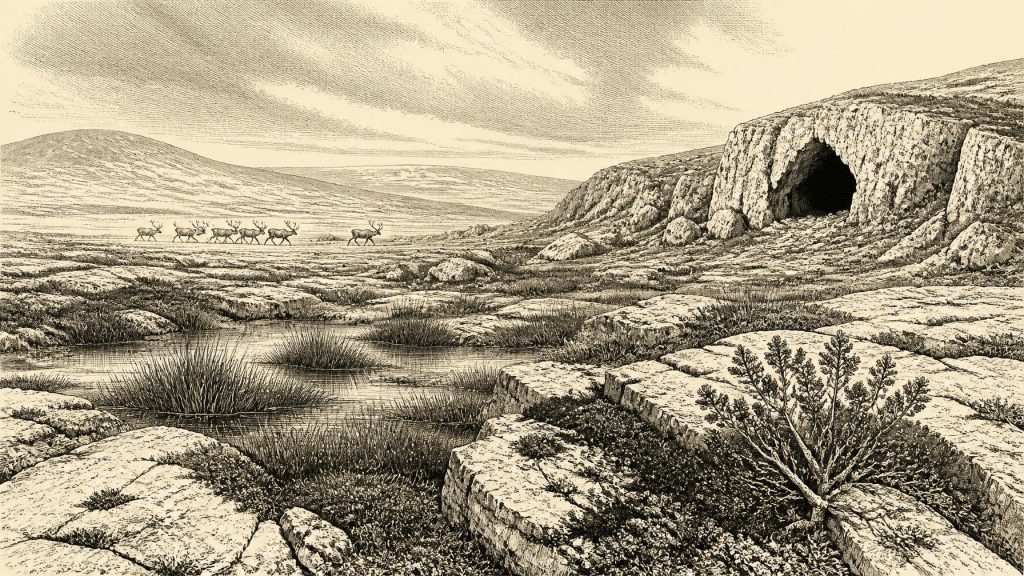
31,586 BCE is only a filing label for a broad, uncertain interval during Marine Isotope Stage 3, when Ireland was cold, treeless and approaching glaciation. Wetlands at Derryvree indicate sedge-rich, muskeg-like habitats amid open ground, ponds and seasonal freezing. Castlepook Cave in County Cork preserves mixed animal remains accumulated over many episodes, including reindeer, mammoth, giant deer, bear, hyaena, wolf, Arctic fox and lemmings. A marked reindeer femur may indicate human butchery, but cannot prove settlement or continuity. No evidence supports farming, institutions or culture. The record instead reveals a changing tundra-like landscape, rich in mammals and possible human visits.
Dateline
Modern calendar-year precision is not available for Ireland at this depth of time. “31,586 BCE” is a useful filing label, not a date to which an Irish event, individual life or seasonal episode can responsibly be attached. Expressed in the archaeological convention of years before 1950, it corresponds only approximately to 33.5 thousand calibrated years before present. At this age, radiocarbon determinations must be calibrated against curves built from several indirect archives, and their results normally produce ranges rather than a single year. The evidence therefore illuminates a broad interval within Marine Isotope Stage 3, during the last glacial cycle, rather than one knowable Irish year.
A Cold-Stage Ireland
Ireland at about 34,000–33,000 calibrated years ago was not the familiar green island of later history. It stood in a generally cold, climatically volatile north-west European world, well before the fullest expansion of the last British–Irish Ice Sheet. That later maximum covered Ireland and its surrounding shelf roughly between 27,000 and 23,000 calibrated years before present, although the timing, thickness and behaviour of ice differed markedly from one region to another. Conditions around the date represented here were therefore part of a long approach towards greater glaciation, not a single nationwide moment at which the island simply froze over.
The old Irish terminology of the “Derryvree Cold Phase” is useful only with caution. Organic silts sealed between tills beneath a drumlin at Derryvree, near Maguiresbridge in County Fermanagh, preserve a cold, treeless wetland environment. Their pollen and plant remains indicate muskeg-like ground: waterlogged, sedge-rich habitats with mosses and plants capable of enduring severe conditions. Such deposits demonstrate that parts of Ireland could contain freshwater pools, marshy hollows and open vegetation during cold phases. They do not provide a weather report for every county, nor can they identify the precise conditions of 31,586 BCE.
Open Ground and Wet Hollows
The landscape inferred from these records was a mosaic rather than an unbroken snowfield. Tree cover was absent or extremely restricted. In its place lay open herbaceous and shrubby communities, with sedges, grasses, mosses and cold-tolerant flowering plants occupying damp ground and exposed mineral soils. Permafrost, seasonal freezing and meltwater would have shaped the surface in many places. Rivers carried sediment; hollows held ponds and peaty muds; wind could move fine material across sparsely vegetated ground. The outlines of later bogs, woods, fields and coastlines should not be projected back into this world.
Regional change mattered. Southern limestone country preserved caves; Fermanagh preserved sediments protected beneath later glacial deposits; offshore shelves preserve evidence for ice margins and sea-level change. Each archive answers a different question. Cave bones tell us that animals entered, died near, or were dragged into particular cavities. Pollen and plant macrofossils describe vegetation around a basin, though not necessarily across the whole island. Glacial landforms and marine cores reveal advances and retreats of ice over much larger areas, but usually with broad chronological brackets. The responsible picture is assembled from these unequal fragments.
Castlepook’s Faunal Record
For Ireland around this broad period, Castlepook Cave near Doneraile in north County Cork is the most evocative source. Its galleries, including Elephant Hall, yielded a remarkable collection of Pleistocene animal remains during excavations undertaken in the early twentieth century. Later radiocarbon work on selected bones established that the cave contains material of very different ages. Reported determinations include a reindeer metacarpal of 35,200 ± 950 radiocarbon years BP, a mammoth rib of 34,100 ± 840 BP, a brown-bear calcaneum of 33,310 ± 770 BP, and giant-deer bones around 32,000 radiocarbon years BP. These are laboratory ages, not interchangeable with BCE dates; their calibrated ranges are older, broader and sometimes affected by the quality of surviving bone collagen.
The important conclusion is not that every animal met in Elephant Hall at once. It is the opposite. Castlepook accumulated bones over a long span, and its deposits were disturbed by carnivores, water movement, collapsing cave deposits and antiquarian excavation. The cave is a palimpsest: a place where remains from different episodes became mixed. Its fauna nevertheless establishes that a substantial cold-stage mammal community occurred in southern Ireland before the Last Glacial Maximum. Reindeer, woolly mammoth, giant deer, brown bear, spotted hyaena, wolf, Arctic fox and lemmings are all represented within the wider assemblage and its dated phases.
Those animals suggest open country capable of supporting grazing and browsing herds, alongside predators and scavengers. Reindeer are particularly suited to cold, open environments and could have moved seasonally across extensive ranges. Mammoth and giant deer similarly point towards landscapes with productive patches of grasses, herbs and shrubs, though their presence in a cave collection does not measure their local abundance. Hyaenas and wolves matter because they may have carried bones into caves or modified them after death. A cave bone is thus evidence both of an animal and of the processes that brought its remains to the place where archaeologists eventually found it.
The Reindeer Question
One Castlepook reindeer femur has attracted exceptional attention because its deep linear mark has been interpreted as a fresh-bone cut or chopping trace made by a sharp stone tool. Public heritage accounts associate the specimen with approximately 33,000 years ago, or about 31,000 BCE in simplified calendar language. If the mark is confirmed as anthropogenic and contemporary with the animal’s death, it would be evidence that a person processed a reindeer carcass in Ireland during the Upper Palaeolithic. That would extend the possible Irish human story far beyond the securely published terminal-Pleistocene bear patella from Alice and Gwendoline Cave in County Clare, dated to about 12,810–12,590 calibrated years BP.
But the distinction between possibility and proof is crucial. The Castlepook femur came from an old cave collection, not from a modern excavation of a sealed occupation surface. No securely associated hearth, stone-tool assemblage, dwelling, burial, human bone or repeated butchery area of comparable age has yet been recovered there. Nor does a single potentially worked bone identify a people, language, migration route or cultural tradition. The find is important because it makes a brief human visit plausible; it cannot demonstrate a permanent settlement, a population continuity, or a named community in Ireland at this date.
Lives Beyond the Evidence
Consequently, political affairs, warfare and diplomacy are absent from the Irish record for this period. There were no states, written laws, kingships, borders or institutions that can be recovered from the evidence. It would be equally unwarranted to imagine tribes fighting over Castlepook, diplomatic relations across the Irish Sea, or an organised Irish territory. If people did reach the island, they may have travelled in very small, mobile groups whose movements followed opportunities in a difficult environment. That is an interpretation drawn from the ecology of large game and from Upper Palaeolithic lifeways elsewhere in Europe, not a directly observed fact about Ireland.
The same restraint applies to society, religion, culture and learning. Upper Palaeolithic peoples elsewhere possessed sophisticated stone technologies, social knowledge, decorative traditions and, in some regions, cave art. None of that can automatically be assigned to Ireland. Castlepook Cave was a useful shelter and carnivore den before it became an archaeological site; there is no Irish ritual deposit, artwork, ornament or grave securely belonging to this interval. A possible cut mark implies practical knowledge of a sharp stone edge and animal anatomy, but no more. The absence of evidence should not be mistaken for proof that visiting people lacked beliefs or culture; it marks the limits of surviving Irish material.
Economy Without Settlement
There is likewise no evidence for farming, herding, pottery, metalworking, markets or sustained trade. The only economy that can cautiously be discussed is the possible taking and processing of wild animals. A reindeer carcass could have provided meat, marrow, hide, sinew and bone, all valuable to mobile hunter-gatherers. Yet even this is conditional at Castlepook: the bone modification remains the key issue, while carnivore action and disturbed cave deposits complicate interpretation. There is no demonstrated quarry of stone tools, no exchange network and no built camp from which to reconstruct daily routines.
The most important development around this notional year was environmental rather than political: Ireland was a cold, changing habitat in which open-country mammals could live and in which ice was becoming an ever more decisive force. Castlepook’s mixed-age bones and Derryvree’s buried wetland are not a year-by-year chronicle. Together, however, they preserve a rare glimpse of an Ireland long before farming, monuments and written memory—an island or near-island landscape of tundra-like ground, wet hollows, large mammals and, perhaps, a fleeting human encounter whose full story has yet to be found.
Primary Sources
- The Irish Quaternary Fauna Project
- The Irish Quaternary Fauna Project (repository copy)
- First Evidence of a Late Upper Palaeolithic Human Presence in Ireland
- First Evidence of a Late Upper Palaeolithic Human Presence in Ireland (PDF)
- New Insights on the Fauna of Ireland's Younger Dryas and Early Holocene from Alice & Gwendoline Cave
- New Insights on the Fauna of Ireland's Younger Dryas and Early Holocene from Alice & Gwendoline Cave (PDF)
- Figure 6: The Subdivision of the Quaternary Period in Ireland
- Irish Association for Quaternary Studies: South Fermanagh Field Guide
- Field Guides
- Dimensions and Chronology of the Last Ice Sheet in Western Ireland
- Radiocarbon Constraints on the History of the Western Irish Ice Sheet Prior to the Last Glacial Maximum
- Early Deglaciation of the British-Irish Ice Sheet on the Atlantic Shelf Northwest of Ireland Driven by Glacioisostatic Depression and High Relative Sea Level
- Maximum Extent and Dynamic Behaviour of the Last British-Irish Ice Sheet West of Ireland
- Ireland: Submerged Prehistoric Sites and Landscapes
- The IntCal20 Northern Hemisphere Radiocarbon Age Calibration Curve (0–55 cal kBP)
- The IntCal20 Northern Hemisphere Radiocarbon Age Calibration Curve (PDF)
- IntCal20: Radiocarbon Calibration Curves
- Testing and Improving the IntCal20 Calibration Curve with Independent Records
- Occurrence of Mammalia Relicts at Site Castlepook Cave
- Heritage Artefacts of County Cork
- The Mesolithic in Ireland: When Was It?
- Reindeer Bone Found in Cork Cave Shows Human Activity in Ireland 33,000 Years Ago