Crag Cave’s Distant Drips31343 BCE
31,343 BCE denotes an imprecise point during Marine Isotope Stage 3, when Ireland’s climate and ice cover changed rapidly. Derryvree, County Fermanagh, preserves sediments between glacial tills, showing a locally ice-free, cold wetland with tundra vegetation, insects and freshwater life. Castlepook Cave, County Cork, contains cold-adapted fauna; a marked reindeer femur may indicate human butchery, but cannot prove settlement or continuous occupation. No evidence supports Irish politics, farming, trade, religion or society at this date. Crag Cave speleothem growth in Kerry demonstrates episodic liquid water and milder intervals. Ireland was a harsh landscape, reconstructed from fragmentary environmental and archaeological evidence.
Dateline
“31,343 BCE” is a modern label for a point roughly 33,300 calendar years before AD 1950. It is not a year for which Ireland has an annal, named ruler, event horizon or archaeological evidence precise enough to identify a twelve-month span. Calendar-year precision is unavailable at this depth of time. The responsible subject is Ireland during the later part of Marine Isotope Stage 3 (MIS 3), a climatically unstable phase of the Late Pleistocene and of the last Irish glacial cycle, traditionally called the Midlandian.
The date belongs to a broad environmental interval rather than a historical chronology. Radiocarbon results of this age must be calibrated because atmospheric carbon-14 levels changed over time. The IntCal20 calibration curve extends to 55,000 calibrated years before present, but it cannot convert every ancient measurement into an exact historical date. Ireland’s evidence is patchy as well: much is buried beneath later glacial deposits or comes from caves disturbed by water, animals and earlier excavation. Still, an important conclusion is secure. During cold phases before the Last Glacial Maximum, some parts of Ireland retained or regained ice-free ground, while others were affected by the expanding and changing British–Irish Ice Sheet.
A Point Within a Long Cold Stage
MIS 3, conventionally dated to about 57,000–29,000 years ago, was not one uniform freeze. Greenland ice cores and North Atlantic records show repeated, abrupt shifts between relatively milder interstadials and severe stadials. Ireland lay on the Atlantic margin of north-west Europe, where ocean circulation, sea level, snowfall and the growth of neighbouring ice masses could alter local conditions quickly. A map labelled 31,343 BCE would therefore be a reconstruction with substantial uncertainty, not a picture of a fixed country.
The British–Irish Ice Sheet was growing towards its later maximum. BRITICE-CHRONO research reconstructs the ice sheet at thousand-year intervals from 31,000 years before present onward, while emphasizing uncertainty in individual ice-margin positions and the differing histories of separate sectors. Maximum total ice volume came later, around 23,000 years before present. The essential point for the earlier period is dynamism. Ice was neither absent from all Ireland nor necessarily a continuous cover across the entire island at every moment. Local glaciers, permafrost, exposed lowlands, lake basins and ice margins could coexist in a changing landscape.
Sea level was much lower than today because enormous quantities of water were locked in continental ice sheets. Yet this does not imply a simple and dependable land bridge from continental Europe to Ireland. The Irish Sea basin had complex topography and was shaped by glaciers, meltwater, changing coasts and marine conditions. Any movement of large mammals or people into the region would have depended on particular routes, seasons and environmental circumstances rather than an easy modern-style overland connection.
Derryvree’s Buried Wetland
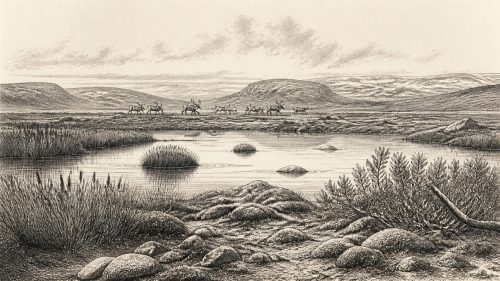
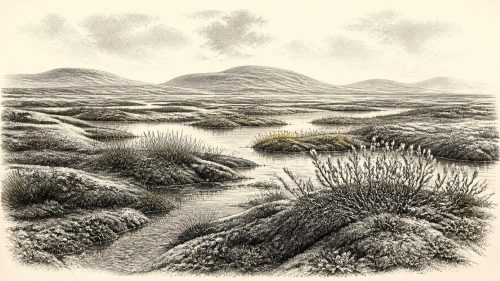
The most revealing Irish environmental archive close to this notional date is at Derryvree, near Maguiresbridge in County Fermanagh. Roadworks in 1969 cut through a drumlin and exposed an exceptional sequence: older glacial till below, freshwater silts, fine sands and organic deposits in the middle, and younger till above. In simple terms, glacier ice deposited debris; during an ice-free interval, water and organic matter accumulated; later ice covered and sealed the deposit. This is direct evidence for environmental change in northern Ireland, not merely an inference from distant climate records.
Organic material from the Derryvree sequence produced a conventional radiocarbon age of 30,500 ± 1,170/1,030 radiocarbon years BP. Its calibrated calendar range is very broad, spanning several millennia rather than identifying one year. The deposit belongs appropriately within the Middle Midlandian and is broadly relevant to the mid-30,000s calendar years BP. The difference between a radiocarbon age and a calendar age is exactly why 31,343 BCE cannot responsibly be presented as the date of a particular pool, plant, animal death or human visit.
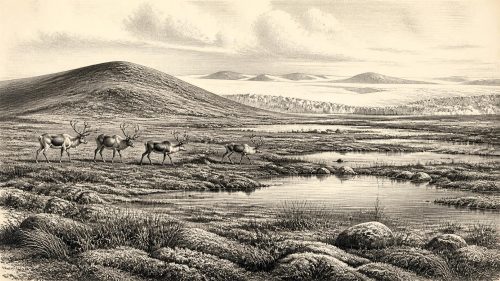
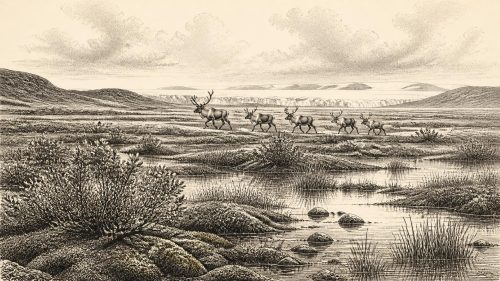
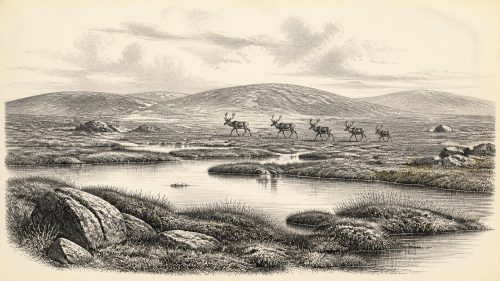
Derryvree’s pollen, plant macrofossils, mosses and insect remains indicate a cold, open landscape. Freshwater mosses and sedges, alongside insects of northern aspect, point to wet ground, shallow water and tundra-like vegetation rather than woodland, fields or a familiar Irish pastoral scene. The setting has often been described as tundra or muskeg: a mosaic of saturated hollows, peaty vegetation, pools and sparsely vegetated drier ground. Plant remains provide especially strong evidence for the local habitat. Pollen preservation was poor, however, and small quantities of tree pollen cannot demonstrate nearby forest; pollen can travel far, be reworked or survive in ways that complicate simple interpretations.
This wetland was not Ireland in miniature. It records one basin in south Fermanagh. Its position between two tills nevertheless shows that, even during a severe glacial age, locally ice-free ground could support freshwater communities for long enough to accumulate sediment, preserve botanical remains and sustain insects. Growing seasons were probably brief, winters formidable, and soils thin or frozen for long periods. The landscape was harsh, but not sterile.
Animals, Caves and One Difficult Mark
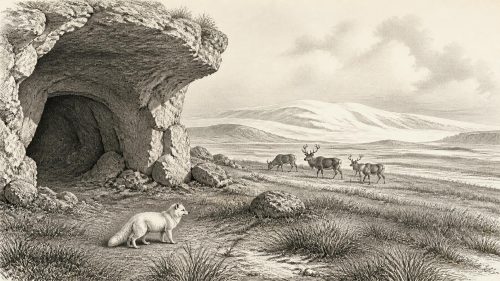
Irish caves provide a different form of evidence. Castlepook Cave near Doneraile in County Cork has produced a major collection of Late Pleistocene animal remains, including cold-adapted species. Cave assemblages require caution. A cave may serve over long periods as a carnivore den, animal trap, shelter, watercourse and sediment store. Bones may have been moved, gnawed, weathered or excavated before modern recording standards. Their presence does not automatically show that an animal lived outside the entrance at the same time as every other specimen.
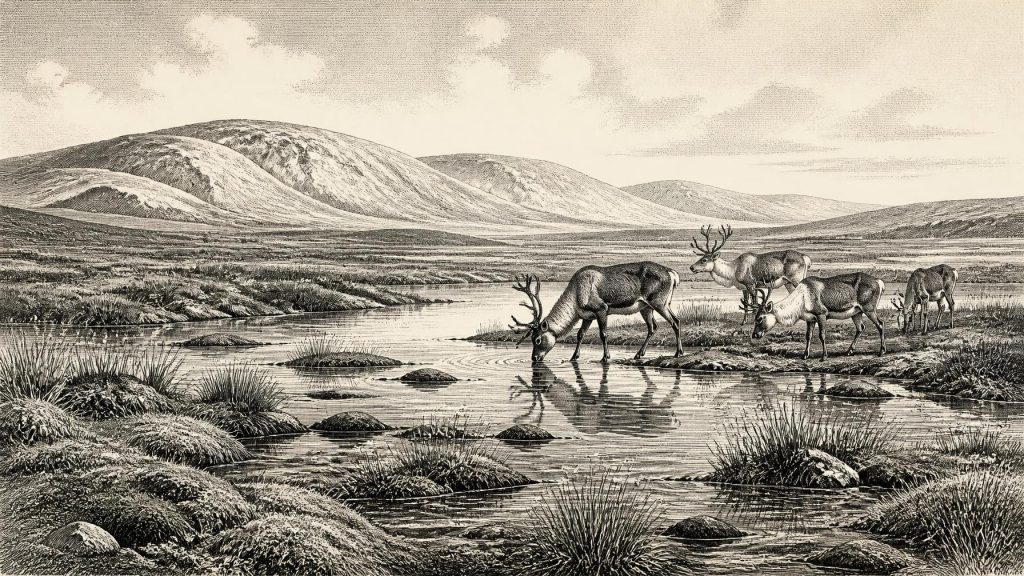
One Castlepook reindeer femur has nevertheless changed the discussion. It has been publicised as dating to about 33,000 years ago and as bearing a deep linear mark interpreted by zooarchaeologist Ruth Carden as a stone-tool cut made during butchery. If that interpretation is confirmed through continuing research, it could be Ireland’s earliest evidence for people handling an animal and would place a possible human incursion broadly close to this timeframe. County Cork heritage material presents the find as evidence that Stone Age hunters may have stalked reindeer in the region about 30,000 years ago.
The limits of the evidence matter as much as its potential significance. The radiocarbon result dates the animal’s death, not a precisely observed butchery event. A proposed cut mark must be compared carefully with damage caused by teeth, trampling, sediment abrasion, excavation tools and natural fracture. Most importantly, the bone did not come from a modernly excavated occupation floor associated with a hearth, stone-tool assemblage, shelter, repeated food-processing deposits or human remains. It is evidence for a possible action on a carcass, not proof of a settled population, village or continuous Irish human community.
Reindeer were well adapted to cold, open country and are plausible inhabitants of this environment. Other Irish cave records show that Late Pleistocene ecosystems included large herbivores and predators, but the precise combinations varied by time and place. No responsible reconstruction should fill every part of the island at 31,343 BCE with mammoths, hyenas or herds of deer simply because such species occur somewhere in Irish Pleistocene collections. Fossil ages, stratigraphy and collection histories must be assessed specimen by specimen.
People: Possibility, Not a Society
If people reached Ireland at this time, they were highly mobile hunter-gatherers, not members of any known Irish people. They left no securely dated dwelling, cemetery, monument, art panel, ceremonial deposit or tool workshop that can be assigned either to this year or to a securely defined 32nd-millennium BCE occupation. There are no names, languages, ethnic labels or political institutions available to history. Terms such as kingdom, tribe, chiefdom, diplomacy and warfare are unsupported.
Nor can the rich Upper Palaeolithic record of mainland Europe be imported wholesale into Ireland. Elsewhere, Homo sapiens groups made sophisticated stone and organic tools, used pigments, maintained long-distance social connections and created striking art. That wider evidence establishes what some contemporaries could do; it does not show that equivalent activities occurred at Castlepook or Derryvree. At most, the reindeer femur allows a cautious hypothesis of a brief visit by people capable of exploiting a carcass in a difficult northern environment.
If visitors were present, everyday life would have been organized around movement, weather, food and risk. Reindeer meat, fat, hide, sinew and bone could all have been valuable. A visit may have been seasonal, opportunistic or part of wider travel through lands now divided by sea. Yet this remains interpretation, not direct Irish evidence. No Irish record from this period establishes the size of a camp, household structure, diet, gender roles, technology, learning or beliefs.
No Politics, Trade or Religion in the Record
Political affairs and diplomacy are absent not because they can be disproved, but because available evidence cannot detect them. The same restraint applies to conflict. Predators competed with one another and with any human visitors for carcasses and shelter, while animals and people faced cold, exposure and unstable terrain. These were ecological pressures, not evidence for warfare. There is no basis for claiming battles, alliances or territorial boundaries in Ireland around this date.
There is likewise no Irish evidence for farming, managed livestock, crops, pottery, metalworking, markets, seafaring trade or exchange institutions. A possible hunting visit would not amount to an economy in the later historical sense. The clearest economy visible in the record is ecological: plants occupied wet and open ground; insects responded to cold-water habitats; herbivores used available forage; carnivores, and perhaps people, obtained meat where they could. The familiar economy of fields, cattle, roads and ports lay tens of millennia in the future.
Religion, formal learning and culture must remain unknown as well. No Irish shrine, burial rite, art object or symbolic assemblage of this age has been securely identified. It would be unreasonable to conclude that people, if present, had no beliefs or social knowledge; all human groups possess culture. It is simply impossible to specify its Irish expression from a single bone with a disputedly human-made mark. Absence of evidence reflects the limits of preservation and discovery, not permission to invent ritual.
Liquid Water in Kerry
Crag Cave near Castleisland, County Kerry, provides an independent environmental clue. Uranium-thorium dating of its speleothems has revealed episodic cave-calcite growth during MIS 3, linked to relatively milder Greenland interstadials. Stalagmite growth requires water to percolate through soil and limestone above the cave. It therefore shows that, at particular times, south-west Ireland was not beneath permanent ice or continuously frozen ground. It does not demonstrate mild conditions in every season, and an individual growth phase cannot be equated with 31,343 BCE. It does, however, confirm that the glacial landscape changed repeatedly.
The most accurate portrait of Ireland around this modern calendar label is consequently a landscape in motion: ice advancing in some sectors, cold wetlands persisting in others, open vegetation supporting specialized life, caves collecting bones, and water occasionally feeding calcite in Kerry. A reindeer bone from Cork raises the serious possibility that people briefly entered this world. It does not yet reveal an Irish society. The history of this moment is written not in chronicles, but in tills, silts, pollen, mosses, insects, cave calcite and one immensely consequential scar on bone.
Primary Sources
- Early Midlandian–Middle Midlandian, Pleistocene, Northern Ireland
- A Middle Midlandian Fresh-Water Series at Derryvree, Maguiresbridge, County Fermanagh, Northern Ireland
- Palaeoecology: The Middle Midlandian Palaeoenvironment of South Fermanagh
- The Irish Quaternary Fauna Project
- Irish Pleistocene Biostratigraphy
- Freshwater Organic Deposits and Stratified Sediments Between Early and Late Midlandian (Devensian) Till Sheets, at Aghnadarragh, County Antrim, Northern Ireland
- Growth and Retreat of the Last British–Irish Ice Sheet, 31,000 to 15,000 Years Ago: the BRITICE-CHRONO Reconstruction
- Growth and Retreat of the Last British–Irish Ice Sheet, 31,000 to 15,000 Years Ago: the BRITICE-CHRONO Reconstruction
- Pattern and Timing of Retreat of the Last British-Irish Ice Sheet
- Episodic Speleothem Deposition Tracks the Terrestrial Impact of Millennial-Scale Last Glacial Climate Variability in SW Ireland
- Spatio-Temporal Dynamics of Speleothem Growth and Glaciation in the British Isles
- The IntCal20 Northern Hemisphere Radiocarbon Age Calibration Curve (0–55 cal kBP)
- IntCal Publications
- The Greenland Ice Core Chronology 2005, 15–42 ka. Part 1: Constructing the Time Scale
- The Greenland Ice Core Chronology 2005, 15–42 ka. Part 2: Comparison to Other Records
- Ice-Core Data Used for the Construction of the Greenland Ice-Core Chronology 2005 and 2021
- Archaeological Heritage of County Cork
- Heritage Artefacts of County Cork
- Castlepook Cave, County Cork: Excavation Report 2022
- Archaeology Research Excavation Grant 2022: Castlepook Cave Final Report
- Reindeer Bone Found in Cork Cave Shows Human Activity in Ireland 33,000 Years Ago
- What Was on the Menu in Prehistoric Ireland?