Crag Cave’s Thaw Signal30474 BCE
Thirty thousand years before the present, Ireland cannot be described through a recoverable historical year, but through uncertain environmental ranges. Derryvree, County Fermanagh, preserves freshwater sediments between glacial tills, indicating an ice-free tundra wetland with cold-adapted vegetation during an interstadial phase. Crag Cave mineral deposits suggest south-western Ireland responded to abrupt climatic ameliorations. Cave fauna, especially at Castlepook, records mammoth, reindeer, giant deer, predators and other Ice Age animals, though remains accumulated over long periods. A possibly cut-marked reindeer bone raises, but does not prove, human presence. Ireland remained a changing, intermittently fully habitable landscape before the Last Glacial Maximum.
Dateline
The label 30,474 BCE is useful as a point on a modern timeline, but it cannot denote a recoverable Irish “year” in the historical sense. No contemporary written calendar, event record, ruler or settlement sequence allows archaeology to identify what happened in Ireland during that particular twelve-month span. In radiocarbon and ice-core terms, the date sits roughly 32,400 years before AD 1950, within Marine Isotope Stage 3 of the Last Glacial period. The responsible picture is therefore one of broad, calibrated ranges and environmental episodes, not annual precision.
A Date Within a Wide Window
At this depth of time, even a radiocarbon measurement is not a calendar date. It measures the remaining radioactive carbon in organic material and reports an age in radiocarbon years before present, where “present” conventionally means AD 1950. Because atmospheric carbon-14 varied substantially through the Ice Age, results must be calibrated against curves such as IntCal20. The calibrated answers are ranges, sometimes broad ones, rather than a single secure year. Nor does a date on a bone, seed or silt automatically date every event represented in its surrounding deposit.
The closest Irish chronological guide is the celebrated freshwater deposit at Derryvree, near Maguiresbridge in County Fermanagh. Roadworks in 1969 cut through a drumlin and revealed organic silts and fine sands sandwiched between two thick tills: unsorted sediment deposited by glacier ice. A sample, Birm-166, returned an age of 30,500 radiocarbon years BP, with a large uncertainty of +1,170 and −1,030 years. Subsequent calibrated discussion places the deposit broadly at about 36,900–31,700 calendar years BP. Thus 30,474 BCE falls within the wide time envelope relevant to this buried landscape, but cannot be assigned to a particular layer, season, plant generation or human visit.
The wider North Atlantic sequence gives a little context, but not local certainty. On the Greenland Ice Core Chronology, the nominal conversion of this date falls near Greenland Interstadial 5, one of the abrupt warmer episodes that punctuated an otherwise cold and highly unstable glacial world. A Greenland temperature signal was not a weather report for Ireland. Yet cave mineral growth at Crag Cave, County Kerry, has independently shown that episodes of liquid-water circulation in south-west Ireland broadly tracked such millennial-scale ameliorations. The implication is modest but important: the island’s climate and ice cover changed repeatedly, and it is unsafe to imagine a timeless, uniformly frozen Ireland.
Derryvree Between the Tills
Derryvree provides the clearest local scene. The lower till shows that glacier ice had earlier occupied the Fermanagh locality. Above it, freshwater silts, sands and organic material accumulated in an ice-free hollow. A later advance laid down the upper till and sealed the older wetland. The order of deposits is firm: ice, then freshwater and vegetation, then renewed ice. The exact duration of the middle episode, and its relationship to every other Irish site, remain much less certain.
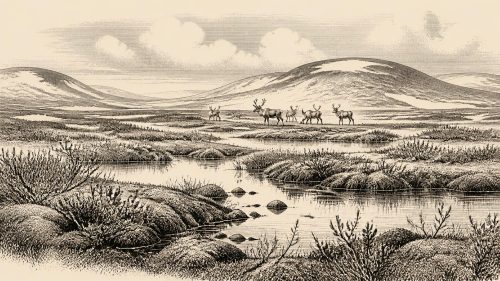
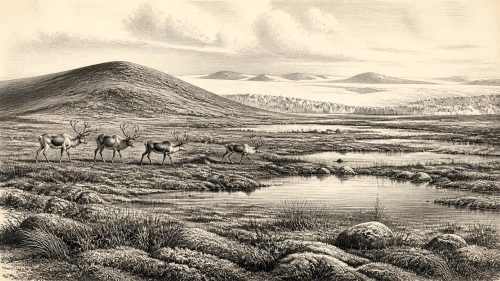
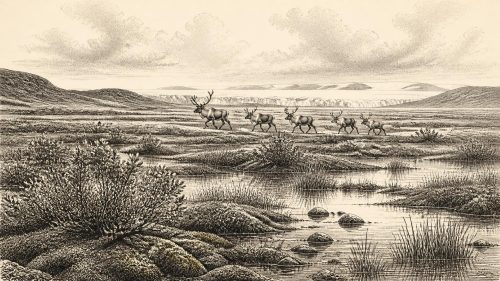
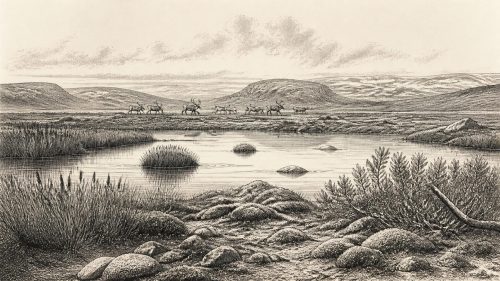
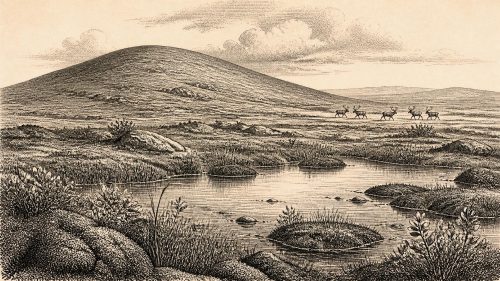
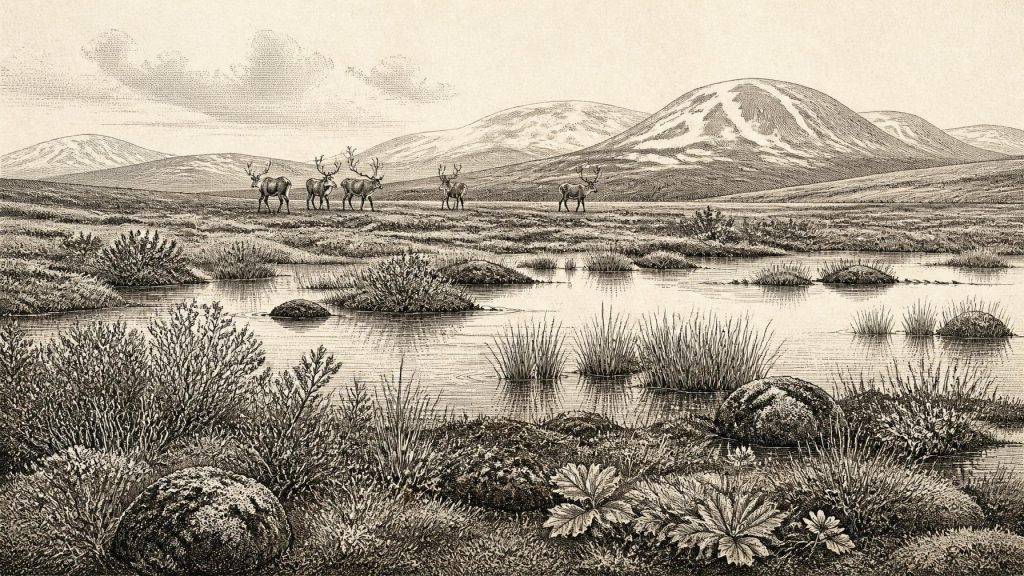
The plant and animal remains in the inter-till sediments indicate a treeless, open tundra or periglacial environment rather than woodland. Mosses, sedges, dwarf willow, mountain avens, clubmosses and other cold-adapted plants occurred alongside aquatic and wet-margin species, including bogbean and water-milfoil. These remains matter because they show more than bare ground. Shallow or slow-moving freshwater, marshy edges and seasonally productive vegetation existed in at least one Fermanagh basin. In summer, such places would have offered food and cover for insects and grazing animals; in winter, frost, snow, short daylight and severe wind exposure would have imposed powerful limits.
This was not the Ireland of later lakes, bogs, forests and coasts. Sea level was much lower globally than today because vast quantities of water were held in northern ice sheets. Ireland was part of a changing north-west European land-and-sea geography, although the precise routes available at any particular moment depended on local shorelines, ice margins, rivers and glacial lakes. The modern island’s familiar regional divisions had no political or cultural meaning. What mattered was terrain: exposed limestone country in the south, wet lowlands, river corridors, uplands, ice fronts and the shifting availability of grassland-like tundra.
Animals in a Cold Mosaic
Irish cave collections show that the island supported, or was repeatedly reached by, a considerably richer Late Pleistocene fauna than survives today. Castlepook Cave, near Doneraile in north County Cork, is especially important. Its deposits and museum collections have yielded remains attributed to woolly mammoth, reindeer, giant deer, brown bear, wolf, Arctic fox, mountain hare, lemmings and spotted hyaena. Direct dates show that cave assemblages accumulated over long spans, rather than representing one living community observed at once. Old excavations, carnivore disturbance and reworked sediments further complicate the record.
That caution does not diminish the broader conclusion. During the millennia before the Last Glacial Maximum, Ireland contained a patchwork of habitats capable of supporting cold-adapted herbivores and their predators. Reindeer are especially evocative because their grazing and seasonal movement suit open tundra, but no evidence permits a reconstructed herd route for 30,474 BCE. Mammoth and hyaena remains are equally significant reminders that the Pleistocene fauna was not merely a colder version of modern Irish wildlife. Predation, scavenging, trampling, den use and water transport all helped form the bone record before archaeologists ever encountered it.
Environmental change was already the great political force of the age, although politics is not the right word for a landscape without demonstrable polities. Ice-sheet growth and retreat could erase habitats, alter drainage, close or open movement corridors and bury whole land surfaces. Later, at the Last Glacial Maximum, the British–Irish Ice Sheet became vastly more extensive, reaching its greatest overall area around 26,000 years ago. At 30,474 BCE that maximum still lay in the future, but the Derryvree succession records that glacial advance and withdrawal were already central to the history of the land.
The Castlepook Human Question
The possibility of people in Ireland around this broad period rests principally on a reindeer femur from Castlepook Cave. Zooarchaeologist Ruth Carden identified a deep linear mark on the bone as damage potentially made by a sharp stone tool while fresh tissue was being cut. County Cork heritage material describes the bone as c. 31,000 BC, and the claim has transformed discussion of Ireland’s Palaeolithic. If the mark is correctly interpreted and belongs to the bone’s Ice Age history, it would indicate that humans handled a reindeer in Ireland far earlier than the formerly accepted record of post-glacial settlement.
But the limits are as significant as the possibility. Castlepook is an old, complex cave assemblage, not a securely excavated camp floor of one date. The femur does not establish who made the mark, whether people killed the animal or encountered a carcass, how many individuals were involved, or whether they remained for hours, days or seasons. No securely associated lithic assemblage, hearth, dwelling, burial, human bone or occupation surface has yet demonstrated a settled Upper Palaeolithic community in Ireland at this time. Recent Castlepook work has appropriately sought new stratified evidence, additional dating and microscopic study rather than treating the question as closed.
Accordingly, neither a permanent population nor an unbroken line of settlement can responsibly be placed in Ireland in 30,474 BCE. If people crossed into or through the island during milder phases, they may have been highly mobile hunter-gatherers operating across a much wider north-west European world. That is an interpretation drawn from the ecology of Ice Age foraging and the possible cut-marked bone, not a fact established for a particular Irish group. There are no names, languages, tribal territories, leaders, diplomatic exchanges or wars available to history here.
Society Without a Written Record
For the same reason, everyday life can only be discussed conditionally. A successful visit by hunters would have required practical knowledge of weather, animal behaviour, stone, hide, fuel and safe routes across dangerous ground. Reindeer, hare and other animals might have supplied meat, skins, sinew and bone; wood would have been scarce in the open tundra; caves could offer shelter but were also used by carnivores. These are reasonable possibilities, not excavated evidence of a household at Castlepook or Derryvree.
Nothing securely illuminates religion, art, teaching, trade or formal exchange in Ireland at this exact point. It would be misleading to fill the silence with cave rituals, shamans, named cultures or imagined trade networks. The nearest defensible cultural statement is that any human activity would belong broadly to the European Upper Palaeolithic world, a period in which Homo sapiens elsewhere made sophisticated stone tools, ornaments, images and social connections. No corresponding Irish assemblage has been securely recovered for 30,474 BCE.
The principal historical development was therefore environmental, preserved accidentally beneath ice and in caves: a cold but locally varied Ireland, intermittently habitable for plants and animals, situated before the full expansion of the last ice sheet. Derryvree’s freshwater bed shows an open tundra wetland between glacial episodes. Castlepook’s bones reveal an Ice Age fauna and raise a compelling, still unresolved question about early people. Together they offer a richer account than an invented event ever could: not a nation in formation, but a vulnerable landscape repeatedly made, inhabited, disturbed and buried by climate.
Primary Sources
- A Middle Midlandian Freshwater Series at Derryvree, Maguiresbridge, County Fermanagh, Northern Ireland
- The Irish Quaternary Fauna Project
- A Reconsideration of the Radiocarbon Dating of the Marine Isotope Stage 3 Fauna from Southern Ireland
- New Insights on the Fauna of Ireland's Younger Dryas and Early Holocene from Alice & Gwendoline Cave
- Episodic Speleothem Deposition Tracks the Terrestrial Impact of Millennial-Scale Last Glacial Climate Variability in SW Ireland
- Trimlines, Blockfields and the Vertical Extent of the Last Ice Sheet in Southern Ireland
- Growth and Retreat of the Last British–Irish Ice Sheet, 31,000 to 15,000 Years Ago: the BRITICE-CHRONO Reconstruction
- Reconstructing the Last Irish Ice Sheet 2: a Geomorphologically-Driven Model of Ice Sheet Growth, Retreat and Dynamics
- Maximum Extent and Dynamic Behaviour of the Last British–Irish Ice Sheet West of Ireland
- Timing and Pace of Ice-Sheet Withdrawal Across the Marine–Terrestrial Transition West of Ireland During the Last Glaciation
- The IntCal20 Northern Hemisphere Radiocarbon Age Calibration Curve (0–55 cal kBP)
- IntCal Publications
- The Greenland Ice Core Chronology 2005, 15–42 ka: Part 1, Constructing the Time Scale
- Scientific Dating of Pleistocene Sites: Introduction
- Castlepook Cave, County Geological Site Report
- Heritage Artefacts of County Cork
- Archaeology Research Excavation Grant 2022: Castlepook Cave Final Report
- Castlepook Cave, Co. Cork, Excavation Report 2022
- Anthropogenic Changes to the Holocene Nitrogen Cycle in Ireland
- The Quaternary of the Irish Midlands
- The Subdivision of the Quaternary Period in Ireland