Castlepook’s Reindeer Scar31251 BCE
Around 31,251 BCE, Ireland cannot be described through precise calendar dating or written history. Evidence from Derryvree, County Fermanagh, records an ice-free Middle Midlandian interval, with wet, treeless tundra vegetation between glacial advances. MIS 3 climates fluctuated, while the British–Irish Ice Sheet was expanding and changing coastlines and routes. Castlepook Cave, County Cork, preserves diverse Ice Age fauna, including a reindeer femur bearing a scar possibly made by a stone tool. This may indicate brief human carcass processing, but old excavation methods and disturbed cave deposits prevent proof of hunting, occupation or settlement. Ireland’s earliest human presence therefore remains unresolved.
Dateline
Modern calendar-year precision is not available for Ireland in 31,251 BCE. No Irish community then kept a written calendar, and neither an event nor a person can responsibly be assigned to this numbered year. The label is a modern conversion: it falls roughly 33,200 years before the radiocarbon convention’s present of AD 1950. Archaeologists instead work with probabilities, calibrated date ranges, stratigraphic sequences and environmental proxies. The appropriate setting is the later part of Marine Isotope Stage 3 (MIS 3), a long and climatically volatile interval before the Last Glacial Maximum.
A Landscape Between Advances
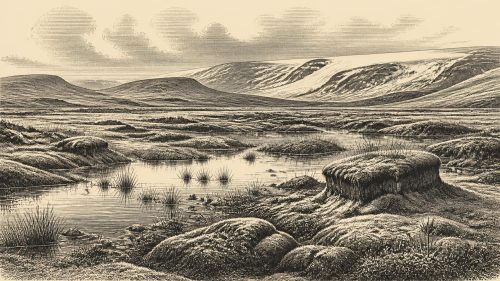
The best Irish evidence near this broad timescale is not a settlement but an environmental archive. At Derryvree, near Maguiresbridge in County Fermanagh, roadworks in 1969 cut through a drumlin and revealed organic freshwater silts and fine sands trapped between two thick glacial tills. Till is debris laid down directly by ice. The sequence therefore records three large-scale changes: an earlier phase of glaciation, a subsequent ice-free interval in which water and vegetation accumulated sediment, and a later ice advance that buried and preserved the deposit.
The organic layer produced the radiocarbon determination Birm-166, reported as 30,500 ± 1,100 radiocarbon years BP. Such a result is not equivalent to a calendar date: atmospheric radiocarbon varied substantially in the deep past, so laboratory ages must be calibrated against independently dated records. The uncertainty is also large enough to span many centuries or millennia. Derryvree cannot tell us what occurred in one year, but it securely demonstrates that part of Fermanagh was ice-free during a cold Middle Midlandian interval broadly relevant to 31,251 BCE.
Its plant and insect remains indicate a treeless, wet tundra or muskeg landscape rather than the green, wooded island familiar today. Mosses, sedges, grasses and herbs grew around shallow water and saturated ground; aquatic plants show that pools and sluggish freshwater existed locally. Mountain-avens, dwarf willow, bogbean and other cold-tolerant taxa point to a periglacial climate, where frost processes shaped the ground even outside the margins of an ice sheet. This was not necessarily a uniform Irish scene. Sheltered hollows, spring-fed watercourses, exposed uplands and limestone country could offer very different conditions within relatively short distances.
Climate, Ice and Changing Coasts
MIS 3 was neither a single unbroken freeze nor a stable warm phase. North Atlantic climates swung repeatedly between colder stadials and relatively milder interstadials. Ireland’s surviving evidence is too sparse to assign Derryvree confidently to a particular short-lived Greenland climate event, yet the freshwater sediments are important precisely because they interrupt a glacial sequence. Speleothems in Crag Cave, County Kerry, formed episodically during parts of MIS 3, independently showing that liquid water percolated through limestone in some milder intervals. Derryvree and Crag Cave should not be treated as identical local climates, but together they caution against imagining Ireland as permanently ice-covered at this date.
At the same time, the direction of change was ominous. The British–Irish Ice Sheet was growing through the period from about 31,000 years ago towards its greatest overall extent around 26,000 years ago. Later ice advances would remodel huge areas, eroding older soils and archaeological surfaces, transporting deposits and burying others beneath till. That destructive history is a major reason why evidence for very early people in Ireland is so exceptionally slight. Absence of camps, hearths and tools cannot simply be read as absence of people; but neither can the likelihood of lost evidence be used to create an unseen settled population.
Sea level was much lower globally than today, and the outlines of the Irish landmass and its surrounding plains differed greatly from modern coastlines. Yet the exact availability of a walkable route, a sea crossing or a shifting mixture of land, ice and water for any particular moment remains uncertain. It is safest to say that movement between Ireland, Britain and north-western Europe was conditioned by changing ice margins, coastlines, rivers and animal ranges. No surviving Irish artefact of this age maps a route, identifies an origin point or demonstrates an exchange network.
Castlepook’s Difficult Evidence
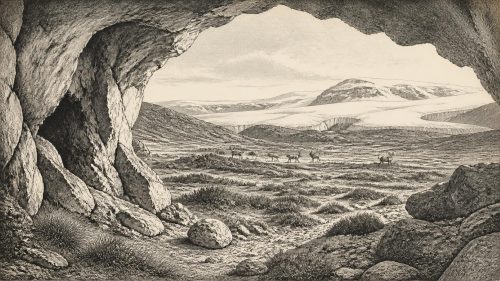
The most arresting object connected with this broad era comes from Castlepook Cave, also called Mammoth Cave, near Doneraile in north County Cork. The cave’s early twentieth-century excavations recovered a rich collection of Ice Age animal remains. Reassessment and improved radiocarbon methods have made Castlepook central to study of Ireland’s MIS 3 fauna, while also exposing the limitations of old collections. The original excavators worked before modern standards of layer-by-layer recording, systematic sieving, sediment analysis and accelerator radiocarbon dating. A bone labelled from the cave is valuable evidence, but seldom a securely located fragment of a single occupation surface.
Among the collection is a reindeer femur carrying a deep linear scar. Ruth Carden has interpreted the mark as damage made by a sharp stone tool during the processing of fresh bone. County Cork heritage material places the bone broadly at about 31,000 BC, making it especially close to the chronological horizon represented by this article. If the interpretation is sustained, it is potentially the earliest evidence that people handled an animal in Ireland. It would be a remarkable extension of the island’s known human story beyond the much later, securely documented Mesolithic record.
But the claim must be described exactly. A dated animal bone establishes an age range for the animal’s death, not an exact date for a mark. Identifying a cut or chop mark requires taphonomic judgement: specialists must distinguish it from carnivore gnawing, trampling, weathering, sediment abrasion, breakage and damage during excavation or storage. Furthermore, Castlepook is a cave archive accumulated over long periods. Carnivores can carry carcass parts into caves; water and gravity can rearrange material. A marked limb bone does not prove that people killed the reindeer at the cave, camped there, or even entered the chamber from which it was recovered.
No securely associated stone-tool assemblage, fireplace, dwelling floor, burial, personal ornament, art or human bone has yet demonstrated a resident Irish community around 33,200 years ago. Recent licensed excavation at Castlepook has sought surviving deposits that may permit more decisive contextual study. Until such evidence is published, the femur is best treated as a narrow but important indication of possible Upper Palaeolithic carcass processing, not as proof of permanent settlement or a named first population.
Animals in an Open Country
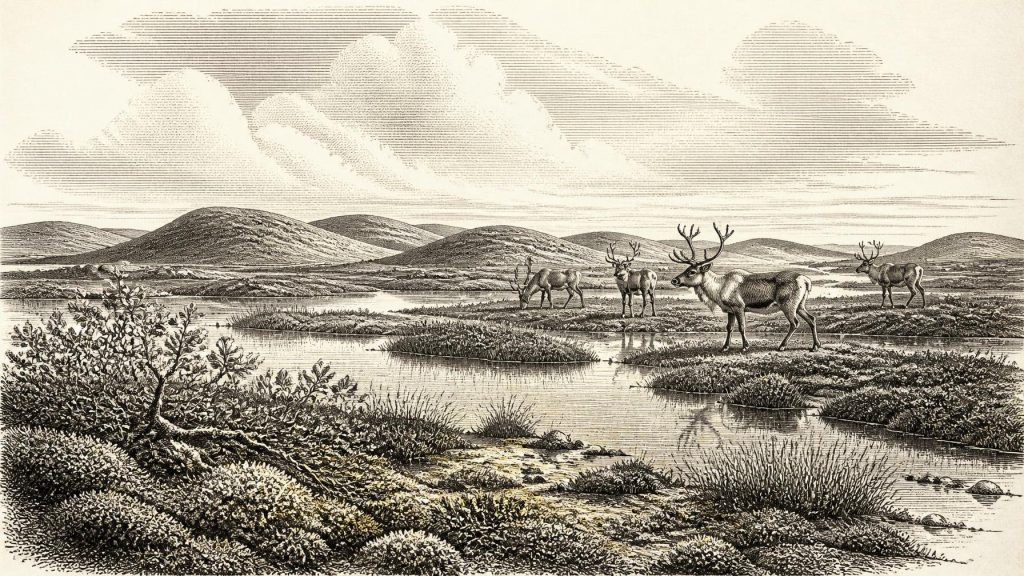
Even where people remain uncertain, the animal record shows that Ireland could support a very different late-Pleistocene fauna at intervals. Castlepook has yielded remains attributed to reindeer, woolly mammoth, giant deer, brown bear, wolf, fox, mountain hare, lemmings and spotted hyaena. Not every species need have occupied the same valley, season or generation: cave collections can combine remains accumulated over thousands of years. Nonetheless, the assemblage confirms that cold-adapted animals and large herbivores reached southern Ireland during MIS 3.
Reindeer are particularly evocative because their movements could link food, terrain and possible human travel. In an open landscape they might have provided meat, fat, marrow, hide, sinew, bone and antler. If the Castlepook scar is anthropogenic, it shows only that a sharp lithic edge was used on one carcass. It cannot disclose whether the animal was hunted, scavenged, butchered elsewhere or divided among several people. Nor can it determine the season, the group’s size, the type of tool, clothing, language or destination. ‘Reindeer hunters’ is a plausible working model, not a fact inscribed on the bone.
Predators matter as much as prey. Spotted hyaena remains and coprolites at Castlepook strongly suggest use of the cave as a carnivore den during part of its history. Hyaenas, wolves and bears could compete for carcasses, carry bones into shelter and alter them after death. This is one reason a cave bone is both informative and difficult. The same processes that preserved evidence of extinct animals can disconnect it from the place where an animal died or was initially processed.
No Politics, No Proven Religion
There is no evidence from Ireland around this horizon for chiefs, kingdoms, territorial borders, diplomacy, organised warfare or political institutions. Nor is there a basis for reconstructing a local religion, burial rite, art style, language, school of learning or oral tradition. Upper Palaeolithic peoples elsewhere in Europe made sophisticated tools, used fire, tailored clothing and participated in wide social networks; some produced striking art and ornaments. Those comparisons demonstrate human capacities, but they are not Irish evidence. Importing continental cave art or later Celtic mythology into the Derryvree and Castlepook record would replace archaeology with fantasy.
Similarly, there was no farming, pottery, metalworking, town, monument or trade system demonstrable in Ireland at this time. If people did make brief visits, their economy would have been one of mobile foraging and opportunistic use of animal and plant resources. That inference rests on the ecology of the period and the possible bone modification, not on an excavated camp. The practical knowledge needed to move safely through exposed country—reading weather, finding water, tracking animals and perhaps navigating ice-free corridors—would have been substantial, but it cannot be translated into a detailed Irish social history.
What the Evidence Allows
For 31,251 BCE, Ireland offers a history of traces rather than annals. Derryvree preserves wet, treeless ground during an ice-free cold interval; Castlepook preserves a complex fauna and a reindeer femur whose scar may record human action. Both sites also teach restraint. Dates have ranges, deposits have histories, and an animal remain is not automatically a settlement. The most responsible picture is of a climatically unstable Irish landscape, periodically able to sustain tundra vegetation and Ice Age mammals, on the eve of more extensive glaciation. Whether a small human party briefly crossed it remains one of the most important, promising and unresolved questions in Irish prehistory.
Primary Sources
- A reconsideration of the radiocarbon dating of the Marine Isotope Stage 3 fauna from southern Ireland
- The Irish Quaternary Fauna Project
- New insights on the fauna of Ireland's Younger Dryas and Early Holocene from Alice & Gwendoline Cave
- Palaeoecology
- Figure 6.— The subdivision of the Quaternary Period in Ireland
- Exploring the chronosequence of the last British–Irish Ice Sheet
- Growth and retreat of the last British–Irish Ice Sheet, 31 000 to 15 000 years ago: the BRITICE-CHRONO reconstruction
- The timing and magnitude of the British–Irish Ice Sheet between Marine Isotope Stages 5d and 2: implications for glacio-isostatic adjustment, high relative sea levels and ‘giant erratic’ emplacement
- Character of advance and retreat of the southwest sector of the British-Irish Ice Sheet during the last glaciation
- The IntCal20 Northern Hemisphere radiocarbon age calibration curve (0–55 kcal BP)
- 2022:564 – Castlepook Cave, Castlepook South, Cork
- Heritage Artefacts of County Cork
- The exploration of Castlepook Cave, Co. Cork. With 3 plates.
- Occurrence of mammalia relicts at site Castlepook Cave
- The colonization of Ireland: A human ecology perspective
- First evidence of a Late Upper Palaeolithic human presence in Ireland
- First evidence of a Late Upper Palaeolithic human presence in Ireland
- A 10Be-dated record of glacial retreat in Connemara, Ireland, following the Last Glacial Maximum and implications for regional climate
- Pattern and timing of retreat of the last British-Irish Ice Sheet
- Oscillating retreat of the last British-Irish Ice Sheet on the continental shelf offshore Galway Bay, western Ireland