Maguirebridge’s Sealed Tundra31324 BCE
31,324 BCE is an editorial date within a broad Late Pleistocene range, not a datable Irish year. At Derryvree near Maguiresbridge, Fermanagh, freshwater sediments later sealed beneath ice preserve pollen, plants, mosses and insects indicating an ice-free, treeless, waterlogged tundra with wetland niches. Castlepook Cave, Cork, contains remains of reindeer, mammoth, giant deer, predators and other cold-stage fauna, although cave deposits span long periods and may be disturbed. A marked reindeer femur may record butchery by humans, but cannot prove settlement. Ireland was regionally variable during MIS 3; later glaciation destroyed much evidence, leaving only fragmentary ecological and human traces.
Dateline
The label 31,324 BCE supplies a useful point on a modern timeline, but it cannot identify an Irish event, ruler, community or season. No calendar was kept in Ireland at this depth of time, and no archaeological method can isolate a single year so far back. In radiocarbon practice, the date falls roughly 33,273 years before AD 1950, within the Late Pleistocene and Marine Isotope Stage 3 (MIS 3), an unstable part of the last Ice Age. The responsible history of Ireland at this point is therefore a history of evidence measured in broad calibrated ranges, not a narrative of year-by-year happenings.
The best Irish evidence relevant to this horizon comes from very different kinds of archive: sediment trapped beneath later ice in County Fermanagh, and animal bones preserved in limestone caves, particularly around Castlepook near Doneraile in north County Cork. Together they show that parts of Ireland supported cold-adapted life during the long approach to the Last Glacial Maximum. They do not demonstrate a settled island population, an Irish polity, or a continuous human occupation.
A Date Beyond Calendar Precision
Radiocarbon measurements are conventionally expressed in years “before present”, where present means AD 1950, but a radiocarbon age is not simply convertible into a calendar year. Atmospheric carbon-14 levels have varied through time, so results must be calibrated against internationally maintained curves. At more than 33,000 years ago, the resulting calendar ranges remain substantial. A numbered BCE date can therefore be a useful editorial convention, but it should not disguise the limits of precision.
The crucial Fermanagh deposit at Derryvree, near Maguiresbridge, was exposed during roadworks in 1969. There, freshwater silts and fine sands lay between two thick tills: sediments deposited directly by separate phases of glacial ice. Organic material from the intervening freshwater layer produced a radiocarbon age of about 30,500 years BP, with a wide analytical uncertainty. Published calibration places the deposit broadly around 36,900–31,700 calibrated years BP. The modern date 31,324 BCE lies within that broad interval, but cannot be pinpointed within it. Derryvree records an episode or episodes of environmental conditions, not the circumstances of one particular year.
Freshwater Beneath the Ice
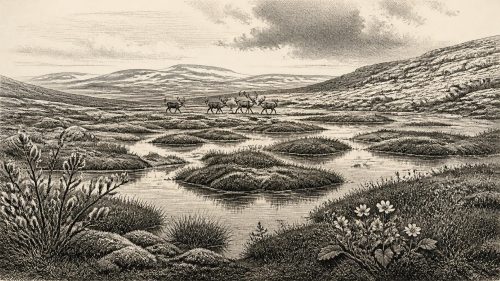
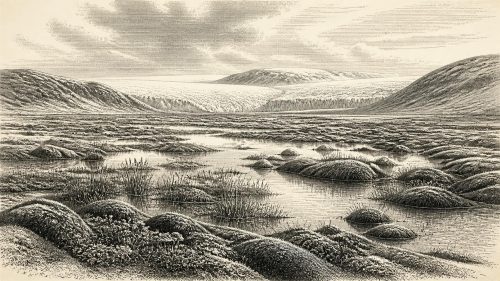
Derryvree matters because the later advance of ice sealed a small environmental archive. Pollen, plant macrofossils, mosses and insect remains from the organic silts indicate open, treeless ground under a periglacial climate. This was not the familiar wooded Ireland of the Holocene, nor a timeless blank expanse of snow. It was a cold landscape of wet hollows, shallow freshwater, sedge-rich margins and exposed mineral ground, with vegetation adapted to a short growing season and severe winters.
The assemblage includes plants associated with tundra and wet ground, such as sedges, mosses, bogbean and aquatic species. Arctic-alpine elements, including mountain avens and dwarf willow, help to indicate the character of the wider setting. Insects add a further dimension: beetles and other small organisms can be highly sensitive indicators of temperature, soil moisture and vegetation cover. Read together, these remains support an interpretation of a waterlogged tundra or muskeg-like landscape, locally productive in summer but climatically harsh.
That conclusion must be kept geographically modest. Derryvree proves that this portion of what is now County Fermanagh was ice-free long enough for freshwater deposits and vegetation to develop before being overridden by ice. It does not provide a complete map of the island at the same moment. Ireland’s glaciers and ice margins changed through time and place; conditions in Fermanagh need not have matched those in Cork, Kerry, the west coast or the Irish Sea basin. Yet the site firmly rejects any simple picture of all Ireland as continuously buried beneath ice throughout the period.
Animals of an Open Country
Cave collections provide the other principal window. Castlepook Cave, formerly often called Mammoth Cave, is close to the Awbeg valley near Doneraile. Excavations in the early twentieth century recovered a remarkable collection of Late Pleistocene animal bones, much of which eventually entered the care of the National Museum of Ireland. Later scientific re-examination and radiocarbon dating have made the collection central to debates about Ice Age Ireland.
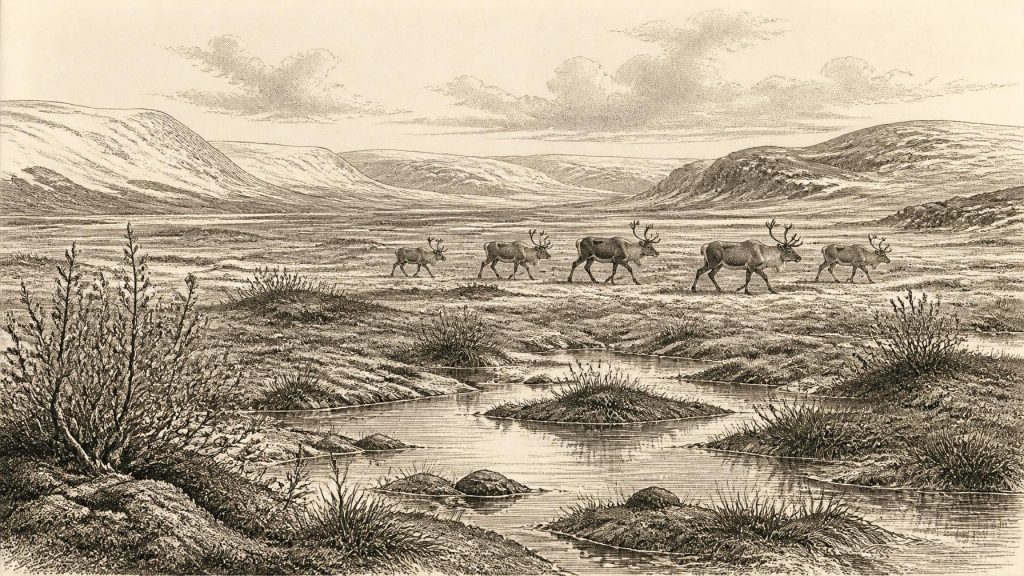
The fauna includes reindeer, woolly mammoth, giant deer, brown bear, wolf, Arctic fox, hare, lemmings and spotted hyaena. Not every species belongs to precisely the same moment: caves may collect bones over millennia, while carnivore activity, water movement, excavation methods and later disturbance can mix deposits. Nevertheless, directly dated specimens show that a diverse cold-stage fauna reached Ireland during MIS 3, broadly between about 45,000 and 20,000 radiocarbon years ago. Around the date represented here, reindeer and other animals of open, cold environments were part of the Irish ecological world.
The presence of spotted hyaena is especially revealing. These were powerful scavengers and hunters, and their remains at Castlepook suggest that caves could be used and reused by carnivores rather than serving as simple natural traps. A cave bone is not automatically evidence of a nearby living landscape in the way a lake pollen core can be. It may record prey dragged inside, a carcass brought by water, an animal that died in shelter, or deposits disturbed long after accumulation. The force of the Castlepook evidence lies in its combined faunal range and dating programme, not in treating every bone as a scene frozen in place.
The Reindeer Femur Question
The most important, and most contested, possibility for human history is a reindeer femur from Castlepook. It has been reported as about 33,000 years old and bears a deep mark interpreted by zooarchaeologist Ruth Carden as a cut made with a sharp stone tool while fresh tissue was being removed. If that interpretation is upheld, it would be the earliest known evidence that people handled an animal in Ireland, dramatically earlier than the well-established evidence for later hunter-gatherer settlement.
Its significance is matched by its limitations. The bone derives from an old cave collection, not from a newly excavated occupation surface with tools, hearths, spatial records and a secure sequence of associated deposits. One possible butchery mark does not reveal how many people were present, where they came from, how long they stayed, whether they killed the reindeer or scavenged it, or whether they returned. It certainly cannot establish a village, a permanent population, a named people or a lineage leading to later Irish communities.
There are good reasons to take the possibility seriously. By this time, Homo sapiens had spread across north-western Europe, and Upper Palaeolithic communities elsewhere had sophisticated stone-working traditions, broad knowledge of animal resources and considerable mobility. Ireland was not culturally beyond their conceivable reach. Lower sea levels also meant a radically different geography around the Irish Sea. But the exact configuration of ice, coasts, exposed shelves and viable routes changed repeatedly. Any human visit implied by Castlepook was a movement across a difficult northern landscape, not proof of an easy or permanent land connection.
Life Without a Recorded Society
There is no evidence from Ireland around this broad date for political institutions, territorial kingdoms, formal diplomacy or organised warfare. Those categories belong to much later archaeological and written worlds. Nor is there Irish evidence for houses, campsites, hearths, graves, art, ornaments, language or religious practice from this interval. It would be misleading to import the cave paintings, figurines or burial customs of continental Europe and present them as Irish facts.
If the Castlepook cut mark is human-made, the narrowest reasonable interpretation is economic rather than political: one person or a small mobile party used a sharp stone edge in processing a reindeer. Meat, marrow, hide, sinew, antler and bone would all have been valuable resources to Ice Age foragers elsewhere, but their precise use at Castlepook is unrecorded. The find offers a question about fleeting human action, not a full account of everyday life.
For the non-human inhabitants, seasonal movement was probably fundamental. Reindeer herds, carnivores and smaller mammals occupied a landscape whose food supply altered sharply between summer growth and winter scarcity. Wetland plants, mosses and insects show that even cold terrain contained local ecological niches. Such places could concentrate food, fresh water and animal movement, though the evidence does not allow a reconstruction of a particular hunting ground or migration route.
Ice on the Horizon
This interval belongs to the wider build-up towards the Last Glacial Maximum, when the British–Irish Ice Sheet eventually became extensive across Ireland, Britain and adjacent continental shelves. Modern reconstructions stress that this expansion was not a single, uniform advance. Ice reached maximum positions at different times in different sectors, generally later than the Derryvree freshwater episode. The full-glacial ice sheet subsequently erased, buried or reworked enormous quantities of earlier land surfaces and archaeological traces.
That destruction helps explain why the evidence is so fragmentary. A mobile group could have left light, scattered traces even under ideal preservation conditions; later ice, erosion, changing rivers and rising seas made their survival still less likely. Ireland’s deepest human past may therefore be underrepresented in the archaeological record. This is an inference about preservation, however, not evidence that a large unseen population once lived on the island.
For 31,324 BCE, then, Ireland can be described with confidence as part of the north-west European Ice Age world: climatically severe, regionally variable, and capable in some places of sustaining tundra wetlands and large mammals. Derryvree’s silts preserve an ice-free freshwater landscape later sealed beneath a drumlin. Castlepook’s bones preserve the remains of an open-country fauna and perhaps a rare human touch. Beyond that threshold, the silence of the evidence is itself the central historical fact.
Primary Sources
- A Middle Midlandian Freshwater Series at Derryvree, Maguiresbridge, County Fermanagh, Northern Ireland
- The Irish Quaternary Fauna Project
- A reconsideration of the radiocarbon dating of the Marine Isotope Stage 3 fauna from southern Ireland
- Growth and retreat of the last British–Irish Ice Sheet, 31,000 to 15,000 years ago: the BRITICE-CHRONO reconstruction
- Timing, pace and controls on ice sheet retreat: an introduction to the BRITICE-CHRONO transect reconstructions of the British–Irish Ice Sheet
- The deglaciation of the western sector of the Irish Ice Sheet from the inner continental shelf to its terrestrial margin
- Dimensions and chronology of the last ice sheet in Western Ireland
- Exploring controls of the early and stepped deglaciation on the western margin of the British Irish Ice Sheet
- Palaeoecology
- Figure 6.— The subdivision of the Quaternary Period in Ireland
- Preliminary Assessment of the Archive of Faunal Remains from Excavated Irish Cave Sites
- 2022:564 – CASTLEPOOK CAVE, Castlepook South, Cork
- Archaeology Research Excavation Grant 2022: Final Report
- First evidence of a Late Upper Palaeolithic human presence in Ireland
- New Insights on the Fauna of Ireland's Younger Dryas and Early Holocene from Alice & Gwendoline Cave
- The Archaeology of Caves in Ireland
- The Mesolithic in Ireland: When Was It?
- Archaeological Heritage of County Cork
- Heritage Artefacts of County Cork
- The IntCal20 Northern Hemisphere Radiocarbon Age Calibration Curve (0–55 cal kBP)
- The problem of a late quaternary landbridge between Britain and Ireland
- Sea-Level Change for the Irish Sea