Castlepook’s Stone-Tool Mark31332 BCE
About 31,332 BCE, Ireland lay within the fluctuating Late Pleistocene climate of Marine Isotope Stage 3, before the Last Glacial Maximum. Derryvree deposits in Fermanagh indicate treeless, periglacial tundra, wetlands and pronounced seasonality, with locally productive habitats between glacial episodes. Castlepook Cave in Cork preserved a diverse, time-mixed fauna including mammoth, reindeer, giant deer, bears, wolves, hyaenas, foxes and lemmings. A deeply incised reindeer femur may record stone-tool use and fleeting human activity, but cannot prove settlement. Low sea levels altered regional connections, while later glaciation obscured evidence. The period is understood through environmental and faunal traces, not historical events.
Dateline
The label “31,332 BCE” is useful only as a modern point of reference. No Irish evidence can identify a named year, season or event at this depth of time, and no calendar existed from which such precision could be recovered. In archaeological terms, the date falls within the Late Pleistocene, in the later part of Marine Isotope Stage 3 (MIS 3), a fluctuating phase of the last Ice Age. It is best approached through broad calibrated ranges, faunal finds, cave deposits and glacial sediments rather than through an imagined annual chronicle. Around this notional date, Ireland was a cold, changing north-western landscape, not the wooded island familiar from later prehistory.
Dating a Changing Landscape
Modern radiocarbon dating uses “before present”, conventionally before AD 1950, and results must be calibrated against changing atmospheric carbon levels. Thus 31,332 BCE corresponds approximately to 33,281 calibrated years before present, but it should not be mistaken for a precise archaeological timestamp. The relevant Irish deposits commonly have uncertainties of centuries or millennia, while bones from old cave excavations may have been displaced after their original deposition. The responsible question is therefore what Ireland was like during the broader interval around 35,000–32,000 calibrated years ago, not what occurred in one recoverable year.
The important climatic setting was not yet the full Last Glacial Maximum. That major expansion of the British–Irish Ice Sheet came later, broadly after about 28,000 calibrated years ago, reaching its principal extent in Irish and Celtic Sea sectors around 25,000–23,000 years ago. Around 31,332 BCE, glaciers and ice masses had already shaped parts of the country and seas, but Ireland was not simply a uniform ice sheet. Conditions varied sharply with region, altitude, season, proximity to ice and changing North Atlantic climate. Habitable ground, where it existed, would have been exposed in patches rather than forming a stable, temperate homeland.
Open Ground, Wet Hollows
The clearest environmental evidence comes from Derryvree near Maguiresbridge in County Fermanagh. There, roadworks exposed freshwater silts and fine sands trapped between two tills within a drumlin. The organic deposit, known by its laboratory designation BIRM-166, produced a conventional radiocarbon determination of 30,500 +1,170/−1,030 BP. Later discussion places the calibrated range broadly at 36,900–31,700 cal BP. That range overlaps the chronological world represented by 31,332 BCE, although it does not date a single landscape moment across all Ireland.
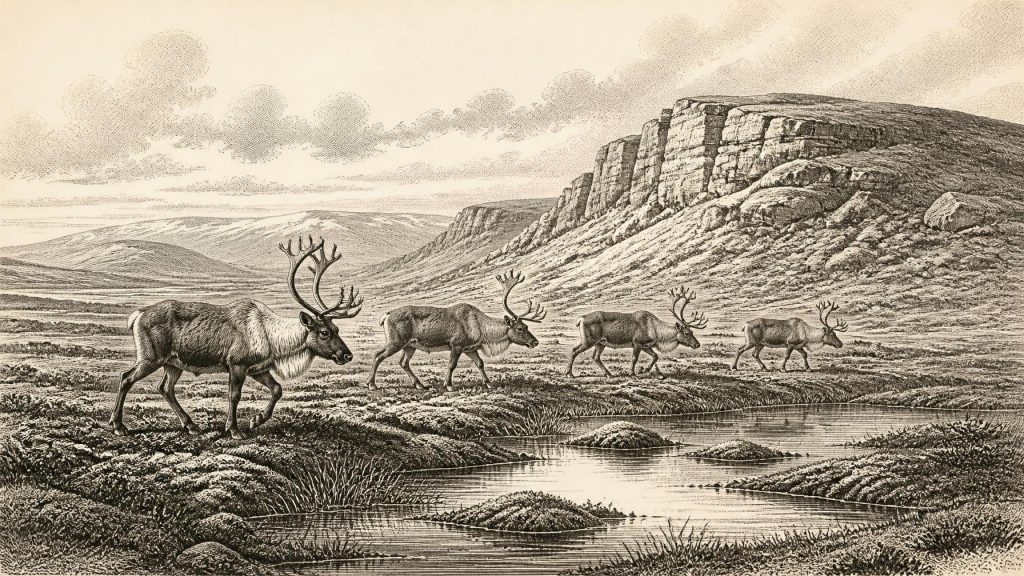
Derryvree’s pollen, plant macrofossils, insects and sediments indicate an open, treeless tundra or muskeg environment under periglacial conditions. Mosses, sedges and herbaceous plants grew around shallow water and waterlogged ground; insects and aquatic plant remains point to local pools rich in organic matter. Dry land may have supported only sparse cover. A few tree-pollen grains do not demonstrate local forest: they may have travelled far, been redeposited or derived from small distant refuges. The reliable conclusion is one of cold, exposed country with wetlands in favourable hollows, not a simple image of either barren polar desert or mild woodland.
This was an environment of strong seasonality. Winter frost and frozen ground would have restricted plant growth and altered drainage; a short summer could nevertheless sustain wetland vegetation, grazing animals and insect life. The silts are valuable precisely because they preserve an ecological assemblage rather than a human story. They show that, at least in south Fermanagh during a broad MIS 3 interval, freshwater conditions occurred between episodes of glaciation. They cannot reveal settlement, language, ownership or ritual.
The Southern Cave Fauna
Southern Irish caves provide another window. Castlepook Cave, near Doneraile in north County Cork and close to the Ballyhoura uplands, produced one of Ireland’s most important assemblages of pre-Last Glacial Maximum animal remains. Excavated principally in the early twentieth century, the cave yielded bones attributed to woolly mammoth, reindeer, giant deer, brown bear, wolf, Arctic fox, mountain hare, Norwegian lemming, collared lemming and spotted hyaena. Direct radiocarbon dating has shown that these remains span a long period rather than one single animal community or one occupation event.
This distinction matters. A mammoth rib, reindeer bone and hyaena element from Castlepook can show that their species reached Ireland during the wider Ice Age interval, but not necessarily that all stood together in one valley or even lived in the same century. Cave passages accumulated bones through several processes: animals may have fallen through openings, died in the cave, been carried by water, dragged in by carnivores or disturbed by later activity. The Irish Quaternary Fauna Project demonstrated that some apparently coherent cave layers had been extensively re-sorted. Recent re-dating with improved pretreatment has also shown that some older results from Irish cave collections were unreliable.
Even so, the fauna supports a broad ecological interpretation. Reindeer, lemmings and Arctic fox are strongly consistent with cold, open habitats; mammoth and giant deer indicate that at intervals there was enough vegetation to sustain large herbivores. Wolves and spotted hyaenas belong to the same wider food web as predators and scavengers. Ireland was therefore capable of supporting more life than the phrase “Ice Age” might suggest. Yet the fossil record does not establish herd size, migration routes, population continuity or the exact distribution of each animal across the island.
A Mark on Reindeer Bone
Castlepook is especially significant because a reindeer femur in the historic collection has been reported as carrying a deep incision consistent with cutting by a sharp stone tool. The bone has been publicised as about 33,000 years old, making it potentially relevant to the broad period represented by 31,332 BCE. If the interpretation is sustained, it would be a remarkable possible indication that Upper Palaeolithic people handled or processed a reindeer in Ireland long before the better-attested terminal Pleistocene and Mesolithic records.
That proposition requires careful limits. The radiocarbon result dates the animal bone, not independently the incision. The femur did not come from a modern excavation of an intact campsite with a hearth, lithic assemblage, dwelling surface or a concentration of freshly butchered carcasses. Nor does one marked bone identify the maker’s species, sex, language, group, journey or duration of stay. Distinguishing a stone-tool cut from damage caused by carnivores, sediment movement, breakage, weathering or excavation depends on detailed taphonomic assessment. It is therefore evidence of high potential, not proof of a settled Irish hunting population.
The most cautious interpretation is of possible short-lived human presence: perhaps a small mobile party encountering, hunting or scavenging a reindeer, if the mark is indeed anthropogenic. Meat, fat, hide, sinew, antler and bone would all have been useful resources, but none of those uses can be demonstrated from this individual femur alone. There is no responsible basis for reconstructing a camp at Castlepook, a regular migration circuit through Cork or a community living year-round in Ireland.
No Polities, No Recorded Society
Political affairs, diplomacy and organised conflict leave no identifiable evidence for Ireland at this date. There were no recorded rulers, territories, monuments or institutions; indeed, there is no securely excavated Irish settlement to which a social structure can be attached. If people visited, their numbers may have been extremely small and their presence intermittent. They would have belonged to wider Upper Palaeolithic worlds known on the European mainland and in Britain, but Irish evidence is insufficient to assign a particular archaeological culture, technology or social identity.
The same restraint applies to religion, art and learning. Caves should not automatically be treated as shrines, and Castlepook has not yielded contemporary parietal art, personal ornaments, burials or symbolic objects attributable to around 31,332 BCE. Nor is there evidence for farming, domestic animals, pottery, metalworking, formal trade networks or permanent villages. Absence of evidence is partly a consequence of later ice action, erosion, rising seas and the limited survival of old ground surfaces, but it remains absence. The richest demonstrable cultural material from this period is the scientific record itself: bones, sediments, pollen and microscopic traces.
Connections Beyond Ireland
Ireland’s fauna nevertheless implies movement and ecological connection beyond its modern shores. Sea level was substantially lower during the Ice Age, exposing wider coastal shelves and changing the geometry of surrounding waters. That did not necessarily create an easy or continuous land route from Britain or continental Europe. The Irish Sea contains deep basins, and the precise pathways available to animals or people varied through time. Any claim that a specific group walked directly into Ireland at this date would go beyond the evidence.
What can be said is that Ireland formed part of a wider north-west European climatic zone. Cave faunas in Britain offer useful comparisons, but they cannot fill every Irish gap. The island’s position at the Atlantic edge, varied relief and shifting ice margins created distinctive local conditions. Later ice-sheet growth would cover and erode large areas, making the survival of an early camp exceptionally unlikely. This helps explain why a single reindeer femur can carry such weight in discussion while still being too slight a basis for certainty.
What the Evidence Allows
A responsible view of Ireland around 31,332 BCE is thus neither empty nor overconfident. Derryvree documents cold, periglacial wetlands and open tundra vegetation in a broadly overlapping time range. Castlepook documents a varied Ice Age fauna in southern Ireland across MIS 3, including reindeer and mammoth. A marked reindeer bone raises the possibility of human activity, but does not yet furnish a dateable settlement or a historical narrative. The key development was environmental: Ireland contained shifting, locally productive habitats before the later glacial maximum transformed much of the landscape.
Future progress depends on direct dating, microscopic study of bone surfaces, renewed cave excavation, palaeoenvironmental sampling and investigation of now-submerged landscapes. The National Museum of Ireland’s historic collections remain central, because specimens recovered long ago can be re-examined using methods unavailable to their excavators. For now, the best account is one of cold-country ecosystems, intermittent opportunity and a tantalising human trace—not a calendar year of kings, battles or communities that archaeology cannot honestly recover.
Primary Sources
- A reconsideration of the radiocarbon dating of the Marine Isotope Stage 3 fauna from southern Ireland
- The Irish Quaternary Fauna Project
- A Middle Midlandian Freshwater Series at Derryvree, Maguiresbridge, County Fermanagh, Northern Ireland
- Palaeoecology: Irish Quaternary Association Field Guide 16
- New insights on the fauna of Ireland’s Younger Dryas and Early Holocene from Alice & Gwendoline Cave
- 2022:564 – Castlepook Cave, Castlepook South, Cork
- Archaeological Heritage of County Cork
- Heritage Artefacts of County Cork
- First evidence of a Late Upper Palaeolithic human presence in Ireland
- First evidence of a Late Upper Palaeolithic human presence in Ireland (author manuscript)
- Dimensions and chronology of the last ice sheet in Western Ireland
- Trimlines, blockfields and the vertical extent of the last ice sheet in southern Ireland
- Pattern and timing of retreat of the last British-Irish Ice Sheet
- Response of the Irish Ice Sheet to abrupt climate change during the last deglaciation
- Ice sheet extension to the Celtic Sea shelf edge at the Last Glacial Maximum
- Stratigraphic and palaeo-geomorphological evidence for the glacial-deglacial history of the last British-Irish Ice Sheet in the north-western Irish Sea
- Exposure-age constraints on the extent, timing and rate of retreat of the last Irish Sea ice stream
- Growth and retreat of the last British–Irish Ice Sheet, 31,000 to 15,000 years ago: the Irish Sea glacial system
- Investigating seasonal mobility in Irish giant deer Megaloceros giganteus through strontium isotope analysis
- IntCal20 Northern Hemisphere radiocarbon age calibration curve (0–55 cal kBP)
- OxCal Radiocarbon Calibration Software