The Castlepook Bone Question31323 BCE
31,323 BCE is a retrospective label within climatically unstable Marine Isotope Stage 3, not a precisely datable Irish event. Environmental records from Crag Cave and northern deposits indicate fluctuating conditions, including milder phases, wetlands and open cold-country habitats. Castlepook Cave, County Cork, preserves remains of mammoth, reindeer, giant deer, hyaena and fauna, demonstrating productive Ice Age ecosystems before the Last Glacial Maximum. A marked reindeer femur may show butchery with a stone edge and early human visitation. However, lacking associated tools, hearths or settlements, it cannot prove population, society or occupation. Ireland’s history remains environmental, while human presence is unresolved.
Dateline
Modern calendar-year precision is not available for Ireland in 31,323 BCE. The number is a retrospective label, roughly 33,270 calendar years before the conventional radiocarbon reference year of 1950, not a date at which an Irish event can be identified. No written record, settlement sequence or securely dated human activity allows historians to say what happened in that particular year. The responsible approach is to place it within the Late Pleistocene, broadly Marine Isotope Stage 3 (MIS 3), and to use archaeological and environmental evidence expressed in wide calibrated ranges and laboratory ages.
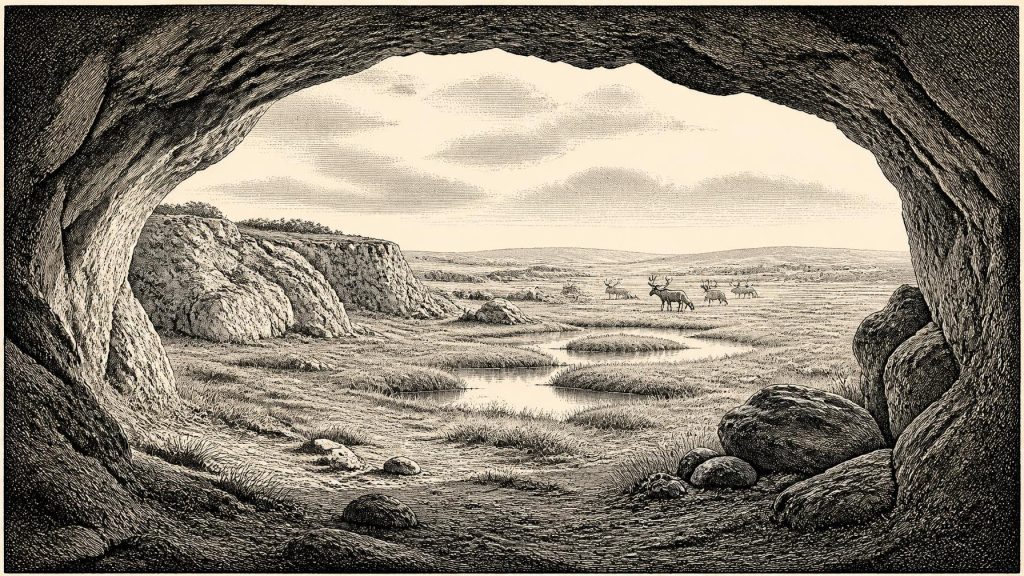
This was an age of sharp climatic instability in the north Atlantic world. Ireland’s landscape was not yet the familiar green island of later millennia, and its human story, if there was one at all, survives only as a difficult and still-debated trace. The most important Irish evidence close to this chronological horizon comes from Castlepook Cave, near Doneraile in north County Cork. It illuminates an Ice Age animal world and raises a profound question about the earliest possible human presence in Ireland. It does not yet prove an established population.
A Date Within a Moving Climate
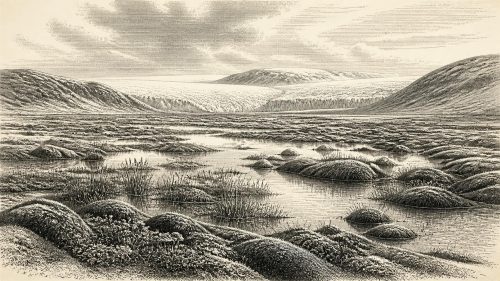
At roughly 33,270 years before present, Ireland lay within MIS 3, generally dated from about 57,000 to 29,000 years ago. This was not one uniform “Ice Age”. Greenland ice cores show repeated millennial swings between relatively milder interstadials and severe stadials. The effects in Ireland included changes in temperature, vegetation, water supply and the extent of local or regional ice. It is therefore misleading to picture the whole island as permanently buried beneath a single ice sheet at this point. The maximum extent of the last British–Irish Ice Sheet belongs later, principally between about 26,000 and 21,000 calendar years ago, although the exact pattern and timing of its growth remain matters of active research.
For 31,323 BCE, scholars cannot securely match a named Irish deposit to a single Greenland climatic episode. Radiocarbon calibration becomes especially difficult in this part of the timescale, while many Irish sediments have been disturbed, overridden by later ice or exposed only briefly in quarries and cuttings. The best conclusion is deliberately modest: parts of Ireland were capable, at intervals during MIS 3, of supporting cold-adapted animals and the vegetation on which they depended; conditions changed greatly through time and from region to region.
Crag Cave in County Kerry supplies an important independent indicator. Uranium-thorium dating of cave calcite shows that dripstone formed episodically through much of the last glacial cycle. Because speleothem growth requires liquid water and conditions generally above freezing within this shallow cave system, it records intervals when south-western Ireland was less hostile than during the coldest phases. It does not provide a diary of life outside the cave, but it makes clear that glacial Ireland experienced climatic pulses rather than unbroken deep freeze.
North Irish Wetlands and Open Ground
Deposits in the north of the island help reconstruct the wider environmental setting, though they cannot be tied precisely to 31,323 BCE. At Derryvree and Hollymount near Maguiresbridge in County Fermanagh, and at Aghnadarragh near Lough Neagh in County Antrim, organic layers lie between tills left by separate episodes of glaciation. Their pollen, plant macrofossils, insects, silts and peats are valuable because they preserve fragments of environments subsequently sealed beneath glacial sediment.
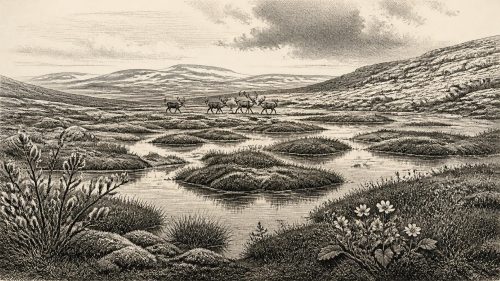
Some of those records are older than the date in question; others have broad or problematic age estimates. Collectively, however, they show that Ireland’s last cold stage included treeless or sparsely vegetated landscapes, wet hollows, shallow freshwater, swampy ground, bare mineral surfaces and flood-prone plains. Cold-phase deposits have produced evidence for mosses, sedges, bogbean, aquatic plants and other tundra or wetland vegetation. Such evidence should not be stretched into a national map for one year. It does demonstrate that even a cold, open Ireland contained varied local habitats: pools and marshes in sheltered basins, grass and herb communities on drier ground, and sediment-laden waters near ice margins.
At Aghnadarragh, a longer sequence also records an earlier, milder MIS 3 episode with birch, pine and spruce, swamps and local pools. That woodland phase is older than about 48,000 radiocarbon years before present and cannot simply be transferred to 31,323 BCE. Its importance lies in showing the scale of change possible within one broad geological stage. Ireland could shift from cool-temperate wooded landscapes to cold, treeless terrain before later ice again transformed much of the surface.
Castlepook’s Animal Archive
Castlepook Cave is the crucial southern counterpart to these northern environmental sequences. Excavations begun in the early twentieth century recovered a very large and now incomplete bone assemblage. Subsequent study has identified remains attributed to woolly mammoth, reindeer, giant deer, brown bear, wolf, arctic fox, hare, lemmings and spotted hyaena. This is not a single herd, season or ecological snapshot. Bones accumulated in different chambers over many thousands of years, and animals, carnivores, water, sediment movement and excavation all affected their final positions.
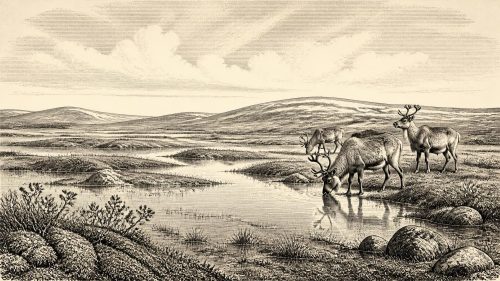
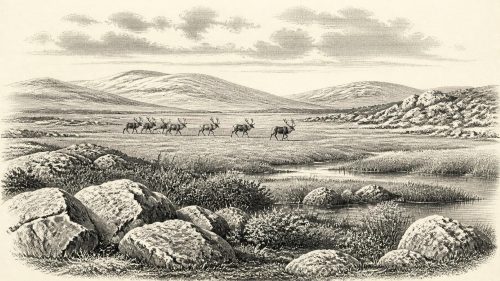
Radiocarbon work nevertheless establishes that some of the cave fauna belongs to MIS 3. Earlier dates from Castlepook have been reassessed using improved pretreatment and accelerator techniques; in some cases the revised determinations are thousands of radiocarbon years older than the original results. The redating has strengthened the case that mammals including giant deer and spotted hyaena were present in southern Ireland well before the Last Glacial Maximum, perhaps disappearing locally by around 40,000 calibrated years before present. The cave’s mammals point towards an open, productive cold-climate mosaic rather than closed forest: a landscape able to sustain grazing and browsing herbivores, their predators and scavengers.
Reindeer are particularly revealing, but not because they permit a simple claim that Ireland was a northern tundra identical to modern Scandinavia. Reindeer thrive across varied arctic and subarctic settings and are highly mobile. Their presence indicates open country and seasonal resources, while mammoth and giant deer point to substantial plant productivity. Hyaenas, wolves and bears remind us that caves were not neutral storerooms. A hyaena den, a natural trap, a shelter used by bears, a place where bones were washed in, and a human stopping-place can all produce overlapping evidence. Distinguishing among those processes is central to responsible interpretation.
The Marked Reindeer Femur
One Castlepook reindeer femur has given this period exceptional significance. Re-examination identified a deep surface modification interpreted as consistent with cutting or chopping by a broad stone edge while fresh bone was being processed. Public heritage accounts have described the object as around 31,000 BCE, and a radiocarbon assessment has been widely reported as placing the animal at about 33,000 years ago. These formulations should not be read as an exact calibrated date for either the animal’s death or the making of the mark. A radiocarbon result dates surviving organic material from the bone; calibration supplies a range of possible calendar ages; the identification of a cut mark is a separate taphonomic judgement.
If the mark is anthropogenic, it is potentially Ireland’s earliest evidence that a person handled and butchered an animal. That would be an extraordinary discovery, placing a human visit to Ireland tens of millennia before the better established post-glacial record. Yet its evidential limits are equally important. No securely associated hearth, stone-tool assemblage, dwelling floor, burial, food store or stratified campsite of this age has been found at Castlepook. Nor can one marked bone establish whether the visitor was alone, part of a small hunting party, or connected to repeated journeys.
The safest interpretation is that the femur records a possibility of brief Upper Palaeolithic human activity, not a settled Ice Age community. Any people involved would have required practical knowledge: a sharp stone edge, the ability to remove meat or disarticulate a carcass, and the mobility to reach a landscape separated from continental Europe by changing seas and land configurations. It cannot identify their language, ancestry, social organisation, religious practice or political allegiance.
Society Without States
There is no evidence for political affairs, diplomacy, territorial kingdoms, formal warfare, monuments, farming, trade networks or organised religion in Ireland at this date. Such topics are not absent because they were necessarily impossible in human society elsewhere, but because Ireland offers no securely interpretable evidence for them in this period. The later concepts of Irish peoples, Gaelic speech, tribal territories and historical provinces have no place in this Late Pleistocene setting.
If people reached the island, their economy would have been one of mobile hunter-gathering, potentially including the opportunistic processing of large animals. That remains an inference from the Castlepook bone, not a demonstrated local way of life. The fauna itself reveals more securely than the human evidence: grazing animals moved through suitable habitats; predators and scavengers followed them; caves collected the remains. Seasonal movement was likely important for animals and would also have mattered to any human visitors, but the routes, duration and frequency of such movements are unknown.
Learning and culture are similarly beyond direct recovery. Stone tools, ornaments, images, structures and burials would be needed to discuss them with confidence, and none is securely linked to this Irish horizon. The most meaningful cultural fact is instead modern: painstaking reanalysis of old collections, improved dating methods and new cave investigations continue to alter the limits of what can responsibly be said about Ireland’s deep past.
An Island of Possibilities
Thus 31,323 BCE should not be remembered as the year of a named hunt, a settlement or a political event. It belongs to a long, fluctuating interval in which Ireland’s physical geography and animal communities were repeatedly reshaped by climate and ice. Northern sediment sequences preserve wetlands and open cold-country vegetation; Crag Cave records intermittent milder conditions; Castlepook preserves a remarkable but mixed record of Ice Age mammals. The marked reindeer femur stands at the edge of that evidence: compelling, potentially transformative and still insufficient to turn possibility into certainty.
For Ireland at this point in time, the clearest history is environmental. The island was a changing Pleistocene landscape inhabited, at different moments, by animals adapted to cold and open country. Whether a small group of people briefly joined that world remains one of the most important unresolved questions in Irish archaeology.
Primary Sources
- New Insights on the Fauna of Ireland’s Younger Dryas and Early Holocene
- A Reconsideration of the Radiocarbon Dating of the Marine Isotope Stage 3 Fauna from Southern Ireland
- The Irish Quaternary Fauna Project
- Quaternary Deposits and Glacial Stratigraphy in Ireland
- Episodic Speleothem Deposition Tracks the Terrestrial Impact of Millennial-Scale Last Glacial Climate Variability in SW Ireland
- Landscapes and Environments of the Last Glacial-Interglacial Transition: A Time of Amazingly Rapid Change in Ireland
- Aghnadarragh
- Figure 6.— The Subdivision of the Quaternary Period in Ireland
- Heritage Artefacts of County Cork
- Mammoth and Musk Ox ESR-Dated to the Early Midlandian at Aghnadarragh, County Antrim, Northern Ireland, and the Age of the Fermanagh Stadial
- Dimensions and Chronology of the Last Ice Sheet in Western Ireland
- Pattern and Timing of Retreat of the Last British-Irish Ice Sheet
- New Data for the Last Glacial Maximum in Great Britain and Ireland
- Maximum Extent and Dynamic Behaviour of the Last British-Irish Ice Sheet West of Ireland
- Early Deglaciation of the British-Irish Ice Sheet on the Atlantic Shelf Northwest of Ireland Driven by Glacioisostatic Depression and High Relative Sea Level
- Oscillating Retreat of the Last British-Irish Ice Sheet on the Continental Shelf Offshore Galway Bay, Western Ireland
- Advance and Retreat of the Marine-Terminating Irish Sea Ice Stream into the Celtic Sea During the Last Glacial: Timing and Maximum Extent
- Last Glacial Maximum Cirque Glaciation in Ireland and Implications for Reconstructions of the Irish Ice Sheet
- Extent and Retreat History of the Barra Fan Ice Stream Offshore Western Scotland and Northern Ireland During the Last Glaciation
- The Quaternary of the Irish Midlands
- Quaternary Site Descriptions
- Cenozoic: Tertiary and Quaternary (Until 11,700 Years Before 2000)