Derryvree’s Radiocarbon Silt31484 BCE
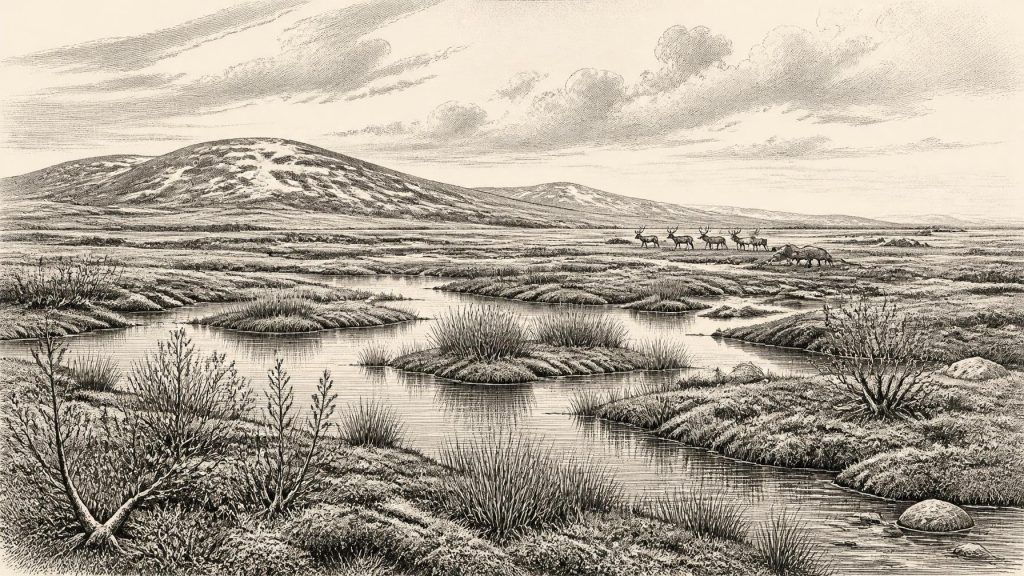
Around 31,484 BCE, Ireland lay within the unstable cold conditions of Marine Isotope Stage 3, not a recoverable historical year. Derryvree, County Fermanagh, preserves freshwater silts between glacial tills, indicating open tundra wetlands supporting sedges, arctic-alpine plants, insects and grazing animals during an ice-free interval. Castlepook Cave, County Cork, contains varied fauna, including mammoth, reindeer and predators, although poorly recorded deposits complicate interpretation. A cut-marked reindeer femur may indicate human butchery, but cannot prove settlement. Later ice advances reshaped landscapes and destroyed evidence, leaving Ireland’s possible Upper Palaeolithic presence uncertain and intermittent. No evidence supports communities, farming, or continuous occupation.
Dateline
31,484 BCE is not a date at which Irish history can be recovered year by year. No written records, named people, settlements, political communities or securely dated events survive from this remote part of the Late Pleistocene. Indeed, modern calendar-year precision is unavailable: radiocarbon results measure probability ranges, must be calibrated against changing atmospheric carbon levels, and commonly carry wide uncertainties at this depth of time. The best approach is therefore to place the notional year within a broader interval, roughly 33,400 calendar years before present, and to ask what deposits, bones and landforms can responsibly reveal about Ireland at or near that time.
Ireland then belonged to Marine Isotope Stage 3, a long and climatically unstable phase of the last ice age. It was not yet the Last Glacial Maximum, when the British–Irish Ice Sheet later reached its greatest extent, but it was a cold world in which ice margins, permafrost, open ground and short-lived milder episodes mattered greatly. The island’s present coastlines did not define its Pleistocene geography. Sea level was much lower than today, exposing large tracts of what are now seabeds, while the extent and continuity of land routes between Ireland, Britain and continental Europe changed with ice, sea level and local topography. Movement into Ireland was physically possible at some stages, but the evidence does not permit a simple map of a permanent land bridge or a settled population.
A Date Made from Ranges
The closest informative Irish environmental record is the freshwater series found at Derryvree, near Maguiresbridge in County Fermanagh. Road works in 1969 cut through a drumlin and exposed silts and fine sands enclosed between two substantial sheets of glacial till. This is a remarkable arrangement: water-laid and organic deposits formed during a locally ice-free interval, then were sealed beneath the products of a later ice advance. A conventional radiocarbon measurement, BIRM-166, gave 30,500 ± 1,170 radiocarbon years before present. Subsequent calibration and chronological discussion place the deposit broadly in the middle part of MIS 3, with a wide calendar-age range that overlaps the general world represented by this article rather than pinpointing 31,484 BCE.
That distinction is essential. Derryvree does not record a single day, season or named episode in 31,484 BCE. Its sediments accumulated over time; fossils may have been moved within the wetland; and the laboratory result has statistical limits. Yet the sequence is direct evidence that, before later glaciation reworked the landscape, part of south Fermanagh contained freshwater, wet ground and a cold-adapted living community. In a country where later ice repeatedly eroded, displaced or buried older surfaces, such an archive is exceptionally valuable.
A Treeless Wetland Landscape
Pollen, plant macrofossils, mosses and insect remains from Derryvree indicate open tundra or muskeg-like conditions rather than forest. Sedges and grasses were important, while the recorded flora included arctic-alpine and wetland plants such as dwarf willow, mountain avens, alpine clubmoss, bogbean and water-milfoil. These remains should not be imagined as a neat modern habitat transplanted unchanged into the past. They instead point to a varied mosaic: shallow pools, saturated mossy ground, plant-rich margins, patches of exposed mineral soil and sparse dry-land vegetation beyond the water.
The climate was periglacial: cold enough for severe winters and frozen ground processes, but not so uniformly inhospitable that freshwater ecosystems could not function. Insects are especially useful here because many species have tight environmental requirements. The Derryvree assemblage supports the interpretation of open, cold conditions with standing or slow-moving water and moss-rich wetland habitats. It is evidence for ecology, not a thermometer reading. Scholars can reconstruct broad climatic character from such combinations, but cannot state the weather on an exact calendar date or claim that every part of Ireland shared precisely the same conditions.
Its wider implication is nevertheless important. Ireland was not simply an unbroken ice sheet or sterile polar desert during every phase of the later Pleistocene. At least locally and intermittently, it offered habitats capable of sustaining plants, invertebrates and grazing animals. Such windows were vulnerable. A subsequent advance of ice overrode Derryvree’s wetland, compressing its evidence between tills and helping to create the drumlin landscape visible in the region today. The deposit is thus both a record of life and a warning against treating modern Ireland’s green, wooded appearance as timeless.
Castlepook and the Animal World
In north County Cork, Castlepook Cave near Doneraile provides another crucial, though more difficult, perspective. Its old cave collections include the remains of mammoth, reindeer, giant deer, spotted hyaena, brown bear, wolf, Arctic fox, stoat, mountain hare and lemmings. This impressive list demonstrates that Ireland could support, or be visited by, a large and ecologically varied Ice Age fauna during MIS 3. Reindeer and mammoth imply open feeding grounds; predators and scavengers indicate a food web with carcasses and herbivores sufficient to support them. Caves, however, are not straightforward snapshots of a single landscape.
Many Castlepook bones were collected during early twentieth-century excavations, before current standards of stratigraphic recording, sampling and dating. Carnivores could drag bones into a cave; water and sediment could redeposit them; and separate episodes may have become mixed. Modern re-dating has also shown that some older Irish cave radiocarbon results underestimated the true age of bones by thousands of years, owing to limitations in earlier preparation methods. The responsible conclusion is that Castlepook preserves an important MIS 3 faunal record, but its animals were not necessarily all alive together, nor does the cave prove a stable human settlement beside every herd.
The Reindeer Femur Question
One Castlepook object makes this period especially significant for the history of people in Ireland: a reindeer femur bearing a deep linear mark interpreted by zooarchaeologist Ruth Carden as damage made by a sharp stone tool during the processing of fresh bone. Heritage presentations have associated the specimen with roughly 31,000 BCE, and the possibility of Upper Palaeolithic activity is therefore directly relevant to this notional year. If the mark is correctly identified, it may indicate that one or more people butchered, or helped process, a reindeer carcass in Ireland during MIS 3.
It must remain a qualified possibility, rather than an established story of Ireland’s first inhabitants. The bone came from an old, disturbed cave collection. A date on bone chiefly dates the animal’s death, not necessarily the formation of a surface mark; nor can it establish the identity, number, origin or intentions of any person who may have made it. No securely associated stone-tool assemblage, hearth, dwelling floor, human remains or repeatedly used hunting camp of comparable age has yet been recovered at Castlepook. Excavation in 2022 found surviving cave sediments and faunal material, but no cultural artefacts. Further microscopic study and securely excavated contexts are needed.
People Without a Proven Society
For that reason, political affairs, diplomacy, warfare, religion and formal learning cannot be described for Ireland in 31,484 BCE. There is no evidence for chiefs, tribes, boundaries, treaties, languages, ritual sites or artistic traditions on the island at this time. Nor is there evidence for farming, livestock, pottery, metalworking, houses or trade networks. To fill these absences with a generic image of “Stone Age Ireland” would be misleading, because the familiar Irish Stone Age belongs overwhelmingly to much later, post-glacial periods.
There is a narrower, evidence-led human context. Across north-west Europe, Upper Palaeolithic people used stone technologies, travelled over large territories and exploited seasonally changing animal and plant resources. If people did reach Ireland in the Castlepook interval, they would have entered a cold, open and risky environment in which reindeer and other mobile resources mattered. That is an inference from the wider European record and from Irish fauna, not proof that a resident Irish community followed a particular annual round. A brief visit, opportunistic butchery or seasonal movement remains more consistent with the small and contested Irish evidence than any claim of continuous occupation.
Change Rather Than Continuity
The most important development around this date was environmental instability. Ireland’s habitable patches existed within a wider glacial system that would intensify dramatically over the following millennia. Ice would expand, lower temperatures and altered drainage would remake landscapes, while later glaciation would destroy or conceal many traces of earlier life. This helps explain why the evidence is so uneven: Derryvree survived because it was sealed beneath till; Castlepook retained bones because caves can trap remains; open-air camps, if they existed, were far less likely to endure.
Thus Ireland around 31,484 BCE is best understood not as a nation in embryo, but as a changing north-western landscape at the edge of the Upper Palaeolithic world. Derryvree’s silts provide firm evidence for cold freshwater tundra wetlands. Castlepook’s fauna shows that large mammals and carnivores used parts of the island during MIS 3. The marked reindeer femur raises the absorbing prospect of a human encounter with that world, but does not yet establish settlement. The history of this moment lies in those careful distinctions: what the deposits demonstrate, what they suggest, and what future fieldwork may yet test.
Primary Sources
- A Middle Midlandian Freshwater Series at Derryvree, Maguiresbridge, County Fermanagh, Northern Ireland
- A Reconsideration of the Radiocarbon Dating of the Marine Isotope Stage 3 Fauna from Southern Ireland
- New Insights on the Fauna of Ireland’s Youngest Pleistocene: A Case Study of Alice and Gwendoline Cave, County Clare
- The Irish Quaternary Fauna Project
- Irish Pleistocene Biostratigraphy
- Quaternary Deposits and Glacial Stratigraphy in Ireland
- Palaeoecology
- Figure 6.— The Subdivision of the Quaternary Period in Ireland
- Growth and Retreat of the Last British–Irish Ice Sheet, 31,000 to 15,000 Years Ago: the BRITICE-CHRONO Reconstruction
- The Evolution of the Terrestrial-Terminating Irish Sea Glacier During the Last Glaciation
- Trimlines, Blockfields and the Vertical Extent of the Last Ice Sheet in Southern Ireland
- Stratigraphic and Palaeo-Geomorphological Evidence for the Glacial-Deglacial History of the Last British-Irish Ice Sheet in the North-Western Irish Sea
- Dimensions and Chronology of the Last Ice Sheet in Western Ireland
- The IntCal20 Northern Hemisphere Radiocarbon Age Calibration Curve (0–55 cal kBP)
- IntCal Publications
- IntCal History
- 2022:564 – Castlepook Cave, Castlepook South, Cork
- Archaeology Research Excavation Grant 2022: Final Report
- Heritage Artefacts of County Cork
- Aghnadarragh
- ESCR Site Summary: Aghnadarragh
- The Mesolithic in Ireland: When Was It?