
Hyenahall’s Bone Archive31303 BCE
Around 31,303 BCE, Ireland experienced fluctuating Ice Age conditions during Marine Isotope Stage 3, not a precisely observable calendar year. Derryvree, County Fermanagh, preserves freshwater sediments formed between glacial advances, revealing treeless tundra, marshes, cold-adapted plants and seasonal freshwater habitats. Castlepook Cave, County Cork, contains a long, mixed bone archive of mammoth, giant deer, reindeer, brown bear and spotted hyaena, demonstrating intermittent access for cold-stage fauna. A marked reindeer femur may indicate brief human carcass processing with a stone tool, but cannot prove settlement. Evidence shows changing ice margins and productive open landscapes, not permanent communities, polities or cultural institutions.
Dateline
“31,303 BCE” is a useful modern label, not a date at which Irish history can be observed year by year. No written record, settlement sequence or precisely dated event permits calendar-year precision this far back. In radiocarbon terms it falls about 33,253 years before AD 1950, within Marine Isotope Stage 3 (MIS 3), a volatile interval of the last Ice Age. The most responsible account must therefore use broad calibrated ranges and distinguish firmly between what material evidence demonstrates and what it may suggest.
For Ireland, the closest and most important evidence comes from two very different archives: waterlogged sediments sealed beneath later glacial deposits at Derryvree near Maguiresbridge, County Fermanagh, and the long-accumulated animal-bone deposits of Castlepook Cave, near Doneraile in north County Cork. Neither is a diary of one year. Together, however, they show that parts of Ireland contained cold but living landscapes during intervals before the Last Glacial Maximum, and that large mammals – and perhaps occasional people – reached the island.
A Date Within a Range
The nominal year lies within a wide calibrated range associated with the Derryvree deposits. Organic material from a moss-rich freshwater bed there gave a conventional radiocarbon determination of 30,500 ± 1,100 radiocarbon years BP. Because radiocarbon years are not identical to calendar years, later calibration places the deposit broadly between about 36,900 and 31,700 calibrated years BP: approximately 34,950–29,750 BCE. That is a large interval by the standards of later history, but it is exceptionally informative for an Irish Ice Age record.
At Derryvree, a road cutting exposed a sequence in which a lower till – sediment laid down by glacier ice – was followed by freshwater sands, silts and organic mud, then buried beneath another till. Its basic meaning is secure: local ice had withdrawn or ceased to cover this ground long enough for standing or slow-moving water, plants and small animals to leave a record; a later glacial advance then sealed it. What cannot be said is that the landscape everywhere in Ireland was simultaneously ice-free, or that the organic bed represents conditions on precisely 31,303 BCE.
More broadly, the date belongs to a time of abrupt North Atlantic climatic oscillations, known from Greenland ice cores as stadials and interstadials. The Irish evidence is not fine-grained enough to assign this particular calendar label confidently to a single Greenland event. Yet episodic growth of speleothems at Crag Cave in County Kerry, dated by uranium-thorium methods, independently shows that milder phases during MIS 3 could allow liquid water to percolate through shallow cave systems in south-west Ireland. Such calcite growth does not prove balmy weather; it indicates conditions sufficiently ameliorated, at least seasonally and locally, for groundwater circulation and cave deposition.
Cold Freshwater at Derryvree
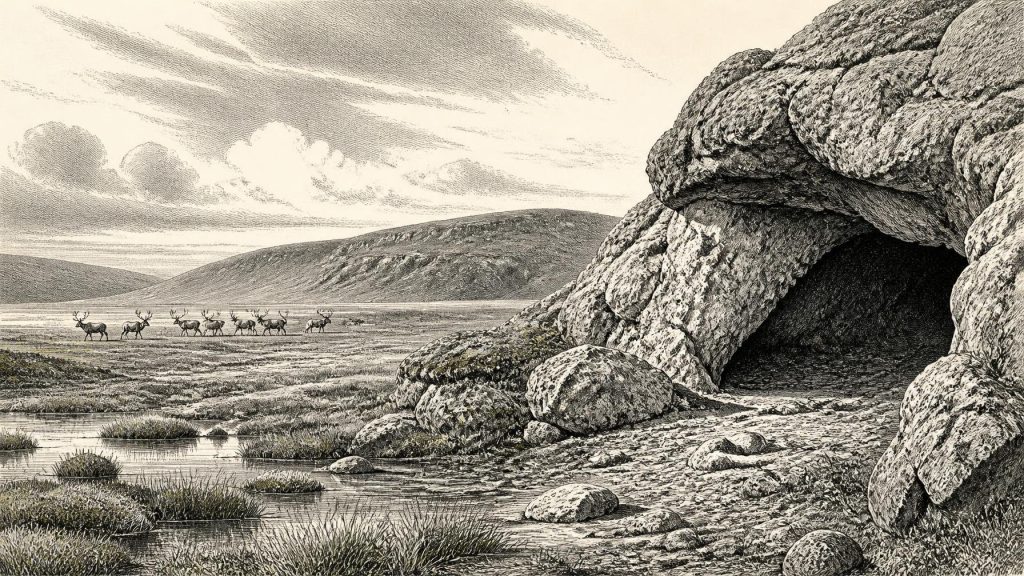
Derryvree offers the clearest glimpse of the northern landscape. Plant macrofossils, pollen and insect remains point to treeless, open ground with wet hollows and shallow freshwater. Mosses, sedges, bogbean and cold-adapted herbs belonged to a tundra or muskeg-like environment, not to forest. Fossils including mountain avens, dwarf shrubs and Arctic-alpine plants indicate a climate severe enough to exclude woodland, while aquatic plants show that pools and marshy margins persisted. Insect evidence similarly records a cold continental regime with marked seasonality.
This was not an empty white plain. Summer growth around waterlogged ground could have been brief but productive. Sedges and herbs fed herbivores; pools supported freshwater life; and sheltered lowlands could differ sharply from exposed uplands. Permafrost or deeply frozen seasonal ground is plausible in such a setting, but the precise extent and continuity of frozen ground cannot be read directly from every plant remain. Nor should a single Fermanagh basin be treated as a map of the entire island. It demonstrates a local ecological window in a landscape repeatedly reshaped by ice.
Regional change was the defining political fact only in the loosest possible sense: there were no known polities, territories, rulers, borders or diplomatic relations. The forces ordering the land were ice-sheet fluctuation, sea level, wind, water and animal movement. Earlier and later glaciers removed, reworked and buried much evidence. This destructive history helps explain why Ireland has so few securely stratified Palaeolithic sites in comparison with parts of Britain and continental Europe.
Castlepook and the Mammal World
In north Cork, Castlepook Cave – historically also called Mammoth Cave – preserves Ireland’s richest known assemblage of vertebrate remains from the period leading towards the Last Glacial Maximum. Excavations undertaken in the early twentieth century recovered more than 2,000 bones from a maze of narrow limestone passages and chambers, including Hyenahall and Elephant Hall. Modern re-dating has shown that some older radiocarbon determinations underestimated the antiquity of the cave fauna. The resulting record spans a long period, rather than a single moment.
The fauna demonstrates that Ireland was accessible to a distinctive cold-stage animal community during portions of MIS 3. Woolly mammoth, giant deer, reindeer, brown bear and spotted hyaena occur in the Castlepook archive; later cold-stage deposits also include Arctic fox, wolf, mountain hare and lemmings. These species did not necessarily live together at the same time, and their presence in a cave does not automatically identify the cave as their normal habitat. Bones could have been transported by carnivores, water, gravity or people, and individual specimens may be separated by thousands of years.
Nevertheless, the assemblage supports a powerful conclusion. Southern Ireland was not uniformly sealed beneath ice throughout this broader period. At least at intervals, open country could sustain grazing and browsing animals, predators and scavengers. Reindeer are especially apt indicators of this mobile, cold-adapted world, but their fossils do not by themselves establish seasonal migrations, herd size or a stable local population. Mammoths and giant deer likewise evoke open landscapes, yet neither permits a detailed reconstruction of the vegetation beyond the places and dates represented by their bones.
The Marked Reindeer Bone
A reindeer femur from Castlepook has transformed discussion of Ireland’s earliest possible human presence. The bone has been publicly reported as about 33,000 years old and bears a deep linear modification interpreted by the palaeozoologist Ruth Carden as a cut or chopping mark made with a sharp stone tool during carcass processing. If that interpretation is correct, it is evidence that people handled a reindeer carcass in Ireland roughly within the broad timespan represented by this article.
The claim deserves attention precisely because it is so limited. It does not provide a hearth, stone-tool assemblage, dwelling, burial, repeated camp or a population. The femur came from an old cave collection formed under excavation methods unlike those now expected, and Castlepook’s deposits were affected by water and by animal activity. There is no published, tightly defined calibrated range for this individual specimen that can justify treating 31,303 BCE as its exact date. Nor can the mark reveal whether people killed the animal, scavenged it, removed meat elsewhere, or visited once rather than repeatedly.
The cautious conclusion is therefore not that Ireland had a permanent human community, but that a brief Upper Palaeolithic visit is plausible and potentially evidenced. Any visitors would have been highly mobile hunter-gatherers using stone-edged tools, operating in a north-west European world where Homo sapiens had long been present. Reaching Ireland may have involved changing coastal routes, ice margins, exposed shelves and perhaps water crossings; the exact palaeogeography remains disputed. The evidence does not allow a responsible reconstruction of their language, kinship, clothing, beliefs, camp organisation or place of origin.
Society Beyond the Evidence
There is no basis for describing farming, trade networks, permanent villages, craft specialisation, religious monuments, formal learning, warfare or diplomacy in Ireland at this point. Agriculture was many millennia in the future. There are no Irish artefacts securely linked to a community of this age, no evidence for exchange goods, and no graves or ceremonial structures from which to infer ritual. Silence on these subjects is not a defect in the story; it is the essential result of the surviving record.
Culture is visible only indirectly. If the reindeer incision is human-made, it records practical knowledge: the ability to make and employ a sharp stone implement in processing an animal. It cannot be expanded into claims about art, social rank or religious practice. The cave itself was a natural feature, not a demonstrated shrine or home. Hyenas may have been major agents in accumulating bones there, a reminder that the archive records animal as well as human behaviour.
Before the Great Expansion of Ice
The years around this notional date preceded the fullest expansion of the last British-Irish Ice Sheet, generally placed much later, around 26,000–19,000 years ago. The approach to that maximum was neither smooth nor uniform. Evidence from western Ireland indicates substantial ice-sheet activity before the Last Glacial Maximum, while the Derryvree sequence proves that non-glacial conditions occurred locally between ice advances. Ireland’s Ice Age was a mosaic of changing margins rather than a single uninterrupted freeze.
Thus the historical significance of 31,303 BCE lies in evidence’s narrow but remarkable survival. Derryvree preserves a cold freshwater environment that existed between glaciations. Castlepook preserves a long faunal archive, including reindeer and predators, from an Ireland capable at times of sustaining life in open Ice Age terrain. One marked reindeer bone offers a serious, still cautious possibility of human activity. Beyond that, responsible history stops: no chiefs, no battles and no calendar-day event, but a changing island at the edge of the Pleistocene world.
Primary Sources
- A reconsideration of the radiocarbon dating of the Marine Isotope Stage 3 fauna from southern Ireland
- Castlepook Cave, County Geological Site report
- A Middle Midlandian Freshwater Series at Derryvree, Maguiresbridge, County Fermanagh, Northern Ireland
- Episodic speleothem deposition tracks the terrestrial impact of millennial-scale last glacial climate variability in SW Ireland
- Radiocarbon constraints on the history of the western Irish ice sheet prior to the Last Glacial Maximum
- Growth and retreat of the last British–Irish Ice Sheet, 31,000 to 15,000 years ago: the BRITICE-CHRONO reconstruction
- Last Glacial Maximum cirque glaciation in Ireland and implications for reconstructions of the Irish Ice Sheet
- Dimensions and chronology of the last ice sheet in Western Ireland
- Ice sheet extension to the Celtic Sea shelf edge at the Last Glacial Maximum
- Relative sea-level changes and crustal movements in Britain and Ireland since the Last Glacial Maximum
- The problem of a late Quaternary landbridge between Britain and Ireland
- Deglaciation, Earth crustal behaviour and sea-level changes in the determination of insularity: A perspective from Ireland
- Spatio-temporal dynamics of speleothem growth and glaciation in the British Isles
- Figure 6: The subdivision of the Quaternary Period in Ireland
- Prehistoric Details: Stone Age collections
- Spotted Hyena Skull, Castlepook Cave
- Castlepook Cave, Cork, 2022 excavation report
- The exploration of Castlepook Cave, Co. Cork
- New insights on the fauna of Ireland's Younger Dryas and Early Holocene from Alice & Gwendoline Cave
- The Irish Quaternary Fauna Project
- Late Pleistocene chronostratigraphy and ice sheet limits, southern Ireland
- Exposure-age constraints on the extent, timing and rate of retreat of the last Irish Sea ice stream
- AMS C-14 dating of deglacial events in the Irish Sea Basin and other sectors of the British-Irish ice sheet
- Archaeological excavations at Killuragh Cave, Co. Limerick