Blackwater Limestone Fauna31188 BCE
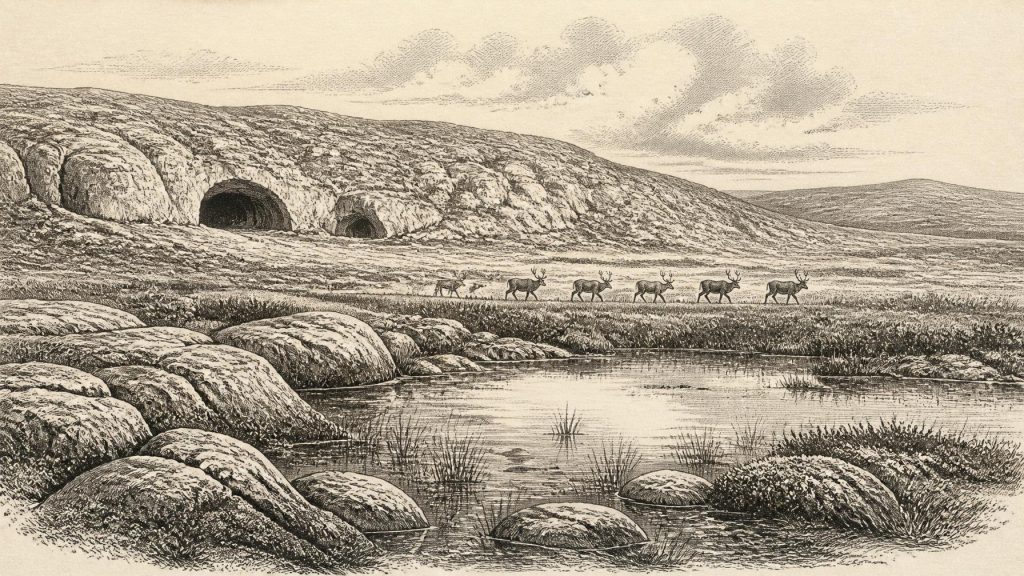
Around 31,188 BCE, Ireland lay in a climatically unstable Late Pleistocene phase before maximum glaciation, although evidence cannot date conditions precisely to that year. Derryvree deposits in Fermanagh indicate local treeless tundra wetlands, while Castlepook Cave in Cork preserves remains of mammoth, giant deer, reindeer, bear, wolf, Arctic fox, lemmings and hyaena, accumulated over long periods. A marked reindeer femur, dated broadly near this horizon, may indicate human butchery, but lacks secure archaeological context. No settlement, tools, hearths, trade or political structures are known. Ireland was a changing cold landscape, intermittently habitable, with possible brief human visits during this period.
Dateline
The label 31,188 BCE is useful for placing this article in a long chronological sequence, but it must not be mistaken for a date that archaeology can identify in Ireland. No written calendar existed, and neither human activity nor an environmental change can be assigned responsibly to that particular year. Expressed in scientific terms, the point falls at roughly 33,100 calendar years before 1950, within the later part of Marine Isotope Stage 3 and before the Last Glacial Maximum. The available evidence consists of dated animal remains, cave deposits, pollen, insects, plant macrofossils, sediment layers and models of ice-sheet growth. Each comes with sizeable ranges and interpretative limits.
An Island in a Changing Cold Stage
Ireland at this time was part of the Late Pleistocene world: cold, climatically unstable and ecologically unlike the later wooded island. It was not yet at the fullest extent of the last British–Irish Ice Sheet. The maximum glaciation belongs broadly to the succeeding millennia, but ice was growing and changing rapidly around the island. Modern reconstructions remain deliberately cautious about precisely where ice lay at around 31,000 years ago: in some sectors the evidence can support either ice-free or ice-covered conditions. This uncertainty is important. A map with a sharp ice margin for 31,188 BCE would imply an accuracy the evidence does not possess.
Nonetheless, several Irish records show that parts of the island had supported terrestrial environments during the wider interval relevant to this date. At Derryvree near Maguiresbridge, County Fermanagh, a freshwater deposit of fine sands and organic silts was found trapped between two tills within a drumlin. Its radiocarbon determination, Birm-166, was 30,500 years BP with a substantial error range; later calibration places the deposit broadly in the interval c. 36,900–31,700 calendar years BP. That range includes the approximate chronological horizon represented by 31,188 BCE, but does not date an event in that year.
The Derryvree deposit records an open, treeless and periglacial setting. Pollen, seeds, mosses and insects point to tundra or muskeg-like ground: wet places with pools and plant-rich mud, bordered by sedges, grasses, herbs and low-growing vegetation. Such evidence provides an environmental comparison, not a panoramic picture of all Ireland. It indicates that at least one north-central locality had cold freshwater habitats before later ice overrode and sealed the deposit. The most responsible conclusion is therefore regional: habitable patches existed in parts of Ireland during the wider middle-to-late glacial interval, while the extent, duration and connectedness of those patches changed profoundly.
Castlepook and the Animal Record
The richest evidence close to this horizon comes from Castlepook Cave near Doneraile in north County Cork, on limestone country north of the River Blackwater. Excavations begun in the nineteenth and early twentieth centuries, supplemented by later work and radiocarbon dating, produced Ireland’s most important assemblage of Ice Age vertebrates. The cave has yielded remains attributed to woolly mammoth, giant deer, reindeer, brown bear, wolf, Arctic fox, mountain hare, lemmings and spotted hyaena. It demonstrates beyond doubt that Ireland’s Pleistocene fauna was once far more diverse than the later historic fauna.
But Castlepook is not a single, undisturbed camp surface. Its animal remains accumulated across a very long period; some were moved or mixed by animals, water, collapse, earlier excavation and the cave’s own complex sedimentary history. Direct dates from bones extend across tens of millennia. A mammoth rib, reindeer metacarpal, brown-bear bones, giant-deer elements and hyaena remains cannot automatically be treated as members of one herd, one food chain or one season. The cave is best understood as a time-depth archive rather than a frozen moment.
Even so, the dated fauna supplies a plausible ecological frame for Ireland around the nominated date. Reindeer are especially significant. Their presence is consistent with open ground, seasonal mobility and forage in a landscape where woodland was limited or absent. Mammoth and giant deer suggest the capacity of some landscapes to sustain very large herbivores, while hyaena and wolf attest to substantial predators and scavengers. Lemmings and Arctic fox reinforce the cold character of the fauna. This was not a uniformly sterile land beneath permanent ice. Nor was it a mild, settled countryside: it was a variable cold-stage environment in which shelter, forage and access to unfrozen water could be highly local and seasonal.
A Mark on a Reindeer Bone
The reason this period has gained particular prominence in Irish prehistory is a reindeer femur from Castlepook. County Cork heritage publications report that a mark on the bone was examined as a possible chop or cut made by a sharp stone tool, and that the bone dates to about 33,000 years ago, often rendered for general audiences as about 31,000 BCE. If that interpretation is sustained, it would represent evidence that people handled, and perhaps butchered, a reindeer in Ireland during the Upper Palaeolithic—far earlier than the previously accepted evidence for human activity on the island.
The qualification matters as much as the possibility. The specimen is not part of a securely excavated occupation floor with a hearth, a cluster of stone tools, butchered bones and a stratigraphic sequence dating a visit. A single surface modification can be informative, but it must be distinguished from damage caused by carnivore teeth, sediment movement, trampling, breakage, excavation or later handling. The bone therefore supports a serious research question, not a full account of a Palaeolithic community. It is reasonable to describe it as possible evidence of human butchery; it is not reasonable to infer a permanent settlement at Doneraile, a population size, a language or a named cultural group.
There is a further chronological caution. The date obtained from bone collagen dates the death of the reindeer, within its scientific range, rather than the exact moment a mark was made. The translation of a radiocarbon age into BCE also depends on calibration curves, which convert atmospheric radiocarbon measurements into calendar-age probabilities. At this depth of time, calibration commonly produces ranges, not anniversaries. “Around 31,188 BCE” should thus be read as a modern indexing point near a broader dated horizon.
People: Presence Is Not Settlement
Across western Europe, the Upper Palaeolithic was already an age of highly mobile Homo sapiens hunter-gatherers using sophisticated stone technologies, clothing, fire, social networks and, in some regions, figurative and cave art. Ireland cannot simply be assigned the same record. No securely associated Upper Palaeolithic toolkit, dwelling, burial, hearth or artwork is presently known from Ireland at this date. The archaeological evidence does not allow us to describe a local Irish society, still less an uninterrupted ancestry leading to later peoples of the island.
If the Castlepook mark records human work, the smallest defensible scenario is a brief encounter between people and animal resources in a suitable part of the landscape. A hunting party may have exploited a carcass or killed an animal; equally, the evidence is too slight to establish the scale and circumstances of the action. Such an episode would have required knowledge, mobility and survival skills, but those are inferences from the wider Upper Palaeolithic world rather than observed Irish artefacts. Subsequent ice advance also probably removed, buried or reworked many exposed land surfaces. This helps explain why traces may be scarce, but absence of surviving evidence cannot itself prove either population or complete abandonment.
No Politics, No Proven Trade
Political affairs, diplomacy and organised conflict cannot be recovered for Ireland at this point. There are no texts, monuments, weapons assemblages or settlement plans from which to identify polities, leaders, territorial boundaries or alliances. Nor is there evidence for farming, herding, metalworking, pottery, exchange institutions or long-distance trade based in Ireland. The relevant economy, if people were present, would have been one of immediate subsistence: movement through difficult country, use of animal and plant resources, and perhaps episodic hunting or carcass processing.
Religion and learning are similarly beyond direct recovery. It would be wrong to project the rich ritual evidence of much later prehistoric Ireland—tombs, ceremonial landscapes, metal deposits and inscribed objects—back across more than twenty-five thousand years. People elsewhere in Upper Palaeolithic Europe clearly possessed symbolic capacities and cultural traditions, but no Irish object from this horizon demonstrates a particular belief, rite, artistic practice or system of knowledge. The caves preserve animal and geological evidence, not an identifiable Palaeolithic religion.
What This Date Can Mean
The historical importance of this horizon lies not in a year-specific event but in the possibility that Ireland was intermittently part of a wider north-west European human and animal world before the last great ice expansion. Derryvree shows cold freshwater tundra conditions in one part of the island; Castlepook preserves a remarkable succession of cold-stage mammals in another; the reindeer femur raises, but does not settle, the question of an early human visit. The later Last Glacial Maximum transformed these landscapes and greatly reduced the odds that open-air evidence would survive.
For 31,188 BCE, then, Ireland should be imagined neither as a documented homeland nor as a blank on the map. It was a changing Pleistocene landscape with wetlands, open vegetation, large herbivores and predators, subject to advancing ice and severe seasonal constraints. A possible human action at Castlepook remains provocative precisely because the record is so sparse. The honest history is one of evidence carefully separated from interpretation: animals are securely present; particular environments are demonstrably recorded; a human visit is plausible but not yet represented by a conventional archaeological site; and calendar-year precision is unavailable.
Primary Sources
- Castlepook Cave, County Cork Geological Site Report
- Heritage Artefacts of County Cork
- Archaeological Heritage of County Cork
- The Irish Quaternary Fauna Project
- New Insights on the Fauna of Ireland’s Younger Dryas and Early Holocene from Alice & Gwendoline Cave
- Growth and Retreat of the Last British–Irish Ice Sheet, 31,000 to 15,000 Years Ago: The BRITICE-CHRONO Reconstruction
- Trimlines, Blockfields and the Vertical Extent of the Last Ice Sheet in Southern Ireland
- A Middle Midlandian Freshwater Series at Derryvree, Maguiresbridge, County Fermanagh, Northern Ireland
- Irish Pleistocene Biostratigraphy
- Figure 6: The Subdivision of the Quaternary Period in Ireland
- Dimensions and Chronology of the Last Ice Sheet in Western Ireland
- Deglaciation Chronology of the Donegal Ice Centre, North-West Ireland
- Vertical Dimensions and Age of the Wicklow Mountains Ice Dome, Eastern Ireland, and Implications for the Extent of the Last Irish Ice Sheet
- Oscillating Retreat of the Last British-Irish Ice Sheet on the Continental Shelf Offshore Galway Bay, Western Ireland
- Could Brown Bears (Ursus arctos) Have Survived in Ireland During the Last Glacial Maximum?
- The Colonization of Ireland: A Human Ecology Perspective
- Ireland’s Palaeolithic Archaeology – Fleeting Footprints in a Frozen Land
- What Was on the Menu in Prehistoric Ireland?
- Introduction to the Late Quaternary and Holocene of Northern Ireland
- Conserving Quaternary Geoheritage in Northern Ireland