Mammoth Cave’s Open Ground30316 BCE
Around 30,316 BCE, Ireland’s history is environmental rather than dated or political. During the unstable Late Pleistocene, ice margins, open tundra, wetlands and changing coastlines shaped a largely treeless landscape. Organic deposits at Derryvree, County Fermanagh, record a cold, locally ice-free freshwater interval between glacial advances, with sedges, mosses, dwarf willow and aquatic plants. Cave deposits at Castlepook, County Cork, preserve fauna, including mammoth, reindeer and predators, although their chronology is mixed. A cut-marked reindeer femur may indicate human butchery, but cannot prove settlement. No evidence supports resident communities, institutions or culture; surviving evidence instead documents habitats and human possibility.

Dateline
The label 30,316 BCE is a modern chronological convenience, not the date of a recorded Irish event. No calendar, written source, settlement sequence or human life-history can be resolved to a particular year at this depth in time. In archaeological terms it corresponds roughly to 32,265 years before AD 1950, but radiocarbon ages must be calibrated and carry substantial uncertainty. The responsible history of Ireland at this point is therefore a history of broad Late Pleistocene conditions, not of named rulers, battles or a dated human episode.
Ireland lay within the later part of Marine Isotope Stage 3, an unstable phase of the last Ice Age. It was approaching, rather than necessarily already experiencing everywhere, the full extent of the Last Glacial Maximum. The island’s surviving evidence is fragmentary because later ice repeatedly eroded, buried and rearranged older ground surfaces. Yet freshwater sediments in Fermanagh, cave faunas in Cork and wider reconstructions of the British–Irish Ice Sheet show that Ireland was neither timeless nor uniformly frozen: it was a changing northern landscape of ice margins, open ground, wetlands and animal movements.
Dating a Landscape, Not a Year
The most useful Irish environmental archive close to this broad horizon is Derryvree, near Maguiresbridge in County Fermanagh. Road works cut through a drumlin and exposed organic-rich freshwater silts and sands caught between two glacial tills. The order of layers is decisive. An earlier glacier deposited the lower till; water, plants and organic detritus accumulated during a subsequent non-glacial interval; later ice deposited the upper till and sealed the deposit. This is strong evidence for local environmental change, though not a complete picture of the entire island.
A conventional radiocarbon determination from the Derryvree organic material, BIRM-166, was reported as about 30,500 ± 1,100 radiocarbon years BP. A widely cited calibrated expression places it broadly between about 36,900 and 31,700 cal BP, approximately 34,950–29,750 BCE. The nominal year considered here falls within that broad span. It cannot, however, be attached to a particular season, sediment lamina or episode in the basin. Calibration curves, the age of legacy samples and the relationship between the measured material and its deposition all require caution.
This distinction matters because the word “ice age” can mislead. Ireland’s landscape did not simply switch from green land to a single blanket of ice on one date. Ice cover waxed and waned, and conditions varied by region, altitude and proximity to coasts or ice margins. Recent syntheses infer that Ireland was largely ice-free until around 32,000 years ago before the last Irish Ice Sheet expanded, while other models stress the complexity and uncertainty of this build-up. Derryvree securely records a cold, locally ice-free freshwater interval between glacial advances; it does not prove that every part of Ireland was open at the same moment.
Wetlands Beneath the Drumlins
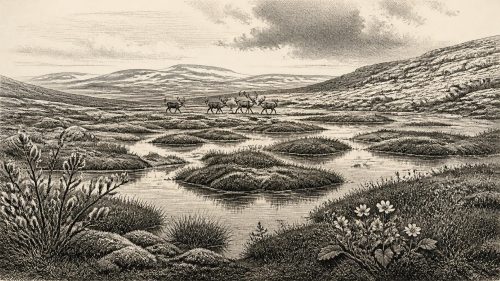
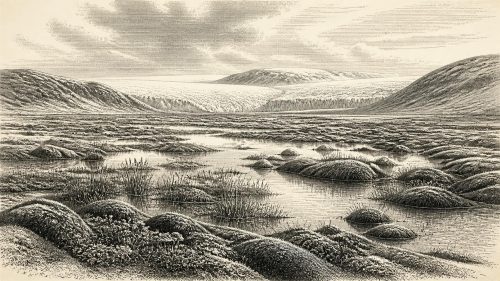
The Derryvree plant record gives the clearest impression of everyday ecology. It indicates treeless, wet and cold terrain rather than forest. Mosses, sedges, dwarf willow, mountain-avens, clubmosses and aquatic plants including bogbean and water-milfoil point to shallow pools, saturated ground and freshwater margins. Such species suggest a tundra or periglacial mosaic: sparse vegetation on exposed ground, wetter hollows in which plants could establish, and short productive summers followed by severe winters.
This was not an empty wilderness. Small basins and slow watercourses would have concentrated drinking water, edible vegetation for herbivores and shelter from wind. Frost action, seasonal thaw and the movement of meltwater continually altered the ground. Trees, enclosed fields and familiar bogs had no place in this world. Nor did Ireland’s later agricultural landscape. The modern shape of many Irish valleys, lowlands and drainage systems owes much to the glacial processes that were already remaking the island’s surface.
Sea levels were far lower than today because water was stored in continental ice sheets, so coastlines and shallow seas differed greatly from the modern map. That did not automatically create a simple walkable bridge to Britain. Ireland’s separation from Britain, the state of the Irish Sea basin and the practical routes available to animals or people changed through time. Any movement into Ireland would have depended on the precise configuration of sea, land, ice and weather at a particular interval, all of which remain subjects of reconstruction rather than direct observation.
Reindeer and Cave Deposits
The animal evidence is richer than the evidence for people. Irish cave collections contain remains of cold-stage fauna including reindeer, brown bear, wolf, fox, hare, lemming, spotted hyaena and woolly mammoth. The Irish Quaternary Fauna Project concluded that a varied mammalian fauna reached Ireland between at least about 45,000 and 20,000 years ago. These remains are important proof that changing habitats could support substantial animals, but each cave assemblage must be treated carefully. Caves often accumulated bones through carnivore activity, water transport, scavenging and the work of nineteenth- and early twentieth-century excavators.
Castlepook Cave near Doneraile in north County Cork, historically called Mammoth Cave, is particularly important. Its limestone passages produced a large and chronologically mixed Ice Age fauna during excavations led by Richard J. Ussher between 1904 and 1912. Mammoth remains gave the cave its name, but reindeer, carnivores and other animals are at least as important for understanding the wider landscape. Open, cold ground with seasonal grazing and accessible water could sustain mobile herbivore herds, while caves offered dens or scavenging sites for predators rather than evidence of permanent human dwellings.
The Reindeer Femur Question
A reindeer femur from Castlepook has made this period especially significant in Irish prehistory. Ruth Carden identified a deep linear mark on the bone as consistent with cutting or chopping by a sharp stone tool, and public heritage accounts have associated the specimen with an age of roughly 33,000 years ago, or about 31,000 BCE. If the mark was made while the bone was fresh, it may show that a person processed a reindeer in Ireland during the broad pre-maximum interval represented by this article.
That is a potentially profound clue, but it is not proof of a settled Upper Palaeolithic population. The femur derives from an old collection, not a modern excavation of an intact occupation floor. No securely associated hearth, stone-tool assemblage, house floor, burial, human bone or repeated camp sequence of this age has been published from Ireland. The date of the animal bone does not itself date the incision to a particular day or prove who made it. Researchers must also distinguish tool damage from carnivore action, breakage and marks introduced during recovery or storage. Renewed work at Castlepook is valuable precisely because it can test such questions using modern excavation and analytical methods.
No Polities, No Proven Society
There is no evidence from around 30,316 BCE for Irish political institutions, chiefs, diplomacy, warfare, territorial states or organised religion. Nor can historians responsibly reconstruct language, kinship systems, dress, art or learning for a resident Irish community. A single possible butchered bone would indicate only a brief act involving a carcass: perhaps visiting hunters, perhaps a very small mobile group, and perhaps an episode that left no enduring occupation. It cannot establish a people, a culture or a claim to continuous settlement.
Nevertheless, comparison with better-documented Upper Palaeolithic communities in Britain and continental Europe can clarify what the evidence might mean without converting analogy into fact. People elsewhere used stone tools, travelled widely, followed seasonal resources and sometimes processed large game. If people reached Ireland, their economy would have depended upon mobility, knowledge of animal behaviour and the ability to navigate a severe, rapidly changing environment. Those are interpretations drawn from the wider north-west European record; they are not directly demonstrated by an Irish camp of this date.
There was certainly no farming, metalworking, pottery production, monument building or long-distance trade network identifiable in Ireland at this time. The island’s later archaeological story—Mesolithic coastal settlement, Neolithic farming, tombs, metalwork and written history—belongs many millennia in the future. Around this date, the best evidence concerns ecological opportunity: water in sheltered basins, forage on open ground, animal dispersal and the advancing or retreating limits of ice.
What Survives
The chief historical development around this notional year was environmental, not political. Ireland was part of a North Atlantic Ice Age world in which habitable ground could appear locally and then be buried by renewed glaciation. Derryvree preserves the plants of one cold freshwater interval; Castlepook preserves an exceptional but complicated animal archive; the reindeer femur raises the possibility of human activity without resolving it. The absence of a secure settlement is not proof that no person ever entered Ireland, but neither is it licence to populate the island with imagined hunters.
For 30,316 BCE, then, Ireland’s history must remain deliberately modest and evidence-led: a treeless country in transformation, with wet hollows beneath later tills, herds and carnivores moving through open habitats, and a tantalising but unconfirmed human trace in a Cork cave. That caution is not a failure of history. It is the most accurate account that the surviving Irish record permits.
Primary Sources
- A Middle Midlandian Freshwater Series at Derryvree, Maguiresbridge, County Fermanagh, Northern Ireland
- Figure 6.— The Subdivision of the Quaternary Period in Ireland
- The Last Irish Ice Sheet: Extent and Chronology
- Trimlines, Blockfields and the Vertical Extent of the Last Ice Sheet in Southern Ireland
- Exploring the Causes, Rates and Patterns of Ice-Sheet Retreat in the Northern Hemisphere During the Last Deglaciation
- Timing and Pace of Ice-Sheet Withdrawal Across the Marine–Terrestrial Transition West of Ireland During the Last Glaciation
- The Colonization of Ireland: A Human Ecology Perspective
- The Irish Quaternary Fauna Project
- First Evidence of a Late Upper Palaeolithic Human Presence in Ireland
- New Insights on the Fauna of Ireland's Younger Dryas and Early Holocene from Alice & Gwendoline Cave
- Archaeology Research Excavation Grant 2022: Castlepook Cave, Co. Cork
- Castlepook Cave, Co. Cork, 2022 Excavation Report
- Heritage Artefacts of County Cork
- The Archaeological Heritage of County Cork
- The Mesolithic in Ireland: When Was It?
- Farming and Archaeology
- Ireland Through Geological Time
- Cenozoic: Tertiary and Quaternary
- Ireland: Submerged Prehistoric Sites and Landscapes
- Anthropogenic Changes to the Holocene Nitrogen Cycle in Ireland
- Outreach and Education Resources
- Irish Quaternary Association Publications
- Advances in Irish Quaternary Studies
- The Deglaciation of the Western Sector of the Irish Ice Sheet from the Inner Continental Shelf to its Terrestrial Margin