Derryvree’s Three-Leaved Fossil31186 BCE
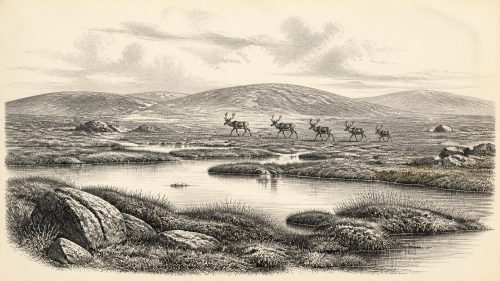
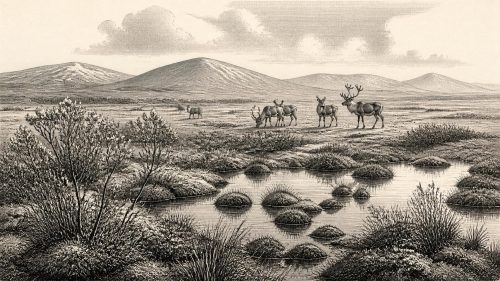
Around 31,186 BCE, Ireland was in the climatically unstable Late Pleistocene, beyond written history. At Derryvree, County Fermanagh, freshwater silts between glacial tills, dated broadly to 36,900–31,700 calibrated years before present, record an ice-free interval. Pollen, mosses, insects and plants, including bogbean, dwarf willow and mountain avens, indicate cold, open tundra wetland. Cave remains at Castlepook suggest a diverse fauna, including reindeer, mammoth and predators, but specimens may differ greatly in age. A marked reindeer bone may indicate brief human butchery, although this remains unconfirmed. No evidence demonstrates permanent settlement, political institutions or cultural practices. Later glaciation obscured much evidence.
Dateline
31,186 BCE is a modern calendar label applied to a time far beyond any Irish written record. It cannot identify a known event, ruler, journey or single season. Around this point—roughly 33,100 calibrated years before present, using 1950 as the archaeological reference point—Ireland lay within the Late Pleistocene, during Marine Isotope Stage 3, a climatically volatile part of the last Ice Age. The responsible history of the island is therefore not a year-by-year narrative in the usual sense. It is a reconstruction from sediments, fossils, cave deposits and dating ranges, with clear boundaries between what the evidence demonstrates and what it only suggests.
A Date Within a Wide Range
The most useful Irish evidence close to this notional year comes from Derryvree, near Maguiresbridge in County Fermanagh. Roadworks in 1969 cut through a drumlin—a streamlined hill shaped by glacial ice—and exposed an exceptional sequence. Freshwater silts and fine sands, rich in organic remains, lay between two deposits of till, the stony, unsorted sediment left by glaciers. The order is secure: ice had affected the locality; an interval followed in which freshwater sediment, plants and small animals accumulated; later ice overrode or buried the deposit.
Organic material from the Derryvree bed produced a conventional radiocarbon age of 30,500 years before present, with a substantial uncertainty of +1,170 and −1,030 years. Radiocarbon years are not equivalent to calendar years, particularly this far back. Calibration has placed the deposit broadly at about 36,900–31,700 calibrated years before present, approximately 34,950–29,750 BCE. Thus 31,186 BCE falls within the possible span of the deposit, but it cannot be assigned to a particular layer, plant, animal or day. Derryvree is an archive accumulated over time, not a diary from a precisely dated year.
Fresh Water Between Glacial Advances
The Derryvree sequence is important because it shows that this part of Fermanagh was ice-free at some point during the broad dated interval. It does not prove that all Ireland was free of ice at once, nor that ice margins stood still. The Late Pleistocene climate shifted sharply on scales of centuries and millennia. Glaciers could advance, thin, retreat and reorganise, while local conditions in lowlands, uplands and coastal basins differed markedly. Later glaciation also destroyed or concealed much earlier evidence, which is one reason the Irish record is sparse.
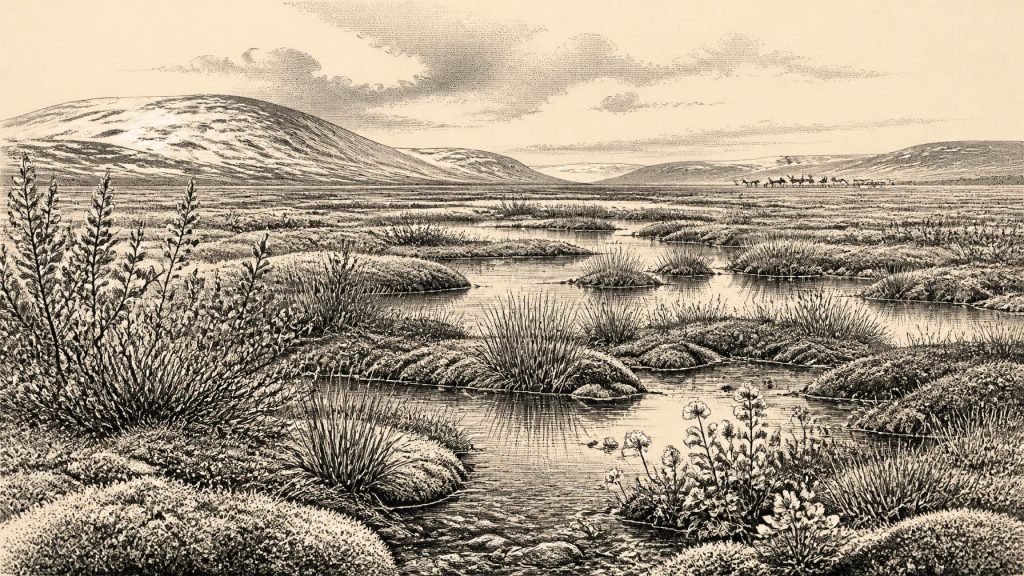
At Derryvree, however, the inter-till silts preserve a cold freshwater setting. Their pollen, plant macrofossils, mosses and insect remains indicate open tundra vegetation and a periglacial climate: ground strongly affected by frost, with short growing seasons and little or no woodland. This was not the oak-and-hazel island familiar from later prehistory. It was a treeless or nearly treeless mosaic of wet hollows, shallow water, sedges, mossy ground, herb-rich patches and exposed mineral soils.
The Three-Leaved Plant
One modest fossil gives the title its meaning. Derryvree produced a seed of bogbean, Menyanthes trifoliata, a plant recognised by its three-part leaf and associated with wet ground and freshwater margins. Other remains include dwarf willow, mountain avens and aquatic plant evidence. Together, these finds do not recreate every species on the ground at a particular moment, but they firmly support the existence of cold-adapted vegetation around pools and marshy ground. Moss assemblages are especially valuable because they retain environmental information often absent from the visibly dramatic record of bones and boulders.
The resulting landscape is sometimes described as tundra or muskeg-like wetland. Such comparisons should be used carefully: Ireland’s topography, Atlantic position and changing ice cover made its environment distinctive. Yet the evidence supports an open, frost-influenced place where freshwater was persistent enough for aquatic and wetland plants, while surrounding terrain remained cold, windswept and sparsely vegetated. Seasonal thaw would have mattered greatly. Meltwater, frozen ground and the brief productive summer were probably more decisive ecological forces than any stable annual climate.
Animals on a Changing Island
Caves, particularly Castlepook Cave near Doneraile in north County Cork, provide a different form of evidence. Their old collections contain remains attributed to mammoth, reindeer, giant deer, brown bear, arctic fox, hare, lemmings, wolf and spotted hyaena. These animals were not necessarily contemporaries, and a cave deposit is not a census of a single local landscape. Carnivores may have dragged bones into dens; water, collapse and early excavations may have mixed material; and individual specimens can be separated by many thousands of years. Recent reassessment has also shown why older radiocarbon results require caution, especially where modern pretreatment methods were unavailable.
Nevertheless, the combined record establishes an important point: before the Last Glacial Maximum, Ireland could support a far richer large-mammal fauna than the island’s later, more isolated Holocene fauna might imply. Reindeer and other grazing animals would have fitted open vegetation, while predators and scavengers occupied the same broad food web. Mammoth and giant deer remains are powerful evidence for the reach of this north-west European faunal world, but they do not prove that either animal stood at Derryvree in 31,186 BCE.
The Castlepook Human Question
A reindeer femur from Castlepook has been reported as bearing a deep mark interpreted by zooarchaeologist Ruth Carden as damage made during butchery with a stone tool. Public heritage accounts associate the bone with an age of around 33,000 years ago, broadly close to the period considered here. If the mark is confirmed as human-made and contemporaneous with the animal’s death, it would be exceptionally early evidence that people entered Ireland and processed reindeer during the Upper Palaeolithic.
That conditional language is essential. The specimen came from an old cave collection, not a modern excavation of an intact occupation floor. The radiocarbon determination dates the animal bone, not a named human action or the duration of any visit. No securely associated hearth, stone-tool assemblage, dwelling surface, burial, repeated butchery area or settlement has yet demonstrated a community in Ireland at this age. The most defensible interpretation is that a brief hunter-gatherer incursion is possible; permanent occupation, continuous population and a route of arrival remain unproven.
No Kingdoms, No Recorded Wars
There is no evidence from Ireland around 31,186 BCE for political institutions, named peoples, chiefs, diplomacy, warfare, law or territorial states. Equally, there is no Irish evidence for farming, herding, pottery, monuments, formal trade networks, literacy, religion expressed in ritual structures, or artistic traditions comparable to those known elsewhere in Upper Palaeolithic Europe. It would be misleading to fill these silences by importing cave art, burial rites or tool industries from France, Iberia or central Europe. Those regions offer context for what human groups elsewhere could do; they are not proof that the same practices occurred in Ireland.
If people did reach the island, their everyday economy would most plausibly have involved mobile foraging, with large animals such as reindeer a potential resource. But even that is an inference from a single contested-looking line of evidence, not a securely documented Irish livelihood. There is no basis for describing a settlement hierarchy, exchange system, household pattern or religious life. The political and cultural history of this date is therefore chiefly a history of absence: not proof that human societies could not have been present, but proof that the surviving Irish record cannot yet demonstrate them.
Regional Change Before the Great Ice
The wider significance of this period lies in change. The Derryvree bed records an interval when freshwater life occupied ground later sealed beneath ice. Castlepook’s fauna indicates that animals moved through, or lived within, ecological connections extending beyond the modern island. Lower sea levels altered the surrounding shelf, but changing coastlines and ice conditions cannot be reduced to a simple, proven land-bridge story for a particular year. Movement may have been possible at some times and difficult at others; the relevant evidence remains incomplete.
Within several millennia, the Last Glacial Maximum would bring much more extensive ice to Ireland and its surrounding shelf, eroding landscapes and restricting habitats. For 31,186 BCE, however, Derryvree preserves a different image: cold water under an open sky, bogbean and dwarf willow at a marsh edge, insects and mosses surviving a severe climate, and a landscape not yet reduced to the later maximum of ice cover. That small fossil seed is not a symbol of a lost nation or a known human community. It is stronger evidence than that: a direct trace of Irish life in deep time, precisely because it tells us only what it can.
Primary Sources
- A Middle Midlandian Freshwater Series at Derryvree, Maguiresbridge, County Fermanagh, Northern Ireland
- Palaeoecology: Field Guide to County Fermanagh
- The Subdivision of the Quaternary Period in Ireland
- Quaternary Deposits and Glacial Stratigraphy in Ireland
- The Irish Quaternary Fauna Project
- A Reconsideration of the Radiocarbon Dating of the Marine Isotope Stage 3 Fauna from Southern Ireland
- New Insights on the Fauna of Ireland’s Younger Dryas and Early Holocene from Alice & Gwendoline Cave
- Sedimentary Ancient DNA Reveals Late Pleistocene Faunal Connectivity Between Ireland and Eurasia
- Archaeology Research Excavation Grant 2022: Final Report
- Castlepook Cave, Co. Cork: Excavation Report 2022
- Heritage Artefacts of County Cork
- Ancient DNA and the Irish Quaternary Fauna
- Dimensions and Chronology of the Last Ice Sheet in Western Ireland
- Last Glacial Maximum Cirque Glaciation in Ireland and Implications for the Extent of the British-Irish Ice Sheet
- Exploring Controls of the Early and Stepped Deglaciation on the Western Margin of the British-Irish Ice Sheet
- Sedimentary and Foraminiferal Records of Late Quaternary Environmental Change West of Ireland and Implications for the Last British-Irish Ice Sheet
- The Late Quaternary History of East-Central Ireland
- Advances in Irish Quaternary Studies
- Dimensions and Chronology of the Last Ice Sheet in Western Ireland
- The Maguiresbridge Freshwater Bed