Freshwater Interbeds31212 BCE
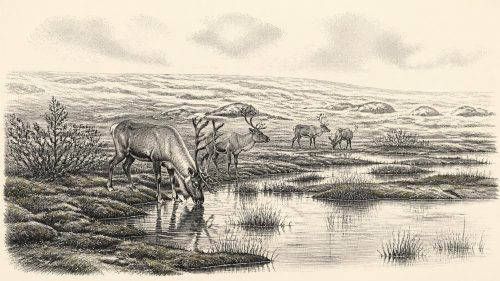
Labelled 31,212 BCE, this Late Pleistocene interval cannot be dated precisely in Ireland. Derryvree, County Fermanagh, preserves freshwater silts between glacial tills, indicating an ice-free, treeless periglacial wetland sometime within a broad calibrated range encompassing the notional year. Ireland was environmentally varied, with shifting ice margins, wetlands and intermittent ecological links to north-west Europe. Castlepook Cave in County Cork yielded MIS 3 remains including mammoth, reindeer, giant deer, predators and lemmings, though they need not have been contemporaneous. A cut-marked reindeer bone may indicate an early human visit, but no secure occupation evidence exists. Later glaciation destroyed evidence, leaving uncertainty.
Dateline
“31,212 BCE” is a useful modern label, not a date anyone then living in Ireland could have named. There was no written calendar, no political record and no archaeological method capable of isolating a particular twelve-month span at such depth in time. In the conventional archaeological system that measures before AD 1950, the notional year falls about 33,161 years before present. It belongs to the Late Pleistocene, within Marine Isotope Stage 3, a long, climatically volatile part of the last Ice Age. The responsible evidence is therefore regional and range-based: buried sediments, fossil plants and insects, animal bones, cave deposits and the landforms made by ice. These reveal changing environments far more clearly than they reveal human lives.
A Date Within a Broad Range
The closest Irish environmental archive is at Derryvree, near Maguiresbridge in County Fermanagh. Road construction in 1969 cut through a drumlin and exposed fine sands, freshwater silts and organic material enclosed between two tills: unsorted sediments deposited directly by glacier ice. The sequence is important because it records three separate conditions. Ice had occupied the ground; a later interval allowed freshwater, wetland plants and invertebrates to flourish; then renewed glaciation buried and preserved that evidence. The deposit is not an annual record and cannot tell us what occurred in 31,212 BCE itself.
A radiocarbon determination from Derryvree, BIRM-166, was published as 30,500 ± 1,200 radiocarbon years BP. Calibration, which is necessary because atmospheric radiocarbon has varied through time, places it broadly at about 36,900–31,700 calibrated years BP. The requested year lies within that wide interval, but cannot be pinned to one layer, one season or one human generation. The range is nevertheless exceptionally valuable: it demonstrates that at least part of north-central Ireland could be ice-free during a severe Late Pleistocene phase before the main expansion of the last Irish Ice Sheet.
Wet Ground in a Cold Country
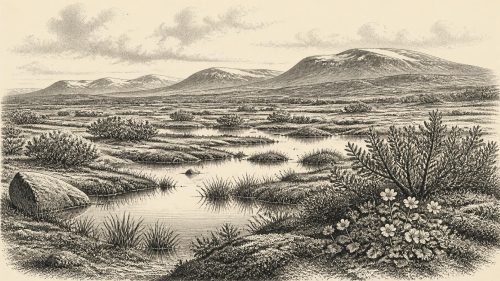
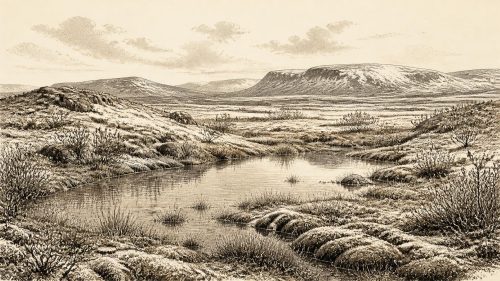
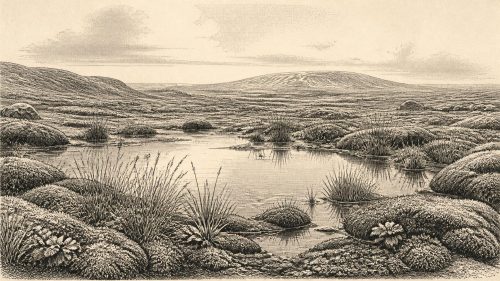
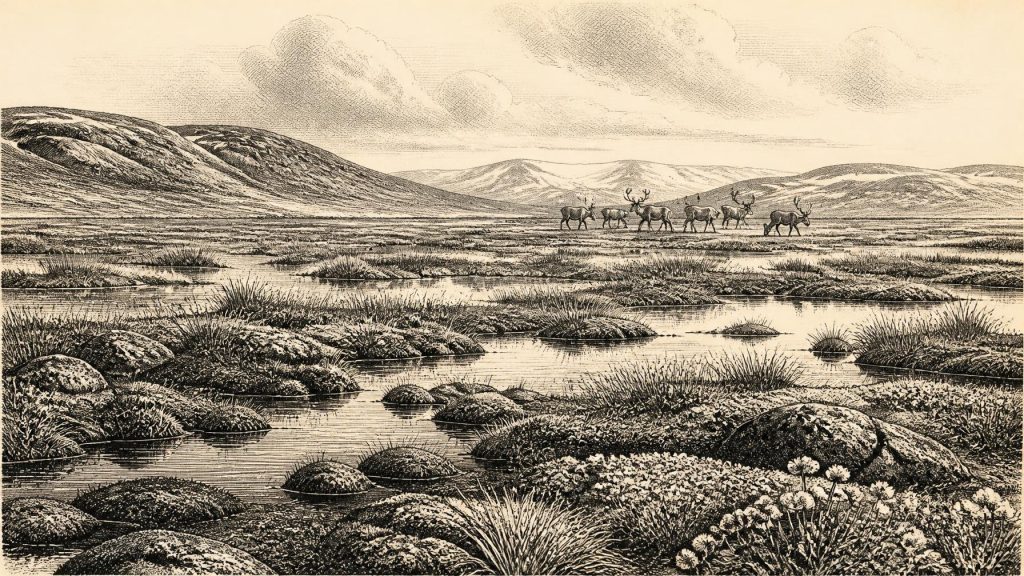
The Derryvree flora and fauna support a carefully bounded reconstruction. Freshwater mosses and sedges, herb pollen, plant macrofossils and insects of cold northern affinity point to wet ground, shallow pools and decaying vegetation within an open, treeless landscape. This was periglacial country: land strongly affected by freezing and thawing, with short summers, long cold seasons and little or no woodland. Sparse dry-land vegetation may have covered exposed ground beyond the wetland. It should not be pictured as a uniform snowfield, but neither was it the green, enclosed and wooded Ireland familiar from later millennia.
That conclusion applies first to Derryvree, not automatically to the entire island. Ireland’s climate was shaped by Atlantic conditions, topography and the shifting margins of ice, so local environments could differ sharply. A low-lying freshwater basin in Fermanagh preserves one kind of evidence; cave deposits in Munster preserve another. The later passage of glaciers also destroyed or deeply buried many older surfaces. This uneven survival is why Ireland’s evidence for this period is striking but fragmentary.
Ice-sheet history reinforces the need for caution. One influential synthesis uses Derryvree and other sites to argue that the bulk of the last Irish Ice Sheet expanded from largely ice-free conditions after roughly 34,000 years ago, reaching much farther south only substantially later. Other evidence from western Ireland indicates major glacial loading and fluctuating margins over a long interval before the Last Glacial Maximum. These are not necessarily incompatible accounts: they emphasise different sectors of a changing ice mass. Around this notional date, Ireland was probably a geographically varied frontier of cold land, wetlands, ice and nearby marine corridors, rather than an island covered everywhere by one stable sheet.
Castlepook’s Animal World
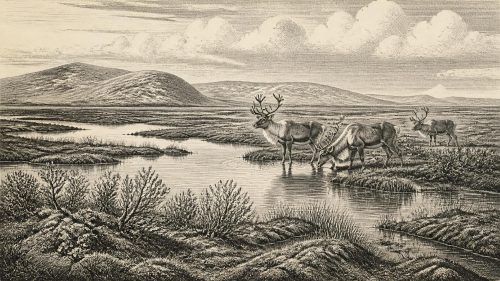
County Cork supplies the most vivid evidence for animal life. Castlepook Cave, in the Awbeg valley beneath the Ballyhoura Hills and also known as Mammoth Cave, produced Ireland’s richest assemblage of older Pleistocene vertebrate remains. Finds made during early twentieth-century excavation include woolly mammoth, reindeer, giant deer, brown bear, wolf, Arctic fox, spotted hyaena and lemmings. The combination evokes a northern, open-country fauna unlike that of later historic Ireland. The cave is especially important because improved radiocarbon methods have shown that several bones are appreciably older than earlier dates had suggested, placing parts of the assemblage in MIS 3.
Yet the list must not be converted into a single, cinematic herd scene. Castlepook was excavated before modern stratigraphic standards, its deposits were complicated, and bones may have entered the cave through different processes and at different times. Carnivores could drag prey or carrion into a cave; water could move smaller material; later disturbance could mix deposits. The presence of mammoth, reindeer and hyaena proves that these species reached Ireland during parts of the broader period. It does not prove that every listed animal met at Castlepook in the same year, or that all occupied precisely the same habitat.
Still, the faunal evidence matters for Ireland’s regional connections. Large mammals did not originate on an isolated island without routes of dispersal. Lower sea levels changed the outline of the Irish Sea basin and reduced maritime distances, while ice, sea and exposed terrain shifted repeatedly. Precisely how each species arrived remains debated. There is no warrant for describing a permanent land bridge at this date, nor for assuming a fixed route used by animals or people. The better conclusion is that Ireland was intermittently connected ecologically to the wider north-west European world, even as cold climate and advancing ice made that connection precarious.
The Human Question
The most consequential but least secure human clue is a reindeer femur from Castlepook. It has been reported as carrying a deep incision interpreted by its researcher as a mark made with a sharp stone tool while a carcass was processed; public accounts associate the bone with an age of about 33,000 years. If both the human interpretation and chronological association are sustained, it would indicate a brief Upper Palaeolithic human presence in Ireland far earlier than the well-established post-glacial settlement record.
That possibility must be stated as possibility, not transformed into a settlement narrative. No securely excavated camp, hearth, dwelling, stone-tool assemblage, burial or occupation surface is known from Ireland around this time. The National Museum of Ireland continues to describe unequivocal Palaeolithic human evidence as absent. The tension reflects a genuine scholarly distinction: a single modified bone from an antiquarian cave collection can be significant, but it is not equivalent to a stratified settlement with many independently dated traces.
If people did reach Ireland during this MIS 3 interval, the strongest inference is modest. They would have been highly mobile hunter-gatherers, equipped with perishable materials and stone technology, capable of exploiting animal carcasses or hunting opportunities. Reindeer would have supplied meat, fat, hide, sinew and bone, but Castlepook’s femur does not establish whether an animal was hunted, scavenged, transported or merely cut up at the cave entrance. It tells us nothing reliable about the visitors’ names, language, ancestry, household size or duration of stay. It certainly cannot establish a continuous population surviving into later Irish prehistory.
Society Without Institutions
Political affairs, diplomacy and organised warfare cannot be recovered for Ireland in this period. There is no evidence for rulers, territories, states, formal alliances or collective institutions. Equally, there is no Irish evidence for shrines, graves, art, ceremony or systems of learning that can be assigned to this date. Silence is not proof that people lacked beliefs, social rules or stories; it means the material record does not permit their reconstruction.
The same restraint applies to economy and trade. There were no farms, cereal fields, domestic livestock, pottery workshops, metalworking or towns. If humans visited, subsistence would have depended on wild resources and mobility. Exchange across long distances is conceivable in Upper Palaeolithic Europe, but no Irish object or provenance study demonstrates a trade network here at c. 33,000 years ago. The practical economy most securely visible is ecological rather than human: wetland plants grew where water persisted, herbivores used suitable open ground, and predators followed prey or carrion.
An Unfinished Irish Past
Later ice was both maker and destroyer of this landscape. It scoured bedrock, reworked sediment, altered drainage and buried rare earlier deposits beneath till. Its maximum volume came much later, around 23,000 years ago in a major reconstruction of the British–Irish Ice Sheet, but its growth was already part of the story at 31,212 BCE. The Derryvree wetland was eventually sealed; many comparable places were erased.
Ireland around this notional year is therefore best understood not as a nation awaiting its recorded history, but as a cold and changing Pleistocene landscape. Derryvree provides evidence for freshwater and tundra-like wetland in Fermanagh; Castlepook indicates that remarkable mammals occupied or reached southern Ireland during the wider interval; one marked reindeer bone raises, but does not settle, the question of an early human visit. These are small surviving windows onto a vast span of time. Their uncertainty is not a defect to conceal: it is the central historical fact.
Source References
Hover over a number to see the source. Select it to open the source.

- [1] A Middle Midlandian Freshwater Series at Derryvree, Maguiresbridge, County Fermanagh, Northern Ireland
- [2] Early Midlandian–Middle Midlandian, Pleistocene, Northern Ireland
- [3] Palaeoecology
- [4] Trimlines, Blockfields and the Vertical Extent of the Last Ice Sheet in Southern Ireland
- [5] Growth and Retreat of the Last British–Irish Ice Sheet, 31,000 to 15,000 Years Ago: the BRITICE-CHRONO Reconstruction
- [6] Radiocarbon Constraints on the History of the Western Irish Ice Sheet Prior to the Last Glacial Maximum
- [7] Dimensions and Chronology of the Last Ice Sheet in Western Ireland
- [8] Last Glacial Maximum Cirque Glaciation in Ireland and Implications for Reconstructions of the Irish Ice Sheet
- [9] The Deglaciation of the Western Sector of the Irish Ice Sheet from the Inner Continental Shelf to its Terrestrial Margin
- [10] Late Pleistocene Chronostratigraphy and Ice Sheet Limits, Southern Ireland
- [11] A Reconsideration of the Radiocarbon Dating of the Marine Isotope Stage 3 Fauna from Southern Ireland
- [12] Pleistocene Vertebrates in the British Isles
- [13] Castlepook Caves
- [14] The Archaeological Heritage of County Cork: An Overview
- [15] Prehistoric Details: Mell Flint Flake
- [16] The Irish Quaternary Fauna Project
- [17] Phylogeographic, Ancient DNA, Fossil and Morphometric Analyses Reveal Ancient and Modern Introductions of a Large Mammal: the Complex Case of Red Deer in Ireland
- [18] New Insights on the Fauna of Ireland’s Younger Dryas and Early Holocene from Alice & Gwendoline Cave
- [19] Archaeological Excavations at Killuragh Cave, Co. Limerick: a Persistent Place in the Landscape from the Early Mesolithic to the Late Bronze Age
- [20] The Mesolithic in Ireland: When Was It?
- [21] The IntCal20 Northern Hemisphere Radiocarbon Age Calibration Curve (0–55 cal kBP)
- [22] OxCal
Primary Sources
- A Middle Midlandian Freshwater Series at Derryvree, Maguiresbridge, County Fermanagh, Northern Ireland
- Early Midlandian–Middle Midlandian, Pleistocene, Northern Ireland
- Palaeoecology
- Trimlines, Blockfields and the Vertical Extent of the Last Ice Sheet in Southern Ireland
- Growth and Retreat of the Last British–Irish Ice Sheet, 31,000 to 15,000 Years Ago: the BRITICE-CHRONO Reconstruction
- Radiocarbon Constraints on the History of the Western Irish Ice Sheet Prior to the Last Glacial Maximum
- Dimensions and Chronology of the Last Ice Sheet in Western Ireland
- Last Glacial Maximum Cirque Glaciation in Ireland and Implications for Reconstructions of the Irish Ice Sheet
- The Deglaciation of the Western Sector of the Irish Ice Sheet from the Inner Continental Shelf to its Terrestrial Margin
- Late Pleistocene Chronostratigraphy and Ice Sheet Limits, Southern Ireland
- A Reconsideration of the Radiocarbon Dating of the Marine Isotope Stage 3 Fauna from Southern Ireland
- Pleistocene Vertebrates in the British Isles
- Castlepook Caves
- The Archaeological Heritage of County Cork: An Overview
- Prehistoric Details: Mell Flint Flake
- The Irish Quaternary Fauna Project
- Phylogeographic, Ancient DNA, Fossil and Morphometric Analyses Reveal Ancient and Modern Introductions of a Large Mammal: the Complex Case of Red Deer in Ireland
- New Insights on the Fauna of Ireland’s Younger Dryas and Early Holocene from Alice & Gwendoline Cave
- Archaeological Excavations at Killuragh Cave, Co. Limerick: a Persistent Place in the Landscape from the Early Mesolithic to the Late Bronze Age
- The Mesolithic in Ireland: When Was It?
- The IntCal20 Northern Hemisphere Radiocarbon Age Calibration Curve (0–55 cal kBP)
- OxCal