
Derryvree’s Ice-Interval Wetland30794 BCE
Labelled 30,794 BCE, this point cannot be reconstructed as a specific Irish year, but falls within the unstable Late Pleistocene MIS 3. At Derryvree, County Fermanagh, sediments record glacial till, an ice-free freshwater wetland, then renewed glaciation; radiocarbon dating provides only a broad range. Mosses, sedges, aquatic plants and insects indicate cold, open, locally varied terrain. Castlepook Cave’s fauna, including reindeer, mammoth, giant deer, predators and lemmings, demonstrates episodic Ice-Age ecosystems, not coexistence at one time. A marked reindeer femur may indicate human butchery, but cannot prove settlement. Environmental change, glaciation and fragmentary evidence define this period most clearly overall.
Dateline
30,794 BCE is not a recoverable year in Irish history. It is a modern calendar label applied to a point roughly 32,744 years before AD 1950, the conventional reference point for “before present” dating. No Irish community left a calendar, annal, named ruler, settlement sequence or event that can be placed in this particular year. The responsible way to approach it is through broad calibrated ranges, stratigraphy and fossils. It falls within the Late Pleistocene, during Marine Isotope Stage 3 (MIS 3): a long, climatically unstable phase before the Last Glacial Maximum. The evidence illuminates changing habitats and possible human presence, not an annual chronicle.
A Date Within a Wide Range
The closest major Irish environmental record is at Derryvree, near Maguiresbridge in County Fermanagh. Roadworks exposed a drumlin cut in 1969, revealing an important sequence: an older glacial till below, freshwater sands, silts and organic muds in the middle, and younger glacial deposits above. Till is the unsorted debris laid down directly by glacier ice. The order of the layers demonstrates a local interval in which ice was absent or had retreated sufficiently for water, plants and organic matter to accumulate, before a later advance buried the ground again.
Organic material from the moss-rich deposit produced the conventional radiocarbon determination BIRM-166, 30,500 radiocarbon years BP, with a large uncertainty of approximately plus or minus 1,100 years. A published calibrated estimate places it broadly around 36,900–31,700 calendar years BP. More recent modelling of regional ice-sheet evidence centres the determination at about 33,500 ± 1,200 calendar years BP. Either expression makes the essential point: 30,794 BCE lies within a wide evidential window, not at a securely identifiable moment within it. The date cannot tell us which plant was rooted in a pool edge, whether a particular animal passed nearby, or whether ice lay elsewhere on the island in that exact year.
This uncertainty is not a defect to be hidden. Radiocarbon ages require calibration because atmospheric carbon-14 has varied through time. IntCal20, the current Northern Hemisphere calibration curve, extends to 55,000 calendar years BP, but its use at this depth produces probability ranges rather than modern-style annual precision. At Derryvree, the stratigraphic evidence is especially valuable: first ice, then a freshwater wetland, then renewed ice. That relative sequence is firmer than any attempt to turn BIRM-166 into a precise Irish date.
Water, Moss and Open Ground
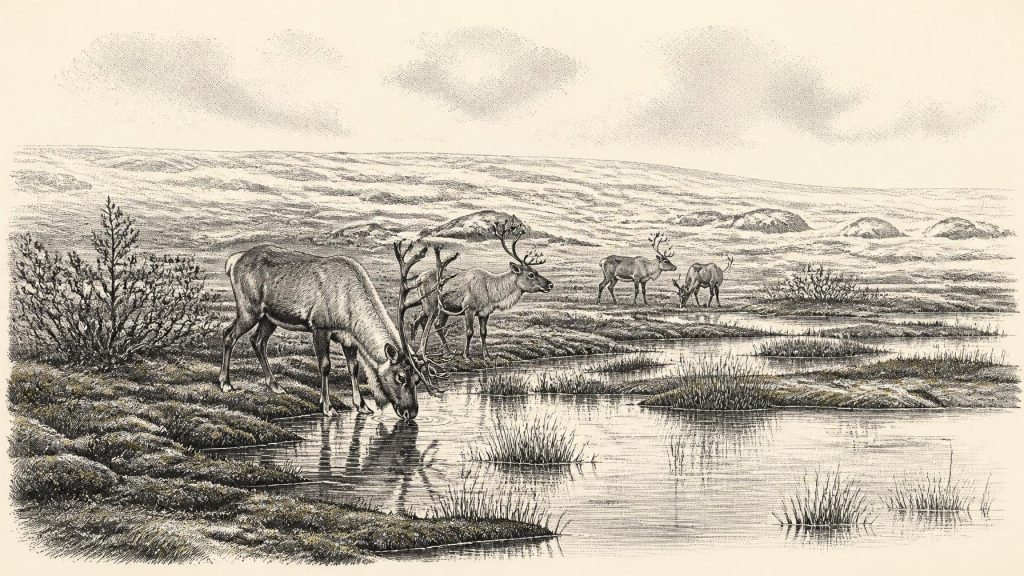
Derryvree offers a rare glimpse of life in an Irish landscape that later glaciation largely erased or concealed. The middle deposits contained freshwater and wetland indicators, including mosses, sedges and aquatic plants. Fossil evidence recorded from the site includes bogbean (Menyanthes trifoliata), alternate water-milfoil and dwarf willow; other plant remains and insect evidence point towards cold, open ground and shallow or slow-moving water. These are observations from a particular basin. The broader picture of a treeless, periglacial wetland is an interpretation drawn from their ecological requirements and the surrounding glacial geology.
It was therefore not the wooded, hedged or farmed Ireland familiar from later prehistory. Nor should it be imagined as a lifeless sheet of snow. The Derryvree record suggests a mosaic of saturated ground, pool margins, fine mineral sediment, low vegetation and seasonal frost. Such terrain could support a functioning ecology during a cold phase: plants growing in the brief productive season, insects exploiting wet and terrestrial niches, and organic remains becoming sealed in accumulating mud. “Tundra” is useful shorthand, but it should not imply a uniform modern Arctic landscape extending unchanged across every Irish county.
Regional variation matters. Derryvree shows that this locality in what is now Fermanagh was ice-free during part of the interval represented by the organic deposits. It does not prove that all Ireland was ice-free at once. Ice margins, rainfall, altitude, coastlines and drainage differed sharply from place to place. Subsequent glacier movement scoured landscapes, shifted sediment and buried older ground beneath till. The scarcity of surviving Irish evidence is itself part of the history: later glaciation removed many sites that might otherwise have preserved traces of animals or people.
The Wider Ice-Age Fauna
Caves provide another imperfect but important archive. Castlepook Cave, also called Mammoth Cave, near Doneraile in north County Cork, yielded a remarkable collection of Late Pleistocene animal remains during excavations led by Richard J. Ussher and colleagues in the early twentieth century. The collection includes reindeer, woolly mammoth, giant deer, brown bear, wolf, spotted hyaena and lemmings. Together these animals demonstrate that, during suitable pre-maximum phases, Ireland supported a far richer cold-stage fauna than the modern island.
The cave should not be treated as a single moment frozen in time. Bones accumulated through different episodes and by different processes. Hyaenas may have dragged prey or carrion into sheltered passages; wolves and foxes could also modify remains; water, sediment movement and antiquarian excavation complicated the original contexts. The 1908 report itself recognised many gnawed bones and the presence of hyaena remains. Direct dating has subsequently shown that some Castlepook specimens are considerably older than dates first obtained in the 1990s. Cave deposits can thus establish the presence of species across long spans, but they rarely provide a photograph of one season, let alone 30,794 BCE.
Nonetheless, the faunal record helps make Derryvree’s wetland intelligible. Reindeer are adapted to cold, open country and suggest extensive grazing landscapes at certain times. Lemmings and Arctic fox point strongly towards northern conditions. Mammoth, giant deer, red deer and horse indicate varied herbivore resources; hyaenas and wolves indicate predators and scavengers within that food web. Their coexistence does not mean that every species stood together at one pool or inhabited the whole island simultaneously. It means that Ireland, across overlapping phases of the Late Pleistocene, was not simply an empty block of permanent ice.
The Reindeer Femur Question
One Castlepook object gives this period particular archaeological importance: a reindeer femur bearing a deep linear mark interpreted by palaeozoologist Ruth Carden as damage made with a sharp stone implement during carcass processing. It has been publicly presented as evidence of human activity around 33,000 years ago, and County Cork heritage material places it broadly in the vicinity of 31,000 BCE. If the interpretation is confirmed, it would show that people handled a reindeer in Ireland during the Upper Palaeolithic, much earlier than the securely dated terminal-Pleistocene butchered brown-bear patella from Alice and Gwendoline Cave, County Clare.
The qualification is crucial. The Castlepook femur is not a securely excavated occupation floor with an associated stone-tool assemblage, hearth, dwelling, burial, repeated butchery area or human remains. It cannot establish whether people killed the animal, scavenged it, removed meat or sinew elsewhere, stayed for hours or weeks, or returned in later seasons. Nor can it identify a language, ethnic group, kinship system or route of travel. The evidence permits a carefully framed possibility of a brief Upper Palaeolithic visit; it does not demonstrate a permanent Irish population or a settled “first Irish” community at this date.
Comparison with Upper Palaeolithic communities in Britain and continental Europe can explain what a mobile hunting party might have been capable of: stone cutting tools, fire, fitted clothing, detailed knowledge of animal behaviour and social links extending beyond a single camp. But such comparisons are not direct evidence for Ireland. No Irish material culture securely attributable to 30,794 BCE presently allows these features to be assigned to a local group. The distinction between plausible context and demonstrated fact is especially important in a landscape where both archaeological survival and old excavation records are uneven.
No Polities, but Profound Change
Political affairs, conflict, diplomacy, religion, formal learning and trade cannot responsibly be reconstructed for Ireland at this point. There were no known Irish kingdoms, named chiefs, borders, shrines, monuments or institutions. There is no evidence for agriculture, animal husbandry, metalworking, pottery, long-distance exchange or built settlement. Even “society” can only be discussed conditionally: if people entered the island, they would have faced a world in which food, fuel, shelter, weather and animal movement were immediate concerns, but their social organisation is unknown.
The dominant historical development was environmental. The Derryvree deposits record a living freshwater interval between episodes of glaciation. In the longer view, the British–Irish Ice Sheet was dynamic during MIS 3 and later expanded greatly during the Last Glacial Maximum, broadly after 27,000 calendar years BP. This expansion altered drainage, eroded earlier surfaces and transformed habitats. Falling global sea levels changed the outlines of the surrounding shelf, but lower sea level alone does not demonstrate a dry land bridge, a known crossing route or a particular method of arrival in Ireland.
For 30,794 BCE, then, Ireland’s history is a history of evidence rather than events. Derryvree preserves a cold freshwater wetland between glacial advances; Castlepook preserves the bones of animals adapted to an Ice-Age world; and one marked reindeer femur raises a significant but unresolved question about human visitation. These fragments do not yield a conventional year-by-year narrative. They instead reveal an island repeatedly reshaped by ice, locally alive with wetland plants and cold-stage fauna, and still capable of revising the earliest history of human presence.
Primary Sources
- New insights on the fauna of Ireland's Younger Dryas and Early Holocene from Alice & Gwendoline Cave
- New insights on the fauna of Ireland's Younger Dryas and Early Holocene from Alice & Gwendoline Cave (PDF)
- Exploring controls of the early and stepped deglaciation on the western margin of the British Irish Ice Sheet
- The timing and magnitude of the British–Irish Ice Sheet between Marine Isotope Stages 5d and 2: implications for glacio-isostatic adjustment, high relative sea levels and ‘giant erratic’ emplacement
- New data for the Last Glacial Maximum in Great Britain and Ireland
- Trimlines, blockfields and the vertical extent of the last ice sheet in southern Ireland
- The IntCal20 Northern Hemisphere Radiocarbon Age Calibration Curve (0–55 cal kBP)
- IntCal Publications
- IntCal History
- BSBI: Menyanthes trifoliata
- BSBI: Salix herbacea
- BSBI: Myriophyllum alterniflorum
- On the Cave of Castlepook, Near Doneraile, Co. Cork
- The Irish Quaternary Fauna Project
- Irish Quaternary Vertebrates
- Advances in Irish Quaternary Studies
- First Evidence of a Late Upper Palaeolithic Human Presence in Ireland
- First Evidence of a Late Upper Palaeolithic Human Presence in Ireland (PDF)
- Episodic speleothem deposition tracks the terrestrial impact of millennial-scale last glacial climate variability in SW Ireland
- Heritage Artefacts of County Cork
- County Cork Heritage Grant Scheme 2023: Castlepook Cave Project
- The Mesolithic in Ireland: when was it?
- A North-Western Habitat: the Paleoethology and Colonisation of a European Peninsula
- Irish Caves Database