BIRM-166’s Tundra Pool30527 BCE
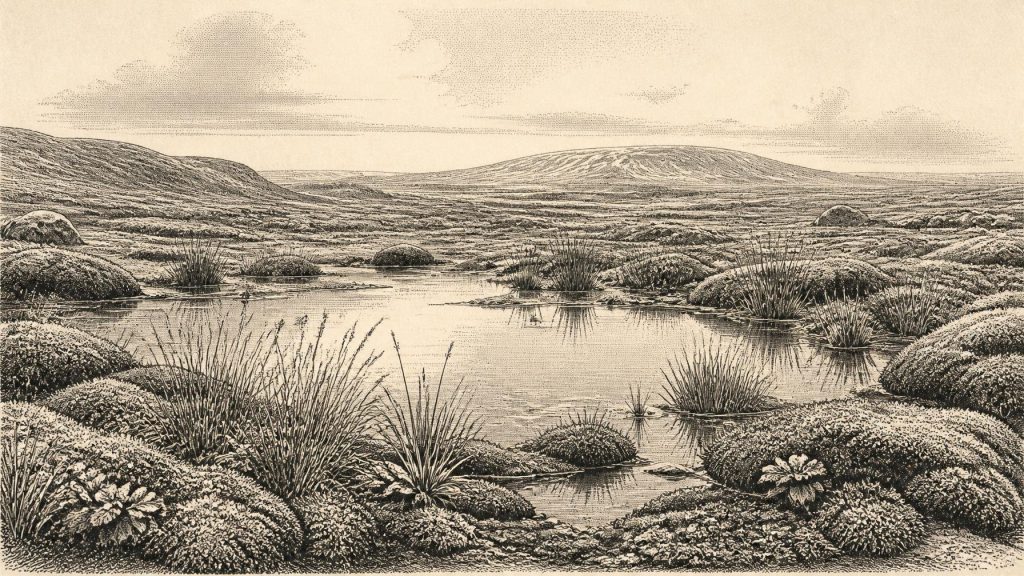
At approximately 30,527 BCE, Ireland’s history is reconstructed from fragmentary Late Pleistocene evidence rather than precise events. At Derryvree, County Fermanagh, organic freshwater sediments between glacial tills, dated broadly to 34,950–29,750 BCE, show an ice-free tundra interval with water, wetland plants and severe seasonal conditions. They do not establish conditions across the island. Castlepook Cave, County Cork, preserves remains of mammoth, reindeer, giant deer and predators, though accumulated deposits cannot represent one moment. A possibly tool-marked reindeer bone may indicate fleeting Upper Palaeolithic human butchery, but no settlement, tools or secure occupation evidence confirms a resident population. Sea routes uncertain.
Dateline
Modern calendar-year precision is not available for Ireland in 30,527 BCE. This date is a useful point on a modern chronological scale, not a year for which an event, ruler, settlement or season can be identified. The most responsible evidence comes from the Late Pleistocene, during Marine Isotope Stage 3: buried sediments, fossil plants and insects, animal bones, cave deposits and the traces of expanding ice. Their dates are expressed as ranges, and their meaning must be kept separate from the interpretations built upon them.
The closest Irish evidence is the BIRM-166 deposit at Derryvree, near Maguiresbridge in County Fermanagh. In 1969, roadworks cut through a drumlin and revealed organic freshwater silts and fine sands between two thick layers of till, the unsorted sediment left by glacier ice. The organic bed produced a conventional radiocarbon result of 30,500 years before present, with a substantial uncertainty of +1,170 and −1,030 years. Later calibration places the deposit broadly at about 36,900–31,700 calibrated years before present, roughly 34,950–29,750 BCE. The nominal year considered here falls within that wide span, but cannot be attached to a particular plant, animal, pool or human action within it.
A Freshwater Interval Between Ice Advances
Derryvree’s great importance lies in its sequence rather than in a single date. First, ice deposited the lower till. Then the locality was ice-free long enough for shallow freshwater, mud and organic material to accumulate. Finally, later ice or ice-derived sediment covered the deposit beneath the upper till. This is firm stratigraphic evidence for environmental change at one site. It does not demonstrate that all Ireland was simultaneously open ground, nor does it reveal precisely how long the freshwater episode lasted.
The fossil assemblage indicates a full-glacial, periglacial landscape: intensely cold, seasonally severe and largely treeless. Pollen was poorly preserved, yet most identifiable grains came from herbaceous plants associated with tundra. Moss macrofossils, sedges and other wet-ground vegetation preserved a more detailed record. Aquatic and waterside species show that this was not simply dry, wind-scoured ground. There were shallow pools or slow water, wet margins and mossy sediment, set within a broader open landscape. Dwarf shrubs and Arctic-alpine plants could exploit sheltered, moist or briefly favourable places, but no evidence supports a closed forest.
This mosaic matters. “Tundra” should not conjure an unbroken white desert. In summer, low vegetation could flower, insects could breed and wet hollows could hold freshwater. In winter, frost, snow cover, frozen soils and strong winds would have sharply limited life. The character of a locality also depended on relief, drainage, exposure and the proximity of ice. A drumlin hollow in Fermanagh cannot stand for every coast, upland or limestone valley. Yet Derryvree is a rare Irish window into an interval later glaciation otherwise erased or buried.
Ice, Land and Regional Change
At this point in the last glacial cycle, the global Last Glacial Maximum had not yet reached its principal peak, conventionally placed around 26,500 to 19,000–20,000 years ago. Ireland’s own ice history was not a single island-wide switch between ice and no ice. Ice masses advanced, thinned and altered their margins at different times in different sectors, while much of the direct terrestrial evidence was later reworked. Recent British–Irish Ice Sheet reconstructions begin at about 31,000 years before present because conditions and margins before and around that threshold remain difficult to resolve.
Derryvree therefore offers an important restraint on sweeping statements. Its buried freshwater sediments show that north-central Ireland was ice-free during the dated interval; the overlying till shows that ice subsequently returned or crossed the site. It would be unsafe, however, to map an exact ice edge for 30,527 BCE from this exposure alone. The proper picture is one of a changing western fringe of north-west Europe, in which glacier growth and climatic oscillation repeatedly transformed routes, habitats and the survivability of animal populations.
Lower sea levels altered the geography around Ireland, but the practical connections available at any particular moment remain difficult to reconstruct. Land, shallow seas, estuaries and ice-choked waters changed as sea level and glacier margins changed. Animal movement into Ireland is demonstrated by fossils, but the precise corridors used by each species are rarely known. No responsible account should imagine a permanent land bridge or a simple, unchanging route from Britain or continental Europe.
Castlepook’s Animal World
County Cork’s Castlepook Cave, near Doneraile, provides the principal faunal counterpoint to the Fermanagh wetland. The old cave collections include remains attributed to woolly mammoth, giant deer, reindeer, brown bear, wolf, Arctic fox, lemmings and spotted hyaena. Radiocarbon dating undertaken through the Irish Quaternary Fauna Project showed that mammals entered or survived in Ireland across a long part of the Late Pleistocene, at least from roughly 45,000 to 20,000 radiocarbon years ago. The cave’s material does not represent one undisturbed moment: bones accumulated in different passages, were subject to carnivore activity and, in some cases, came from deposits whose original layering had been disturbed.
That warning is especially important for everyday life. Reindeer were well suited to cold, open environments and may have travelled through landscapes resembling the Derryvree record, while mammoth, giant deer and predators signal a varied large-mammal community across the wider period. But a bone in a cave does not prove that the animal lived beside the cave, died there, or belonged to the same season as another bone nearby. Hyaenas and other carnivores may have carried carcass parts into the galleries. Castlepook supplies compelling evidence of Ice Age fauna in Ireland, not a census of a single local herd in 30,527 BCE.
People: A Possibility, Not a Population
One Castlepook reindeer femur has been presented by palaeozoologist Ruth Carden and County Cork heritage publications as bearing a deep mark made by a sharp stone tool during butchery. If that interpretation is sustained, it would indicate that Upper Palaeolithic people handled a reindeer carcass in Ireland around this broad era. It would be an exceptionally important find, suggesting a brief visit by mobile hunters rather than the much later, well-attested Mesolithic settlement of the island.
The limits are as important as the possibility. No associated stone tool, hearth, dwelling, human burial, occupation floor or securely excavated camp has been recovered at Castlepook for this proposed early human presence. The femur derives from an old cave collection, and the age of an animal bone does not automatically establish the date of a surface mark. Cave deposits also demand careful distinction between cut marks, tooth damage, breakage, weathering and later disturbance. It is therefore not sound to describe a settled hunting community, a named people or a continuous Irish population at this date.
If people were present, the most that evidence can presently support is a small, highly mobile party with access to a sharp stone edge and knowledge of animal carcass processing. Meat, hide, marrow, sinew and bone were valuable resources for Upper Palaeolithic groups elsewhere in north-west Europe, but none can be demonstrated as a regular Irish economy from one contested object. The same restraint applies to trade. No imported tool assemblage, exchange network or repeated crossing route has been found in Ireland for this period.
No Polities, No Recorded Beliefs
There is no evidence for political institutions, leaders, warfare, diplomacy, territorial boundaries or formal religion in Ireland at this date. Nor can art, language, ritual practice, kinship rules or teaching traditions be recovered from the Derryvree sediments or Castlepook fauna. Absence of evidence is not proof that people who may have passed through lacked social lives or beliefs; rather, Ireland has not yielded the archaeological contexts needed to describe them. The rich symbolic cultures known in some contemporaneous European Upper Palaeolithic regions cannot simply be transferred across the Irish Sea.
The history appropriate to 30,527 BCE is consequently environmental and evidential. In Fermanagh, a cold freshwater tundra interval survived between episodes of glaciation. Across the island and its changing approaches, animals occupied habitats that later ice sheets would greatly disrupt. In Cork, caves retained fragments of that vanished fauna and perhaps a tantalising trace of human butchery. These are not the foundations of a year-by-year political narrative. They are the hard-won, partial records from which Ireland’s deep Ice Age past can responsibly begin to be understood.
Primary Sources
- Middle Midlandian Freshwater Series at Derryvree, Maguiresbridge, County Fermanagh, Northern Ireland
- Middle Midlandian Freshwater Series at Derryvree, Maguiresbridge, County Fermanagh, Northern Ireland
- Palaeoecology
- The Subdivision of the Quaternary Period in Ireland
- The Irish Quaternary Fauna Project
- Occurrence of Mammalia Relicts at Site Castlepook Cave
- The Exploration of Castlepook Cave, County Cork
- Archaeological Heritage of County Cork
- Heritage Artefacts of County Cork
- 32564: Castlepook Cave, Castlepook, Cork
- Trimlines, Blockfields and the Vertical Extent of the Last Ice Sheet in Southern Ireland
- Growth and Retreat of the Last British–Irish Ice Sheet, 31,000 to 15,000 Years Ago: the BRITICE-CHRONO Reconstruction
- The Timing and Magnitude of the British–Irish Ice Sheet Between Marine Isotope Stages 5d and 2
- Timing and Pace of Ice-Sheet Withdrawal Across the Marine–Terrestrial Transition West of Ireland During the Last Glaciation
- Exploring Controls of the Early and Stepped Deglaciation on the Western Margin of the British–Irish Ice Sheet
- The Last Glacial Maximum
- The IntCal20 Northern Hemisphere Radiocarbon Age Calibration Curve (0–55 cal kBP)
- Middle Midlandian Interstadial Deposits at Greenagho, Near Belcoo, County Fermanagh, Northern Ireland
- New Insights on the Fauna of Ireland’s Younger Dryas and Early Holocene from Alice & Gwendoline Cave
- New Insights on the Fauna of Ireland’s Younger Dryas and Early Holocene from Alice & Gwendoline Cave
- The Mesolithic in Ireland: When Was It?
- The Last Glacial Maximum