A Reindeer at Doneraile31194 BCE
About 31,194 BCE is a modern chronological label, not a recorded Irish year. Ireland then lay in the Middle Midlandian cold stage, before maximum glaciation, with variable tundra-steppe, wetlands and sparse vegetation. Derryvree deposits in Fermanagh provide environmental evidence for this harsh, ice-free or ice-marginal landscape. Castlepook Cave near Doneraile contains remains of mammoth, reindeer, giant deer and other cold-climate animals, accumulated across long periods. A marked reindeer femur, possibly cut by a stone tool, suggests a brief Upper Palaeolithic human visit, but cannot prove settlement. Glaciation, erosion and rising seas have left Ireland’s human record fragmentary, provisional and unresolved.
Dateline
The label 31,194 BCE cannot identify a recorded Irish year, an event, a ruler or a date in anybody’s calendar. There were no written records, fixed local calendars or named communities from which an annual history can be made. It is a modern chronological marker, roughly 33,000 years before the conventional radiocarbon reference date of AD 1950. For Ireland at this depth of time, responsible dating is expressed through radiocarbon determinations, calibrated ranges and broad climatic phases, often carrying uncertainties of centuries or more. The most appropriate setting is the later part of Marine Isotope Stage 3, within the Midlandian cold stage of Irish Quaternary history and well before the Last Glacial Maximum.
A Landscape Before Maximum Ice
Ireland was not yet the universally ice-covered land of the glacial maximum, which came much later, broadly between about 27,000 and 21,000 years ago in the wider British–Irish Ice Sheet system. Its climate nevertheless was severe, unstable and unlike that of modern Ireland. Long-term shifts between colder and relatively milder episodes affected glacier growth, vegetation, watercourses and animal movements. It is misleading to picture a single, unchanging ‘Ice Age’ scene, still less to assume that every part of the island experienced identical conditions at the same moment.
The closest informative environmental sequence is at Derryvree, near Maguiresbridge in County Fermanagh. Roadworks in 1969 exposed freshwater silts and fine sands trapped between deposits of glacial till. Organic material from this sequence produced a conventional radiocarbon date of 30,500 ± 1,170/1,030 BP. That measurement is not an annual date and cannot simply be converted into a precise BCE year. It does, however, place the deposit broadly within the Middle Midlandian, the same large climatic interval relevant to the date under consideration.
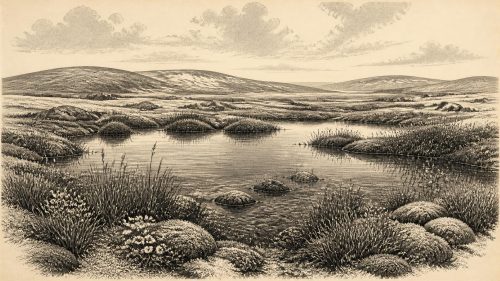
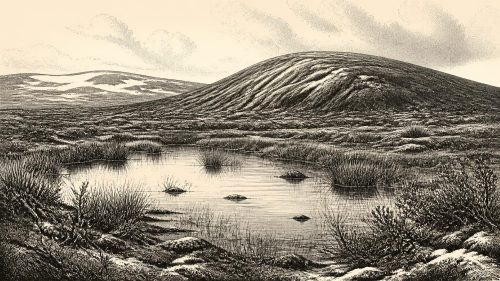
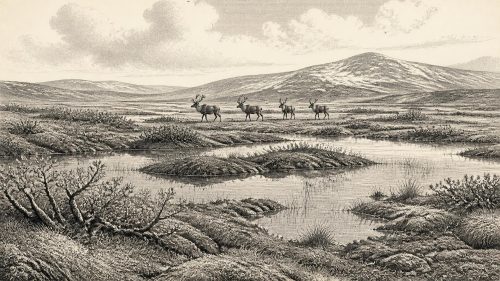
Derryvree preserves a rare Irish glimpse of a cold, ice-free or ice-marginal landscape. Pollen, seeds, mosses and insect remains point to open tundra or tundra-steppe conditions, with very limited tree cover. Sedges, grasses, mosses, dwarf willow, Arctic-alpine plants and wet-ground species grew where local moisture, soil and the short summer allowed. Shallow pools and waterlogged hollows interrupted more exposed ground. The landscape has often been compared to muskeg: cold, wet, peaty terrain in which vegetation, standing water and frost acted together. This was not a blanket of permanent snow, but neither was it the green, wooded island familiar today.
Animals in a Cold Mosaic
The animal record gives the period its strongest sense of life. Cave deposits, particularly in southern Ireland, have produced remains of large mammals associated with late Pleistocene open-country environments. Castlepook Cave, also known as Mammoth Cave, near Doneraile in north County Cork has yielded woolly mammoth, reindeer, giant deer, brown bear, hare, fox, lemming and spotted hyaena among its rich but complicated faunal archive. These animals were not necessarily contemporaries in one single episode: cave collections formed over long spans and were often excavated before modern stratigraphic methods were available. Their presence nevertheless demonstrates that Ireland could support, at different points in the wider period, a varied cold-climate fauna.
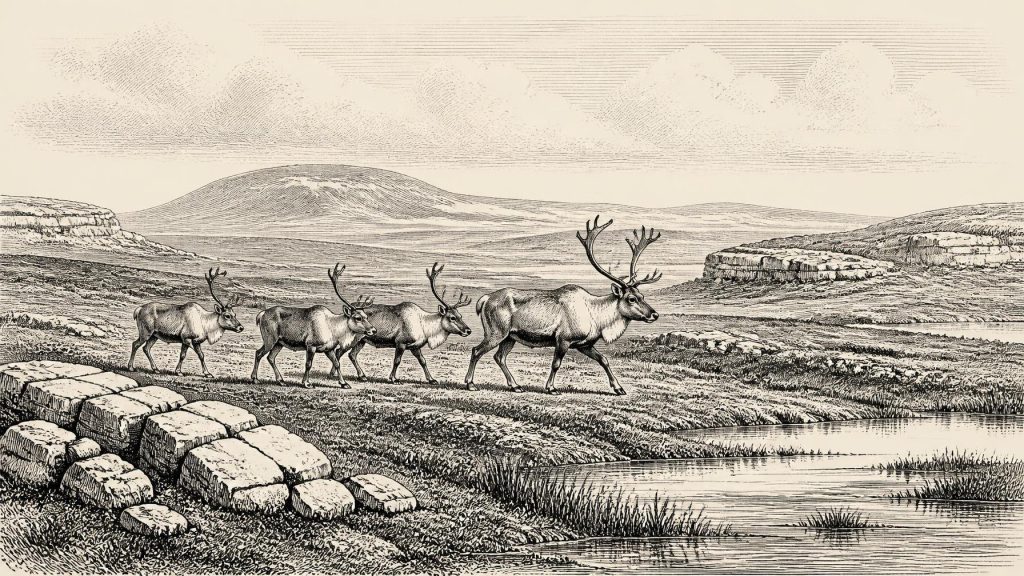
Reindeer were especially well suited to an open, seasonal country. They could exploit lichens, sedges and other tundra resources, and their movements may have followed changing forage and snow conditions. Giant deer and mammoth suggest broad feeding grounds rather than dense forest. Predators and scavengers, including hyaenas, indicate a more complex food web than the phrase ‘frozen wilderness’ implies. Yet cave bones do not provide a census of a national fauna. Carcasses may have been dragged in by carnivores, washed into chambers or accumulated through natural deaths as well as human action.
The Castlepook Question
A fragment of reindeer femur from Castlepook is the most consequential object for any discussion of people in Ireland around this remote date. It was recovered during early twentieth-century cave work and has been reported as roughly 33,000 years old. A prominent deep mark on the bone has been interpreted by zooarchaeologist Ruth Carden as damage made by a sharp stone implement while the bone was fresh: potentially evidence of carcass processing by a human visitor. County Cork heritage material has therefore presented the specimen, cautiously, as a possible indication of Stone Age hunters in the Doneraile district around 31,000 BCE.
The distinction between the evidence and its interpretation is essential. The dated bone establishes the age of the reindeer, within the limits of its laboratory result and calibration; it does not independently date the surface mark, identify its maker or prove where the animal was killed. Nor was the femur recovered in a modern excavation alongside a securely associated tool assemblage, hearth, built shelter or undisturbed floor. Stone-tool cuts must be distinguished from carnivore damage, trampling, sediment abrasion, weathering, breakage and marks introduced during excavation or handling. The proposed human modification is important and plausible enough to warrant serious investigation, but it is not equivalent to proof of a permanent Irish settlement.
If the mark is confirmed as anthropogenic, the most economical interpretation is a brief Upper Palaeolithic incursion: one or a small number of highly mobile hunter-gatherers encountered and processed a reindeer somewhere in the wider landscape. They may have reached Ireland by sea, or across a shorter sea crossing than exists today when global sea level was lower. It would still not follow that they lived continuously on the island, that Castlepook was a camp, or that their descendants remained. Ireland’s position beyond the Irish Sea made access a substantial practical matter even in low-sea-level times.
Society Without a Settlement Record
No political affairs, chiefs, alliances, wars or diplomacy can responsibly be assigned to Ireland in this period. There is no evidence for states, territories, formal institutions or named peoples. Likewise, no Irish shrine, burial, artwork, spoken language or learning tradition can be identified for around 31,194 BCE. The absence is not proof that visiting people had no beliefs, stories, social rules or knowledge; Upper Palaeolithic communities elsewhere in Europe possessed sophisticated stone-working traditions, social networks and symbolic practices. It means only that none of these can presently be demonstrated in Ireland for this date.
Nor can an Irish economy or trade network be reconstructed. A putative hunting visit would imply practical knowledge of animals, seasons, clothing, fire, cutting tools and safe movement through difficult terrain, but these are inferences from the wider Upper Palaeolithic world, not discoveries from a securely excavated Irish camp. There is no direct evidence here for houses, boats, stored food, exchange goods or recurring seasonal rendezvous. The lone reindeer bone, if humanly modified, would illuminate subsistence in the narrowest possible sense: meat and perhaps marrow or hide were valuable resources.
Fragmentary Ireland
The scarcity of evidence is itself historically meaningful. Later ice advances, erosion, rising seas and the disturbance of cave deposits removed or obscured much of the archaeological record. Sites that once stood on coastal plains may now lie beneath the sea, while glacial action could destroy shallow camps and redeposit sediments. The contrast with continental Europe is striking: people of broadly comparable age left stone tools, living surfaces, ornaments and art in many regions, whereas Ireland offers only scattered environmental archives and a disputed or provisional human trace.
Thus the most accurate portrait of Ireland around 31,194 BCE is not one of a known community but of possibility constrained by evidence. Cold open ground, wetlands and freshwater pools supported hardy vegetation and substantial grazing animals. Cave systems such as Castlepook accumulated bones that now reveal a changing Ice Age ecosystem. A marked reindeer femur raises the prospect that people briefly entered that world. It does not yet allow a conventional national history. The real historical development is the emerging recognition that Ireland’s human story may reach further back into the Upper Palaeolithic than older accounts allowed, while remaining precarious, episodic and unresolved.
Primary Sources
- Palaeoecology
- Figure 6.— The Subdivision of the Quaternary Period in Ireland
- Extent and Timing of the Last Glacial Maximum (LGM) in Britain and Ireland: A Review
- The Irish Quaternary Fauna Project
- Heritage Artefacts of County Cork
- The Mesolithic in Ireland: When Was It?
- First Evidence of a Late Upper Palaeolithic Human Presence in Ireland
- First Evidence of a Late Upper Palaeolithic Human Presence in Ireland
- New Insights on the Fauna of Ireland’s Younger Dryas and Early Holocene from Alice & Gwendoline Cave
- New Insights on the Fauna of Ireland’s Younger Dryas and Early Holocene from Alice & Gwendoline Cave
- The Geological Heritage of County Leitrim
- Soils of County Waterford
- Late Quaternary Stratigraphy and Glacial History of Southern Ireland
- Ireland’s Palaeolithic Archaeology – Fleeting Footprints in a Frozen Land
- Reindeer Bone Found in Cork Cave Shows Human Activity in Ireland 33,000 Years Ago
- What Was on the Menu in Prehistoric Ireland?
- The IntCal20 Northern Hemisphere Radiocarbon Age Calibration Curve (0–55 cal kBP)
- The IntCal20 Approach to Radiocarbon Calibration Curve Construction: A New Methodology Using Bayesian Splines and Errors-in-Variables
- IntCal: International Radiocarbon Calibration
- Salix herbacea (Dwarf Willow)
- Myriophyllum alterniflorum (Alternate Water-milfoil)
- The Irish Quaternary Fauna Project