
Castlepook’s Cutmark31534 BCE
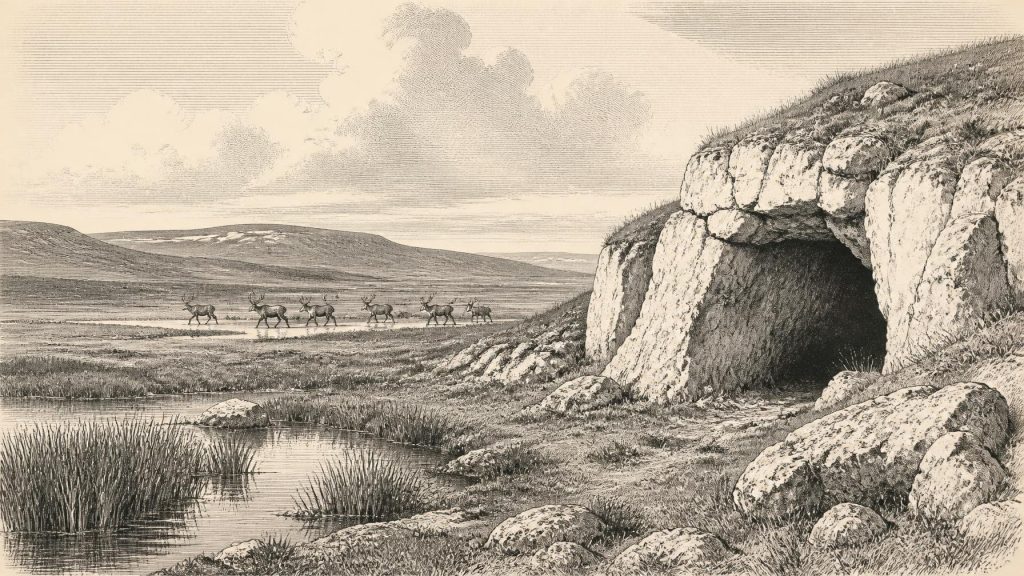
31,534 BCE is not a recoverable Irish calendar year, but lies within Marine Isotope Stage 3, an unstable Pleistocene period. Lower sea levels altered connections with Britain and Europe, while ice-free areas supported open steppe-tundra, wetlands and cold-adapted plants. Derryvree deposits demonstrate such environments. Castlepook Cave preserves mixed animal remains, including mammoth, reindeer, giant deer and hyena, accumulated over millennia rather than as one community. A cutmarked reindeer femur c. 31,000 BCE may provide Ireland’s earliest evidence of human carcass processing. It cannot prove hunting, settlement or colonisation. Glaciation, flooding and early excavation left fragmentary evidence of potential visits there.
Dateline
The label “31,534 BCE” supplies a point on a modern timeline, not a year that can be recovered from Ireland’s archaeological record. No contemporary Irish calendar, settlement sequence or historical event allows activity to be dated to that individual year. The responsible view is broader: this point falls in the later part of the Pleistocene, within Marine Isotope Stage 3, roughly 33,500 calibrated years before present (where “present” is conventionally 1950). Dates of this depth carry substantial ranges, and the relationship between radiocarbon years, calibrated calendar years and climatic episodes is not exact. What can be examined is the evidence for Ireland’s landscapes, animals and possible human visitors during the wider interval around the early 30,000s BCE.
A Changing Ice-Age Country
Ireland was not yet the island familiar today. Sea level was far lower than now because immense quantities of water were held in northern ice sheets. The coastlines lay well beyond their modern positions, exposing parts of the continental shelf and altering routes between Ireland, Britain and mainland Europe. Yet a lower sea did not necessarily mean a simple, continuous land bridge available at every moment. Glaciers, rivers, marshes, sea channels and shifting shorelines made the geography of movement complicated. Any people or animals reaching Ireland did so within a north-west European world whose physical connections changed repeatedly.
This was also an unstable climatic era. The global Last Glacial Maximum, when the British–Irish Ice Sheet reached its greatest extent, lay in the future, principally after about 26,000 years ago. Around the date represented here, however, the climate already oscillated sharply between colder stadial phases and comparatively milder interstadials. Ireland’s surviving land records are patchy, but they show that neither a timeless frozen wasteland nor a familiar green, wooded island is an adequate picture. Local conditions depended upon altitude, drainage, exposure and the proximity of ice.
Organic deposits buried beneath later glacial sediments at Derryvree in County Fermanagh are among the key environmental archives. Their mosses, sedges, aquatic plants and other fossil remains indicate freshwater or wet-ground habitats in an open, treeless setting during part of the Middle Midlandian glacial sequence. The deposits have long been associated with a radiocarbon determination of about 30,500 radiocarbon years BP, although its uncertainty and the problems of correlating individual Irish deposits with wider climate records demand caution. Derryvree does not describe an exact annual scene in 31,534 BCE. It does, nevertheless, demonstrate that cold-stage Ireland could contain wetlands and plant communities, rather than being uniformly buried beneath ice.
Open Ground and Seasonal Resources
The most likely broad landscape in lower, ice-free districts was an open mosaic of grassland, herb-rich steppe-tundra, bare mineral ground, sedge wetland and scattered low shrubs. Dwarf willow, mountain avens, mosses and other cold-tolerant plants occur in Irish Pleistocene palaeoenvironmental records. Such vegetation could support grazing and browsing animals, while pools and wet patches offered summer water and plant food. Wind, frost action and short growing seasons would have shaped everyday survival far more decisively than any political boundary.
Animal bones from Irish caves reveal a fauna much richer than that of later historic Ireland. Castlepook Cave, also called Mammoth Cave or Doneraile Cave, in north County Cork, is particularly important. The cave system has produced more than 2,000 bones, and its directly dated remains span a long and mixed interval before and around the Last Glacial Maximum, approximately 45,700 to 19,950 years BP. Its fauna includes woolly mammoth, giant deer, reindeer, brown bear and spotted hyena; later material includes Arctic fox, wolf and lemmings. These finds are evidence that such animals occurred in Ireland at various times. They do not prove that every species was alive together, or at Castlepook, in the precise year under consideration.
That distinction is essential. Caves are not neutral snapshots of a landscape. They trap bones brought in by carnivores, washed by water, dropped through openings or disturbed by later digging. Castlepook’s maze of narrow galleries and chambers served as a repository over many millennia. Spotted hyenas may have carried carcass parts into the cave, and water movement has obscured parts of the original sequence. The presence of a mammoth bone, for example, records an Ice-Age animal and a route by which bone reached the cave; it does not by itself reveal a mammoth hunt, a human camp or a single contemporary animal community.
The Reindeer Femur
The object that makes the period around 31,534 BCE unusually significant in Irish prehistory is a reindeer femur from Castlepook. The bone, recovered from the cave collections and held by the National Museum of Ireland, has been assigned broadly to about 31,000 BCE in public heritage interpretation. It bears a deep incision that zooarchaeologist Ruth Carden has interpreted as a fresh-bone cut or chop made by a sharp stone implement during carcass processing. If that diagnosis is accepted, it is potentially Ireland’s earliest evidence for human handling of an animal.
It is an important claim, but a deliberately limited one. A mark on one bone is not the same thing as a settlement. No securely associated hearth, stone-tool assemblage, house floor, burial, repeated occupation surface or food-processing area of this age has yet been found in Ireland. Nor does the bone establish whether people killed the reindeer, scavenged it, removed hide or sinew, took marrow, or butchered the animal elsewhere before its remains entered a carnivore-used cave. The bone’s date concerns the animal’s death; the interpretation of the mark concerns what happened to the bone; and neither proposition supplies modern calendar-year precision.
The find should therefore be described as possible Palaeolithic human activity, rather than proof of a resident population. It is, however, consistent with what is known farther east in north-west Europe. Mobile Upper Palaeolithic groups travelled through cold, open landscapes, exploiting seasonally available animals and materials. A brief visit by a small hunting party would leave a far slighter trace than a later village. At Castlepook, the reindeer femur raises the prospect of such an incursion into Ireland; it does not permit a narrative of permanent colonisation.
No Polities, No Recorded Beliefs
There were no Irish states, kingdoms, tribes known by name, treaties or diplomatic institutions that can responsibly be placed at this date. Equally, there is no evidence for organised warfare in Ireland around 31,534 BCE. If people came to the area, their social world would have been that of small, highly mobile foraging groups, connected by kinship, shared knowledge and movement across a wider European landscape. This is an inference from comparative Upper Palaeolithic archaeology, not a fact demonstrated by an excavated Irish camp.
The same restraint applies to religion, art and learning. Ireland has no securely dated cave art, portable art, ceremonial monument, burial or symbolic object from this period. It would be unreasonable to infer the absence of beliefs, stories, ritual or sophisticated environmental knowledge: all human communities possess social and learned traditions. But archaeology cannot recover their content here. The practical knowledge needed to survive—reading animal tracks, finding dry shelter, anticipating weather, selecting stone and navigating a changing terrain—would have been substantial, while remaining invisible in the present Irish evidence.
Economy Without Farms
There was no agriculture, herding, metalworking, market exchange or settled economy in Ireland at this date. Had people used the landscape, their subsistence would have rested on hunting, scavenging and the gathering of seasonal plant, bird, fish or small-animal resources where conditions allowed. Reindeer are especially suggestive because their movements can concentrate food, hide, bone and antler resources. Yet the Castlepook femur cannot show a planned reindeer hunt. It only makes the possibility of carcass processing credible.
Trade likewise cannot be demonstrated. No Irish lithic assemblage of this age identifies the source of stone tools or proves contact networks. The wider European Upper Palaeolithic world certainly circulated knowledge and materials over long distances, but no particular exchange route can be drawn across Ice-Age Ireland. The strongest conclusion is geographical rather than commercial: Ireland was biologically and potentially humanly connected to neighbouring regions often enough for large mammals to arrive, despite the severe and fluctuating conditions.
A Fragile Record
The evidence around 31,534 BCE survives in fragments: a wetland deposit beneath glacial sediments, cave bones with complex histories, radiocarbon measurements, and one contested-looking but potentially momentous cutmark. Later ice advances scoured and buried landscapes; rising seas drowned former coastal plains; and early cave excavations removed much material before modern recording methods existed. That loss explains why Ireland’s Palaeolithic record is so thin compared with those of Britain and continental Europe.
For this point in time, Castlepook’s reindeer femur deserves emphasis precisely because it is exceptional. It offers a credible opening to the possibility that people entered an Ice-Age Ireland populated by reindeer, mammoths, giant deer and hyenas. It does not turn that possibility into a dated settlement, a named community or a national origin story. The more compelling history is one of an exposed, cold and changeable landscape, intermittently habitable and still capable of yielding new evidence when its old cave collections and undisturbed deposits are studied afresh.
Primary Sources
- Castlepook Cave: Cork County Geological Site Report
- New Insights on the Fauna of Ireland’s Younger Dryas and Early Holocene through the Archaeological Excavation of Alice and Gwendoline Cave, County Clare
- The Irish Quaternary Fauna Project
- Figure 6.— The Subdivision of the Quaternary Period in Ireland
- Heritage Artefacts of County Cork
- Spotted Hyena Skull
- 2022:564 – Castlepook Cave, Castlepook South, Cork
- The IntCal20 Northern Hemisphere Radiocarbon Age Calibration Curve (0–55 cal kBP)
- The IntCal20 Approach to Radiocarbon Calibration Curve Construction: A New Methodology Using Bayesian Splines and Errors-in-Variables
- Growth and Retreat of the Last British–Irish Ice Sheet, 31,000 to 15,000 Years Ago: The BRITICE-CHRONO Reconstruction
- Pattern and Timing of Retreat of the Last British-Irish Ice Sheet
- Last Glacial Maximum Cirque Glaciation in Ireland and Implications for Reconstructions of the Irish Ice Sheet
- The Problem of a Late Quaternary Landbridge Between Britain and Ireland
- Landscapes and Environments of the Last Glacial-Interglacial Transition: A Time of Amazingly Rapid Change in Ireland
- Irish Pleistocene Biostratigraphy
- Pleistocene Vertebrates in the British Isles
- Patterns of Late Quaternary Megafaunal Extinctions in Europe and Northern Asia
- The Exploration of Castlepook Cave, County Cork
- IQUA Newsletter No. 58
- Ireland’s Palaeolithic Archaeology – Fleeting Footprints in a Frozen Land