
BIRM-166 Before Glaciation31060 BCE
31,060 BCE is an approximate modern label for late Marine Isotope Stage 3, not a datable Irish year. Ireland faced increasingly cold, unstable conditions before the Last Glacial Maximum, with expanding ice, low sea levels and open, treeless periglacial landscapes. Derryvree, County Fermanagh, preserves wetland sediments indicating an ice-free tundra ecosystem of sedges, mosses and arctic-alpine plants. Castlepook Cave, County Cork, yielded cold-stage fauna, including reindeer, mammoth and hyaena, evidencing intermittent regional connectivity. A possibly cut-marked reindeer femur suggests brief human visitation, but cannot prove settlement. Subsequent glaciation destroyed evidence, leaving environmental change central to this deeply uncertain Irish period.
Dateline
The label 31,060 BCE is a modern way of locating an immensely remote interval, not a year that can be recovered from an Irish calendar or historical record. It corresponds roughly to 33,010 years before the conventional radiocarbon baseline of 1950, but that arithmetic conversion must not be mistaken for a precisely calibrated archaeological date. No Irish event, person, settlement or season can be assigned to this particular year. The responsible subject is instead Ireland during the later part of Marine Isotope Stage 3, before the Last Glacial Maximum, when climates fluctuated sharply and the island’s landscapes, animal populations and possible human visitors left only scattered traces.
An Approximate Horizon
At this broad horizon, Ireland was entering the colder trajectory that would culminate in extensive glaciation. The timing and extent of ice growth remain matters of active research, and the island was not necessarily covered uniformly at every moment. Current syntheses place the principal build-up of the British–Irish Ice Sheet after roughly 35,000–32,000 calibrated years ago, with its maximum much later, broadly between about 27,000 and 21,000 years ago. Thus 31,060 BCE belongs near a transition: a time when cold-stage conditions, expanding ice and changing sea level increasingly shaped the possibilities for life.
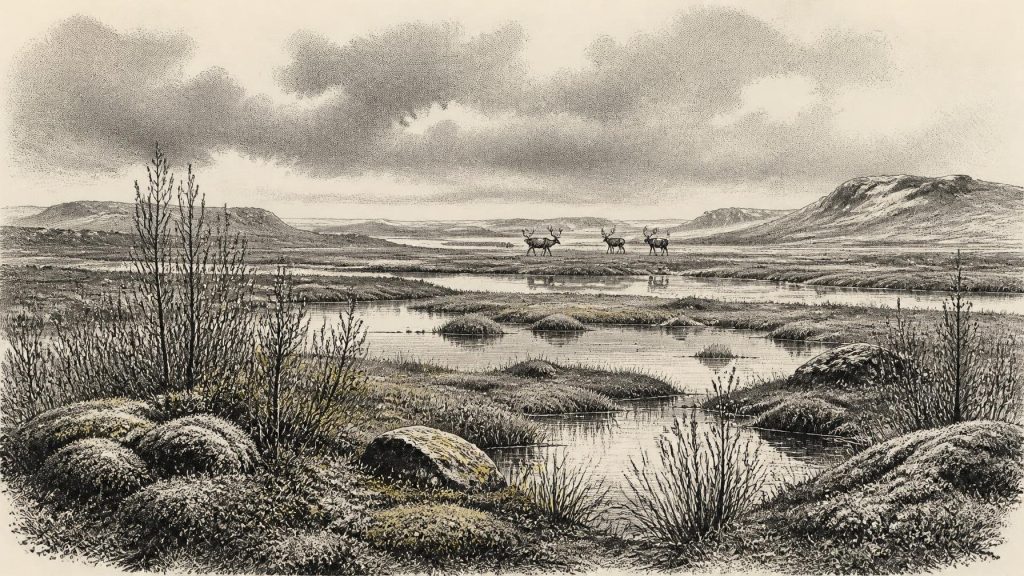
It would be misleading to picture modern Ireland under a simple white blanket. The evidence instead points to a varied, unstable northern landscape: exposed ground, periglacial soils repeatedly frozen and thawed, short growing seasons, pools and wetlands in sheltered hollows, and locally different conditions according to altitude, drainage and proximity to ice. The familiar wooded island of later millennia did not exist. Trees were severely restricted or absent across much of the region; vegetation was predominantly open and cold-adapted.
The Derryvree Evidence
One of the most useful Irish archives is Derryvree in County Fermanagh. There, a road cutting through a drumlin exposed organic freshwater silts and sands sealed between two layers of glacial sediment, or till. The organic deposit produced the radiocarbon measurement BIRM-166: 30,500 ± 1,100 radiocarbon years before present. Modern calibration gives a broad range of approximately 36,900–31,700 calendar years before present. That range overlaps the general timescale represented by 31,060 BCE, but it does not date a single day, year or even necessarily the entire deposit to that point.
The Derryvree sediments are valuable because their pollen, plant remains and associated deposits record an ice-free episode in north-central Ireland before renewed glaciation. They indicate a treeless, wet, cold environment often described as tundra or muskeg: sedges, mosses, dwarf shrubs and hardy herbs around shallow fresh water. Finds such as bogbean, water-milfoil, mountain-avens, clubmosses and dwarf willow show that this was not barren ground. It was a functioning wetland ecosystem, though one unlike the modern Fermanagh landscape. Freshwater plants imply open pools or slow water; sedges and mosses indicate marshy margins; arctic-alpine species point to a rigorous climate.
That evidence should not be stretched into a map of the entire island. Derryvree records one locality, and its sediments accumulated over time. Nevertheless, it establishes an important point: parts of Ireland remained capable of sustaining vegetation and freshwater habitats before the great ice advance. In historical terms, the leading development was environmental rather than political—the contraction of habitable ground as cold intensified and ice sheets grew.
Animals in an Open Landscape
Caves in the limestone country around Castlepook, near Doneraile in north County Cork, provide a complementary but differently problematic record. Excavations conducted between 1904 and 1918 recovered a major collection of Pleistocene animal bones. The National Museum of Ireland preserves material including spotted hyaena, while research on the wider assemblage has identified woolly mammoth, reindeer, giant deer, brown bear, Arctic fox, wolf, hare, stoat and lemmings. These animals were not necessarily present together in one season or even one millennium: cave deposits can combine remains accumulated over long periods, moved by water, scavengers, carnivores and early excavators.
Even so, the fauna demonstrates that pre-maximum Ireland was intermittently linked to a wider north-west European cold-stage world. Reindeer and lemmings support the picture of open, chilly habitats; mammoth and giant deer attest to substantial grazing or browsing animals; hyaenas and wolves reveal predators and scavengers within the food web. Castlepook was especially important as a carnivore site. Bones in a hyaena-used cave cannot simply be read as the leftovers of people: carnivores transported, chewed and altered carcass parts, creating a crucial warning for archaeological interpretation.
Sea levels were much lower than today because large volumes of water were stored in continental ice sheets. Ireland was therefore less isolated than the modern island, though the exact configuration of land, sea, ice and passable routes changed through time. The animal record supports connectivity with Britain and ultimately continental Europe; it does not demonstrate one permanent land bridge, one migration path or a human crossing at this exact date.
The Reindeer Femur Question
The closest possible evidence for people near this broad period is a reindeer femur from Castlepook. Re-examination of the old collection identified a deep linear mark interpreted by zooarchaeologist Ruth Carden as damage made with a sharp stone tool while fresh bone was being processed. The bone has been publicly reported as approximately 33,000 years old. If the mark is confirmed as human-made and contemporary with the animal’s death, it would be evidence that a person or people handled a reindeer in Ireland during the Upper Palaeolithic—far earlier than the securely established post-glacial settlement record.
Its importance requires equal caution. The specimen comes from an antiquarian cave collection, not a modernly excavated occupation floor with recorded layers, a hearth, tools and food waste in place. A radiocarbon determination dates the animal, not automatically the cut. Identifying a stone-tool mark is a separate specialist judgement, because trampling, carnivore damage, weathering and excavation can all modify bone. Nor can one limb fragment reveal whether people killed the reindeer, scavenged it, removed meat or hide, opened the bone for marrow, or processed it elsewhere before the fragment entered the cave.
The most that can responsibly be inferred is modest but significant: brief human visitation is possible, and perhaps supported by this object; permanent occupation is not demonstrated. There is no securely dated Irish dwelling, fireplace, stone-tool assemblage, burial, personal ornament, art object or human bone from around 31,060 BCE. A hunter-gatherer party exploiting a large animal is plausible in the wider European context, but it remains an interpretation rather than a documented Irish community.
Society Beyond the Record
Accordingly, political affairs, diplomacy and organised conflict cannot be reconstructed for Ireland at this date. There is no evidence for leaders, territories, named peoples, alliances, warfare, language or institutions. It would be anachronistic to project later Gaelic, Celtic or Irish identities into the Late Pleistocene. Religion and culture are equally beyond direct recovery: no Irish ritual place, image, grave, musical object or teaching tradition of this age has been identified.
If people did reach the island, their economy would have depended on mobile foraging and intimate knowledge of animal movement, weather, raw materials, shelter and fuel. Such a statement follows from Upper Palaeolithic lifeways elsewhere in Europe, not from a fully evidenced Irish camp. There is no basis for claiming trade networks, settled villages or regular seasonal circuits in Ireland itself. The tangible economy visible in the record is ecological: plants fixing themselves in wet ground, herbivores moving through open country, and predators and scavengers following them.
Approaching the Ice Maximum
The long-term regional change was decisive. In the millennia after this approximate horizon, the British–Irish Ice Sheet expanded, reworked older landscapes and buried or removed much of the evidence that might once have survived. Glacial erosion helps explain why Ireland’s record of early human activity is exceptionally sparse compared with parts of Britain and continental Europe. It also means absence of evidence cannot prove that no person ever arrived before the final glaciation; it does mean that claims of a settled Ice Age population currently outrun the data.
Ireland around 31,060 BCE is therefore best understood through a buried wetland in Fermanagh, cave fauna in Cork, uncertain routes across a lower-sea-level north-west Europe, and a single contested mark on reindeer bone. These traces illuminate a cold but living country on the threshold of greater ice. They do not provide an annual chronicle. Their real historical value lies in showing how climate change, animal mobility and the survival of fragile deposits set the limits of what can be known about Ireland’s deepest human past.
Primary Sources
- The Irish Quaternary Fauna Project
- New Insights on the Fauna of Ireland’s Younger Dryas and Early Holocene from Alice & Gwendoline Cave
- The Colonization of Ireland: A Human Ecology Perspective
- Ireland: Submerged Prehistoric Sites and Landscapes
- Extent and Timing of the Last Glacial Maximum (LGM) in Britain and Ireland: A Review
- Trimlines, Blockfields and the Vertical Extent of the Last Ice Sheet in Southern Ireland
- The Deglaciation of the Western Sector of the Irish Ice Sheet from the Inner Continental Shelf to its Terrestrial Margin
- Exploring Controls of the Early and Stepped Deglaciation on the Western Margin of the British-Irish Ice Sheet
- Irish Pleistocene Biostratigraphy
- Figure 6.—The Subdivision of the Quaternary Period in Ireland
- Spotted Hyena Skull
- Irish Fauna: Ground Floor
- Ireland’s Palaeolithic Archaeology – Fleeting Footprints in a Frozen Land
- Reindeer Bone Found in Cork Cave Shows Human Activity in Ireland 33,000 Years Ago
- Castle Pook Cave Project
- Quaternary
- Geology of Ireland
- Ireland Through Geological Time
- Publications
- Field Guides
- Outreach and Education Resources
- A New Radiocarbon Calibration Curve for the Northern Hemisphere (IntCal20)