
Derryvree’s Intertill Freshwater Series31041 BCE
At 31,041 BCE, Ireland’s history is reconstructed from environmental archives rather than human records. Derryvree, County Fermanagh, preserves freshwater silts and deposits between glacial tills, indicating a local ice-free interval with open tundra, wetlands, mosses, pools and cold-adapted insects before renewed ice advance. Its broad dating range encompasses the year but cannot identify conditions. Cave evidence from Crag Cave indicates climatic oscillations, while Castlepook Cave documents diverse cold-stage mammals, though accumulated remains were not necessarily contemporary. No secure human settlement or tools date to this period; a possible modified bone remains uncertain. Ireland was a variably glaciated Late Pleistocene landscape.
Dateline
Modern calendar-year precision is not available for Ireland in 31,041 BCE. No one on the island recorded a year, a ruler, a battle or a seasonal occurrence; indeed, there is no securely identified settlement, hearth or tool assemblage that can be placed in this particular year. The date is a modern chronological label, roughly 33,000 years before the radiocarbon convention of AD 1950. It falls in the Late Pleistocene, during Marine Isotope Stage 3, a long and climatically unstable part of the last Ice Age. The responsible history of Ireland at this depth is therefore a reconstruction from ice-laid sediments, fossil plants, insects, animal bones and cave deposits, all dated in ranges rather than to an exact calendar year.
A Date Within a Long Range
The closest unusually informative Irish evidence comes from Derryvree townland, about two kilometres north-east of Maguiresbridge in County Fermanagh. Road excavations in 1969 cut through a drumlin and exposed freshwater silts and fine sands enclosed between two thick, distinct layers of till: unsorted debris left by glacier ice. The sequence establishes an important order of events. Ice had reached the locality and deposited the lower till; during a later ice-free interval at that spot, water and organic sediment accumulated; then renewed glacial activity covered the deposit with upper till. It is a record of environmental change, not a diary of a particular year.
Organic material from the freshwater series, sample BIRM-166, produced a conventional radiocarbon determination of 30,500 years BP, with a substantial uncertainty of +1,170/−1,030 years. Modern calibration has been expressed as approximately 36,900–31,700 calendar years BP, or about 34,950–29,750 BCE. The date 31,041 BCE lies inside that broad interval, but this overlap must not be exaggerated. It does not demonstrate that a particular pool, sedge bed or animal population existed in that numbered year. It means that Derryvree is the best local archive for the sort of cold, fluctuating landscape that may responsibly illuminate Ireland at this point.
Wet Ground Between Ice Advances
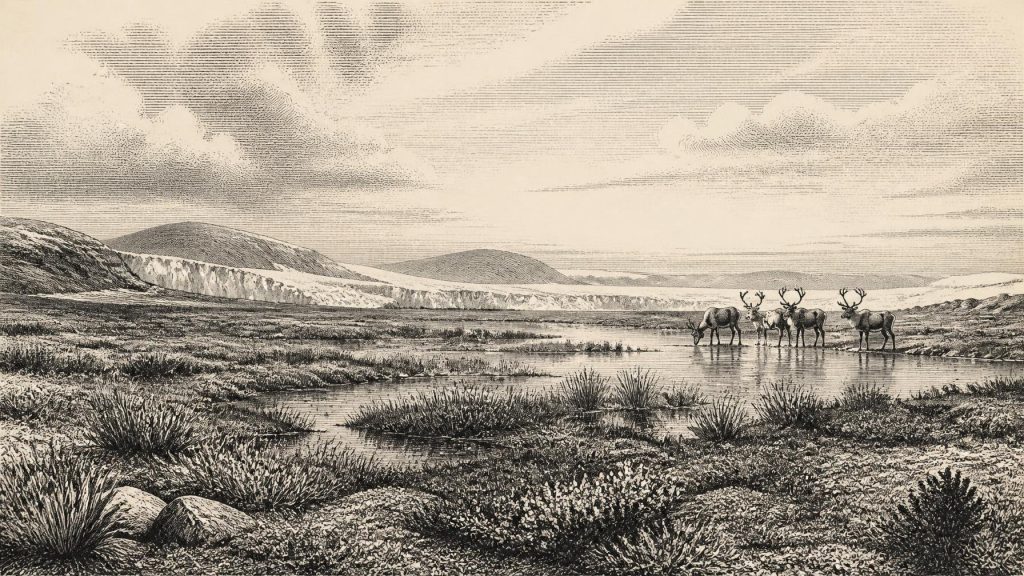
The Derryvree sediments contained plant and insect evidence interpreted as a full-glacial, open-tundra environment. Rather than woodland, the locality supported a wet, exposed mosaic of shallow pools, saturated ground, mosses and low vegetation. The insect assemblage has been read as evidence for a muskeg-like wetland: organic-rich water and peat-forming ground with open pools, fringed by mosses. Such a place was not lifeless. It offered microhabitats in which aquatic and wetland plants, invertebrates and cold-adapted vegetation could survive, even while the wider climate remained severe.
That conclusion is evidence-based, but it is also local. Derryvree cannot stand for every valley, coast or upland across Ireland. A freshwater basin in Fermanagh had its own drainage, shelter, altitude and relationship to nearby ice. Nor should the presence of organic sediment between tills be converted into a claim that all Ireland was ice-free. It shows that this part of northern Ireland experienced an interval without ice cover at the site itself, between separate episodes of glaciation. The upper till is equally important: conditions later changed enough for ice to return or expand over the wetland and bury its record.
Climate in Motion
At 31,041 BCE, Ireland was not yet at the Last Glacial Maximum, the later phase when the Irish sector of the British–Irish Ice Sheet became far more extensive. Yet it was already part of a high-latitude Atlantic world in which climate could shift markedly over millennia and sometimes much more abruptly. The Derryvree evidence belongs to this unstable setting. In south-west Ireland, uranium-thorium dates from broken and reworked speleothems in Crag Cave show episodic growth during MIS 3. Because cave calcite needs liquid water to percolate through soil and rock, these growth phases indicate intervals when mean annual conditions locally rose above freezing. They reinforce the picture not of unchanging cold, but of climatic oscillation.
These records do not yield a weather report for 31,041 BCE. They do, however, establish the scale of uncertainty that any historical reconstruction must respect. An apparent improvement in one cave record or one wetland sequence need not have produced the same conditions everywhere at the same moment. Ice-sheet margins were mobile, coastlines lay far beyond their modern positions because global sea level was lower, and landscapes could change as snowfields, permafrost, rivers and frozen ground responded to shifts in temperature and moisture. The familiar map of Ireland, with its modern shorelines, roads and fields, is of little help in visualising this world.
Animals on the Southern Landscape
Fermanagh supplies the clearest environmental sequence, but the principal evidence for large mammals comes from limestone caves in southern Ireland, especially Castlepook Cave near Doneraile in north Cork. Old excavations there recovered a remarkable but complicated assemblage, including mammoth, reindeer, giant deer, brown bear, wolf, Arctic fox, mountain hare, lemmings and spotted hyena. Direct dates show that some of these animals occurred in Ireland before the Last Glacial Maximum. The cave is therefore powerful evidence that parts of Ireland could support, or at least be reached by, varied cold-stage mammals during the wider period.
It is not, however, a single intact animal community frozen in time. Castlepook was explored in the nineteenth and early twentieth centuries, before modern excavation standards. Its bones came from a cave system affected by carnivore activity, collapse, water movement and later disturbance. Radiocarbon dating has shown that the assemblage spans long stretches of time, and researchers warn against treating every species found there as contemporary. The animal list is best understood as a regional archive accumulated over millennia, not as a census of the landscape in 31,041 BCE.
Even with that reservation, the cave evidence suggests an open, cold landscape capable of sustaining grazing and browsing animals, their predators and scavengers. Reindeer and mammoth evoke broad feeding ranges; lemmings and Arctic fox point towards severe conditions; spotted hyena reveals a carnivore guild now unimaginable in Ireland. The presence of hyena remains at Castlepook is particularly significant because the cave is Ireland’s foremost cold-stage mammal locality. Yet fossils tell us occurrence, not abundance. They cannot establish whether herds were numerous, seasonal visitors or sparse populations passing through a wider north-west European range.
The Human Question
There is no sound basis for describing a settled human society in Ireland in 31,041 BCE. No house, hearth, burial, settlement surface or securely associated stone-tool assemblage is known for this date. A reindeer bone from Castlepook has been presented as bearing a possible fresh-bone cut or chop mark and has attracted attention as a potential indication of human carcass processing around 33,000 years ago. If that interpretation is ultimately sustained, it would transform the chronology of human activity in Ireland. It would still indicate an encounter with an animal, perhaps by one person or a small mobile group, rather than a permanent population or a village.
For now, the evidential context demands restraint. The relevant specimen derives from an old cave collection rather than a modern, sealed excavation context. Natural damage, carnivore modification, breakage and post-depositional movement must always be excluded before a mark can be securely accepted as human work. Subsequent research at Irish caves has underlined how important direct dating, re-excavation and taphonomic study are in separating human action from the complex histories of cave deposits. The first firmly published evidence for Palaeolithic human presence currently rests much later, in the terminal Pleistocene record from Alice and Gwendoline Cave in County Clare.
No Polities, Trade or Ritual Record
Political affairs, diplomacy and organised warfare are beyond the reach of the evidence. There are no named peoples, territories, chiefs, alliances or institutions. Likewise, no Irish evidence from this point permits claims about language, religion, art, schooling, trade routes, social rank or family structure. It is tempting to import the better-known Upper Palaeolithic cultures of continental Europe into Ireland, but that would confuse analogy with proof. People elsewhere in Europe made sophisticated stone technologies, ornaments and cave art; none of this demonstrates their presence in Ireland at 31,041 BCE.
The economy that can be observed is ecological rather than human. Wetland plants photosynthesised, insects occupied narrow habitats, herbivores fed across open country and carnivores exploited animal carcasses. If people did reach Ireland during this broad period, hunting and scavenging large game would be plausible activities by comparison with contemporaneous hunter-gatherers elsewhere. But plausibility is not evidence. The Irish record does not reveal the mode, frequency or season of any visits, still less a network of exchange.
What This Year Can Mean
The most important development represented by 31,041 BCE is not a human event but a precarious environmental interval. At Derryvree, freshwater and organic sediments accumulated after an earlier glacial episode and before later ice covered the site. Across the island, the surviving record is patchy because subsequent glaciers eroded, mixed and buried older deposits. In Cork, caves protected fragments of a vanished mammal world, although their chronology and formation histories remain difficult to disentangle. In Kerry, cave mineral deposits preserve evidence that milder episodes punctuated the wider cold stage.
Ireland at this date was consequently neither a blank white void nor a familiar inhabited island in waiting. It was a changing Late Pleistocene landscape, locally capable of wetland life and visited or occupied by varied cold-adapted animals, while ice conditions altered across the region. The Derryvree freshwater series is its clearest witness: a small, buried archive which shows why the past must be described in calibrated ranges, cautious inferences and environmental processes rather than invented annual events.
Primary Sources
- A Middle Midlandian Freshwater Series at Derryvree, Maguiresbridge, County Fermanagh, Northern Ireland
- A Middle Midlandian Freshwater Series at Derryvree, Maguiresbridge, County Fermanagh, Northern Ireland
- Episodic Speleothem Deposition Tracks the Terrestrial Impact of Millennial-Scale Last Glacial Climate Variability in SW Ireland
- The Irish Quaternary Fauna Project
- A Reconsideration of the Radiocarbon Dating of the Marine Isotope Stage 3 Fauna from Southern Ireland
- Growth and Retreat of the Last British–Irish Ice Sheet, 31,000 to 15,000 Years Ago: The BRITICE-CHRONO Reconstruction
- Late Pleistocene Chronostratigraphy and Ice Sheet Limits, Southern Ireland
- New Insights on the Fauna of Ireland's Younger Dryas and Early Holocene from Alice & Gwendoline Cave
- Occurrence of Mammalia Relicts at Site Castlepook Cave
- The Exploration of Castlepook Cave, County Cork
- Spotted Hyena Skull
- Ice Age Ireland
- Ireland Through Geological Time
- Geology of Ireland
- Quaternary Geology of Ireland
- Figure 6.—The Subdivision of the Quaternary Period in Ireland
- Publications
- The Mesolithic in Ireland: When Was It?
- 32564: Castlepook Cave, Ballyhooly, Cork
- Prehistoric Details