Derryvree’s Interstadial Palimpsest30301 BCE
About 30,301 BCE, Ireland lay within a fluctuating Late Pleistocene cold stage, not a datable historical moment. At Derryvree, County Fermanagh, organic freshwater sediments between glacial tills record an ice-free interval broadly dated to 36,900–31,700 years ago. Mosses, sedges, aquatic plants and Arctic-alpine shrubs indicate wet, treeless tundra, later overridden by advancing ice. Castlepook Cave, County Cork, preserves a disturbed, multi-period fauna including reindeer, giant deer, mammoth, predators and scavengers, demonstrating varied habitats. Neither site proves human settlement: possible modified bone is inconclusive, while firm human evidence is far later. These deposits reveal ecological persistence, diversity and expanding ice-sheet conditions.
Dateline
The label 30,301 BCE gives a useful point on a modern timeline, but it cannot identify an Irish event, season, individual or community. This was deep in the Late Pleistocene, within Marine Isotope Stage 3, long before written records and far beyond the precision of ordinary calendar history. In terms of the radiocarbon convention whose ‘present’ is AD 1950, the nominal year is about 32,250 calendar years before present. The most relevant Irish evidence consists not of settlements but of deposits that accumulated over centuries or millennia. It therefore illuminates a broad environmental interval, rather than one particular year.
A Date Within a Wide Range
The key site is Derryvree, near Maguiresbridge in County Fermanagh. Roadworks through a drumlin exposed a remarkable sequence: freshwater silts and fine sands rich in organic material lay between two thick glacial tills. Till is the unsorted debris deposited by glacier ice. The order of the layers is the essential historical evidence. Ice had covered the locality; the ice withdrew or ceased to occupy it long enough for pools, sediment and vegetation to develop; then a later advance buried and protected that evidence beneath fresh glacial material.
Organic material from the Derryvree bed produced the conventional radiocarbon determination Birm-166, 30.5 ± 1.1 radiocarbon thousand years before present. When calibrated, the deposit has been placed broadly between about 36.9 and 31.7 thousand calendar years before present. That broad range includes 30,301 BCE, but does not mean that the deposit dates precisely to that nominal year. It is better understood as a time-window into an ice-free episode in Fermanagh during a fluctuating cold stage. The old term ‘Derryvree Cold Phase’ remains useful shorthand, although modern work stresses that the exact extent and timing of Irish ice before the Last Glacial Maximum remain difficult to reconstruct.
Fresh Water Beneath Future Ice
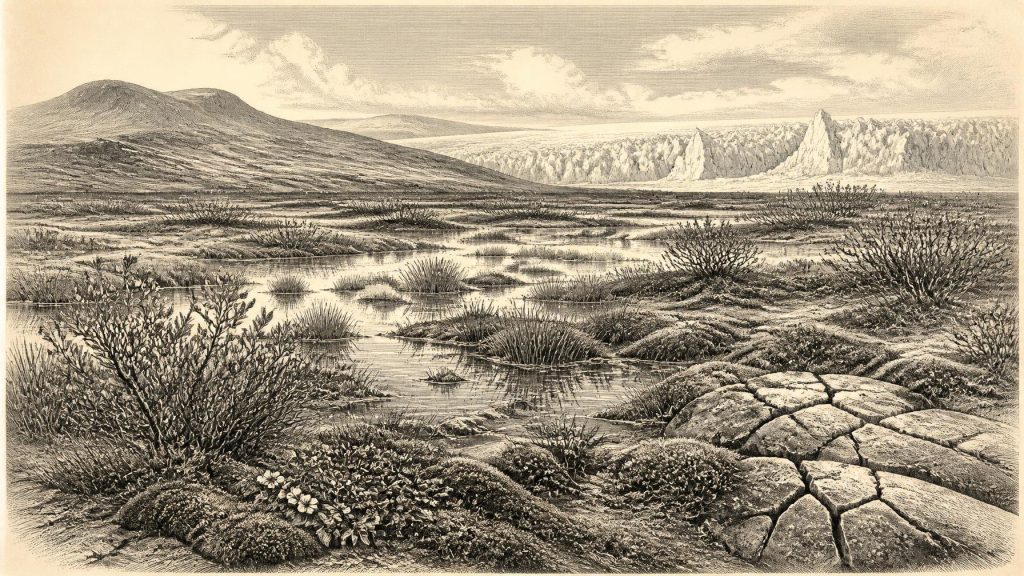
Derryvree’s plant and animal traces describe a treeless, wet tundra or muskeg landscape. Mosses, sedges, grasses and hardy Arctic-alpine plants grew around shallow pools and waterlogged ground. Fossil remains include aquatic and waterside plants such as water-milfoil and bogbean, alongside mountain avens, dwarf willow and juniper. This was not a forested Ireland, nor an empty waste of bare ice. It was a severe but biologically productive patchwork of open wetland, low vegetation and exposed mineral ground.
The word ‘muskeg’ is an interpretative comparison, borrowed from northern wetland landscapes rather than a claim that Fermanagh exactly resembled any modern place. The evidence directly establishes freshwater conditions, plant remains and cold-adapted vegetation at one locality. From these, researchers infer cold winters, short growing seasons and periglacial processes such as repeated freezing and thawing. The Derryvree bed cannot supply a national weather report. Ireland’s relief, proximity to the Atlantic and changing ice margins meant that conditions could vary considerably between lowland Fermanagh, the western seaboard and southern limestone country.
Nevertheless, the site is important because it disproves any simple picture of uninterrupted ice cover. At some point within its dated interval, life occupied ground that would later be overridden by ice. The deposit is also an accident of preservation. Most contemporary soils, plants and animal traces were eroded by later glaciation or lie beneath younger sediments and the modern sea. A buried wetland in a drumlin is thus a rare survivor of a largely destroyed landscape.
Ice Sheet in Motion
Across Ireland, the wider trend was towards the growth of the last Irish sector of the British–Irish Ice Sheet. Reconstructions indicate that the island was substantially ice-free until around 32,000 years ago, after which ice expanded rapidly, though not everywhere at precisely the same time. By the later Last Glacial Maximum, roughly 27,000–23,000 calendar years ago in many reconstructions, ice covered much of Ireland and extended offshore onto the Atlantic and Irish Sea shelves. The Fermanagh sequence belongs near the beginning of that transformation, not to the maximum itself.
This changing geography mattered more than any political boundary could have done. Lower global sea levels exposed larger coastal plains and altered the shapes of the Irish Sea and Atlantic margins, while advancing ice blocked routes, reshaped drainage and scoured older deposits. The island was not yet necessarily isolated in the later sense: connections and separations between Ireland, Britain and the continental shelf changed with sea level, ice position and local crustal movement. Yet there is no basis for describing a dependable travel corridor, trade route or migration pathway at Derryvree’s date. Physical possibility is not evidence that people used it.
Castlepook’s Animal Record
Far to the south, Castlepook Cave near Doneraile in County Cork offers a second, very different archive. Its chambers accumulated a rich but complicated assemblage of Ice Age animal remains. Radiocarbon dating has placed particular bones from the cave at differing points in Marine Isotope Stage 3, including reindeer at roughly 35,200 radiocarbon years before present, giant deer around 32,200 radiocarbon years before present, and other specimens at both older and younger dates. These are not a single herd, nor a single moment in time. Water movement, carnivore activity, nineteenth- and early twentieth-century excavation, and disturbance within the cave all complicate the associations.
Even with those cautions, Castlepook establishes that Ireland supported a varied cold-stage fauna over the wider period: reindeer, giant deer, woolly mammoth, brown bear, wolf, Arctic fox, mountain hare, lemmings and spotted hyaena are represented. Some of these animals would have ranged across open ground; others were predators or scavengers. The spotted hyaena is especially significant. Its presence helps explain why a cave could become a bone repository: carnivores may have brought carcass parts inside, gnawed them or used sheltered spaces repeatedly. Animal bones in a cave are therefore evidence of ecology and taphonomy before they are evidence of human hunting.
The fauna should not be compressed into a picturesque ‘mammoth steppe’ scene dated exactly to 30,301 BCE. Different species and bones have different dates, and their habitats may have changed as climates shifted. What can responsibly be said is that southern Ireland had, during portions of this broad pre-maximum interval, habitats capable of supporting large herbivores and carnivores. Combined with Derryvree’s wet tundra, the evidence suggests an environmentally varied Ireland rather than a uniform blanket of ice or grassland.
People: A Genuine Gap
There is no securely dated human settlement, hearth, tool assemblage, dwelling, burial or artwork in Ireland attributable to about 30,301 BCE. Nor can political affairs, diplomacy, warfare, religion, language, formal learning, farming, trade or social organisation be recovered from the Derryvree deposits. These are not omissions in the historical record; they are categories for which the evidence does not exist at this date. Farming lay tens of millennia in the future, and even the island’s first well-attested, sustained hunter-gatherer settlement belongs to the much later early Holocene.
A claim sometimes associated with Castlepook concerns a marked reindeer bone interpreted as possibly cut by a sharp stone tool. If that interpretation proves sound, it could indicate a fleeting human encounter with an animal in Pleistocene Ireland. It would still not demonstrate a resident population, camp, kin group, hunting economy or cultural tradition, and the complicated cave context prevents it from being attached to this precise date. The strongest published evidence for Upper Palaeolithic human presence in Ireland currently concerns a butchered brown-bear bone from County Clare dating to about 12,800–12,600 calendar years before present—far later than the Derryvree interval.
What Everyday Life Can Mean Here
For humans, everyday life at this date is unknowable because human presence itself is unproven. For the landscape, however, the evidence is vivid. Seasonal thaw sustained pools and wet ground; sedges and mosses trapped sediment; dwarf shrubs occupied suitable patches; herbivores moved through open country; predators and scavengers exploited carcasses and shelter. These processes, rather than human institutions, are the history available for Ireland around 30,301 BCE.
Derryvree consequently deserves attention not as the setting for an invented Ice Age village, but as a fragile record of persistence between glacial advances. Its freshwater layers show that the Irish past was shaped by sharp environmental reversals, local refuges and preservation as much as by continuity. The most important development around this nominal year was the unstable relationship between living tundra and a growing ice sheet: an ecological interval that later glaciers sealed beneath the drumlin landscape of Fermanagh.
Primary Sources
- A Middle Midlandian Freshwater Series at Derryvree, Maguiresbridge, County Fermanagh, Northern Ireland
- The Irish Quaternary Fauna Project
- The Irish Quaternary Fauna Project (full-text copy)
- Castlepook Cave, County Geological Site Report
- The Exploration of Castlepook Cave, County Cork
- The Exploration of Castlepook Cave, Co. Cork. With 3 plates.
- A Reconsideration of the Radiocarbon Dating of the Marine Isotope Stage 3 Fauna from Southern Ireland
- First Evidence of a Late Upper Palaeolithic Human Presence in Ireland
- New Insights on the Fauna of Ireland's Younger Dryas and Early Holocene from Alice & Gwendoline Cave
- The Colonization of Ireland: A Human Ecology Perspective
- Ireland: Submerged Prehistoric Sites and Landscapes
- Pleistocene Glaciations in Ireland
- Figure 6: The Subdivision of the Quaternary Period in Ireland
- Cenozoic: Tertiary and Quaternary
- The Timing and Magnitude of the British–Irish Ice Sheet Between Marine Isotope Stages 5d and 2
- Growth and Retreat of the Last British–Irish Ice Sheet, 31,000 to 15,000 Years Ago: the BRITICE-CHRONO Reconstruction
- The Deglaciation of the Western Sector of the Irish Ice Sheet from the Inner Continental Shelf to its Terrestrial Margin
- Deglaciation Chronology of the Donegal Ice Centre, North-West Ireland
- Dimensions and Chronology of the Last Ice Sheet in Western Ireland
- Last Glacial Maximum Cirque Glaciation in Ireland and Implications for Reconstructions of the Irish Ice Sheet
- Episodic Speleothem Deposition Tracks the Terrestrial Impact of Millennial-Scale Last Glacial Climate Variability in SW Ireland
- Soils of County Waterford
- Postglacial Colonisation of Ireland: Evidence from Plants and Animals
- Spotted Hyena Skull
- Castlepook Cave, Castlepook South, Cork: 2022 Excavation Report