Maguirebridge’s Water-Milfoil Silt31094 BCE
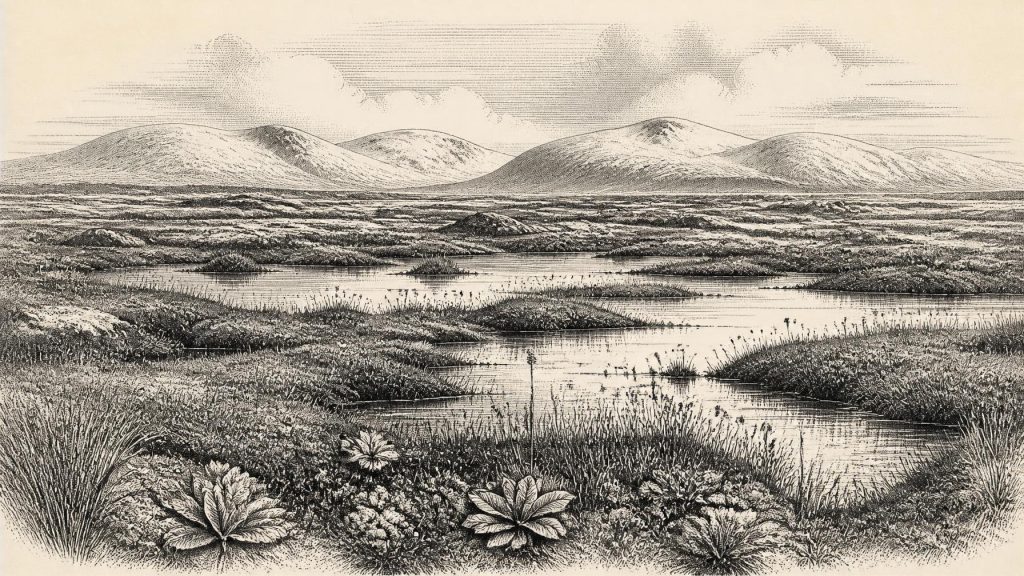
Around 31,094 BCE, Ireland has no identifiable events or communities, but Derryvree deposits near Maguiresbridge provide a broad environmental guide. Freshwater silts, dated approximately 34,950–29,750 BCE, formed during an ice-free interval between glacial advances. They indicate a cold, treeless periglacial wetland of sedges, mosses, herbs, pools and aquatic water-milfoil. Castlepook Cave’s long, disturbed faunal sequence records cold-adapted mammals, including reindeer, across a wider period. A reindeer bone dated about 33,000 years ago bears a possible butchery mark, suggesting brief human activity, not settlement. Approaching ice-sheet expansion, shifting access routes and fragmentary evidence define Ireland’s unstable Late Pleistocene environment and history.
Dateline
The label 31,094 BCE is useful for arranging a modern chronology, but it cannot identify a known event, ruler, journey or community in Ireland. No written record, named person, political unit or calendar survives from this depth of time. Nor can archaeology place activity on a particular day or even securely within a single solar year. In radiocarbon terms, this notional year falls about 33,044 calendar years before AD 1950, within the later part of Marine Isotope Stage 3 and before the Last Glacial Maximum. The responsible approach is therefore to examine dated deposits whose calibrated ranges include or lie close to this point, and to distinguish what they demonstrate from what they merely make plausible.
A Date Within Broad Ranges
The most informative Irish sequence is at Derryvree, near Maguiresbridge in County Fermanagh. Roadworks in 1969 cut through a drumlin and exposed a remarkable sandwich of deposits: a lower glacial till, freshwater silts and fine sands containing organic remains, and a younger till above. The order is secure. Ice had covered the locality; subsequently, a waterlogged landscape accumulated sediment and plant and animal remains; later glacier ice overran and sealed it. The organic layer produced a conventional radiocarbon determination of 30,500 +1,170/−1,030 radiocarbon years BP. Modern calibration places it broadly around 36,900–31,700 calibrated years BP, or roughly 34,950–29,750 BCE.
Thus 31,094 BCE sits inside a wide calibrated interval associated with the Derryvree deposits, not at a precisely observable moment in their formation. The dated sample gives neither an anniversary for a pond nor a date for each seed, insect and sediment grain. Calibration curves themselves become less exact at such antiquity because atmospheric radiocarbon varied through time. Yet the range is sufficiently close to make Derryvree the best local environmental guide to Ireland around this notional year.
A Treeless Wetland in Fermanagh
Derryvree does not reveal a familiar green and wooded Ireland. Its plant remains, pollen and invertebrate evidence indicate an open, cold, periglacial environment. Periglacial means a landscape shaped by intense freezing and thawing at the edge of, or beyond, glacier ice: seasonally frozen ground, sparse vegetation, unstable wet soils and short growing seasons. Sedges, mosses and cold-tolerant herbs formed much of the cover. Fossil evidence includes bogbean (Menyanthes trifoliata), a plant of wet ground and shallow water, and alternate water-milfoil (Myriophyllum alterniflorum), an aquatic plant. These finds support the presence of pools, marshy margins or sluggish freshwater channels.
The scene was therefore a mosaic rather than a single uniform tundra. A shallow basin could have held open water and water plants while higher or better-drained ground supported low herbaceous vegetation. Dwarf willow and mountain-avens are among the kinds of cold-climate plants recorded from comparable Irish middle-glacial contexts. This is evidence for local habitats, however, not a licence to paint every hill and valley of Ireland alike. Derryvree was one protected freshwater setting in Fermanagh. Conditions in the limestone lowlands of Cork, the western seaboard and upland Donegal may have differed substantially.
The deposits also settle an important regional question. They prove that this part of Fermanagh was ice-free long enough for a freshwater ecosystem to develop between two episodes of glacial deposition. They do not prove that the whole island was ice-free. The build-up of the British–Irish Ice Sheet was under way on a regional and uneven basis after roughly 35,000–32,000 years ago; its broad maximum came later, conventionally placed around 27,000–21,000 years ago. Ireland at this time was changing, not standing at one neat boundary between “ice-free” and “glaciated”.
Castlepook’s Long Faunal Record
County Cork offers a different type of evidence. Castlepook Cave near Doneraile, also known as Mammoth Cave, is Ireland’s richest known archive for vertebrate life leading towards the Last Glacial Maximum. More than 2,000 bones have been recovered there, although the cave’s deposits were disturbed by water movement, carnivore activity and early excavations. Direct radiocarbon dates from individual bones span a long interval, approximately 45,700 to 19,950 years BP. The cave cannot therefore be read as a snapshot of one year, nor can all its species be assumed to have met one another.
Nevertheless, the fauna establishes that Ireland supported, at different points during this broad period, a formidable Pleistocene animal community. Castlepook has produced remains of woolly mammoth, giant deer, reindeer, brown bear and spotted hyaena, with later Ice Age remains including Arctic fox, wolf and lemmings. Re-dating of Castlepook material using improved ultrafiltration methods showed that several older determinations had understated the true age of the bones by thousands of years. This revision has made the cave especially important for Marine Isotope Stage 3, while also warning against reliance on old dates obtained before modern pretreatment methods.
Near 31,094 BCE, a reindeer is the most evocative and relevant animal. Reindeer thrive in open country where lichens, grasses, sedges and herbs can be exploited. Their presence accords with the Derryvree picture of a cold, open landscape, but it does not establish a continuous herd in every Irish region. Mammoths and hyaenas likewise belong to the cave’s long record rather than a securely simultaneous local scene. The strongest conclusion is modest: Ireland was ecologically connected enough, at least intermittently, to sustain or receive cold-adapted mammals before the ice sheet reached its later maximum.
The Reindeer Bone and Human Possibility
Castlepook has also transformed discussion of the Irish Palaeolithic. A reindeer femur, recovered from the cave’s historic collections, was reported in 2021 to carry a deep mark consistent with butchery by a sharp stone implement and to date to roughly 33,000 years ago. If the mark is correctly identified as human-made, it is potentially the earliest evidence of human action in Ireland by a very large margin. It would suggest that people reached the island, or its then changing north-west European margin, during the difficult climatic interval before the Last Glacial Maximum.
That claim needs careful wording. One modified bone is not a settlement. Castlepook has produced no securely associated hearth, worked-stone assemblage, dwelling floor, human burial or repeated concentration of butchered carcasses from this age. Its sediments and collections also have complicated histories. The bone may record a brief episode of carcass processing by a very small party rather than a permanent population. Nor can it identify whether the people involved were resident, visiting seasonally, or passing through a wider hunting range. The 2022 archaeological investigation at Castlepook located surviving cave sediments but recovered no cultural artefacts, underlining how incomplete the evidence remains.
Society Without Institutions
There is no evidential basis for kingship, tribal names, laws, diplomacy, organised warfare, trade routes or religious institutions in Ireland at this date. There are no monuments, graves, houses, ceramics, metalwork or artworks securely attributable to around 31,094 BCE. It would be misleading to project later Irish cultural traditions, languages or territorial identities into this world. Even the term “Ireland” is geographical shorthand for the landmass that would become the island, not a political community.
If the Castlepook modification proves anthropogenic, the minimum inference is practical knowledge: someone used a sharp-edged stone tool on fresh animal bone, probably while processing a carcass. Such a task could provide meat, marrow, hides, sinew and bone, but none of those outcomes can be demonstrated from the mark alone. Comparisons with Upper Palaeolithic hunter-gatherers elsewhere in north-west Europe make small, mobile groups exploiting seasonal animal resources a reasonable interpretation, not an Irish fact. The archaeological record does not yet reveal their language, kinship, ritual, learning or artistic life.
Movement, Access and Survival
How mammals or people reached this land is equally unsettled. Lower global sea levels changed coastlines, but Ireland’s relationship with Britain and the surrounding seas was governed by complex ice, sea-level and crustal movements. The faunal record proves that large mammals arrived during the wider Late Pleistocene; it does not specify their route in the year 31,094 BCE. Whether movement involved exposed ground, ice connections, narrow-water crossings or changing combinations of these remains a matter for palaeogeographical reconstruction. For people, no boats, landing places or routeways are known.
The chief development visible at this date is therefore environmental instability. Fermanagh’s freshwater silt records an ice-free, wet, treeless interval, while the Irish glacial system was approaching a major expansion. Castlepook preserves evidence that large animals occupied or entered southern Ireland during the wider period, and perhaps that humans handled a reindeer carcass. Soon afterwards, advancing ice would destroy, bury or render inaccessible much of the evidence that might have clarified the story. Around 31,094 BCE, Ireland’s history is not one of states or settlements, but of fragile habitats, mobile animals and a tantalising human trace at the edge of a deepening Ice Age.
Primary Sources
- A Middle Midlandian Freshwater Series at Derryvree, Maguiresbridge, County Fermanagh, Northern Ireland
- A reconsideration of the radiocarbon dating of the Marine Isotope Stage 3 fauna from southern Ireland
- The Irish Quaternary Fauna Project
- Castlepook Cave: Cork County Geological Site Report
- 2022:564 – Castlepook Cave, Castlepook South, Cork
- New insights on the fauna of Ireland's Younger Dryas and Early Holocene from Alice & Gwendoline Cave
- Extent and timing of the Last Glacial Maximum (LGM) in Britain and Ireland: a review
- Late Pleistocene chronostratigraphy and ice sheet limits, southern Ireland
- Trimlines, blockfields and the vertical extent of the last ice sheet in southern Ireland
- Exploring the chronology of the last British-Irish Ice Sheet across the North Channel, Ireland
- Figure 6: The subdivision of the Quaternary Period in Ireland
- The Quaternary of Fermanagh and Tyrone: Field Guide
- Early Midlandian–Middle Midlandian, Pleistocene, Northern Ireland
- Menyanthes trifoliata
- Myriophyllum alterniflorum
- Phylogeographic, ancient DNA, fossil and morphometric analyses reveal ancient and modern introductions of a large mammal: the complex case of red deer (Cervus elaphus) in Ireland
- Stoats (Mustela erminea) provide evidence of natural overland colonization of Ireland
- The colonization of Ireland: A human ecology perspective
- Ireland: Submerged Prehistoric Sites and Landscapes
- IntCal20 Northern Hemisphere Radiocarbon Age Calibration Curve (0–55 cal kBP)
- IntCal: History
- Freshwater organic deposits and stratified sediments between early and late Midlandian (Devensian) till sheets, at Aghnadarragh, County Antrim, Northern Ireland