

Maguirebridge’s Bogbean Waters31009 BCE
At the notional date of 31,009 BCE, Ireland cannot be described year by year, but evidence places it within a volatile Late Pleistocene cold stage. Derryvree, County Fermanagh, preserves wetland sediments between glacial tills, dated broadly to 36,900–31,700 calibrated years ago. Plant, pollen and insect remains indicate treeless tundra, freshwater pools and marsh vegetation. Castlepook Cave, County Cork, records diverse mammals, including reindeer, mammoth and hyaena, demonstrating intermittent connections with Europe. A marked reindeer bone may indicate Upper Palaeolithic butchery, yet cannot prove settlement. Growing ice later buried much evidence, leaving human presence uncertain and environmental reconstruction necessarily appropriately cautious.
Dateline
Modern calendar-year precision is not available for Ireland in 31,009 BCE. No written chronology, settlement sequence or dated event can identify what happened in that particular year. The responsible approach is to place the notional date within the Late Pleistocene, broadly Marine Isotope Stage 3 and the Irish Midlandian cold stage, and to use evidence whose ranges overlap it. Around 32,959 calibrated years before present (where “present” is conventionally AD 1950), Ireland was a changing Ice Age landscape. Its history survives not in annals but in sediments, pollen, seeds, insects, animal bones and the marks left by later ice.
A Date Within Broad Ranges
The closest exceptional environmental archive lies at Derryvree near Maguiresbridge, County Fermanagh. Roadworks exposed freshwater sands, silts and organic layers sealed between two tills: unsorted deposits made by glacier ice. Their order is clear. Ice had occupied or affected the district; a period of freshwater and wet-ground deposition followed; then another glacial advance buried the record. Organic material from the deposit produced a conventional radiocarbon determination of 30,500 ± 1,100 radiocarbon years BP. That is not a calendar date. When calibrated, it corresponds to a broad interval, commonly expressed at roughly 36,900–31,700 calibrated years BP, rather than to a single year. The range encompasses the requested horizon, but does not prove that every plant or pool described by the deposit existed in 31,009 BCE itself.
This distinction matters. Derryvree was an accumulating wetland record, not a moment frozen in time. Radiocarbon dating gives an age estimate for carbon in sampled organic matter; calibration translates that estimate probabilistically against changing atmospheric radiocarbon. The large uncertainty of the original measurement, the duration over which sediment accumulated and the later disturbance caused by glaciation all require restraint. The deposit can illuminate conditions in part of northern Ireland around this broad period. It cannot provide an annual weather report, a political history or a date for an individual animal’s death.
Open Water in a Treeless Country
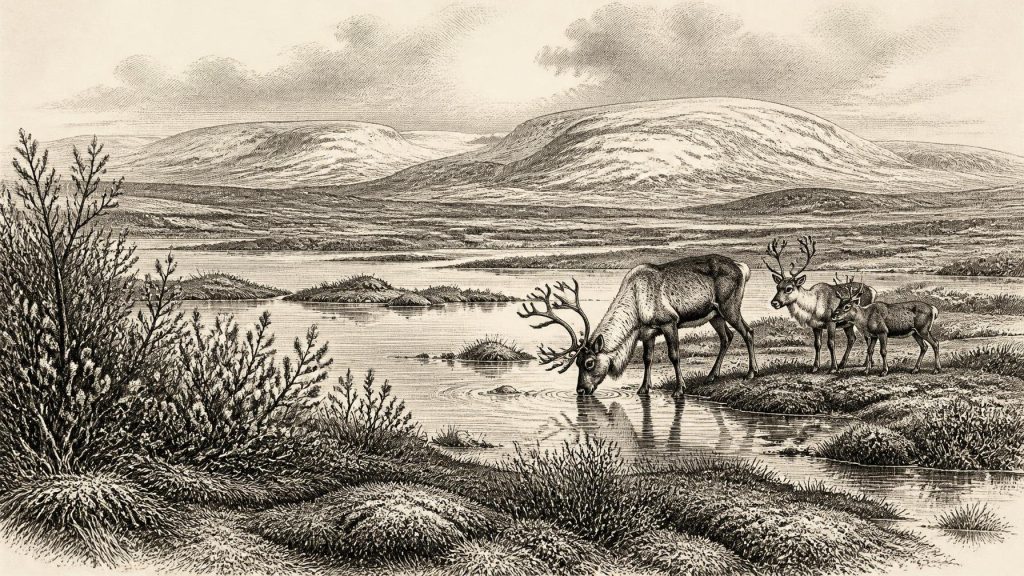
What Derryvree does demonstrate is a cold, open, periglacial wetland landscape. Pollen, plant macrofossils, mosses and insect remains indicate that local freshwater pools and saturated ground supported vegetation despite harsh conditions. Sedges and grasses were important. Fossil evidence also includes dwarf willow, lesser clubmoss, bogbean and water-milfoil: plants suited to open ground, wet margins or shallow water. Their presence should not be turned into a picturesque certainty about a whole island. It does, however, show that at least one Fermanagh locality was not simply a lifeless field of ice at the time its organic beds formed.
The landscape was tundra-like rather than forested. There is no evidence for closed woodland, arable fields or managed pasture. Low vegetation would have been exposed to strong winds, frost, short growing seasons and marked seasonal contrast. Moss-rich ground and plant-filled pools could coexist with more sparsely vegetated mineral soils. Insects recovered from the deposit support this reconstruction of muskeg or marshy tundra with open water. The fossil plants are direct evidence of local habitats; interpretations of regional temperature, rainfall and seasonality are necessarily broader inferences from that ecology and from comparison with cold environments elsewhere.
Animals at the Atlantic Edge
Irish cave collections provide a second, different window. Castlepook Cave, near Doneraile in north County Cork, is the island’s richest known Pleistocene vertebrate locality. Its old excavations recovered remains attributed to mammoth, reindeer, giant deer, horse, brown bear, wolf, fox, hare, lemmings and spotted hyaena, among other animals. Not every specimen belongs to the same time, and the cave deposits were disturbed by carnivores, water movement and early excavation. Nevertheless, radiocarbon programmes and subsequent reassessment show that a varied large-mammal fauna reached Ireland before the Last Glacial Maximum.
For the broad period surrounding 31,009 BCE, the combination of Derryvree and Castlepook suggests an island with exploitable but demanding habitats: wet tundra in parts of the north and open country capable of supporting grazing and browsing mammals in the south. Reindeer are especially compatible with such a world, though an animal bone from a cave does not map an entire herd range. Hyaena remains are equally important reminders that caves may have been dens, scavenging places and bone traps rather than human shelters. The animals indicate episodes of connectivity with wider north-west European populations during low-sea-level phases; they do not establish a simple, permanently dry land bridge or a constant route into Ireland.
The Castlepook Human Question
A reindeer femur from Castlepook has made this period unusually significant for Irish prehistory. It has been reported as bearing a deep modification interpreted as a cut or chopping mark made on fresh bone with a sharp stone tool. Public heritage material has associated the specimen with about 31,000 BC, while reports of its radiocarbon age have used other chronological conventions. If the modification is confirmed as human-made, it would be evidence that somebody processed a reindeer in Ireland during the Upper Palaeolithic, vastly earlier than the formerly accepted record of post-glacial human activity.
It is vital, however, to state what the bone cannot yet demonstrate. It is not proof of a permanent Irish population, a village, a hunting territory, a family group or continuous occupation. The specimen derives from an older cave collection rather than a securely excavated living floor with associated stone tools, hearths, structures and discarded food remains. A bone date gives the age of the animal’s death, not necessarily the instant when a surface mark was made. Carnivore damage, sediment abrasion, breakage and excavation damage must be excluded through detailed taphonomic study. Recent work at Castlepook has identified surviving deposits and renewed scientific interest, but the 2022 excavation recovered no cultural artefacts.
People, Society and Culture
Accordingly, society around this date remains unknown rather than absent. If people did reach Ireland, they were most plausibly highly mobile hunter-gatherers operating within the wider Upper Palaeolithic world of north-west Europe, using perishable equipment and stone tools that have not yet been securely recovered in Ireland from this horizon. That is an interpretation based on neighbouring regions and the proposed Castlepook evidence, not a demonstrated Irish social system. There is no responsible evidence for named groups, languages, chiefs, clans, territorial boundaries, laws or diplomacy.
There is likewise no evidence here for agriculture, herding, pottery, metalworking, markets, overseas commerce, monuments, formal burial, art or organised religion. A single possible butchered bone could suggest the practical use of animal meat, hide, marrow or sinew, but cannot reveal ritual, belief or learned tradition. The most meaningful “economy” visible in the evidence is ecological: animals feeding across open country, carnivores using caves, and any possible visitors obtaining resources from a difficult seasonal landscape. Trade cannot be inferred. Nor can conflict: predation and competition among animals are not evidence of human warfare.
Ice Was Approaching
The date sits before the fullest development of the last British–Irish Ice Sheet. Large-scale reconstructions show that ice growth and maximum extent varied between sectors, with major advances and shelf-edge ice later in the last glacial cycle. By roughly 27,000–23,000 calibrated years ago, the Irish Ice Sheet achieved much of its last maximum extent; its effects erased or buried extensive earlier evidence. At about 31,009 BCE, therefore, it is misleading to imagine either a uniformly ice-covered Ireland or a stable ice-free island. Northern Ireland may already have contained growing ice centres, while the Derryvree record preserves an earlier or broadly overlapping ice-free wetland interval whose exact relation to every regional glacier remains uncertain.
That later ice is part of the story, not merely an obstacle to it. It explains why the archaeological record is so slight and why Derryvree and Castlepook carry such weight. Their evidence reveals a real Ice Age Ireland of freshwater pools, sparse tundra vegetation and substantial mammals, while also exposing the limits of present knowledge. For 31,009 BCE, the strongest conclusion is not a year-specific event but a carefully bounded one: Ireland lay within a volatile cold-stage world, and its rare surviving deposits preserve habitats and animals that make a possible early human visit worth investigating, not yet a settled national prehistory.
Primary Sources
- A Middle Midlandian Freshwater Series at Derryvree, Maguiresbridge, County Fermanagh, Northern Ireland
- Quaternary Deposits and Glacial Stratigraphy in Ireland
- The Irish Quaternary Fauna Project
- Figure 6: The Subdivision of the Quaternary Period in Ireland
- Section 1: Introduction
- Castlepook Cave: Cork County Geological Site Report
- Heritage Artefacts of County Cork
- Archaeology Research Excavation Grant 2022: Castlepook Cave Final Report
- 2022:564 – Castlepook Cave, Castlepook South, Cork
- Growth and Retreat of the Last British–Irish Ice Sheet, 31,000 to 15,000 Years Ago: The BRITICE-CHRONO Reconstruction
- Dimensions and Chronology of the Last Ice Sheet in Western Ireland
- Response of the Irish Ice Sheet to Abrupt Climate Change During the Last Deglaciation
- Oscillating Retreat of the Last British-Irish Ice Sheet on the Continental Shelf Offshore Galway Bay, Western Ireland
- Advance and Retreat of the Marine-Terminating Irish Sea Ice Stream Into the Celtic Sea During the Last Glacial: Timing and Maximum Extent
- Extent and Retreat History of the Barra Fan Ice Stream Offshore Western Scotland and Northern Ireland During the Last Glaciation
- Aghnadarragh
- Menyanthes trifoliata
- Salix herbacea
- Selaginella selaginoides
- Myriophyllum alterniflorum