
The Derryvree Bogbean Lens31093 BCE
31,093 BCE is a modern point within a broad Late Pleistocene range, not a date with recorded events. At Derryvree, County Fermanagh, freshwater sediments between tills demonstrate a local ice-free interval, probably 34,950–29,750 BCE. Plants, pollen and insects reveal cold, wet, treeless tundra with pools and periglacial conditions. Castlepook Cave, County Cork, preserves a mixed, time-depth fauna including mammoth, reindeer, giant deer, hyaena and Arctic fox, but its deposits require caution. A marked reindeer bone may indicate brief human carcass processing around 33,000 years ago, not settlement. Evidence supports environments and animal access, while social and political history remains unknown.
Dateline
Modern calendar-year precision is not available for Ireland in 31,093 BCE. No written chronology, annually layered Irish archive, settlement sequence or securely dated event can identify what happened in that particular year. The number is a modern label for a point roughly 33,000 calendar years before AD 1950, within the Late Pleistocene and Marine Isotope Stage 3, an unstable phase of the last Ice Age. The responsible history is therefore one of broad calibrated ranges, sediments and fossils rather than rulers, battles or named communities.
A Date Within a Wide Range
The closest Irish environmental evidence is the Derryvree freshwater series near Maguiresbridge, County Fermanagh. Roadworks in 1969 cut through a drumlin and exposed fine sands, silts and organic muds lying between two thick bodies of till, the unsorted debris deposited by glacier ice. The sequence is particularly valuable because it records a clear order: ice had previously occupied the locality; a non-glacial freshwater environment then developed; and later ice deposited the upper till that sealed the fragile organic bed.
Organic material from Derryvree produced the radiocarbon determination BIRM-166, 30,500 radiocarbon years before present, with a substantial uncertainty of +1,170 and −1,030 years. A radiocarbon age is not identical to a calendar age, especially so far back. Published calibration places the deposit broadly around 36,900–31,700 calibrated years before present, approximately 34,950–29,750 BCE. The modern label 31,093 BCE falls inside that broad interval, but it cannot be assigned to a particular day, season, generation or layer of the deposit. Derryvree is an environmental archive accumulated over time, not a diary.
Fresh Water Between Ice Advances
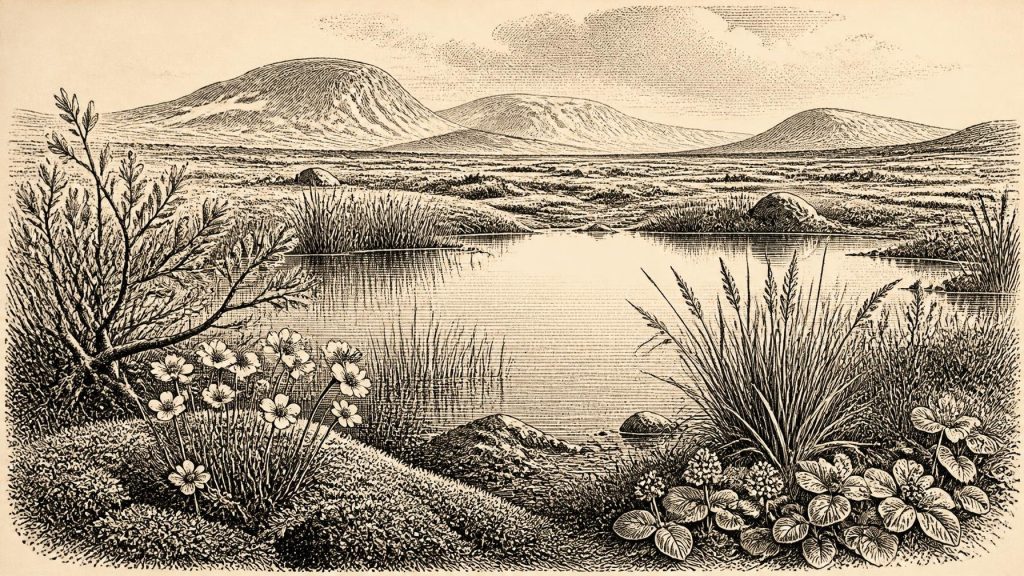
What Derryvree directly demonstrates is local ice-free ground and freshwater sedimentation during a cold stage. Its fossil plants, mosses, pollen and insect remains indicate open tundra or muskeg: wet, treeless ground with pools, waterlogged vegetation and a short productive season. Sedges and grasses were important components, while dwarf willow, mountain-avens, bogbean and aquatic water-milfoil signal a mosaic rather than a featureless frozen plain. Moss-rich margins and shallow open water would have made the site locally varied even under severe climatic conditions.
The evidence supports hard winters, cool summers and periglacial processes such as repeated freezing and thawing. It does not show a mild Irish landscape. Nor does it prove that every part of the island was free of ice at once. Derryvree was a local basin in what is now Fermanagh, and conditions could have differed sharply across uplands, coasts and regions closer to active glacier margins. Yet the bed is important precisely because later glaciation erased or buried so much evidence. It preserves a rare glimpse of Ireland before the full expansion of the last British–Irish Ice Sheet.
At this point in the wider glacial cycle, ice growth was neither a single island-wide event nor a simple advance from one direction. Successive ice masses altered drainage, stripped older soils and reshaped relief. The drumlins of northern Ireland belong to that long glacial inheritance, though a drumlin visible today cannot be treated as a landscape preserved unchanged from 31,093 BCE. The Derryvree deposit instead captures an interval between episodes of glacial occupation, later enclosed within the landform.
The Animals of Cold-Stage Ireland
Southern Irish caves provide a complementary, though complicated, picture. Castlepook Cave, also called Mammoth Cave, near Doneraile in County Cork has yielded one of Ireland’s richest Pleistocene faunal collections. Its remains include woolly mammoth, reindeer, giant deer, brown bear, wolf, fox, Arctic fox, mountain hare, lemmings and spotted hyaena. Taken together, these animals show that Ireland was intermittently accessible to a much richer cold-stage fauna than survives on the island today.
The cave collection must nevertheless be read cautiously. Much was recovered in antiquarian excavations, rather than from modern, continuously recorded layers; bones could have been moved by carnivores, water, digging and later disturbance. Direct radiocarbon dating has also shown that the material does not represent one short episode. Reassessment of Castlepook and other southern Irish cave assemblages has pushed some earlier results substantially further back, underlining that a cave is a time-depth accumulation, not a snapshot of a single local herd.
Spotted hyaena is especially revealing. A hyaena den, scavenging site or carnivore-visited shelter can collect and modify bones in ways that resemble a human food deposit if examined without context. Its presence at Castlepook also makes clear that predator and prey relationships, rather than human affairs, form the best-attested conflict in Ireland’s record at this depth of time. Reindeer, mammoths and giant deer moved through landscapes in which food, exposure, snow cover, predators and changing routes all mattered.
The Human Question at Castlepook
A reindeer femur from Castlepook has given this era unusual archaeological significance. The bone bears a deep mark interpreted by zooarchaeologist Ruth Carden as possible damage from a stone tool during carcass processing, and it has been reported as dating to around 33,000 years ago. If that interpretation is sustained, it would indicate a very early human visit to Ireland, far earlier than the island’s formerly accepted evidence for occupation.
It is not, however, evidence for a settled population. No securely associated stone-tool assemblage, hearth, dwelling, burial, human bone, occupation surface or repeated domestic refuse of comparable age has been recovered at Castlepook. The mark cannot presently establish whether people killed the animal, encountered a carcass, removed meat, hide or sinew, or briefly passed through an area also used by carnivores. A responsible reading is that the bone raises a serious possibility of transient human activity; it does not establish an Irish village, territory or continuous Palaeolithic community.
Society Without a Social Record
For political affairs, diplomacy and organised warfare, the evidence is silent. There are no names, languages, boundaries, graves, monuments or artefacts from which to reconstruct institutions or beliefs in Ireland at this date. Likewise, no Irish evidence supports claims about ritual, art, formal religion, clothing styles, kinship rules or trade networks. The absence of such evidence is not proof that no people ever entered the island, but it does set limits on what can responsibly be said.
If the Castlepook mark records human butchery, the least speculative inference is a brief encounter between a small mobile party and a reindeer carcass, using a sharp stone edge. Such visitors would belong broadly to the Upper Palaeolithic world known elsewhere in north-west Europe, where people relied on flexible movement, detailed knowledge of animals and seasonal landscapes, and portable equipment. That wider comparison can explain what was possible; it cannot fill Ireland with unobserved camps, alliances or migrations.
Movement, Coasts and Connections
Lower global sea levels changed the shape of the Irish Sea world. Coastlines lay farther from their present positions, and the shelf, channels and sea crossings differed from those familiar today. These changes helped make faunal arrivals possible at various times, but they do not by themselves demonstrate a permanent dry-land route, nor do they prove human movement on any particular route in 31,093 BCE. Animal dispersal and human travel must be assessed separately.
There is similarly no basis for describing an economy in the later prehistoric sense. There was no farming, metalworking, market exchange or permanent field system. The demonstrable economy of the landscape was ecological: plants grew in brief seasons; herbivores converted them into mobile biomass; predators and scavengers followed; freshwater pools concentrated life in a cold open country. Any human subsistence activity remains hypothetical except for the limited possibility suggested by the marked Castlepook bone.
An Ice-Age Landscape, Not a Recorded Year
The most important development illuminated by this date is not a single event but an interval of environmental possibility. Around the broad Derryvree range, parts of Ireland could support cold, wet tundra habitats between glacial episodes. Those habitats contained distinctive plant communities and formed part of a wider north-west European world in which reindeer, mammoths, hyaenas and other mammals sometimes reached Ireland. The island was neither timelessly buried beneath ice nor securely known to be inhabited.
Thus 31,093 BCE should be understood as a carefully placed point within a long, changing Late Pleistocene horizon. Derryvree offers firm evidence for a freshwater tundra environment; Castlepook offers strong evidence for an Ice Age fauna and a provocative, still limited indication of human carcass processing. Beyond those archives, certainty gives way to inference. Ireland’s history at this depth is written in mud, pollen, bone, teeth and till—and its most honest chronology is measured in millennia, not years.
Primary Sources
- A Middle Midlandian Freshwater Series at Derryvree, Maguiresbridge, County Fermanagh, Northern Ireland
- Exploring the ice-free Ireland hypothesis: a review of the glacial landscape of Ireland during the last glaciation
- A reconsideration of the radiocarbon dating of the Marine Isotope Stage 3 fauna from southern Ireland
- The Irish Quaternary Fauna Project
- Castlepook Cave: County Geological Site Report
- Spotted Hyena Skull
- The IntCal20 Northern Hemisphere Radiocarbon Age Calibration Curve (0–55 cal kBP)
- Growth and retreat of the last British–Irish Ice Sheet, 31,000 to 15,000 years ago: the BRITICE-CHRONO reconstruction
- Irish Pleistocene Biostratigraphy
- Pleistocene Vertebrates in the British Isles
- The Quaternary of Northern Ireland: Irish Quaternary Association Field Guide
- Figure 6.— The Subdivision of the Quaternary Period in Ireland
- BSBI: Menyanthes trifoliata
- BSBI: Salix herbacea
- BSBI: Dryas octopetala
- BSBI: Myriophyllum alterniflorum
- Ireland’s Palaeolithic Archaeology – Fleeting Footprints in a Frozen Land
- Heritage Artefacts of County Cork
- Castlepook Cave, Co. Cork, 2022 Excavation Report
- New Insights on the Fauna of Ireland’s Younger Dryas and Early Holocene from Alice & Gwendoline Cave
- Mammoth Cave
- The Mesolithic in Ireland: When Was It?