Doneraile’s Reindeer Record30928 BCE
About 30,928 BCE is best understood as an uncertain horizon within Marine Isotope Stage 3, rather than a precise date. Derryvree, County Fermanagh, preserves freshwater sediments between glacial tills, showing locally ice-free, treeless tundra wetlands with cold-adapted plants and animals before later ice expansion. Castlepook Cave, County Cork, yielded fauna including reindeer, mammoth, hyena and Arctic fox. An incised reindeer femur, broadly dated to around 31,000 BCE, may indicate stone-tool butchery, but cannot prove settlement. Lower sea levels may have enabled movement, although routes remain unknown. No political, cultural or religious history is demonstrable; environmental evidence dominates this prehistoric record.
Dateline
“30,928 BCE” is a useful modern label, not a date that anyone living in prehistoric Ireland could have named or recorded. No event can responsibly be assigned to that single calendar year. The appropriate setting is the later part of Marine Isotope Stage 3, a long, unstable phase of the last Ice Age. Calendar conversion also needs care: radiocarbon measurements and ice-core chronologies are expressed in different systems, with uncertainties far wider than one year. The closest securely relevant Irish environmental evidence, the Derryvree freshwater deposits in County Fermanagh, has produced a conventional radiocarbon age of about 30,500 ± 1,100 radiocarbon years BP; calibration places the deposit broadly within roughly 36,900–31,700 calendar years BP, or about 34,950–29,750 BCE. Thus 30,928 BCE falls within a defensible environmental horizon, not within a pinpointable historical moment.
A Brief Ice-Free Interval
Ireland was not yet at the fullest expansion of the last British–Irish Ice Sheet. That came later, principally during the Last Glacial Maximum, when ice expanded dramatically between roughly 28,000 and 26,500 years ago and reached its greatest extent around 26,000–24,000 years ago in many sectors. Around the date represented here, however, parts of Ireland were ice-free or at least beyond an active ice margin. This does not mean mild conditions. It means a cold, exposed country in which glaciers had temporarily retreated or had not yet advanced over particular districts.
The most informative local record comes from Derryvree, near Maguiresbridge in County Fermanagh. A road cutting through a drumlin revealed freshwater silts and fine sands trapped between two thick sheets of glacial till. That sequence is unusually eloquent. The lower till records an earlier glacial advance; the organic-rich sediments represent a period when open water, plants and small animals occupied the site; and the upper till shows that ice later returned and overrode the landscape. The deposit therefore preserves an interval of terrestrial life that would otherwise have been erased by later glaciation.
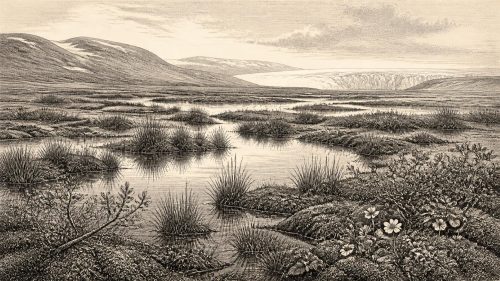
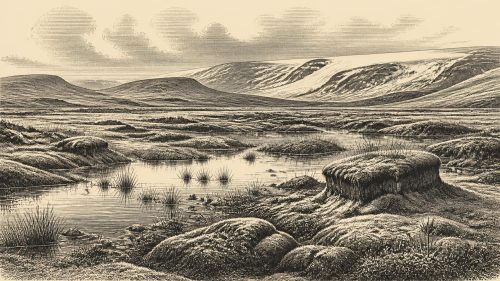
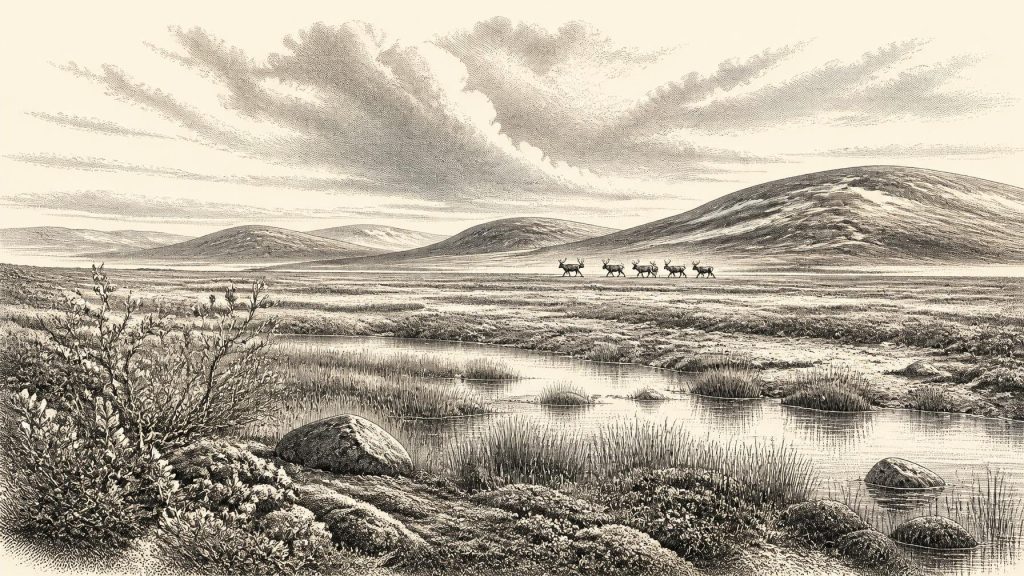
Plant macrofossils, pollen and animal remains from Derryvree indicate a treeless tundra or muskeg-like wetland. Sedges and aquatic plants grew around shallow water. Mountain avens, dwarf willow, lesser clubmoss, bogbean and other cold-adapted taxa point to a landscape of low vegetation rather than forest. The ground was probably seasonally frozen, locally waterlogged in summer and vulnerable to frost disturbance. It was an environment of pools, wet hollows, gravelly ground and sparse herb-rich cover, not a uniform white wilderness. The Irish landscape at this time was dynamic on a human timescale: slight shifts in temperature, snowfall, wind and summer thaw could transform what animals could graze and where water lay.
Cold Climate, Not a Single Season
North Atlantic climate during Marine Isotope Stage 3 changed abruptly and repeatedly. Greenland ice cores record a succession of Greenland Stadials and Interstadials, episodes in which temperature and atmospheric circulation shifted substantially within decades. It is tempting to assign an Irish deposit neatly to one named Greenland event, but the Derryvree date range is too broad for secure year-by-year correlation. The responsible conclusion is narrower: the sediments formed during one of the oscillating cold phases before the Last Glacial Maximum, when northern Ireland could sustain open, periglacial freshwater habitats.
The scale of Ireland’s ice cover at precisely this point remains debated. Ice-sheet reconstructions must combine deposits on land, marine sediments, exposure dating and models, and different regions of Ireland did not necessarily experience the same conditions simultaneously. Derryvree provides direct evidence that its locality was ice-free while the freshwater deposits accumulated. It cannot, by itself, prove that every coast, mountain and plain was similarly open. Equally, later evidence for thick ice in western and southern Ireland should not be projected backwards without qualification. At 30,928 BCE Ireland was moving towards a harsher glacial world, but it had not yet become the fully ice-dominated island of the maximum.
Castlepook and the Human Question
County Cork supplies the most arresting, and most contested, clue to human activity. Castlepook Cave, also known historically as Mammoth Cave, lies near Doneraile in the Awbeg valley. Excavations begun under Richard J. Ussher in the early twentieth century recovered a vast collection of Pleistocene animal bones. Reassessment, direct radiocarbon dating and improved bone pretreatment have shown that some Castlepook fauna is considerably older than dates obtained in the 1990s suggested. The cave’s assemblage includes reindeer, woolly mammoth, giant deer, wolf, brown bear, Arctic fox, hare, lemming and spotted hyena: animals suited to a cold, open north-west European environment.
One reindeer femur is particularly important. It has been assigned broadly to around 31,000 BCE and carries a deep surface incision interpreted by zooarchaeologist Ruth Carden as a cut made with a sharp stone tool while the bone was fresh. If that reading is correct, people processed a reindeer in Ireland during the Upper Palaeolithic, tens of millennia before the long-established evidence for post-glacial settlement. It would be a profound revision of the island’s human story.
But the distinction between evidence and interpretation matters. The dated bone is real; the incision is real; and stone-tool butchery is a plausible interpretation. Yet the specimen comes from an old cave collection rather than a modern, sealed excavation context. No securely associated stone tool, hearth, dwelling, human bone, occupation floor or concentration of similarly dated butchered remains has yet been published from Castlepook. Nor can the femur establish whether people killed the animal, merely processed a carcass, stayed nearby for a season, or formed a lasting population. Later excavations, including work in 2022, demonstrate that the cave still has research potential, but they do not turn a single marked bone into proof of a settlement.
Animals, Movement and Survival
The Castlepook fauna nevertheless makes the wider ecological setting vivid. Reindeer could have exploited lichens, sedges, grasses and herbs across open ground; hares and lemmings occupied comparable cold habitats; carnivores followed prey and scavenged carcasses. Spotted hyenas, now confined to Africa, used caves as dens and bone accumulators in Pleistocene Ireland. A cave assemblage is consequently not a straightforward menu of animals hunted by people. Hyenas, wolves, water, collapse and repeated occupations by animals can all move, gnaw, scatter and preserve bones. Its principal value is as evidence for the animal communities that reached Ireland during favourable windows, and for the complex processes by which their remains entered caves.
Those animals had to move through a changing geography. Sea level was lower than today because vast quantities of water were held in ice sheets, exposing areas now beneath the surrounding seas. Yet this should not be simplified into a certain, broad dry-land bridge connecting Ireland and Britain at the date in question. The existence, route and usefulness of any connection depended on ice position, relative sea level and local topography. Some reconstructions have envisaged exposed terrain or temporary northern connections; other studies stress that routes across the Irish Sea were discontinuous, glaciated or submerged. The careful conclusion is that animal and possible human movement from Britain or continental Europe was possible during some Pleistocene phases, but the exact route used around 30,928 BCE is unknown.
No Polities, No Proven Religion
There is no evidence for political affairs, diplomacy, named communities or territorial authority in Ireland at this date. There are no farms, fields, monuments, cemeteries, houses, pottery assemblages or written traditions from which to reconstruct social hierarchy, belief or learning. It would be misleading to populate the tundra with clans, chiefs or ritual systems simply because hunter-gatherer societies existed elsewhere in Upper Palaeolithic Europe.
Nor is there evidence for an Irish economy in the later sense of farming, craft production or trade. If the Castlepook mark is human-made, it supports only the modest but significant inference that people had access to a sharp stone edge and animal food or materials. Reindeer carcasses could provide meat, fat, hide, sinew, bone and antler, but none of those possible uses can be demonstrated for Ireland from this object alone. The most economical reading is one of mobility: small groups may have entered a demanding, resource-variable landscape, perhaps following game or exploiting a short-lived opportunity. Permanent occupation remains unproven.
An Archive Beneath Later Ice
The chief historical development around this notional year was environmental rather than political. Ireland contained ice-free ecological pockets where tundra plants, freshwater organisms and large mammals survived or passed through, while the climatic trajectory was towards renewed and more extensive glaciation. Derryvree’s buried wetland and Castlepook’s cave bones are fragments of that world, preserved precisely because sediment and ice sealed them away.
They also explain why certainty is limited. Later glaciers stripped soils, remodelled valleys and destroyed most surface traces of early human activity. Old cave excavations removed many deposits before modern recording standards, while bones held in museum collections may still be redated and reassessed. Ireland at 30,928 BCE is therefore not a blank page, but neither is it a narrative of recorded events. It is a cautiously reconstructed landscape: cold water among sedges, open tundra under unstable skies, reindeer and predators moving through southern and northern refuges, and one marked bone that may preserve the faintest trace of people at the edge of the known Irish past.
Primary Sources
- A Middle Midlandian Freshwater Series at Derryvree, Maguiresbridge, County Fermanagh, Northern Ireland
- A Reconsideration of the Radiocarbon Dating of the Marine Isotope Stage 3 Fauna from Southern Ireland
- The Irish Quaternary Fauna Project
- New Insights on the Fauna of Ireland’s Younger Dryas and Early Holocene from Alice & Gwendoline Cave
- Exploring Controls of the Early and Stepped Deglaciation on the Western Margin of the British Irish Ice Sheet
- Figure 6.—The Subdivision of the Quaternary Period in Ireland
- Heritage Artefacts of County Cork
- 2022:564 — Castlepook Cave, Castlepook South, Cork
- Archaeology Research Excavation Grant 2022: Final Report
- Spotted Hyena Skull
- The Problem of a Late Quaternary Landbridge Between Britain and Ireland
- The Island of Ireland: Drowning the Myth of an Irish Land-Bridge?
- A Stratigraphic Framework for Abrupt Climatic Changes During the Last Glacial Period Based on Three Synchronized Greenland Ice-Core Records
- Ice-Core Data Used for the Construction of the Greenland Ice-Core Chronology 2005 and 2021 (GICC05 and GICC21)
- Trimlines, Blockfields and the Vertical Extent of the Last Ice Sheet in Southern Ireland
- Dimensions and Chronology of the Last Ice Sheet in Western Ireland
- The Evolution of the Terrestrial-Terminating Irish Sea Glacier During the Last Glaciation
- Red Deer in Ireland: Phylogeography, Population History and the Impact of Human Intervention
- Lesser Clubmoss: Selaginella selaginoides
- Irish Pleistocene Biostratigraphy