Castlepook’s Chopped Femur30681 BCE
About 30,681 BCE, Ireland lay within the climatically volatile Late Pleistocene, when ice, low sea levels and open tundra landscapes shaped life. Derryvree in Fermanagh preserves a buried freshwater wetland, dated broadly to 36,900–31,700 years before present, with cold-adapted plants and insects. Castlepook Cave in Cork yielded remains of mammoths, reindeer, giant deer and predators, accumulated across episodes largely through natural processes. A cut-marked reindeer femur may indicate human carcass processing, but cannot demonstrate settlement, continuous occupation or society. Evidence remains sparse, disturbed and subject to redating; future analysis may clarify this possible early human presence amid Ice Age conditions.
Dateline
Modern calendar-year precision is not available for Ireland in 30,681 BCE. The label is a retrospective convenience, equivalent to roughly 32,630 years before AD 1950, rather than a date that any contemporary community could have marked. At this depth of time, radiocarbon measurements must be calibrated and expressed as broad probability ranges, often spanning centuries or millennia. The appropriate setting is the later Middle Pleistocene? No: it is the Late Pleistocene, within Marine Isotope Stage 3, a long and climatically volatile phase of the last Ice Age. Ireland’s evidence is sparse, discontinuous and frequently recovered from deposits disturbed by ice, water, carnivores and early excavation. Yet it is sufficient to illuminate a cold, open and changing landscape, and to raise an important—though still cautious—question about very early human activity.
A Date Within a Long Cold Phase
Thirty thousand years ago Ireland was not the familiar green, wooded island of later millennia. Nor was it necessarily a single unbroken white expanse of ice. The growth and retreat of the British–Irish Ice Sheet were complex, varying between regions and through time. Geological research now indicates that substantial ice had developed earlier in the last cold stage, while Marine Isotope Stage 3 also contained episodes when areas of land were ice-free or lay near glacier margins. By about 30,000 years ago, major expansion towards the Last Glacial Maximum was under way, but the exact configuration of ice over every Irish valley, coast and upland cannot be reconstructed year by year.
That uncertainty is important. It rules out dramatic claims that all of Ireland was either habitable or wholly glaciated at this precise moment. The evidence instead supports a regional picture: some sectors experienced advancing or persistent ice, while others could sustain exposed ground, wetlands, freshwater and cold-adapted animals. Sea level was lower globally because large volumes of water were locked in ice, but lower sea level did not automatically make travel to Ireland simple. The changing Irish Sea basin, ice margins, channels, coasts and weather presented formidable obstacles. A possible human visit must therefore not be casually converted into a story of easy migration, permanent colonisation or a land bridge.
Derryvree’s Buried Wetland
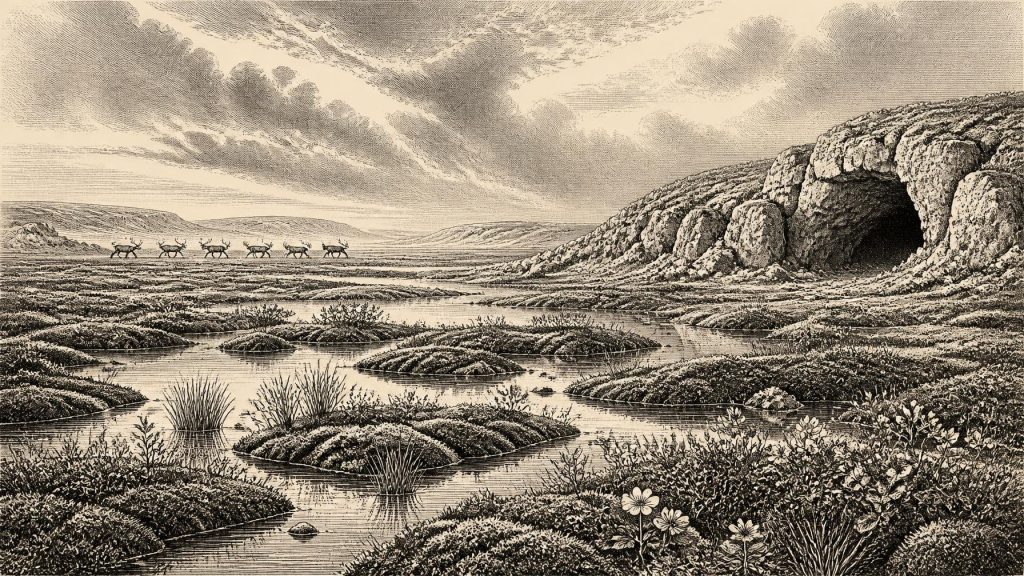
The strongest environmental evidence close to this broad horizon comes from Derryvree near Maguiresbridge in County Fermanagh. There, a road cutting through a drumlin revealed organic freshwater sediments sealed between two bodies of glacial till. The buried silts, sands and plant remains preserve a brief environmental archive that later ice covered and protected. A conventional radiocarbon determination on this material, BIRM-166, produced an age of about 30,500 radiocarbon years before present. When calibrated, the deposit has been placed broadly within approximately 36,900–31,700 calibrated years before present. The range is much more useful than any artificial single year, and 30,681 BCE belongs near its younger part.
Derryvree does not offer a national weather report. It records conditions in one lowland basin, and the organisms represented there lived or were deposited over an interval rather than on one day. Nevertheless, its pollen, plant macrofossils and insect evidence are eloquent. They indicate treeless, cold-stage vegetation and wet ground, including moss-rich muskeg-like communities with pools or shallow water. Sedges, dwarf willow, mountain-avens, bogbean and other hardy plants show that parts of the landscape could support a specialised tundra or tundra-steppe flora. Aquatic and wetland organisms confirm that liquid water persisted locally despite severe winters.
This was a landscape of short productive summers, long cold seasons and limited shelter. Trees were absent or extremely scarce, so there were no forests comparable with those that would later cover much of the island. Ground cover was instead a patchwork of herbs, grasses, mosses, low shrubs, exposed mineral soil and wet hollows. Such a mosaic could feed grazing and browsing animals in season, while also making movement across the country physically demanding. Wind, frost, seasonal thaw and unstable drainage were active forces in daily ecological life.
The Fauna of Mammoth Cave
For larger animals, Castlepook Cave near Doneraile in north County Cork is the key Irish archive. Known also as Mammoth Cave, it was investigated principally in the early twentieth century by Richard J. Ussher and colleagues, and its old collections have since been reassessed by the Irish Quaternary Fauna Project and later researchers. Direct dating has shown that some of its animal remains belong to Marine Isotope Stage 3, although the cave’s deposits accumulated over long periods and were not all contemporary. Modern redating has also demonstrated that several older radiocarbon results were too young, a reminder that the chronology of such material must remain open to revision.
The Castlepook assemblage demonstrates that Ireland hosted, or was repeatedly reached by, an imposing cold-stage fauna. Woolly mammoth, reindeer, giant deer, brown bear, wolf, Arctic fox, mountain hare, collared and Norwegian lemmings, and spotted hyaena are represented among the remains attributed to the wider assemblage. These are not a roster of animals seen together on a single occasion; they are records accumulated across different episodes. But taken with the Fermanagh environmental evidence, they support the image of open country able to sustain herbivores and their predators or scavengers. Mammoths and giant deer evoke the scale of the terrain; lemmings and Arctic fox point to cold conditions; hyaenas reveal that caves could be carnivore dens as well as shelters.
There is no basis for treating Castlepook as a human dwelling. Bone accumulations in caves may result from animals dying naturally, predators hauling prey underground, scavenging, flowing water, roof collapse and excavation practices that pre-dated modern standards of recording. A cave full of bones is not automatically a hunting camp, a food store or a ritual place. The most defensible account is that Castlepook preserves fragments of a wider Ice Age ecosystem, brought together by both natural processes and the behaviour of carnivores.
The Reindeer Femur Question
One object gives this date exceptional interest: a reindeer femur from Castlepook that bears a deep linear incision. Zooarchaeologist Ruth Carden has interpreted the mark as having been made on fresh bone by a sharp stone implement during carcass processing. County Cork heritage material places the bone broadly at about 31,000 BCE, and public reporting has described it as roughly 33,000 years old. If the incision is confirmed as a tool mark made soon after the animal’s death, it would be evidence that a person handled a reindeer carcass in Ireland far earlier than the long-accepted terminal-Pleistocene traces of people on the island.
That is an important possibility, not a licence for certainty. The bone’s date measures the age of the animal’s remains, while identifying a mark as human-made is a separate taphonomic judgement. The fragment derives from an old cave collection rather than a recently excavated, sealed occupation floor. No securely associated hearth, stone-tool assemblage, dwelling, human burial or concentrated butchery deposit has yet been recovered. Recent investigation at Castlepook has underlined how little undisturbed Pleistocene material survives. The careful conclusion is therefore narrow: the femur may record brief human processing of a reindeer, but it does not establish a settlement, a resident population, a named people or continuous occupation of Ireland.
Society Beyond the Evidence
If people were present, their economy can only be inferred in the most general terms. Across Upper Palaeolithic Europe, reindeer were valuable sources of meat, fat, hides, sinew, antler and bone, and mobile groups often followed the seasonal opportunities offered by large game. That wider comparison helps explain why a reindeer limb might have been processed, but it cannot tell us how many people came to Ireland, where they slept, what language they spoke, or whether they returned. There is no Irish evidence at this date for houses, hearths, boats, clothing, ornaments, art, formal burial, exchange networks or organised political authority.
Accordingly, political affairs, diplomacy, conflict and religion cannot responsibly be narrated for 30,681 BCE. There were no written records, monuments or identifiable communities from which to reconstruct leaders, alliances or belief. The absence is not evidence that Ice Age people lacked social lives, knowledge or ritual: hunter-gatherers elsewhere in Europe possessed sophisticated skills, social relationships and symbolic practices. It means only that Ireland has not yielded material that can connect such practices securely to this time and place. The distinction between what is plausible in a European context and what is demonstrated in Ireland must be retained.
An Island Before History
The most meaningful development around this date was environmental rather than political. Ireland stood within an unstable Ice Age world in which ice, sea, climate and animal movement continually remade the possibilities for life. Derryvree shows a cold freshwater wetland landscape capable of supporting specialised plants and insects. Castlepook shows that large mammals and carnivores reached the island during the broader period. Its marked reindeer femur presents a tantalising, potentially transformative sign that people may also have arrived, perhaps only briefly.
Future work may strengthen, refine or overturn parts of this picture. Better dating, microscopic study of bone surfaces, targeted cave excavation, ancient biomolecular methods and re-examination of museum collections all matter because the evidence is so slight. For now, 30,681 BCE should not be imagined as a year of recorded Irish events. It is a point within a calibrated Ice Age interval: a time of tundra wetlands, reindeer and mammoths, dangerous carnivores, growing ice and an unresolved human trace in a Cork cave.
Primary Sources
- A Reconsideration of the Radiocarbon Dating of the Marine Isotope Stage 3 Fauna from Southern Ireland
- The Irish Quaternary Fauna Project
- Heritage Artefacts of County Cork
- Archaeological Heritage of County Cork
- 2022:564 – Castlepook Cave, Castlepook South, Cork
- New Insights on the Fauna of Ireland’s Younger Dryas and Early Holocene from Alice & Gwendoline Cave
- First Evidence of a Late Upper Palaeolithic Human Presence in Ireland
- First Evidence of a Late Upper Palaeolithic Human Presence in Ireland
- The Mesolithic in Ireland: When Was It?
- The IntCal20 Northern Hemisphere Radiocarbon Age Calibration Curve (0–55 cal kBP)
- The IntCal20 Northern Hemisphere Radiocarbon Age Calibration Curve (0–55 cal kBP)
- The Timing and Magnitude of the British–Irish Ice Sheet Between Marine Isotope Stages 5d and 2
- Growth and Retreat of the Last British-Irish Ice Sheet, 31,000 to 15,000 Years Ago
- Exploring Controls of the Early and Stepped Deglaciation on the Western Marine-Terminating Margin of the British–Irish Ice Sheet
- Last Glacial Maximum Cirque Glaciation in Ireland and Implications for Reconstructions of the Irish Ice Sheet
- Trimlines, Blockfields and the Vertical Extent of the Last Ice Sheet in Southern Ireland
- Dimensions and Chronology of the Last Ice Sheet in Western Ireland
- Quaternary
- Figure 6: The Subdivision of the Quaternary Period in Ireland
- Pleistocene Vertebrates in the British Isles