Cork’s Reindeer Butchery Question30885 BCE
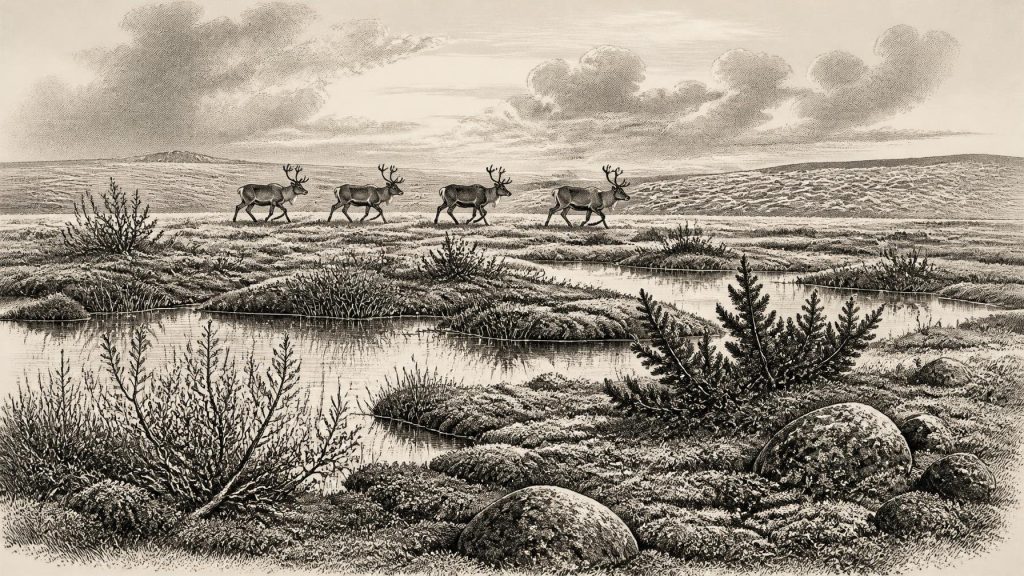
Labelled 30,885 BCE, this period cannot be dated as a single event. Derryvree, County Fermanagh, preserves freshwater sediments between glacial tills, indicating an ice-free, tundra-like wetland with pools, sedges, mosses and cold-adapted plants during MIS 3. Castlepook Cave, County Cork, contains a mixed Late Pleistocene fauna, including reindeer, mammoth, giant deer, hyaena and lemmings, demonstrating intermittent ecological connections and cold open habitats. A marked reindeer femur may indicate human butchery around 33,000 years ago, but lacks supporting occupation evidence. Growing British–Irish ice sheets later overran landscapes, destroying records and leaving Ireland’s human presence uncertain throughout this climatically unstable glacial interval.
Dateline
The label 30,885 BCE creates an illusion of precision that the evidence cannot sustain. No person in Ireland marked that year, and no archaeological deposit can be assigned to it with calendar-year accuracy. In modern chronological terms it lies roughly 32,834 years before AD 1950, within the later part of the Last Glacial Period and Marine Isotope Stage 3 (MIS 3). The responsible subject is therefore not an event in a single year, but an Ice Age Ireland represented by broad calibrated ranges, especially evidence from Derryvree near Maguiresbridge in County Fermanagh and Castlepook, or Mammoth Cave, near Doneraile in County Cork.
Those two sites illuminate very different things. Derryvree is an environmental archive: freshwater silts, sands, plants, insects and pollen were trapped between separate deposits of glacial till. Castlepook is a cave-bone archive: its fossils show that sizeable mammals and predators reached parts of Ireland before the Last Glacial Maximum. Neither produces a conventional historical narrative. Together, however, they show an island that was not biologically empty, but was cold, changeable and increasingly vulnerable to expanding ice.
A Date Without a Chronicle
The nearest important Irish radiocarbon determination is from Derryvree. Organic freshwater sediments there produced a conventional age of about 30,500 radiocarbon years before present, with a substantial uncertainty. Calibration converts such measurements into calendar ages, but not into a single recoverable moment: published discussion places the deposit broadly at about 36,900–31,700 calibrated years before present. This wide range encompasses the period represented by 30,885 BCE, but does not demonstrate that the visible plants, insects or waters existed in that precise numbered year.
That distinction is fundamental. Radiocarbon dates are estimates with probability ranges; sediment layers can also accumulate over long intervals, and animal bones from caves may have been redeposited or collected over generations. The older the evidence, the less defensible it is to turn a modern calendar label into a dated incident. Ireland at this horizon has no written names, rulers, borders, campaigns, treaties, settlements or known ritual places. It must be approached as palaeoenvironmental history, with archaeological questions kept separate from archaeological proof.
Derryvree’s Cold Wetlands
At Derryvree, road cutting through a drumlin in 1969 exposed a remarkable sequence: organic-rich freshwater deposits sealed between two thick tills. Till is sediment laid down directly by glacier ice. The stratigraphy therefore records an interval when local ground supported water, vegetation and small animal life before a later ice advance buried the landscape. It is an unusually valuable survival because subsequent glaciation removed or disturbed much of Ireland’s earlier surface record.
The plant and insect assemblages point to open, cold-country conditions rather than the familiar wooded Ireland of recent millennia. Mosses, sedges and grasses were important. Finds of bogbean and water-milfoil indicate freshwater and wet margins; mountain-avens, dwarf willow and lesser clubmoss suit exposed, cold or thinly vegetated ground. Juniper was also present. Such evidence supports a mosaic of shallow pools, saturated sedge ground, mossy patches and drier mineral surfaces: a tundra-like or periglacial wetland, not necessarily a featureless frozen plain.
Periglacial does not mean that the locality lay permanently under ice. It denotes terrain shaped by severe cold, seasonal freezing and thawing, sparse vegetation and proximity to glaciers. Derryvree’s freshwater life proves that at least this locality experienced an ice-free interval. It cannot be stretched into a detailed map of the entire island. Coastal, upland and western conditions may have differed greatly, while the climate and ice margins shifted repeatedly. Even the word “Ireland” needs care, since the modern island’s coastlines had not yet assumed their present form.
Animals in the Cork Cave
Castlepook Cave supplies the most striking evidence for the wider animal world. Excavated principally by Richard J. Ussher and colleagues in the early twentieth century, the limestone cave produced a notable collection of Late Pleistocene bones. Subsequent work, including direct radiocarbon redating with improved collagen preparation, has revised the chronology of parts of this material. The broad conclusion is robust: significant elements of the Castlepook fauna belong to MIS 3, before the Last Glacial Maximum, though the cave assemblage is not a single undisturbed deposit from one season or one landscape.
The fauna includes reindeer, woolly mammoth, giant deer, brown bear, wolf, foxes, mountain hare and lemmings, with spotted hyaena especially significant. Castlepook is Ireland’s only securely known locality for spotted hyaena. These species did not necessarily all occupy the cave neighbourhood simultaneously, and their presence does not allow a simple reconstruction of a single “mammoth-steppe” community. Yet they establish that Ireland could at times sustain, or receive, a substantial cold-stage fauna. Reindeer imply open grazing country; lemmings reinforce the evidence for cold habitats; mammoth and giant deer point to enough seasonal plant productivity to support large herbivores.
Caves are not neutral containers. Carnivores may drag prey and scavenged bones underground; water can move sediment; earlier excavators often removed deposits before modern recording methods existed. Castlepook’s mixture of bones should therefore be read as evidence of regional animal presence across time, not as a census. The cave may have served animals as a shelter, den, trap or bone-accumulation place. In particular, hyaena activity offers a practical explanation for mixed prey remains without presuming human hunting.
The Marked Reindeer Bone
The most consequential human question concerns a reindeer femur from Castlepook. It has been reported as dating to around 33,000 years ago and bears a deep linear mark interpreted by some researchers as damage made during carcass processing with a sharp stone implement. If that interpretation is confirmed, it would show that people reached Ireland in the Upper Palaeolithic, far earlier than the formerly accepted Mesolithic settlement evidence.
It remains a question, not a secure settlement story. The object comes from an old cave collection, not a modern excavation with an intact occupation surface. No associated hearth, stone-tool assemblage, dwelling, burial or repeated butchery area has been demonstrated for this horizon. Nor can one marked bone identify the number, origin, language, kinship, beliefs or duration of any possible human visit. The careful conclusion is narrower but still important: people may have briefly encountered and processed a reindeer in Ireland during late MIS 3; firm evidence for a resident population has not yet been recovered.
Society Beyond the Evidence
There is consequently no responsible basis for describing political affairs, diplomacy, war, social rank, religious practice, art or formal learning in Ireland at this date. There were no known farms, villages, tombs, monuments, metalworking sites or exchange networks. If people did enter the island, they would have belonged to mobile Upper Palaeolithic hunter-gatherer worlds known elsewhere in north-west Europe, but that is regional comparison, not evidence for an Irish camp or community.
The same caution applies to economy and trade. The direct evidence concerns wild plants and animals, not production or commerce. Reindeer, mammoth and other mammals could have moved through a changing north-west European landscape when sea level was lower and the geography of coasts, shelves and ice differed from today. Their presence confirms ecological connection of some sort, but the exact routes into Ireland remain uncertain. It does not prove regular human travel, boat use, exchange or seasonal migration between specific places.
Ice-Sheet Growth and a Vanishing Record
The broader setting was one of climatic instability. The British–Irish Ice Sheet was entering an important phase of growth around this broad period, although its advance was regionally uneven and its greatest Last Glacial Maximum extent came later, principally around 27,000–23,000 years ago. The Derryvree sediments show that ice-free wetland could exist during MIS 3; the tills above them show that the opportunity did not last indefinitely. In time, glaciers overran large areas, reworked older deposits and helped erase the evidence most likely to preserve campsites, tracks and shallow settlements.
Thus Ireland around 30,885 BCE is best understood as a precarious environmental threshold. It was neither a permanently ice-covered void nor a stable green homeland. Cold freshwater pools and sedges persisted at Derryvree. Large herbivores and formidable predators occurred in the wider landscape represented at Castlepook. A single reindeer bone raises the possibility of human action, but no more. The enduring history of this period is the interaction of water, frost, vegetation, animals and advancing ice—and the disciplined limits that the surviving evidence places upon the stories we can tell.
Primary Sources
- A Middle Midlandian Freshwater Series at Derryvree, Maguiresbridge, County Fermanagh, Northern Ireland
- A Reconsideration of the Radiocarbon Dating of the Marine Isotope Stage 3 Fauna from Southern Ireland
- The Irish Quaternary Fauna Project
- New Insights on the Fauna of Ireland's Younger Dryas and Early Holocene from Alice & Gwendoline Cave
- Growth and Retreat of the Last British–Irish Ice Sheet, 31,000 to 15,000 Years Ago: the BRITICE-CHRONO Reconstruction
- Trimlines, Blockfields and the Vertical Extent of the Last Ice Sheet in Southern Ireland
- The Timing and Magnitude of the British–Irish Ice Sheet Between Marine Isotope Stages 5d and 2
- New Data for the Last Glacial Maximum in Great Britain and Ireland
- Stratigraphic and Palaeo-Geomorphological Evidence for the Glacial-Deglacial History of the Last British-Irish Ice Sheet in the North-Western Irish Sea
- Maximum Extent and Dynamic Behaviour of the Last British–Irish Ice Sheet West of Ireland
- Radiocarbon Constraints on the Age of the Maximum Advance of the British–Irish Ice Sheet in the Celtic Sea
- Dimensions and Chronology of the Last Ice Sheet in Western Ireland
- Growth and Retreat of the Last British-Irish Ice Sheet: British Antarctic Survey Record
- Castlepook Cave: County Geological Site Report
- The Exploration of Castlepook Cave, Co. Cork
- Mammoth Cave, County Cork
- IAH Field Trip 2014: Castlepook (Mammoth) Cave
- Irish Association for Quaternary Research Guide 16
- Radiocarbon Dates from the Oxford AMS System: Archaeometry Datelist 31
- The Quaternary History of Ireland
- Autumn 2023 Newsletter