Cork Reindeer at Ice’s Edge30886 BCE
Labelled 30,886 BCE, this period cannot be dated precisely by modern calendar years and is understood through fragmentary environmental evidence. Ireland, approaching harsher glaciation, experienced shifting ice margins, low sea levels and changing habitats. Derryvree, County Fermanagh, preserves freshwater deposits between tills, indicating treeless periglacial wetlands with cold-adapted plants and insects. Castlepook Cave, County Cork, produced reindeer, mammoth, giant deer and carnivore remains, demonstrating a seasonally productive cold landscape and complex food web. A marked reindeer femur may indicate human butchery, but lacks secure context and cannot prove settlement. No political, social or cultural evidence survives; human visits remain uncertain.
Dateline
The label 30,886 BCE is useful only as a modern filing device. It does not identify a recorded Irish year, a season, a ruler or an event. At this depth of time, no calendar used by people in Ireland is known, and modern calendar-year precision is unavailable. Converted conventionally, the label falls roughly 32,835 years before AD 1950, within the Late Pleistocene and the climatically variable Marine Isotope Stage 3. Radiocarbon determinations and their calibrated ranges, not a single BCE year, are the responsible means of dating the surviving evidence. Ireland at this point must therefore be approached through sediments, fossils, cave deposits and the uncertain traces of animal and possible human movement.
A Landscape Before the Maximum Ice
This was not yet the Last Glacial Maximum, the phase when the British–Irish Ice Sheet later reached its greatest documented extent, broadly between about 27,000 and 21,000 years ago. But it was a cold-stage world moving towards more severe glaciation. Ice margins, sea level, vegetation and animal routes changed repeatedly over periods far longer than a human lifetime. Recent reconstructions place important growth of the last British–Irish Ice Sheet after roughly 35,000–32,000 years ago, while also stressing that the timing and extent of early advances remain difficult to reconstruct. It would be misleading to draw a sharp line across Ireland and declare every district either permanently frozen or reliably open at 30,886 BCE.
Much of the island’s later glacial history has erased or buried earlier ground surfaces. Ice scoured bedrock, shifted sediment and laid down till, while later rivers, peat growth and human land use changed the surface again. That destruction is one reason Ireland has so few securely contextualised records from this remote period. The absence of a camp, house or hearth is not proof that nobody ever entered a region; equally, it is no licence to turn a sparse fossil record into a populous prehistoric Ireland. The evidence is strongest for shifting environments and visiting or resident animals, much weaker for people.
Derryvree’s Buried Wetland
The most instructive Irish environmental archive for the broader period lies at Derryvree, near Maguiresbridge in County Fermanagh. In a road cutting through a drumlin, investigators found organic freshwater silts and fine sands trapped between two distinct sheets of glacial till. The lower till records an earlier ice advance; the upper one represents later glaciation. Between them lay evidence that the ground had, for a time, escaped ice cover and supported freshwater conditions.
A radiocarbon determination from the Derryvree organic deposit was published as 30,500 radiocarbon years BP, with a substantial uncertainty of plus 1,170 and minus 1,030 years. That is not the same thing as a calendar date. Atmospheric carbon-14 varied through time, and modern calibration curves convert a radiocarbon measurement into a probability distribution of calendar ages rather than an exact year. Nor can the date prove that every plant, insect and sediment layer at Derryvree formed simultaneously. It does, however, securely anchor the deposit in the Middle Midlandian, Ireland’s regional name for part of the last cold stage, and close enough to the nominated date to illuminate its environmental setting.
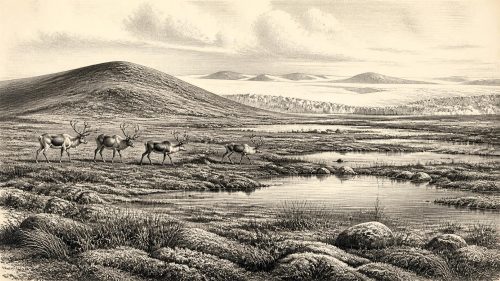
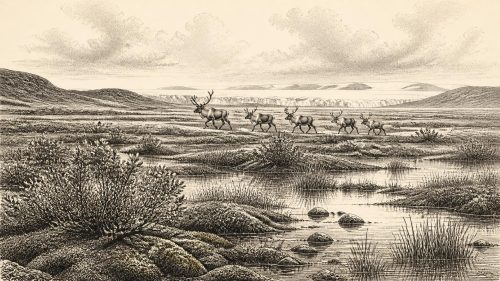
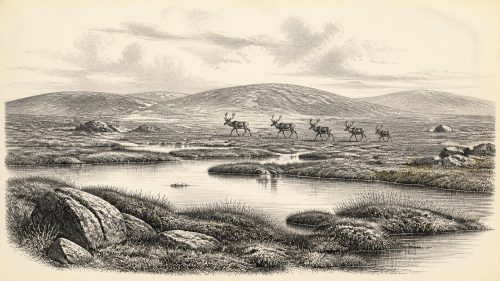
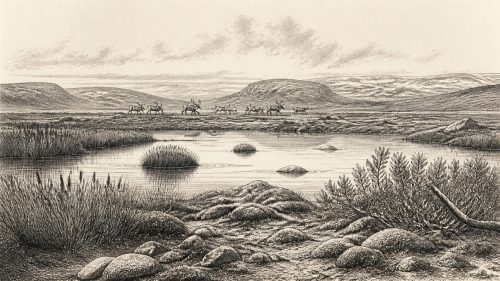
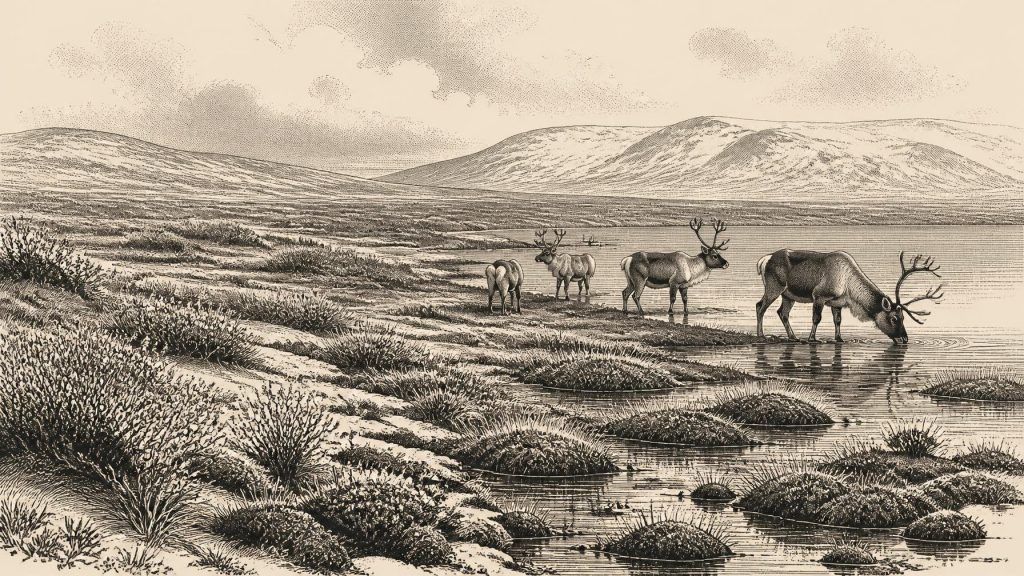
The plants and insects in the Derryvree beds point to a treeless, cold, open landscape. Mosses, sedges, dwarf shrubs and aquatic plants flourished around pools, saturated ground and slow-moving water. Fossils include indicators of northern, severe conditions; the original investigators interpreted the setting as tundra and muskeg-like wetland under a periglacial climate. Periglacial does not mean covered by glacier ice. It describes a landscape shaped by intense cold near or beyond ice: seasonally thawing surface layers, frozen ground, frost disturbance, sparse plant cover and meltwater in warmer months.
That reconstruction should not be imagined as an unbroken blanket of uniform tundra across Ireland. Derryvree is a local record from a lowland basin in what is now Fermanagh. Its pools and wet ground could coexist with drier gravel, exposed rock, frost-shattered slopes and snow patches elsewhere. The plants demonstrate that water, light and a short growing season could sustain life locally. They do not establish a fixed temperature, a modern-style bog, or the exact view from Derryvree in the artificial calendar year 30,886 BCE.
Reindeer, Mammoth and Carnivores
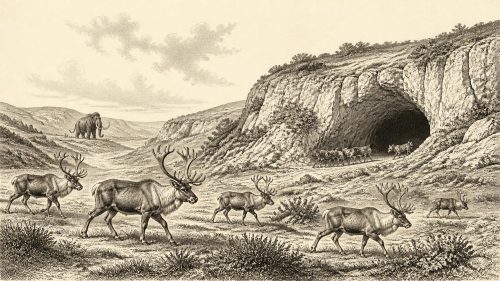
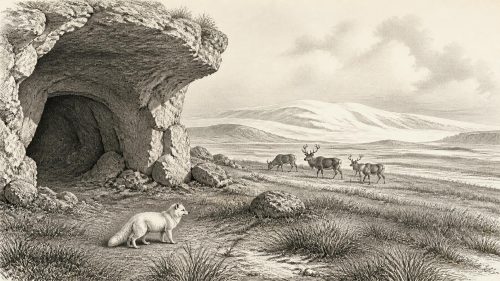
County Cork provides the other major window. Castlepook Cave, near Doneraile, yielded one of Ireland’s richest collections of Pleistocene animal remains during excavations begun in the early twentieth century and supplemented by later work. Its assemblage includes reindeer, woolly mammoth, giant deer, brown bear, wolf, Arctic fox, lemmings and spotted hyaena. These animals did not necessarily occupy the cave at one moment or form one living community in the precise modern sense. Cave deposits can accumulate through repeated episodes of death, scavenging, transport and disturbance. Improved radiocarbon work has also shown that some earlier dates from Irish cave bone need reassessment.
Even so, the Castlepook collection demonstrates that Ireland was not biologically empty during Marine Isotope Stage 3. Reindeer and lemmings are consistent with cold, open environments. Arctic fox and mountain hare further suggest northern ecological conditions. Mammoths, giant deer and reindeer required productive vegetation over substantial areas, at least seasonally, while wolves and hyaenas occupied the upper levels of a predator and scavenger system. A cave was not a neutral census station: carnivores may have dragged prey or bone into it, and some animals may have died there. The collection is evidence for a broader food web, not a population count.
The cave also warns against treating Ireland as an isolated Atlantic island in its modern form. Sea level was lower during glacial phases, exposing parts of the continental shelf and altering channels between Ireland, Britain and the European mainland. Yet lowered sea level did not automatically create one simple, dry land bridge at every date. Water depth, ice margins, coastlines and the changing topography of the Irish Sea all mattered. Animals evidently reached Ireland during this long cold interval, but the precise routes, frequency of crossings and degree of connection remain unresolved.
The Reindeer Femur Question
One Castlepook object has exceptional significance: a reindeer femur reported to carry a deep linear mark interpreted by palaeozoologist Ruth Carden as a cut or chop made on fresh bone with a sharp stone implement. County Cork heritage material has publicised the bone as approximately 33,000 years old and as potential evidence for Upper Palaeolithic human activity. If the modification is confirmed as a human butchery mark contemporary with the animal’s death, it would show that a person, or a small group, handled a reindeer in Ireland during this earlier Ice Age period.
That is an important possibility, but it is not the same as proof of an established settlement. The bone comes from an old cave collection rather than a sealed occupation floor. There is no securely associated stone-tool assemblage, hearth, built shelter, burial, human skeleton, repeated butchery deposit or dwelling of comparable age in Ireland. A date on the bone dates the animal’s death within a range; it cannot independently fix the instant when its surface was marked. The strongest wording is therefore that Castlepook offers a provocative, limited indication of possible human activity, requiring further contextual and microscopic study.
It is reasonable to observe that Upper Palaeolithic people elsewhere in north-west Europe were highly mobile hunter-gatherers who used stone tools, clothing, fire and varied social networks. It is not responsible to transfer their whole way of life to Ireland merely because a marked bone may indicate one encounter. There is no basis for naming an Irish group, estimating its population, assigning a language, or describing a seasonal round for this date. Nor should the famous later evidence of human modification on a brown-bear bone from Alice and Gwendoline Cave in County Clare be projected backwards: that securely dated Late Upper Palaeolithic evidence belongs around 12,800–12,600 calibrated years BP, roughly twenty millennia later.
No Polities, No Recorded Conflict
Political affairs, diplomacy and organised warfare cannot be recovered for Ireland around this date. There were no known states, chiefs, territorial boundaries, written records or monuments from which political life can be inferred. Conflict between people is equally unproven. Predation, scavenging and competition for animal carcasses were part of the ecological world indicated by the Castlepook fauna, but they are not evidence of human warfare.
Everyday life is similarly beyond direct recovery. No Irish domestic hearth, clothing fragment, food store or tool kit can securely be placed in 30,886 BCE. If people did enter the island, they may have done so briefly, perhaps following game or exploiting a carcass; that is interpretation, not established fact. The reindeer femur cannot tell us whether hunters killed the animal, found it already dead, visited in summer or winter, camped nearby, crossed alone or returned again.
Culture Beyond Recovery
Nothing currently supports claims for religion, formal ceremony, cave art, personal ornament, music, storytelling or teaching in Ireland at this horizon. Such practices may have existed among any people who reached the island, but archaeological silence cannot be filled with attractive conjecture. Likewise, there is no demonstrable local economy or trade network. A possible stone-tool cut mark would indicate practical knowledge of carcass processing, not exchange, craft specialisation or commerce.
The real history of Ireland around 30,886 BCE is consequently environmental and evidential. In parts of the island, freshwater wetlands and cold-adapted vegetation existed between episodes of glaciation. Large herbivores and formidable carnivores moved through a changing north-west European landscape. At Castlepook, one altered reindeer bone raises the possibility that people occasionally reached this demanding terrain. Later ice would cover wide areas and obscure much of this world. What survives is fragmentary, but it is enough to replace the old image of an empty, featureless Ireland with a more compelling one: a cold, unstable land of pools, sedges, reindeer, mammoth and uncertain human contact at the edge of advancing ice.
Primary Sources
- A Middle Midlandian Freshwater Series at Derryvree, Maguiresbridge, County Fermanagh, Northern Ireland
- Early Midlandian–Middle Midlandian, Pleistocene, Northern Ireland
- A reconsideration of the radiocarbon dating of the Marine Isotope Stage 3 fauna from southern Ireland
- The Irish Quaternary Fauna Project
- Castlepook Cave: County Geological Site Report
- On the Cave of Castlepook, Near Doneraile, Co. Cork
- Pleistocene vertebrates in the British Isles
- Heritage Artefacts of County Cork
- 32564: Castlepook Cave, County Cork
- First Evidence of a Late Upper Palaeolithic Human Presence in Ireland
- New Insights on the Fauna of Ireland's Younger Dryas and Early Holocene from Alice & Gwendoline Cave
- The Archaeology of Caves in Ireland
- Extent and Timing of the Last Glacial Maximum in Britain and Ireland: A Review
- Growth and Retreat of the Last British–Irish Ice Sheet, 31,000 to 15,000 Years Ago: the BRITICE-CHRONO Reconstruction
- The Timing and Magnitude of the British–Irish Ice Sheet Between Marine Isotope Stages 5d and 2
- Dimensions and Chronology of the Last Ice Sheet in Western Ireland
- Extent and Deglacial Chronology of the Last British–Irish Ice Sheet: Implications of Exposure Dating Using Cosmogenic Isotopes
- Trimlines, Blockfields and the Vertical Extent of the Last Ice Sheet in Southern Ireland
- Exploring Controls on the Configuration and Stability of the Late Pleistocene British–Irish Ice Sheet
- The IntCal20 Northern Hemisphere Radiocarbon Age Calibration Curve (0–55 cal kBP)
- Figure 6.—The Subdivision of the Quaternary Period in Ireland
- Quaternary Site Descriptions