
Arenaria Ciliata at Derryvree30853 BCE
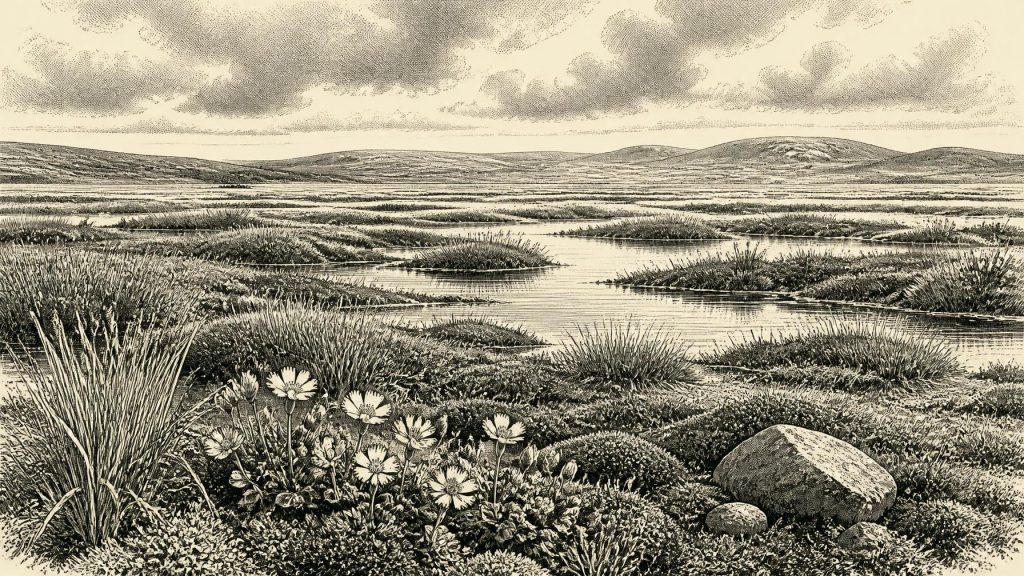
Around 30,853 BCE, Ireland lay in the fluctuating cold conditions of Marine Isotope Stage 3. Freshwater silts at Derryvree, County Fermanagh, preserved between glacial tills, record an ice-free interval of treeless tundra, sedge-rich wetland and shallow pools. Fringed sandwort demonstrates cold-adapted plant life, while insects and sediments indicate biologically active periglacial conditions. Southern caves preserve evidence of diverse fauna, including mammoth, reindeer, giant deer, bears, wolves and hyaenas, though their dates and associations remain uncertain. No securely established human presence exists. Later ice advances buried and reshaped these temporary habitats, preserving fragmentary environmental evidence of a changing Late Pleistocene landscape.
Dateline
The label 30,853 BCE is a modern chronological convenience, not a date that anyone then living in Ireland could have named. It corresponds approximately to 32,800 years before AD 1950, the conventional radiocarbon ‘present’, but modern calendar-year precision is unavailable at this depth of time. The most relevant Irish evidence is dated in broad calibrated ranges rather than to a single year. That evidence places Ireland in the Late Pleistocene, within Marine Isotope Stage 3 (MIS 3), during the long and fluctuating cold phase before the Last Glacial Maximum. It reveals no polity, settlement or biography. Instead, it offers a rare glimpse of an Irish landscape of open tundra, wet ground and mobile animal life, already vulnerable to the return of major ice.
A Date Inside a Range
The closest securely relevant archive is Derryvree, near Maguiresbridge in County Fermanagh. Road works in 1969 cut through a drumlin and exposed organic silts and fine sands trapped between two distinct layers of glacial till. The material was a freshwater deposit: evidence that, between episodes of ice advance, this part of Fermanagh had supported standing or slow-moving water and vegetation. A radiocarbon determination from the deposit, Birm-166, was reported as 30,500 radiocarbon years BP, with a substantial laboratory uncertainty. When expressed through later calibration, it has been placed broadly at about 36.9–31.7 thousand calibrated years BP. The nominal year 30,853 BCE falls within that range, but cannot be pinned to a particular layer, season or event.
This distinction matters. Radiocarbon years are not calendar years, because atmospheric carbon-14 concentrations have varied through time. Calibration converts a measurement into a probability range; it does not produce an anniversary in the modern calendar. The Derryvree sequence is therefore valuable precisely because it gives a securely dated environmental interval, not because it identifies conditions on one notional day in 30,853 BCE. Its position beneath later till is equally important: it records an ice-free phase before ice again occupied or overrode the area.
A Drumlin Marshland
The sediments describe a landscape very unlike Ireland’s later wooded and farmed countryside. Fossil plants, insects and sedimentary evidence indicate treeless, open tundra under a periglacial climate. The terrain around the freshwater basin seems to have included mossy, sedge-rich wetland – often termed muskeg – with shallow pools and organic mud. Freeze-thaw processes shaped exposed ground. The vegetation was low and discontinuous, adapted to cold, short growing seasons and waterlogged soils rather than to a dense forest canopy.
One especially evocative part of this evidence is the record of fringed sandwort, Arenaria ciliata, a plant now associated with Arctic and alpine environments. Its occurrence in the Derryvree deposits demonstrates that species able to endure cold open ground formed part of Ireland’s Late Pleistocene flora. It does not mean that the modern Irish population has survived unchanged since that time, nor does it make Derryvree a complete portrait of the whole island. A buried wetland samples a local habitat. Nevertheless, it firmly corrects any image of an entirely sterile, ice-covered Ireland at this point: at least parts of the north-western interior could sustain freshwater life and a tundra plant community.
The ecological picture should not be over-softened. ‘Ice-free’ did not mean mild. Permafrost or seasonally frozen ground, severe winters, sparse woody cover and strong seasonal contrasts were likely features of the broader setting. Nor was the island necessarily uniform. Topography, distance from ice margins, exposure to the Atlantic and local drainage produced regional differences. Uplands and areas nearer developing ice centres may have been markedly harsher than the Derryvree basin. The evidence supports a cold but biologically active refuge landscape, not a single climate for every valley and coast.
Animals at the Edge of the Ice
Southern Irish caves provide a complementary, though differently dated and more complicated, record. Castlepook Cave near Doneraile, County Cork, has produced Ireland’s richest known collection of pre-Last Glacial Maximum vertebrate remains. Its material includes mammoth, reindeer, giant deer, brown bear and spotted hyaena, while other levels have yielded Arctic fox, wolf and lemmings. Individual radiocarbon dates span a long stretch of the Middle and Late Ice Age rather than one brief occupation. The cave deposits were also disturbed by water and accumulated over time; the animals listed need not all have met in the cave, let alone lived together in 30,853 BCE.
Even so, Castlepook establishes the scale of the animal world to which Derryvree belonged. Ireland was connected ecologically to wider north-west European faunal movements during MIS 3. Herbivores could exploit open vegetation, while large carnivores and scavengers followed prey or used caves as dens and repositories. Spotted hyaenas probably contributed substantially to the collection of bones at Castlepook. Their presence is a reminder that caves are not neutral storehouses: bone assemblages reflect predation, scavenging, transport, water movement and later excavation histories as well as the living fauna outside.
Re-dating work has made this caution more rather than less necessary. Modern ultrafiltration and other improvements in radiocarbon practice have shown that several earlier Irish cave dates were too young, in some cases by thousands of years. The broad conclusion is robust – a varied cold-stage fauna occupied Ireland before the Last Glacial Maximum – but the detailed chronology is under revision. At this date, mammoth-steppe and tundra species are useful indicators of possible regional environments, not warrants for illustrating every Irish hillside with the full menagerie.
No Known Community
There is no securely established settlement, hearth, stone-tool assemblage, burial or dwelling in Ireland that can responsibly be assigned to this year or interval. The National Museum of Ireland continues to state that no clear evidence has emerged for human presence in Ireland during the Palaeolithic. That institutional caution is appropriate. Reports and reassessments of Ice Age bone assemblages can generate important questions about human arrival, but a marked bone alone must be considered against natural damage, carnivore activity, excavation context and independent corroboration. At present, the environmental archives tell a much fuller story than archaeology does.
Consequently, there can be no meaningful account of Irish political affairs, warfare, diplomacy, religious institutions, literacy or organised trade in 30,853 BCE. There are no named leaders, boundaries, alliances, monuments or currencies. To infer them from the presence of large mammals would be fiction. If small groups of people ever entered Ireland during an earlier, less glaciated phase of the Upper Palaeolithic, their movements would have been part of wider hunter-gatherer networks around the Irish Sea and Atlantic fringe; but that remains a possibility to investigate, not an established chapter of Irish settlement history.
The absence of evidence is itself historically important. It distinguishes this period from the Mesolithic, after about 8000 BCE, when repeated settlement, lithic technology and subsistence sites begin to provide an archaeological record of people living in Ireland. Around 30,853 BCE, Ireland’s recoverable past is primarily geological, palaeobotanical and zoological. The actors that can be identified are glaciers, pools, plants, insects and animals rather than communities and institutions.
An Unstable North Atlantic World
Derryvree should also be understood within a wider North Atlantic climate system. Greenland ice cores show that MIS 3 was punctuated by abrupt shifts between colder stadials and comparatively milder Greenland Interstadials. Irish cave calcite from Crag Cave in County Kerry provides independent evidence that conditions favourable to liquid water and speleothem growth appeared episodically during the last glacial period. These records do not allow every Irish deposit to be matched exactly to one Greenland event, but together they show that the climate was not static. Environmental opportunities could open and close over centuries or millennia, rapidly by geological standards.
At approximately 32,800 calibrated years BP, the Derryvree wetland belonged to this volatile world. The later expansion of the Irish Ice Sheet had not yet created the island-wide maximum associated with roughly 26,000–20,000 years ago, although ice dynamics differed across regions and remain actively researched. The two tills enclosing the Derryvree freshwater deposits provide the compelling local sequence: glaciation, an intervening cold wetland, then renewed glaciation. They show that Irish landscapes were repeatedly remade, with habitats and animal routes interrupted by ice advances.
For everyday life in the only sense the evidence allows, the key story is ecological resilience. Plants colonised wet mineral ground; insects occupied mosses and pools; herbivores crossed open country; carnivores found prey and shelter. Freshwater sediment accumulated quietly enough to preserve their traces. Yet the setting was temporary. Later ice sealed much of that evidence beneath the drumlin. Derryvree’s fringed sandwort thus stands for more than a single fossil plant: it marks an interval when cold-adapted life persisted in Ireland between glacial episodes, leaving a fragmentary but remarkably eloquent record of a landscape before people can securely be placed within it.
Primary Sources
- A Middle Midlandian Freshwater Series at Derryvree, Maguiresbridge, County Fermanagh, Northern Ireland
- A Reconsideration of the Radiocarbon Dating of the Marine Isotope Stage 3 Fauna from Southern Ireland
- Episodic Speleothem Deposition Tracks the Terrestrial Impact of Millennial-Scale Last Glacial Climate Variability in SW Ireland
- Trimlines, Blockfields and the Vertical Extent of the Last Ice Sheet in Southern Ireland
- Late Pleistocene Chronostratigraphy and Ice Sheet Limits, Southern Ireland
- New Data for the Last Glacial Maximum in Great Britain and Ireland
- Last Glacial Maximum Cirque Glaciation in Ireland and Implications for Reconstructions of the Irish Ice Sheet
- Castlepook Cave: County Geological Site Report
- Prehistoric Details: Stone Age Collections
- The Archaeological Heritage of County Cork
- The IntCal20 Northern Hemisphere Radiocarbon Age Calibration Curve (0–55 cal kBP)
- The Greenland Ice Core Chronology 2005, 15–42 ka. Part 1: Constructing the Time Scale
- The Greenland Ice Core Chronology 2005, 15–42 ka. Part 2: Comparison to Other Records
- A Stratigraphic Framework for Abrupt Climatic Changes During the Last Glacial Period Based on Three Synchronized Greenland Ice-Core Records
- Pattern and Timing of Retreat of the Last British–Irish Ice Sheet
- BRITICE Glacial Map, Version 2: A Map and GIS Database of Glacial Landforms of the Last British–Irish Ice Sheet
- Exploring Controls of the Early and Stepped Deglaciation on the Western Margin of the British-Irish Ice Sheet
- The Irish Quaternary Fauna Project
- Irish Pleistocene Biostratigraphy
- Cenozoic: Tertiary and Quaternary (Until 11,700 Years Before 2000)
- Pleistocene Vertebrates in the British Isles
- Our Friends in the North: On the Arctic Genetic Affinity of Arenaria ciliata L. and A. norvegica Gunn. in Ireland